When my father sent me a text that said only Please come now, I was sitting in the parking garage beneath my office building staring at a draft contract that had already ruined my morning twice.
I don’t spook easily. I work in contract administration for a commercial construction firm, which means I spend most of my life in rooms where people use words like partnership and flexibility while trying very hard not to say exactly what they mean. My job is to notice what they leave out. I read the footnotes, the indemnity clauses, the schedule assumptions, the little buried phrases that look harmless until three years later when a budget explodes and everybody starts pretending they never agreed to anything.
That kind of work does something to your nervous system. You become hard to surprise. You stop trusting warm language. You know that “temporary” can last fourteen months, “shared use” can become a lawsuit, and “family understanding” is usually what people say right before they try to take something they didn’t build.
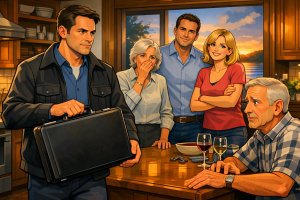
So when my father texted me Please come now, no punctuation, no explanation, no second line, I didn’t wonder whether he meant later. I didn’t try to call first and solve it from my car. I packed my laptop into my bag, shut off my monitor, and walked out of the office without explaining to anyone why.
My father had early-onset Parkinson’s. By then, his hands shook most days and his balance was unpredictable enough that stairs had become negotiations instead of architecture. He had never, in my entire life, asked for help unless he had already exhausted every other option, and even then he usually did it sideways. “If you happen to be free Sunday,” he would say when what he meant was I need someone to drive me to a neurologist I’m scared of. “No pressure,” he would add when the pressure was obviously all his. Pride and tenderness had always lived in the same room inside him.
Please come now meant something had already gone wrong.
The drive to the lake house was ninety minutes if traffic behaved and you caught the lights leaving the city. That afternoon it felt like I crossed an entire country of bad possibilities. I called both my parents. Voicemail. I called my sister. Straight to voicemail on the second ring, which told me she had looked at my name and declined it. That made my jaw set.
By the time I turned onto the gravel road leading to the cottage, I already knew Vanessa was there. Her SUV sat in the driveway angled carelessly toward the flower bed my mother had planted with marigolds the previous spring. Craig’s black pickup was backed up to the side entrance with the hatch open. Behind it stood a man in khakis holding what looked like a camera bag and another guy wearing a polo shirt with a local property management logo on the chest.
And my mother, at two o’clock in the afternoon, was standing on the porch in her bathrobe.
Not because she was ill. Not because she had just showered. Because something had happened fast enough and wrong enough that she had not even gone upstairs to change before calling my father into the kitchen and telling him to text me.
She saw my car before I’d fully stopped. Even from the driveway I could read her face: that tightly managed calm she wore when she was carrying too many things at once and refusing to drop any of them in public.
I got out of the car and shut the door harder than I intended.
The man with the camera turned.
The property manager looked from me to Craig’s truck and back again, instantly sensing that whatever arrangement he thought he was walking into had not been described accurately.
The lake was behind the house, dark and still, fringed with hemlocks and late-summer gold. On another day the sight of it would have lowered my pulse in under ten seconds. I built that place to do exactly that. But that afternoon the water just looked like a witness.
My mother met me halfway up the porch steps. “Your father’s inside,” she said quietly.
“What happened?”
She pressed her lips together for a moment before answering. “Craig says they’re just discussing options. Your father says he never agreed to anything. Vanessa says nobody’s listening to her. The man with the camera took pictures of the dock.”
That was enough to make everything in me go still.
Not soft stillness. Steel stillness. The kind that comes right before your mind stops feeling and starts sorting.
I stepped into the house and saw my father at the kitchen table with both hands flat on a manila folder as if he were physically stopping it from spreading farther across the wood.
His jaw was tight. His cane was propped beside the chair. He looked up at me with the kind of relief that is almost its own heartbreak.
“I told them to wait,” he said.
Vanessa was standing by the living room bookshelf moving things from one shelf to another for no reason except that she always touched other people’s spaces when she was uncomfortable. Craig stood near the island, sleeves rolled, phone in hand, posture easy in the specific way men stand when they believe the room will eventually bend to them.
My sister smiled first. She had always smiled first in conflict, as if good lighting could change the content of a conversation.
“Riley,” she said, “good, you’re here. We were just trying to talk this through like adults.”
I set my bag on the entry bench and looked at the folder under Dad’s hands.
“What is that?”
Craig answered before anyone else could.
“A seasonal revenue projection. Conservative numbers.”
I looked at him.
“Revenue projection for what?”
He gave me the patient, faintly amused expression he used whenever he wanted to imply that someone else was emotional and he was the only person in the room still committed to practicality.
“For the property.”
He actually said it like that. The property. Not the cottage. Not Mom and Dad’s place. Not the lake house. The property, the way men talk about something they’ve already mentally converted into percentages.
My father spoke without raising his voice. “I told him I’m not renting out my home.”
Craig turned one palm upward. “No one said year-round. We’re talking high-season management. Strategic use. You two could still come whenever it’s unbooked.”
My mother closed her eyes.
I stood very still in the center of the kitchen, looking at the man with the property management polo through the side window where he waited awkwardly by the truck, and realized that Craig had not merely had an idea. He had brought people.
He had brought strangers to my parents’ anniversary gift and was already discussing monetizing their occupancy around peak demand.
I said, “Start at the beginning.”
Vanessa stepped in with that soothing voice she had used since childhood whenever she was seconds away from being caught doing something selfish and wanted the rest of us to feel unreasonable about noticing.
“It’s not what you’re making it. Craig was just thinking long-term. We all know this place sits empty some of the week. Mom and Dad aren’t here full-time yet. He knows a management company that handles everything. The cleaning, the scheduling, the insurance. It could generate thirty, maybe forty thousand a season. That’s not nothing.”
I looked at her.
She pressed on, mistaking my silence for uncertainty. “It’s actually smart, Riley. I mean, with Dad’s care costs only getting higher—”
“Stop,” my father said.
It wasn’t loud, but the whole room changed around it.
Vanessa looked at him, startled.
He spoke slowly, because Parkinson’s had stolen speed from some things but not clarity. “Do not use my illness to explain this to me.”
There was a beat of silence in which even Craig seemed to understand he had overstepped by proxy.
Then Craig tried a different tone.
“No one’s taking anything from you,” he said. “We’re trying to make the asset work for the family.”
That sentence told me almost everything I needed to know. Not for Mom and Dad. For the family. Meaning everyone. Meaning him. Meaning the same man who had once tried to explain to my mother at Thanksgiving that she should sell the original wedding silver because “sentimental capital is still capital if you liquidate it right.”
I had never trusted Craig.
That is a different thing than disliking him. Dislike can soften with time. Distrust, when it begins early and keeps getting confirmed, hardens into bone.
Craig married my sister six years ago. He was handsome in a tidy, strategically approachable way, all good haircuts and moderate cologne and the practiced eye contact of someone who knows charm is an investment. He sold commercial insurance for a while, then “consulted,” then tried real estate, then joined some kind of short-term rental coaching group during the pandemic and started talking about passive income with the fervor of a man who had never actually built anything but desperately wanted the rewards of ownership.
He wasn’t a fool. That would have been easier. Fools make noise and break things quickly. Craig understood timing. He understood optics. He understood how to use other people’s embarrassment against them. He could enter a family argument, position himself as the only person discussing numbers rationally, and make everyone else feel childish for objecting to their own exploitation.
Vanessa, for her part, did not see this because the version of Craig aimed at her was always affectionate, admiring, slightly beleaguered by other people’s lack of vision. She told herself he was entrepreneurial. I told myself she liked living beside a man who made every decision sound inevitable.
I had not told either of them about the cottage while I was building it because I knew exactly what would happen if I did. Vanessa would cry when she saw the plans. Craig would ask about square footage, zoning, lake access, and comparable rental rates. They would frame their involvement as enthusiasm and later treat it as contribution. By the time the house was finished, they would be speaking about “what we’re doing for Mom and Dad” with the ease of people who had supplied none of the money, labor, or risk.
So I built it quietly.
Two years earlier I found the lot by accident. Half an acre on a narrow, quiet lake ninety minutes from the city, with an old structure on it so warped and undersized the listing called it a “cottage with potential,” which is real estate language for a teardown someone hopes sentimentality will overpay for. The day I first drove out there, the sky was iron gray and the water looked almost black under the hemlocks. The dock tilted slightly to one side. The cabin smelled like mildew and dead field mice. But the land was perfect.
Dad could sit there for hours and watch light move over water without having to explain himself to anyone.
Mom could drink coffee in silence.
The road in was close enough for doctors, far enough for peace.
I bought it the following month.
People like to imagine grand gifts arrive in one burst of emotional certainty. The truth is they are usually built in spreadsheets and bank transfers and permit applications. I had been saving since my first serious paycheck. Not dramatically. Not in a punishing way. Just steadily, consistently, with the stubbornness I inherited from both my parents and aimed more efficiently. I knew what I earned. I knew what I needed. I knew what could wait. By thirty I had enough for the down payment on the lot and enough professional knowledge to manage the rest without getting skinned alive by contractors.
My work made the project easier in all the unromantic ways that actually matter. I could draft scope language. I could review payment schedules. I could smell change-order nonsense before it formed fully in a superintendent’s mouth. I hired a contractor I had worked with for six years, a man named Eli who built schools and medical offices and understood that “accessible” did not need to look clinical if somebody cared enough to do it right.
I designed the cottage for my parents’ real life, not the fantasy version of aging polite children sometimes buy for them. One story. Wide doorways. No thresholds to catch Dad’s feet on bad days. Grab bars in the shower disguised as elegant metal rails. Counter heights adjusted for seated reach. Cabinet pulls my father could grip when tremors were worst. A wraparound porch with only two shallow steps and a side entrance where a ramp could be added later without making the whole place look like a facility. A long sightline from the recliner by the front window straight to the water, because by then I knew watching stillness had become one of the few things that truly rested him.
I paid for everything myself.
The land. The demolition. The build. The dock. The furnishings. The widened bath. The kitchen appliances. The quiet luxury vinyl flooring that wouldn’t turn treacherous in damp weather. The generator. The security system. The pantry stock. Three hundred ten thousand dollars, total, by the time the place was complete and ready to hold them.
I put the deed into an irrevocable trust before I ever handed them the keys.
That part was not paranoia. It was expertise.
I know what gifts become when people die without structure. I know what siblings do when property gets sentimental and expensive at the same time. I know that verbal promises are just weather if the paper underneath them isn’t sound. So I met with a property attorney in the county where the lake house sat. We built it clean. My parents as sole lifetime beneficiaries. Exclusive use and occupancy rights. No unilateral sale. No rental authority. No transfer by outside family members. On their deaths, disposition controlled by trust terms I wrote with very calm hands and very specific language.
I prepaid fifteen years of property taxes because I did not want them ever sitting at that kitchen table worrying about whether a missed payment or rising tax bill would turn the place into pressure.
Then I arranged the surprise.
I told them I was taking them to dinner for their fortieth anniversary. Instead, I drove them ninety minutes under October light through rolling roads edged in gold and rust, turned onto the gravel lane, and stopped in front of the porch light glowing warm against the darkening trees.
My mother put her hand over her mouth.
My father turned in the passenger seat and just stared at me as if he had misheard the entire drive.
When I told them it was theirs, fully theirs, protected, held, secure, my father sat absolutely still for so long I was suddenly afraid I had overwhelmed him into silence.
Then he said, in a voice rougher than usual, “Is this some kind of joke?”
“No,” I said. “It’s real.”
Mom whispered, “Riley.”
That was all. Just my name. But it sounded like a blessing and a wound at the same time.
Dad got out of the car and made it up the two porch steps without his cane. I saw it and pretended not to, because the pride of that mattered more than the fact itself. He walked straight through the front room to the porch, braced one hand on the railing, and looked at the water.
I stood behind him with the trust documents in a folder tucked under my arm and watched his shoulders settle in a way I had not seen in years.
“I thought that ship had sailed,” he said quietly. “I thought we were past the age of getting a place like this.”
My mother walked room to room touching counters, cabinet doors, the edge of the sink, the blanket folded at the foot of the bed. She opened and closed the kitchen drawers three separate times as if testing whether kindness could be structural.
The first weekend I stayed with them, we ate takeout on the porch and watched dusk lower itself over the lake like a soft curtain. On Sunday morning, my mother reorganized the silverware drawer because she said she needed a private task or she might burst into tears every ten minutes. Dad asked me to stand in the bathroom while he practiced the reach to the shower bar and the seated turn from bench to towel hook. We adjusted the angle of the porch chairs twice before he said, with deep satisfaction, “Now I can see everything.”
That was what I built it for.
Not admiration. Not family consensus. Not legacy performance.
For the look on his face when the water caught evening light and there was finally nowhere else he had to be.
Three days later my mother told Vanessa.
Of course she did.
My mother cannot hold joy in secrecy for long. Pain she will swallow for years. Joy escapes her like breath.
She mentioned the cottage in a phone call and, because happiness makes people less cautious, likely mentioned enough details for Vanessa to ask for the address. My mother called me that same night, voice carefully neutral in the way it got when she was already feeling a pull in the room and wanted me to know without saying the obvious.
“Vanessa wants to come up this weekend with Craig and the boys,” she said. “Just to see it. Is that alright?”
I answered exactly what I meant. “Mom, it’s your home. You decide who visits.”
She was quiet for a second. “Of course.”
Then, softer: “I just wanted to check.”
Which was my mother’s way of saying something already feels wrong and I wish you were here to witness it with me.
I should have gone that Saturday.
Instead, I stayed in the city fighting a contractor dispute over steel pricing on a school addition and told myself it was just a family visit. I told myself my sister might still know how to enter a room without converting it into possibility. I told myself I could not treat every beautiful thing as if it needed defending from the moment it existed.
That was my error.
By the time I arrived after Dad’s text, the first line had already been crossed.
Craig had brought a property manager and a photographer.
That fact sat in the room like gasoline.
I looked at the folder under Dad’s hands. “Who gave them permission to come here?”
Neither parent answered immediately. Vanessa did.
“We were only exploring what options might look like. Nobody signed anything.”
Craig lifted the page in front of him. “Because I was waiting for you to be included. Out of courtesy.”
I actually laughed at that, once, with no humor in it at all.
“Courtesy.”…………………..

