Part 1
At exactly 9:00 a.m., a black BMW nosed into my driveway like it belonged there, glossy paint catching the winter sun. A white Mercedes followed, familiar as a bad habit.
I watched from my home office window, mug warm in my hands, my cursor blinking on a code review that suddenly felt miles away. Mom stepped out first, perfectly styled, perfectly irritated, pointing at my front garden with the same rigid finger she’d used when I was eight and tracking mud across her “good” carpet.
She didn’t like my wildflowers. She didn’t like anything I chose that she hadn’t approved.
The realtor emerged from the BMW with a tablet and the kind of smile that was all teeth and zero warmth. She lifted her phone and began taking photos of my porch as if she’d already purchased it.
The doorbell chimed.
Then again.
Then my mother’s fist hit the wood. Hard. Three strikes, like she was serving a warrant.
“Natalie! Open up. We have business to discuss!”
I didn’t rush. I saved my work, closed my laptop, rinsed my mug, refilled it, and took one slow sip. I wasn’t stalling because I was scared.
I was stalling because letting them wait was the only power I’d had for most of my life, and I was done giving it away.
“This is Ms. Brennan,” Mom announced, already strolling into my living room. “Coldwell Banker. She’s here to assess the property.”
“I’m sorry,” I said, tone calm enough to make my pulse look like a lie, “what property?”
Dad wandered in behind them with his hands in his pockets and that familiar expression: the one that said disappointment was his default setting.
Staying. As if my home was a couch I’d overstayed on.
“I’m sure we can find you a nice apartment once we get this place market-ready,” she continued, professional voice, pity undertone. “Sometimes a fresh start is best.”
My mother was already running her fingertips along the restored wallpaper I’d spent weekends salvaging, patching, and sealing. “This has to go. It’s… old.”
“It’s vintage,” I said.
“It’s ugly,” Mom corrected, like she was editing my life in real time.
Dad pointed at the wall between kitchen and dining room. “Tear it down. Open concept. That’s what sells.”
They were talking about my house as if I wasn’t standing there. As if I was furniture they’d already decided to donate.
I leaned against the doorframe and took another sip of coffee. “And what makes you think you can sell it?”
Mom turned sharply. “Because we said so.”
Dad added, “Because we’re your parents.”
Ms. Brennan’s eyes flicked between them and me, sensing tension but not understanding the shape of it.
Mom’s face tightened into that expression she wore when she felt superior and inconvenienced at the same time. “Losers like you should rent forever,” she said, voice loud enough to land like a slap. “You’re thirty-four, single, hiding behind a computer job. You don’t need a four-bedroom house. It’s embarrassing.”
Ms. Brennan crouched by the window, measuring with an app. “These will need updating. Double-pane. Energy efficient. Buyers expect modern amenities.”
I let the silence stretch until it felt like a rope pulled taut.
“Ms. Brennan,” I said, “can I ask you something?”
Her smile tightened. “Of course, dear.”
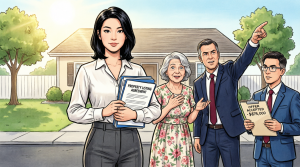
Did they show you paperwork?”
Mom rolled her eyes. “Oh my God.”
“Proof of ownership,” I clarified. “A deed. A title. Anything that shows they have the legal right to sell this house.”
Ms. Brennan hesitated. “Well… they’re your parents. They said the house was inherited from your father’s sister.”
“My father’s sister left it to me,” I said.
Mom made a dismissive noise. “She’s delusional. Always has been.”
Dad nodded like they were presenting a united front in court. “We had to take over her finances years ago. She’s not capable.”
My stomach tightened, not because I believed them, but because I remembered being seventeen and hearing those exact words used to justify controlling my bank account, my car keys, my college applications.
“Would you like to see the deed?” I asked Ms. Brennan.
I pulled out my phone and opened the digital copy I kept in a folder titled Helen. It wasn’t sentimental. It was practical. It was protection.
Natalie Cross. Sole owner. Transfer date: 2019.
Ms. Brennan’s face changed like a curtain dropped. She stared, then looked up at my parents.
“You told me you owned this property,” she said, voice sharpened by sudden self-preservation.
Dad’s jaw clenched. “We’re her parents.”
“That isn’t ownership,” Ms. Brennan said. She took a step backward, then another. “You’ve wasted my time and potentially implicated me in attempted fraud.”
“It’s not fraud!” Mom shrieked. “We’re helping her! She doesn’t deserve a house like this. She was supposed to be a doctor or a lawyer. Not—” Mom’s gaze raked over my yoga pants and sweatshirt like it was evidence. “Not some computer person working in pajamas.”
“I’m a software engineer,” I said, evenly. “I make four hundred thousand a year. I own three patents. But please, continue explaining how I’m a loser.”
Dad’s face flushed deep red. “You’re lying.”
“Am I?” I turned my phone slightly as if I might pull up tax returns. “Should I show Ms. Brennan my income too? Or maybe the deed to the rental property I bought last year. Or the one I bought the year before.”
My parents froze. They had never asked about my job. Never cared. To them, Kevin was the surgeon. Angela was the social climber. And I was the spare child, the one who didn’t sparkle the way they liked.
“Get out,” I said.
Mom laughed, quick and sharp. “You can’t kick us out. We’re your parents.”
I looked at Ms. Brennan. “Would you please call the police? I have trespassers who won’t leave.”
Ms. Brennan backed toward the door. “I’m not getting involved,” she said, but her eyes were on my parents now, wary. “Ma’am, sir… falsely claiming to own property and attempting to sell it is serious. You might want to leave before this escalates.”
She fled down my walkway, heels clicking like punctuation.
Dad stepped closer, trying to loom. “This isn’t over,” he growled. “You owe us. We raised you. Fed you. Housed you for eighteen years—”
“And I noticed you never visited once in the five years I’ve lived here,” I said, voice soft. “Not until you thought you could profit from me.”
Mom’s eyes narrowed. “You living in Helen’s house like some charity case. Helen only left it to you because she felt sorry for you. The pathetic middle child no one wanted.”
There it was. The truth, spoken like a casual fact.
“Helen left it to me,” I said, “because I was the only one who visited her when she was dying. I was the only one who cared. You didn’t even come to her funeral.”
“We were busy,” Dad muttered.
“You were in Vegas,” I said. “I saw the photos.”
I held the door open. “Leave now. Or I call the police.”
They left, but not quietly. Mom knocked over my porch planter with a practiced flick of her purse. Dad scraped his key down the side of my car as he passed, a childish cruelty from a grown man.
The sound made my chest go cold.
Then I remembered.
My Tesla’s cameras caught everything.
That night, my phone buzzed with texts.
Kevin: Did you really kick Mom and Dad out? They say you stole Aunt Helen’s house.
Angela: How could you? They were trying to help you. You’ve always been selfish.
I didn’t answer.
Instead, I opened the county property records site and typed in my parents’ address, curiosity hardening into something heavier.
Foreclosure notice. Four months behind. Filed three weeks ago.
My fingers hovered.
Then I dug deeper.
Dad’s business had filed for bankruptcy. Credit card lawsuits. Liens. An eviction notice scheduled for thirty days from yesterday.
That was why they came.
They didn’t come to save me.
They came to steal from me, because they were about to lose everything.
I stared at the screen and felt something in me settle, like the last puzzle piece snapping into place.
For years, I’d wondered if I was crazy for feeling used, if I was too sensitive, if maybe I really was the problem.
Now the proof glowed in plain black letters on a white government website.
I wasn’t the failure.
I was their backup plan.
And I was done being one.
Part 2
The next morning, I called Diana.
Diana wasn’t just a lawyer; she was the kind of woman who treated injustice like an engineering problem: identify the weak points, apply pressure, document everything.
When she answered, I didn’t bother with small talk.
“They brought a realtor to my house,” I said. “Told her they owned it. Told me to pack my trash. Dad keyed my car.”
A pause. Then Diana let out a low laugh. Not amused. Energized. “Natalie,” she said, “this is a gift. Did you get it on camera?”
“Doorbell and car cameras,” I said. “Audio too.”
“Beautiful,” she replied. “File a police report for trespassing and vandalism. And attempted fraud. Also, restraining order.”
“They’re my parents.”
“They’re criminals who share your DNA,” Diana corrected. “Those are different categories.”
I swallowed, because the truth stung even when you’d already known it.
By noon, I had a police officer in my living room, taking notes while I played the footage. Mom’s voice filled the room, bright with cruelty. Losers like you should rent forever.
The officer’s expression didn’t change, but his pen moved faster when Dad’s key met my car.
I signed the report.
When the officer left, I stood in my hallway and looked at the wallpaper again, the one Mom called ugly. I remembered Aunt Helen running her hand over it years ago, voice gentle.
This house has good bones, Nat. But bones aren’t what make it a home. People do.
I took a breath. Then another.
For the first time, I didn’t feel guilty.
I felt clear.
Two days later, they showed up again.
Different realtor.
Same Mercedes.
This time, they didn’t ring. They tried the doorknob like the house was already theirs.
I watched through the camera feed on my phone, standing in my kitchen, the kettle hissing behind me.
Mom spoke to the new realtor with practiced charm, gesturing broadly. Dad stood with his arms crossed, smirking like he’d already won.
I opened the door just enough to keep the chain engaged.
“What now?” I asked.
Mom’s eyes flicked to the chain like she’d cut it with her stare if she could. “We’re finishing what we started.”
I turned my head slightly, speaking past her to the realtor. “Hi. Did they show you proof they own the property?”
The realtor blinked. “Well, they said—”
“They don’t,” I said. “I do.”
Dad’s smile dropped. “You think you can humiliate us?”
“You humiliated yourselves,” I replied.
Mom’s face hardened into rage. “You’re going to regret this.”
I closed the door and called the police.
When the officers arrived, my parents performed outrage like it was theater. Dad shouted about family rights. Mom cried about betrayal. The realtor stood awkwardly, clutching her clipboard like a shield.
The officers warned them. Trespass again and it becomes arrest.
They left in a storm of threats and insults.
Diana’s words echoed: With their financial situation, they’re going to get desperate.
Desperate came faster than I expected.
The day after the warning, my security system alerted me while I was in the grocery store choosing apples.
Motion detected. Backyard.
I opened the live feed.
Dad was at the sliding door, shoulders hunched, working a tool against the frame. Mom stood lookout, scanning like a teenager committing a prank.
Something in me went oddly calm.
I called 911.
I stayed on the line and watched as police lights washed the backyard blue and red. I watched Dad’s hands shoot up. I watched Mom’s mouth open in a scream I couldn’t hear through the feed.
Arrested.
The next morning, I sat in court wearing a sweater Aunt Helen had knitted me years ago, the sleeves a little too long. It felt like armor.
They stood in orange jumpsuits.
My parents.
The people who taught me table manners, who told me to say “please,” who insisted reputation was everything.
Now their reputation smelled like stale jail air.
The judge read the charges: attempted breaking and entering, trespassing, vandalism, attempted fraud.
Their public defender cleared his throat. “Your Honor, my clients are facing eviction and believe they had a right to their daughter’s property—”
“No one has a right to someone else’s property,” the judge cut in. “Bail is set at ten thousand dollars each.”
Mom’s head snapped toward me, eyes wild with expectation, like she assumed I’d stand up and pay.
I didn’t move.
I didn’t blink.
I stared back until she looked away first.
They sat in jail for three days before Angela posted bail.
I found out because Kevin called me, voice tight. “You really let them stay in jail?”
“I didn’t put them there,” I said. “They broke into my house.”
“They’re desperate,” he insisted. “You don’t understand—”
“Oh, I understand,” I said. “They’re desperate because they spent their whole lives pretending they were rich.”
Kevin exhaled. “Natalie, what do you want?”
I wanted to say: I want you to see me. I want you to admit what they did to me. I want an apology that doesn’t come with a hand out.
Instead I said, “I want them to stop.”
After I hung up, I opened my laptop, not to work, but to build a fence they couldn’t climb: paperwork.
Diana filed for a restraining order. We scheduled a hearing. I gathered footage, screenshots, public records, everything.
Then I did something else.
I made a decision that felt like stepping onto a bridge I hadn’t known existed.
I looked up the foreclosure details on my parents’ house, the one they’d bragged about for thirty years. The one with marble counters, a chandelier taller than I was, a rose garden Mom treated like her only child.
There was an auction date. There were bank contacts. There was a number for cash offers.
I called.
The banker sounded tired, the way people do when they’ve heard every excuse. When I said “cash offer,” her tone changed, becoming suddenly respectful.
I didn’t buy it as Natalie Cross.
I bought it as an LLC I’d created years ago for rental properties, something boring and anonymous.
Stonebrook Holdings.
Cash offer. As-is. Quick close.
The bank practically sighed with relief.
The price made me blink: four hundred thousand.
They’d owed almost two million.
Their “mansion” wasn’t a mansion. It was a stage set held up by debt.
I wired the money.
Signed the documents.
And felt, not triumph, but a strange, steady sense of balance returning to the universe.
My parents were released on bail on a Friday.
They were served eviction papers on Monday.
The new owner was giving them seventy-two hours to vacate.
They called me that night.
Mom was sobbing into the phone, loud enough that it sounded performative. “Natalie, please. We have nowhere to go. No money. Nothing.”
I held the phone away from my ear for a second, letting the noise fade.
When I brought it back, my voice was quiet. “Rent an apartment.”
Dad’s roar thundered in the background. “We’re not those people!”
I almost laughed. Not because it was funny. Because it was so perfectly them.
“You’re right,” I said. “Those people probably didn’t try to steal their daughter’s house.”
Mom choked. “Family forgives.”
“Family doesn’t break in through the backyard,” I replied.
“Was buying our house your revenge?” Dad shouted.
“The bank’s house,” I corrected. “You haven’t owned it for months.”
Silence.
Then Mom’s voice, small and stunned: “You bought it?”
I leaned back against my kitchen counter and looked at the framed photo of Aunt Helen on the wall, her smile crooked, her eyes kind.
“What are you going to do with it?” Mom whispered.
I smiled, but it wasn’t cruel. It was certain.
“I’m turning it into transitional housing,” I said. “For women leaving domestic violence situations.”
Mom sucked in a breath like I’d slapped her.
Dad exploded again. “You’re destroying our lives!”
“No,” I said, and my voice finally carried something sharp. “You destroyed your own lives. You spent thirty years telling me I was worthless. You tried to steal what I worked for. You taught me losers don’t deserve property.”
I paused.
“Turns out you were right,” I said. “Losers don’t deserve property.”
And I hung up.
Part 3
The day the eviction happened, the sky was bright and cold, the kind of day that made everything look sharper than it felt.
I arrived in my Tesla, parking down the street like a stranger. Not because I was afraid of them, but because I needed the distance to keep my spine straight.
A moving truck sat in the driveway. Not packed neatly, not organized. Just chaos. Cardboard boxes half-open. Garbage bags stuffed with clothes. Mom’s designer coat shoved into a bag like it meant nothing.
My parents stood on the lawn, stunned, as if reality had breached the gated community without permission.
Kevin was there, arguing with a police officer in his surgeon’s jacket, as if wearing it made him morally right.
Angela hovered near Mom, eyes red, mascara smudged, whispering about how unfair it all was.
The locksmith was already working.
Diana had warned me: don’t go alone. So I had a property manager with me, a calm older woman named Marisol who treated drama like weather.
I stepped forward with the keys in my hand.
Mom saw me first.
Her face shifted through disbelief, rage, and something like panic. “You,” she said. “What are you doing here?”
Marisol answered, polite and detached. “We’re the representatives for the new owner.”
Dad’s head snapped toward me. “You did this.”
“I didn’t miss your mortgage payments,” I said.
Kevin turned, jaw tight. “Natalie, what are you doing? Where are they supposed to go?”
I looked at him and felt the old family gravity tugging, the familiar pressure to fix what they broke.
Then I remembered Mom’s voice in my living room: Losers like you should rent forever.
“Maybe you could help them,” I said. “You’re the golden child, right? Successful surgeon. Surely you have space.”
Kevin’s face went pale. “Rebecca would never—”
“The kids,” I finished, because in this family, kids were always the excuse when adults didn’t want responsibility.
Angela stepped in, voice shrill. “I’m in the middle of a divorce! I can’t take them!”
I nodded slowly. “Funny,” I said. “How family obligations only flow one way.”
Mom made a sound between a sob and a snarl. “We gave you everything!”
“No,” I said. “You gave me conditions. You gave me shame. You gave me a lifelong habit of thinking I had to earn basic kindness.”
The locksmith opened the door and stepped aside. The officer watched my parents carefully, prepared.
Dad lunged forward, and the officer blocked him with one arm.
“Sir,” the officer said, firm. “Step back.”
Dad’s face contorted. “She’s doing this to punish us!”
I met his gaze. “I’m doing this to protect myself. That’s what you never taught me.”
Mom stared at the house like she could will it back into being hers. “At least tell me why,” she said, voice cracking. “Why would you do this?”
I lifted the keys slightly, not as a trophy, but as a symbol.
“Because Aunt Helen would have,” I said. “She believed homes should shelter people who need them. Not people who hoard them to look impressive.”
Mom’s lips trembled. “This is our home.”
“It was,” I said. “And you turned it into a stage.”
The police officer guided them toward their boxes. Kevin and Angela stood frozen, suddenly faced with the fact that their parents’ problems weren’t magical—they were logistical.
Mom grabbed my wrist, nails digging in. “You’re my daughter.”
I gently peeled her hand away. “That’s not a password,” I said.
When I drove away, my hands were steady on the wheel. My heart wasn’t. It thudded hard, like it had been running for years and had finally stopped long enough to feel the pain.
Over the next month, Stonebrook Holdings became something real.
I didn’t just want to take. I wanted to build.
Marisol helped me navigate permits, contractors, safety codes. Diana handled the legal transition. I met with a nonprofit director named Sienna who had been running shelters out of church basements for years, exhausted and determined.
“We don’t just need beds,” Sienna told me over coffee in a diner that smelled like pancakes. “We need stability. We need a place where women can breathe without waiting for the next hit.”
I nodded. “The house has six bedrooms,” I said. “We can redesign. Add locks that make sense. Cameras in the right places. A safe room. A play space.”
Sienna’s eyes softened. “You’re serious.”
“I’m furious,” I corrected. “But yes. I’m serious.”
We tore out the fancy dining room table my parents used to show off and replaced it with a long, sturdy table that could survive crayons and spilled soup. The home office Dad called his “executive suite” became a playroom, bright rugs and shelves of books. Mom’s rose garden became a vegetable garden, because survival required food more than flowers.
The first family arrived on a rainy Tuesday.
A woman named Faith stepped out of a car holding a toddler on her hip and a bag in her hand like it was all she owned. Her cheekbone was bruised yellow-green. Her eyes flicked toward the house and then away, like she didn’t trust something that looked too nice.
Sienna greeted her gently. “You’re safe here,” she said.
Faith’s voice shook. “How long can we stay?”
“As long as you need,” Sienna said. “We’ll make a plan together.”
Faith’s shoulders collapsed with relief so sudden it looked like gravity.
I stood back by the porch, out of the way. I didn’t want to be a hero in someone else’s story. I just wanted the house to do what houses should: hold people up.
Faith glanced at me, cautious. “Are you… the owner?”
I hesitated, then nodded.
She stared at the front door, then at the warm light inside. “Why would you do this?”
I thought of Aunt Helen. Of my parents’ sneer. Of the word loser, thrown like a stone.
“Because I know what it’s like,” I said carefully, “to be told you don’t deserve stability.”
Faith’s eyes watered. She nodded once, like that was enough.
When she stepped inside, it felt like the house exhaled for the first time in decades.
My parents, meanwhile, slid into the kind of life they’d always judged.
A motel off the highway for a while. Then a cheaper one. Kevin and Angela split the cost for a month and then stopped answering calls.
Mom got a job at Walmart. Dad worked at a car wash. Their hands cracked in winter. Their pride took the first hit, then their bodies followed.
I heard all of it through the family grapevine, through texts Kevin sent that were half-accusation, half-plea.
He wanted me to feel sorry.
I did, sometimes, in small, inconvenient flashes.
Then I remembered Dad’s key scraping my car.
And Mom’s voice: rent forever.
The day the transitional housing officially opened, we held a small gathering in the living room.
Six women, four kids, Sienna, Marisol, Diana, and me.
Sienna raised her cup of tea. “To new beginnings,” she said.
Faith raised hers too, her toddler babbling on her lap. “To not going back,” she whispered.
I felt my throat tighten. “To Aunt Helen,” I said quietly.
And the room hummed with agreement.
Later that night, after everyone went to bed, I walked through the house alone.
The chandelier still hung in the foyer, glittering. But now it lit up sticky fingerprints on the banister and a child’s drawing taped to the wall: a house with a sun and a stick family smiling too big.
It wasn’t perfect.
It was real.
Part 4
A week after the house opened, a letter arrived.
Handwritten.
Mom’s cursive was unmistakable, sharp loops and heavy pressure like she was trying to carve the paper into obedience.
I stood at my kitchen counter and stared at the envelope for a full minute before opening it.
Natalie,
We’re sorry. We’ve learned our lesson.
Family should forgive. Family helps.
We need money. Just a little, to get back on our feet.
We’re your parents.
I read it twice, not because I needed to, but because a part of me still expected the words to turn into something else—something like love.
They didn’t.
There was no apology that named what they’d done. No acknowledgement of the insult, the threat, the attempted fraud, the break-in. Just sorry as a tool, forgiveness as a demand, and money as the point.
I sat down with the letter in my hands and let myself feel the grief I’d avoided for years.
Not grief for who they were now.
Grief for the parents I’d wanted. The ones I’d imagined could exist if I just achieved enough, earned enough, became enough.
That fantasy finally died on my kitchen table.
I opened the folder on my phone again: the deed to my house.
I printed a copy.
Highlighted the line: Natalie Cross, sole owner.
At the bottom, I wrote in pen:
Losers don’t deserve property. You taught me that. Thanks for the lesson.
I mailed it back.
Then I blocked their number.
The next months became busy in the best way.
Sienna and I built programs: job placement assistance, childcare partnerships, legal clinics. Diana volunteered time. Marisol organized donations with ruthless efficiency.
The house that once echoed with my parents’ bragging now echoed with bedtime stories, job interviews practiced in the mirror, and the quiet sound of women relearning how to breathe.
One evening, Faith knocked on the doorframe of the small office we’d turned into a resource room.
“Hey,” she said softly. “I got the job.”
I looked up from my laptop. “You did?”
She grinned, wide and disbelieving. “Dental assistant training. I start Monday.”
“That’s amazing,” I said, and meant it.
She hesitated, then stepped closer. “I wanted to thank you. I know you don’t like… being thanked. Sienna told me.”
“I don’t mind gratitude,” I said. “I just don’t want it to turn into debt.”
Faith nodded, eyes shining. “It won’t. It’s just… I used to think I deserved what happened to me. Because he told me I was nothing. And I believed him.”
My chest tightened. “Yeah,” I said quietly. “I know that feeling.”
Faith looked around the room, at the shelves of donated books, the bulletin board of community resources. “This place changed my brain,” she said. “It’s like… the walls argue back when I hear his voice in my head.”
I laughed softly. “Good,” I said. “Let them.”
A year passed.
Then another.
Some families stayed for months. Some stayed longer. Some left and came back for support groups, bringing cookies, bringing news, bringing proof that the world didn’t end when you chose yourself.
In that time, Kevin stopped calling as much.
He didn’t apologize. Not directly.
But once, after a long silence, he sent a text:
I didn’t know how bad it was. With them. With you. I’m sorry.
It wasn’t everything.
It was something.
Angela disappeared into her own mess, drifting from one relationship to the next. Sometimes she posted inspirational quotes online about healing and forgiveness, as if aesthetic could replace accountability.
My parents stayed at the edge of my life like shadows that couldn’t cross a line anymore.
Occasionally, someone would tell me they’d seen Mom at Walmart, shoulders hunched, hair pulled back, scanning shelves with the same critical eyes that once scanned my report cards.
Sometimes guilt would rise in me like a tide.
Then I would walk into the transitional house and hear a child laugh from the playroom.
And the guilt would drain away, replaced by something steadier: purpose.
On the fifth anniversary of the house opening, we held a small celebration.
Faith came back wearing scrubs, confident now, carrying a tray of cupcakes. Her toddler was taller, chattering about school.
She pulled me aside after the speeches and the photos.
“I’m buying a house,” she said, voice shaking with excitement. “A little one. Nothing fancy. But it’s mine.”
My eyes stung. “Faith,” I said, “that’s incredible.”
She reached into her bag and pulled out a small framed picture: a sketch of the big house, with stick figures and a vegetable garden and a sun drawn too large.
“I made this,” her kid announced proudly, shoving it toward me.
Underneath, in messy letters, it said: safe house.
I laughed, wiping my eyes. “Thank you,” I said.
Faith’s gaze softened. “When I move,” she said, “I want to donate monthly. Not because I owe you. Because I want someone else to hear the walls argue back.”
I nodded, throat too tight to answer.
That night, after everyone left, I went to the office where we’d hung a photograph I’d taken from my parents’ old house.
It showed them at a charity gala, designer clothes, champagne glasses, smiles polished like mirrors. The picture of success.
Beneath it was a simple plaque:
This house shelters people who needed it. Let it remind us that true wealth isn’t what you take. It’s what you give.
I stood there for a long time, not because I was savoring their downfall, but because the irony had finally transformed into something useful.
Their cruelty had funded kindness.
Their arrogance had become shelter.
Their obsession with appearance had turned into a home where no one had to pretend.
My phone buzzed once, an unknown number.
A voicemail appeared, then another.
I didn’t listen.
I stepped outside instead, onto the porch of my own house across town, the one Aunt Helen left me, the one I restored with my own hands.
The wildflowers were blooming again.
I breathed in the cool night air and felt something I’d chased my whole life settle into place.
Not revenge.
Not vindication.
Freedom.
And the clearest ending I could imagine:
They came to sell my house because they thought I was powerless.
They didn’t know my name was on the deed.
They didn’t know I’d learned, quietly, how to protect myself.
And they definitely didn’t know what I’d do with theirs.
Because I didn’t just take their house.
I turned it into a place where people who had been called losers could finally believe they deserved a door that locked, a table that held them, and a future that was theirs.
Part 5
The first time I saw my mother again in person, it wasn’t dramatic.
There were no sirens. No screaming. No courtroom.
It was a Tuesday in late March, the kind of day where the sky looked washed out, like winter had forgotten to leave but spring kept tapping on the door anyway.
I was at a community center ten minutes from the transitional house, meeting with a local nonprofit coalition about expanding childcare options. The building smelled like gym mats and old coffee, and the hallway walls were covered in posters about food drives and after-school tutoring.
I turned a corner and nearly walked into her.
She was standing by a bulletin board, reading a flyer about a free resume workshop. Her hair was pulled back in a plain ponytail. No highlights. No salon blowout. Her coat was a cheap puffer that squeaked a little when she moved. She looked smaller than I remembered, not because she’d shrunk, but because her confidence—her armor—was gone.
For one second, I saw what she wanted me to see: a tired woman trying to survive.
Then she looked up and our eyes locked, and I saw what she actually was: the same person, only stripped of her stage.
Her mouth opened.
“Natalie,” she said, like my name was a claim.
I didn’t move toward her. I didn’t step back either. I just let the space between us exist.
“Hi,” I said.
Her eyes flicked over my face, searching for something—pity, guilt, weakness. When she didn’t find it, her expression tightened.
“You’re here,” she said, and it sounded accusatory, as if I’d invaded her territory.
“I have a meeting,” I replied.
She swallowed. “I didn’t know you came to places like this.”
I almost smiled at the absurdity. Places like this. As if kindness had a zip code.
“I go where the work is,” I said.
Her gaze dropped to the folder under my arm. She recognized it, the crisp, organized look of someone who had their life together. The life she’d always insisted I couldn’t build.
She took a cautious step closer. “Natalie… we need help.”
There it was. Not hello. Not I’m sorry. Not how have you been.
A need.
I kept my voice steady. “What kind of help?”
Her shoulders slumped, a performance of humility. “Your father’s hours got cut. I’m working but it’s not enough. The motel is—” she waved her hand like the words were too unpleasant. “We can’t live like that.”
I nodded slowly. “Then don’t.”
Her brows knit. “What do you mean?”
“Apply for housing assistance,” I said. “There are programs. I’m sure you’ve seen the flyers.”
Her face reddened. “Those are for people who actually need them.”
I stared at her. “So you don’t need them?”
She hesitated, caught. “We—of course we do. But it’s humiliating.”
I let the silence stretch until it made her uncomfortable.
“Humiliation,” I said quietly, “is what you handed me for thirty years. You just didn’t call it that.”
Her lips trembled with anger. “You’re punishing us.”
“I’m setting boundaries,” I corrected.
“After everything we did for you—”
“No,” I said, sharper now. “After everything you did to me.”
Her eyes flashed, then softened. She tried another tactic. “You know, your father cries at night.”
I didn’t react.
“He says he misses you,” she continued, voice lower, meant to sound tender. “He says he made mistakes.”
“Mistakes are spilling milk,” I said. “Attempting fraud and breaking into my home are choices.”
She flinched as if she hadn’t expected me to say it out loud in public.
“People are staring,” she hissed.
“Then don’t talk to me,” I replied.
Her breathing quickened, and for a moment I wondered if she might lash out physically like she’d done with my porch planter. Instead, she leaned in, eyes narrowed.
“You think you’re better than us now,” she said.
I met her gaze and spoke softly, so only she could hear. “I think I’m safer without you.”
That landed. Not because it was cruel, but because it was true.
She stepped back as if I’d pushed her.
I walked around her and toward my meeting room, my heart pounding but my feet steady. I didn’t look over my shoulder.
Ten minutes later, Marisol texted me: Your mother just came by the house. She left a note for you at the front desk.
I stared at the message.
She’d followed me.
Not to reconcile.
To see if the house—my parents’ former house—was still within reach.
I took a breath and typed: Don’t give it to her. Please keep it for our records.
Then I put my phone away and went into the meeting.
Because the best way to end an old cycle was to keep building something new.
Part 6
The note was short, written on lined paper torn from a notebook.
You owe us. Family is everything. We made you.
I handed it to Diana when I saw her later that week.
Diana held the note with two fingers like it was sticky. “She followed you to the property?”
“Yes,” I said. “She found me at the community center.”
Diana’s eyes sharpened. “That’s a violation if the restraining order includes proximity.”
“It does,” I confirmed. “Two hundred yards.”
“Then we document,” Diana said, already pulling out her phone. “We don’t argue. We don’t negotiate. We document.”
This was something I’d learned only recently: people like my parents thrived in chaos. They wanted emotional mess, because mess made it easier to manipulate.
Documentation was antiseptic. It killed the drama.
Still, as calm as I tried to be, the encounter rattled something loose inside me. That night, I found myself wandering through my own house, touching doorknobs, checking locks, peering through blinds like I expected their Mercedes to appear.
At 2:00 a.m., I sat at my kitchen table with Aunt Helen’s old recipe box open in front of me.
It didn’t matter that I wasn’t hungry. The box wasn’t about food.
It was about grounding.
Inside, among the index cards, there was a folded letter in Aunt Helen’s handwriting. I’d seen it before but never opened it all the way, afraid it would feel like a goodbye.
Now, with my nerves buzzing and my mind spinning, I unfolded it carefully.
Natalie,
If you’re reading this, you probably need a reminder of something you already know: you are not what they said you were.
Some families treat love like a prize. Earn it. Perform for it. Bleed for it. That isn’t love. That is control.
I left you this house not because you needed rescuing, but because you understand what a home is supposed to be. You showed up. You listened. You saw me when others looked past me.
You do not owe anyone your peace.
I sat very still, tears hot in my eyes.
Aunt Helen, even gone, was still doing what my parents never did: telling me the truth in a way that made me stronger, not smaller.
I wiped my face, folded the letter, and slid it back into the box.
Then I opened my laptop and did something I’d been avoiding for months: I searched my name and my parents’ names on public records.
I wasn’t looking for gossip. I was looking for risk.
What I found made my stomach drop.
Dad had opened a new LLC.
Different name, same pattern.
He was trying to build credit. Trying to buy something on paper, even if it was built on nothing.
The filings were fresh—only a few weeks old. And the address listed?
A P.O. box in my neighborhood.
I called Diana immediately.
“This is typical,” she said after I emailed her the screenshot. “He’s trying to reposition himself. People like him can’t stand being powerless. He’ll try to regain leverage.”
“Over me?”
“Over anyone,” Diana said. “But yes, especially you. Because you’re the proof that he lost.”
My skin prickled. “What do we do?”
Diana’s voice was firm. “We stay ahead. We reinforce the restraining order. We alert the transitional house staff. We increase security. And we make sure you stop thinking you’re the one causing this.”
I exhaled slowly. “Sometimes it feels like I’m still twelve.”
“Of course it does,” Diana said. “That’s when the conditioning starte
I stared at the dark screen, my reflection faint.
“What if they show up again?” I asked.
“Then we let the system work,” Diana replied. “And if they escalate, we respond. Not emotionally. Legally.”
After we hung up, I walked to my front door and checked the deadbolt.
Then I opened my phone and sent Marisol a message: Please schedule a staff refresher on safety protocols. And add my parents’ photos to the front desk binder.
A pause.
Then Marisol replied: Already done.
It was a small thing, but it made my shoulders drop.
For the first time, I wasn’t alone in defending my boundaries.
Part 7
The escalation came in May.
It didn’t start with a break-in this time.
It started with a lie.
Sienna called me one afternoon, voice tight. “Natalie, we have an issue.”
I closed my laptop. “What happened?”
“There’s a rumor spreading,” she said. “Someone posted online that the house is a scam. That women here are being exploited. That donations are being misused.”
Cold washed through me. “Who posted it?”
Sienna sighed. “Anonymous account. But the language—” she hesitated. “It sounds like your mother.”
I opened my browser, fingers already moving.
The post was on a neighborhood forum, accompanied by an old photo of my parents’ house from before we renovated it. The caption was written like a warning:
Beware of this so-called shelter. The owner stole the house from her own parents. She has a history of mental instability. Who knows what she’s doing with vulnerable women and children? Don’t donate. Don’t trust.
My hands shook—not with fear, but with anger so clean it felt like clarity.
They couldn’t get the house back, so they were trying to poison it.
Sienna continued, “A local reporter reached out for comment.”
“Don’t respond yet,” I said.
“Okay,” Sienna said quickly. “What do you want to do?”
I stared at the screen and thought of every time my parents had threatened my reputation. Every time they’d implied I was crazy when I disagreed with them. Every time they’d tried to make me doubt my reality.
And I realized something: my parents didn’t just want my property.
They wanted my narrative.
They wanted to own the story of me.
Not anymore.
“Call Diana,” I said. “And schedule an emergency board meeting tonight. We’re going to address this head-on.”
That evening, we gathered around the big table in the dining room—the table that had once hosted my parents’ performative dinner parties. Now it was covered in laptops, notebooks, and coffee cups.
Sienna looked tired but determined. Marisol had a folder of printouts. Diana arrived with a legal pad, expression cold.
Faith was there too. Not because she had to be, but because she insisted.
“This place saved me,” Faith said, jaw set. “I’m not letting anyone smear it.”
“But it’s anonymous,” Marisol said.
Diana nodded. “It’s harder, not impossible. We can subpoena platform records if needed. But first—” she turned to me. “Do you want to go public?”
I breathed in slowly.
In my family, going public meant shame. It meant consequences. It meant Mom’s hissed warning: Don’t embarrass us.
But maybe embarrassment wasn’t the enemy.
Maybe silence was.
“Yes,” I said.
Sienna looked relieved. “Okay. Then we tell the truth.”
The next day, we released a statement. No drama. No insults. Just facts.
We explained the mission of the transitional housing program, outlined financial transparency, and invited community members to tour the facility in a controlled, safe way.
And then—because Diana advised it—we included one more thing: a public record link confirming ownership through Stonebrook Holdings, and documentation that the prior owners had been foreclosed upon.
We didn’t name my parents.
But anyone who wanted to connect the dots could.
The neighborhood response was immediate.
Some people apologized for believing the post. Others admitted they’d always found my parents “a little intense.” A few, predictably, doubled down on moralizing about family loyalty.
But then something happened I didn’t expect.
Women began commenting—women I didn’t know, women who lived in big houses and small apartments and everything in between.
They wrote about parents who demanded money, parents who used guilt like a leash, parents who treated children like investments.
One comment hit me like a bell:
Sometimes the bravest thing you can do is stop letting someone hurt you just because they share your last name.
Faith took my phone and read the comments, eyes bright. “See?” she said softly. “You’re not alone.”
My throat tightened. “I know.”
But knowing in your head and knowing in your bones were different.
That week, donations increased. Volunteers signed up. The reporter ran a story—careful, respectful—about the house’s mission, highlighting survivors’ privacy and focusing on community impact.
The anonymous post got buried under truth.
And my parents?
They didn’t stop.
But they lost their power to control the story.
Part 8
On a humid Saturday in June, I got a call from an unknown number.
I almost ignored it, but something made me answer.
A man’s voice came through, cautious. “Is this Natalie Cross?”
“Yes,” I said.
“My name is Officer Delgado,” he said. “I’m calling about your parents.”
My stomach dropped. “What happened?”
“We responded to a disturbance,” he said. “Your father was arrested.”
I closed my eyes briefly. “For what?”
“Attempted assault,” Delgado said. “He got into an altercation at his workplace. He’s in custody.”
I exhaled slowly. “Do you need something from me?”
“No,” Delgado said. “But he requested to call you.”
I almost laughed at the audacity.
“He can request,” I said. “That doesn’t mean I’ll answer.”
Delgado hesitated. “Your mother also asked for your contact information. She’s claiming you’re responsible for their situation.”
I felt the familiar urge to defend myself, to explain, to prove I wasn’t cruel.
Then I remembered Aunt Helen’s words: You do not owe anyone your peace.
“I’m not responsible for their choices,” I said.
Delgado paused. “Understood. I needed to confirm. Also—there’s something else. Your father mentioned an LLC. Said you stole his house through some corporate trick.”
I let out a slow breath. “The bank foreclosed,” I said. “I purchased legally through an LLC. There’s documentation.”
Delgado’s tone stayed neutral. “That’s what it looks like. I’m just collecting information.”
“Send me an email,” I said. “I’ll forward the records.”
After the call, I sat at my kitchen table, hands clasped.
I didn’t feel triumphant. I didn’t feel guilty.
I felt tired.
Because there was a kind of exhaustion that came from watching someone repeatedly choose self-destruction and insist it was your fault.
That evening, Kevin showed up at my house.
Not announced. Not invited. Just standing on my porch like he belonged there, hands shoved into the pockets of his expensive jacket.
I opened the door but didn’t step aside.
“What are you doing here?” I asked.
He looked uncomfortable. “I didn’t know where else to go.”
“You have my number,” I said.
Kevin’s jaw tightened. “Dad’s in jail again.”
“I heard,” I replied.
Kevin’s eyes flickered. “He’s… not doing well.”
I leaned against the doorframe. “Kevin, what do you want?”
He swallowed. “I want you to help.”
There it was again. The same pattern. The same expectation.
I waited.
Kevin rubbed his face like he was exhausted. “Rebecca threatened to leave if my parents move in. Angela won’t take them. I can’t keep paying for motels. It’s ruining me.”
I stared at him. “So you came to me.”
His eyes flashed with frustration. “You have money, Natalie. You always had money.”
I laughed once, bitter. “I always had money?”
He flinched.
“You didn’t even know what I did for a living until last year,” I said. “You didn’t know because you didn’t care.”
Kevin’s face softened, guilt surfacing. “That’s not fair.”
“It is fair,” I said quietly. “It’s reality.”
He exhaled sharply. “Fine. You’re right. We ignored you. They treated you like garbage. I know.”
The admission startled me.
Kevin continued, voice cracking slightly. “But they’re still our parents.”
I studied him. This was the first time he’d ever looked at me like a person instead of a problem.
“I’m not asking you to abandon them,” I said. “I’m asking you to stop trying to hand them to me like I’m the family dumpster.”
Kevin’s face tightened, but he didn’t argue.
I added, “There are assisted living options. There are income-based housing programs. There are social workers who can help. But if you want my involvement, it’s going to be on my terms.”
Kevin stared. “What terms?”
“No money directly,” I said. “No moving in. No access to my home. Everything goes through third parties and formal programs. And they stay away from me and the transitional house.”
Kevin looked like he wanted to protest.
Then he sagged, defeated. “Okay,” he said.
I didn’t offer him a hug. I didn’t invite him inside.
But I did something else.
I handed him a printed list of resources—housing assistance, legal aid, employment services, addiction counseling, financial literacy programs.
Because my goal was never to destroy them.
My goal was to stop them from destroying me.
Kevin stared at the list. “You had this ready.”
“I’ve been ready for years,” I said.
He nodded slowly, and for the first time in my life, he looked at me with something like respect.
“Nat,” he said softly. “I’m sorry.”
I believed he meant it.
Not fully. Not perfectly.
But enough to matter.
When he left, the porch light cast his shadow long on the walkway.
And I realized something: endings weren’t always fireworks.
Sometimes endings were a closed door, a clear boundary, and a quiet decision to keep choosing yourself.
Part 9
The years after that weren’t peaceful in a fairytale way.
They were peaceful in the way a healed bone is still a little tender when it rains.
My parents didn’t become kind. They didn’t transform. They didn’t suddenly understand.
But they stopped having access.
And without access, their power shrank.
Dad spent a few weeks in county jail for the assault. He got probation. Anger management classes. Mandatory counseling. He complained, of course. He blamed everyone. He didn’t change because someone told him to.
He changed a little because consequences started to follow him like a shadow he couldn’t outrun.
Mom stayed at Walmart, climbing slowly from cashier to shift supervisor. She hated it. The humiliation ate at her. But she learned how to smile at strangers, how to follow rules, how to clock in and out.
Sometimes I heard—through Kevin—that she’d started saying things like, “People are rude,” and, “It’s hard on your feet.”
She sounded, for the first time, like she was living in the same world as everyone else.
Kevin and I began talking occasionally. Not about Mom and Dad, mostly about neutral things: weather, his kids, a movie he liked. We were learning how to be siblings without our parents as the center of gravity.
Angela drifted in and out, still dramatic, still convinced the universe owed her a softer landing. I stopped trying to fix her, too.
The transitional housing expanded.
Stonebrook Holdings purchased a second property, smaller, designed for longer-term stays. Sienna hired more staff. Faith became a peer mentor, helping new residents navigate the first shaky weeks.
One day, a woman named Lila arrived with a teenage son who barely spoke. He kept his hood up and his eyes down, like he expected the floor to swallow him.
Sienna introduced me quietly. “This is Natalie,” she said. “She’s part of why we have this place.”
Lila’s son looked up at me briefly, eyes wary. “Why would you do this?” he asked, voice rough.
I paused. “Because I know what it’s like to be told you’re nothing,” I said. “And I know what it’s like to believe it.”
He stared at me, then nodded once, as if filing the information away.
Later, that same kid started helping in the garden. He didn’t talk much, but he watered the plants with careful attention, like if he did it right, something might grow that wouldn’t hurt him back.
That was the thing about building something good: it didn’t erase your past, but it made the future heavier than the old story.
On the tenth anniversary of Aunt Helen’s death, I visited her grave alone.
I brought wildflowers, because she’d always loved them, and because my mother would have hated the messiness of them.
I stood there in the quiet and told her everything—not in dramatic speeches, but in simple sentences.
“The house is still helping people,” I said. “Faith bought her own place. Lila’s son is starting community college. Sienna says we might open a third location.”
I swallowed hard, throat tight. “I’m okay,” I whispered.
The wind moved the flowers, gentle.
I imagined Aunt Helen’s voice the way it used to sound when she’d sit at her kitchen table, sipping tea, watching me fix a cabinet hinge like it was the most important thing in the world.
You were always strong, Natalie. You just needed someone to stop calling it stubborn.
I stood there a long time, then turned to leave.
As I walked back to my car, my phone buzzed.
A new email.
From Diana.
Subject: Final Update – Cross Restraining Order / Property Matters
I opened it.
Diana wrote that the restraining order would be lifted soon unless renewed, but given the last three years of no direct contact and no violations, renewal might not be necessary. She also included a note: your parents have signed a long-term lease in an income-based senior apartment complex. They are stable for now.
Stable.
For now.
I leaned against my car and let out a breath I didn’t realize I’d been holding.
They had a place to go.
Not my place.
Not my house.
But a place.
And that—finally—felt like closure.
Because the story wasn’t about them getting punished forever.
It was about them losing the right to keep hurting me.
It was about me choosing, again and again, to build a life they couldn’t control.
And it was about a simple truth Aunt Helen had understood long before I did:
A home isn’t about property value.
It’s about values.
Part 10
Three months later, on a quiet Sunday morning, I got one last letter from my mother.
No demand for money this time.
No “you owe us.”
Just a plain envelope, the handwriting softer, less sharp than it used to be.
I stared at it, heart thudding, and considered tossing it unopened.
Then I remembered: boundaries didn’t mean fear.
Boundaries meant choice.
So I opened it.
Natalie,
I don’t know if you’ll read this. I don’t know if you should.
Your father says I shouldn’t write. He says it’s pointless. Maybe he’s right.
I used to think being a good mother meant shaping you into what I wanted. I thought if you weren’t impressive, I had failed. And then I blamed you for my fear.
I don’t know how to apologize in a way that matters. I’m not good at it.
But I remember Helen’s funeral. I remember not going. I told myself it was because I was busy. That was a lie. I didn’t go because I was ashamed that Helen loved you more than she loved me. Because you showed up for her and I didn’t.
I was jealous of my own daughter.
I don’t expect forgiveness. I don’t deserve it.
I just wanted you to know that sometimes, at Walmart, I see women with bruises. I see kids holding their mothers’ hands too tight. And I think about that house.
I think… maybe you did something right.
Mom
I read it twice.
Then I sat down and let myself feel it all at once: anger, grief, relief, sadness, something like compassion that didn’t ask me to sacrifice myself.
The letter didn’t erase anything.
But it was, for the first time, not a weapon.
It was an admission.
I didn’t rush to respond. I didn’t need to. A response wasn’t required for closure.
Still, a week later, I wrote a short note back. Not dramatic. Not cruel. Not forgiving in the way she wanted.
Just honest.
I received your letter.
I’m glad you’re stable.
I’m not ready for a relationship. That may never change.
But I hope you keep learning how to see people as they are, not as what you want from them.
Natalie
I mailed it and felt, quietly, like I’d placed the last stone on a path.
After that, the story continued—because life always continued—but the conflict ended.
My parents never got my house.
They never touched the deed.
They never controlled my life again.
And the house they tried to steal from me became something they could never understand but could not undo: a shelter, a starting point, a place where people who had been told they were worthless could begin to believe otherwise.
Years later, when the third transitional home opened, Faith stood beside me at the ribbon-cutting, holding a pair of scissors in her scrubs.
She leaned in and whispered, “Your walls argue back in three locations now.”
I laughed, eyes stinging. “Good,” I said. “Let them.”
We cut the ribbon.
People cheered.
Children ran through the hallway, laughing, making the kind of noise that meant safety.
And in that moment, I knew the ending was clear, solid, and mine:
They came to sell “this dump” and told me I’d rent forever.
They didn’t know my name was on the deed.
They didn’t know what I’d do with theirs.
I took what they tried to steal, protected it, and used it to build homes out of heartbreak.
Not because I needed revenge.
Because I finally understood what Aunt Helen tried to teach me all along:
The best proof that you were never a loser is the life you build when you stop listening to people who need you small.
THE END!
Disclaimer: Our stories are inspired by real-life events but are carefully rewritten for entertainment. Any resemblance to actual people or situations is purely coincidental.

