I read your uploaded Facebook post + comment continuation story about the homeless man and the church janitor.
PART 3 — THE BOX IN THE STORAGE CLOSET
The cardboard box was smaller than I expected.
That is the first thing I remember.
After all those years…
after all those winters…
after carrying that anonymous kindness around in my chest like something sacred…
I somehow expected the box to feel bigger.
But it sat on the secretary’s desk looking almost ordinary.
Brown cardboard.
Faded tape.
My name written across the front in thick black marker.
Not my full name.
Just:
“FOR THE MAN IN THE CAR.”
My throat tightened immediately.
Because I had never told anyone there my name.
Not once.
The secretary looked emotional watching me stare at it.
“We almost threw it away during renovations,” she admitted quietly.
“It was hidden behind old Christmas decorations in a storage closet.”
I swallowed hard.
“Did he leave it?”
She nodded slowly.
“We think so.”
Think so.
Even now, years later, the man still felt half imaginary somehow.
Like maybe he had only existed during that terrible winter and disappeared afterward like a story people tell each other to survive hard times.
My hands actually shook when I touched the box.
The cardboard felt soft with age.
Fragile.
Dusty.
The secretary stepped away politely and gave me privacy.
For a few seconds, I just stood there staring at it.
Then finally opened the lid.
Inside were three things.
An old photograph.
A folded letter.
And a small gray rock.
The second I saw the rock, I stopped breathing properly.
Because I recognized it immediately.
The door rock.
The same one he used every night to keep the church door cracked open for me.
I picked it up carefully.
It looked so small in my hand.
Tiny.
Funny how something so small can hold back so much darkness.
Underneath the rock sat the photograph.
Old.
Bent slightly at the corners.
A younger version of the janitor stood beside a woman smiling in front of the church years earlier.
He looked healthier there.
Stronger.
Full dark beard instead of gray stubble.
And beside him…
A little girl.
Maybe seven years old.
Big winter coat.
Gap-toothed smile.
Holding his hand tightly.
I stared at the picture for a long time.
Because suddenly he became real in a different way.
Not just “the janitor.”
A father.
A husband.
A whole person with a life outside the hallway where he quietly saved me.
Then finally I unfolded the letter.
The handwriting matched the little cardboard note beside the blanket all those years ago.
Simple.
Careful.
Slightly shaky.
I sat down before reading because somehow my legs no longer felt stable.
The letter began:
“If you are reading this, it means two things happened.
First, you survived long enough to come back.
Second, Carol finally cleaned out the storage closet like she threatened for ten years.”
I laughed unexpectedly through tears.
Actually laughed.
Because suddenly I could hear his voice somehow.
Warm.
Dry humor.
Quiet.
The letter continued:
“I never asked your name because I figured if you wanted me to know it, you would tell me.
People carrying shame deserve privacy too.”
That line hit me so hard I had to stop reading for a second.
Because he understood.
God, he understood everything without needing explanations.
He continued:
“You reminded me of somebody once.
That’s probably why I kept leaving the door open.”
I looked back down at the page.
“My daughter Emily used to sleep in her car too.”
Everything inside me froze.
The room suddenly felt too quiet.
Too still.
I kept reading.
“She was nineteen.
Working nights.
Trying to stay in college.
Too proud to tell anyone she was drowning.”
My chest tightened painfully.
“Winter scared me because I knew the signs.
The apologizing.
The pretending everything was temporary.
The way hungry people stop looking directly at food.”
Tears blurred the words suddenly.
I wiped my eyes quickly and kept reading.
“She died in February of 2009.”
The entire room disappeared around me for a second.
“She fell asleep in her car during a snowstorm behind a grocery store two towns over.
The heater stopped working.”
I covered my mouth instantly.
Because suddenly everything made horrible sense.
The blanket.
The soup.
The open door.
The quiet kindness.
He wasn’t just helping me.
He was trying to save someone he could not save before.
I kept reading while tears dropped onto the page.
“People always say they wish they could go back and change one thing.
One moment.
One decision.
But life doesn’t work that way.
You don’t get to reopen old doors.
You only get new ones.”
I physically had to stop reading again because I could not see anymore through the tears.
The secretary quietly brought me tissues without saying a word.
I thanked her automatically.
Then continued.
“The night I saw your car behind the church, you looked exactly how Emily used to look after double shifts.
Same posture.
Same exhaustion.
Same loneliness.”
My hands shook harder.
“So I made myself one promise:
This time, I would not look away.”
Jesus Christ.
That sentence shattered me completely.
I cried openly sitting there in that church office like a child.
Not polite tears.
Real grief.
Because all those years I thought a stranger randomly saved me.
But the truth was more painful and more beautiful than that.
A grieving father saw another human being freezing in the dark and decided not to lose someone twice.
The letter continued:
“I know you probably felt embarrassed accepting help.
Emily hated needing help too.
Maybe that’s why people like you disappear quietly when life gets heavy.
You think struggling makes you failures instead of human.”
I stared at that line forever.
Because yes.
That was exactly it.
The shame.
The terrible exhausting shame of needing help at all.
Then came the part that changed me permanently.
“If you survived this season of your life, promise me something.
When you notice someone else drowning quietly…
leave the door open.”
Silence filled the office.
The kind of silence that changes people.
At the bottom of the page was one final sentence.
“For the record, I was always very proud of you for coming inside.”
I completely broke after reading that.
Because somehow…
without ever truly speaking…
this man had understood exactly how hard it was for me to walk through that church door the first night.
Pride can kill people.
Shame too.
And he knew it.
The secretary sat beside me quietly after a while.
“That was his daughter?” I finally whispered.
She nodded slowly.
“Emily.”
I stared at the photograph again.
The little girl in the winter coat smiling beside him.
“When did she die?”
“2009.”
I closed my eyes.
Two years before I parked behind that church.
Two years before a grieving father quietly left a door open for another exhausted stranger because he could not survive watching history repeat itself.
The secretary looked emotional too now.
“He never talked much about her after.”
“But every winter he volunteered extra hours.”
“Stayed later than anyone else.”
I swallowed hard.
“He knew I was there the whole time?”
She smiled sadly.
“Oh honey.”
“He absolutely knew.”
That made me laugh softly through tears.
Of course he did.
The fogged windows.
The same car every night.
The way I slipped out before sunrise.
I had not been invisible at all.
Not to him.
Then the secretary said something I will never forget.
“He used to call you ‘the young man trying very hard not to give up.’”
God.
That nearly shattered me again.
Because that was exactly what I had been.
Trying very hard not to give up.
Before leaving, I asked the question sitting heavy in my chest.
“What was his name?”
The secretary smiled softly.
“Walter.”
Walter.
After all those years, finally a name.
I drove home in silence afterward with the box sitting carefully on the passenger seat beside me.
The rock.
The photograph.
The letter.
At a red light halfway home, I suddenly started crying again.
Because grief is strange.
You can mourn someone you barely knew if they touched your life deeply enough.
That night, I placed the little gray rock on my bookshelf beside the framed photograph.
And for the first time in years…
I slept without feeling ashamed of the version of me who once lived inside that freezing car.
Because Walter had changed something I never realized needed changing.
He made me understand survival was not weakness.
Needing warmth was not weakness.
Needing food was not weakness.
Needing another human being was not weakness.
It was just human.
The next morning, I did something I had never done before.
I drove downtown before work.
Parked beside a gas station.
And waited.
About forty minutes later, I saw him.
Young guy.
Maybe twenty-two.
Sleeping in the driver’s seat of an old truck with fogged windows.
I recognized the posture immediately.
The exhaustion.
The pretending.
For a long moment, I just sat there gripping the steering wheel.
Then slowly…
I reached into the passenger seat beside me.
Picked up a paper bag filled with:
- socks
- bottled water
- protein bars
- gloves
- and a folded note
I walked quietly to the truck window and set the bag beside the tire.
Then I tucked the note underneath carefully.
It only said:
Gas station bathroom gets warm after sunrise.
Coffee shop across the street refills for free if you ask nicely.
You are not invisible.
And as I walked away…
for the first time in my life…
I finally understood what Walter had really given me that winter.
Not shelter.
Not soup.
Not blankets.
Hope that kindness could survive grief and still keep moving forward from one exhausted person to another.
PART 4 — THE FIRST WINTER AFTER THE LETTER
After reading Walter’s letter, something inside me changed in a way I did not fully understand at first.
Not dramatically.
I did not suddenly become fearless.
I did not magically stop remembering the cold.
I did not stop waking up some nights convinced I had forgotten to lock a car door that no longer existed.
Trauma does not disappear because someone explains it kindly.
But shame?
Shame weakens when another human being finally names it out loud.
For years, I told nobody about the car.
Nobody.
Not coworkers.
Not friends.
Not the woman I eventually dated for almost three years.
Not even my own brother.
Because homelessness carries this strange invisible humiliation in America.
People treat it like a moral failure instead of a financial emergency.
Especially if you are employed.
Especially if you “look normal.”
People understand addiction stories.
They understand dramatic collapse.
They understand headlines.
What they do not understand is how quickly ordinary life can quietly turn into survival.
A medical bill.
A divorce.
One layoff.
A landlord raising rent.
A transmission dying at the wrong time.
Then suddenly you are brushing your teeth inside a gas station bathroom at 5:30 in the morning trying not to look suspicious.
So for years, I buried that version of myself.
The freezing man in the sedan became someone I treated almost like an embarrassing relative.
Somebody I survived.
Somebody I outgrew.
Then Walter’s letter arrived and forced me to confront something painful:
I had spent years respecting the man who saved me while secretly despising the version of myself he saved.
That realization wrecked me.
For almost two weeks after finding the box, I carried the letter everywhere.
Folded carefully inside my coat pocket.
At work.
At home.
In grocery store parking lots.
Sometimes I would reread only one line.
“People carrying shame deserve privacy too.”
Or:
“This time, I would not look away.”
Or the one that destroyed me every single time:
“For the record, I was always very proud of you for coming inside.”
Nobody had ever said they were proud of me for surviving before.
People praised recovery.
Success.
Stability.
But Walter understood something different.
Sometimes survival itself is the victory.
The next snowfall came earlier that year.
Heavy wet snow.
The kind that turns roads silver under streetlights.
I remember sitting in my living room staring out the window while holding a cup of coffee and suddenly feeling something close to panic.
Because snow still did that to me.
Even after all those years.
Cold weather has memory.
People do too.
And somewhere out there that night, I knew someone else was sitting inside a car pretending they were okay.
That thought would not leave me alone.
Finally around 11 p.m., I stood up, grabbed my keys, and drove downtown.
No real plan.
Just restlessness.
I stopped at a grocery store first and bought:
- blankets
- gloves
- socks
- hand warmers
- bottled water
- protein bars
- instant soup
- tea bags
- disposable cups
The cashier looked confused.
“You planning for the apocalypse?”
I almost laughed.
“No.”
“Just winter.”
Then I drove for almost three hours.
Gas stations.
Parking lots.
Rest stops.
Dark corners behind shopping centers.
And once you know what to look for…
you start seeing it everywhere.
Fogged windows.
Cars parked slightly away from others.
People sitting too still.
Back seats packed carefully with clothes.
Invisible homelessness.
At 1:12 a.m., I found a woman sleeping in a blue hatchback near a laundromat.
Young.
Maybe twenty-five.
Her windows were completely fogged over.
I parked two rows away and sat there staring at the car for several minutes.
My heart pounded embarrassingly hard.
Because suddenly I understood how Walter must have felt the first night he saw me.
The terrible balance between helping and frightening someone already vulnerable.
I did not want to scare her.
I did not want her thinking I was dangerous.
Finally, I wrote a note.
The laundromat bathroom stays unlocked all night.
Coffee shop across the street opens at 5.
You are not bothering anyone by surviving.
Then I left the supplies beside her back tire quietly and drove away before she woke up.
My chest hurt the whole drive home.
Not from sadness exactly.
Recognition.
Because suffering becomes unbearable once you realize how many people carry it silently around you every day.
After that night, I could not stop noticing.
The teenager asleep in a truck behind the supermarket.
The older man changing clothes in a library bathroom.
The woman at the diner carefully hiding extra crackers inside her purse.
Once you survive desperation yourself, you develop radar for it.
Not because struggling people “look homeless.”
Because exhausted people all move the same way eventually.
Carefully.
Apologetically.
Like they are trying to take up less space in the world.
Three months after finding Walter’s letter, I returned to the church again.
This time with flowers.
White carnations.
Simple.
The secretary recognized me immediately.
“You came back.”
“Yeah.”
She smiled softly.
“You’re not the only one.”
That surprised me.
“What do you mean?”
She hesitated.
Then quietly admitted:
“After Walter died, people kept mailing checks.”
“Small ones.”
“Anonymous ones.”
I stared at her.
“What kind of people?”
She shrugged gently.
“Single mothers.”
“Former addicts.”
“Students.”
“One truck driver from Ohio.”
“An elderly woman from Arizona.”
My throat tightened instantly.
Walter had been doing this for more people.
Not just me.
God.
The secretary continued:
“We didn’t understand at first.”
“Then eventually we realized…”
She looked toward the old hallway.
“He had been leaving the door open for years.”
I physically sat down after hearing that.
Because suddenly Walter became even larger in my mind.
Not some lonely grieving janitor saving one freezing stranger.
A man quietly fighting back against invisibility one exhausted person at a time.
The secretary brought out another box eventually.
Smaller this time.
Inside were copies of letters.
Thank-you letters.
Dozens of them.
Some handwritten.
Some typed.
Some barely readable through tears and age.
One said:
“You left soup outside the fellowship room during the worst week of my life.”
Another:
“My son survived that winter because you never embarrassed him.”
Another:
“I still keep the gloves you left behind the church office door.”
I could barely breathe reading them.
Because Walter had built an invisible network of survival without anybody even realizing it.
No announcements.
No sermons.
No recognition.
Just quiet repeated kindness.
One letter destroyed me more than the others.
It was from a woman named Denise.
She wrote:
“I wanted to tell you that my husband survived long enough to meet our daughter because of the nights you let him sleep inside the church basement during February of 2006.
He died three years later from cancer.
But because of your kindness, our daughter got to know her father first.”
I covered my face reading that.
Because suddenly the ripple effects became impossible to measure.
Walter was not just helping people survive nights.
He was altering entire futures.
Children existed because of him.
Families stayed together because of him.
People lived long enough to recover because he refused to look away.
And nobody even knew his name.
That realization changed the direction of my life completely.
Over the next year, I quietly started doing more.
At first small things.
Gift cards left anonymously.
Hotel rooms paid for during blizzards.
Gas money slipped inside envelopes.
Then bigger things.
I started volunteering weekends at shelters.
Helping people write resumes.
Driving struggling workers to job interviews.
And the strangest part?
The more honestly I talked about my own past…
the less ashamed I became of it.
One evening during a volunteer dinner, a young man admitted he was sleeping inside his truck while working construction.
The entire room went quiet immediately.
Because shame always expects rejection.
I looked at him and simply said:
“Yeah.”
“I used to sleep in a sedan behind a church.”
The relief on his face happened instantly.
Not because I solved his problems.
Because I made survival speakable.
That matters more than people realize.
Months later, the church officially renamed the old fellowship hallway.
Not publicly.
Not dramatically.
Just a small plaque near the back entrance.
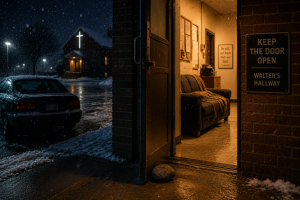
WALTER’S HALLWAY
KEEP THE DOOR OPEN
I cried the first time I saw it.
Not because it was fancy.
Because it was true.
That hallway really had kept people alive.
One winter night several years later, I returned there after another heavy snowfall.
The building looked smaller now somehow.
Older.
But the back door still stood exactly where it always had.
I stood outside for a long time staring at it while snow drifted quietly through the parking lot.
Then suddenly I noticed something.
A small gray rock holding the door slightly open.
I froze completely.
Warm yellow light spilled softly across the snow.
And inside the hallway…
sat a folded blanket on the couch.
PART 5 — THE MAN SITTING ON THE COUCH
For a second, I genuinely thought I was imagining it.
Snow drifted slowly through the church parking lot while cold wind pushed against my coat.
And there—
through the cracked doorway spilling warm yellow light onto the snow—
sat a man wrapped in an old blanket on the exact same couch where I once slept.
My chest tightened so suddenly it hurt.
The gray rock holding the door open looked almost identical to Walter’s.
Small.
Ordinary.
Sacred.
I stood frozen near the steps for several long seconds.
Because suddenly time felt strange.
Like the years between then and now had collapsed completely.
The man inside looked older than I had been.
Maybe late fifties.
Gray beard.
Work boots sitting beside the couch drying near the heater vent.
He held a paper cup in both hands while staring at nothing.
The same stare exhausted people always get eventually.
Not dramatic sadness.
Just survival fatigue.
The church hallway smelled exactly the same too.
Old carpet.
Coffee.
Radiator heat.
Dust.
Safety.
God.
The memories hit me so hard I physically grabbed the railing beside the steps.
I remembered:
- waking up before sunrise so nobody would see me
- washing my face in the church bathroom sink
- pretending not to cry while eating soup from styrofoam cups
- the first night I realized the blanket had been washed before being left for me
Tiny kindnesses.
Life-saving kindnesses.
And now another man sat inside that same light trying very hard not to fall apart.
I stepped closer carefully.
The hallway floor creaked immediately beneath my shoes.
The man looked up fast.
Fear flashed across his face instantly.
That same fear.
Please don’t make me leave.
I raised one hand gently.
“It’s okay.”
He nodded quickly anyway.
“I’m not staying long.”
God.
Always apologizing.
I smiled softly.
“You hungry?”
He looked confused by the question.
Then embarrassed.
“A little.”
I walked toward the fellowship kitchen automatically because somehow my body still remembered where everything was.
The coffee machine sat exactly where it always had.
Different paint.
Same room.
Inside the refrigerator waited:
- sandwich trays
- soup containers
- bottled water
- handwritten labels
Somebody had continued Walter’s work.
I stood there staring at the shelves for a long moment while emotion climbed slowly into my throat again.
Because kindness had survived him.
That mattered deeply.
I heated soup quietly while the man sat motionless on the couch like he was afraid touching anything might get him thrown out.
When I handed him the bowl, his hands shook slightly.
“Thank you.”
“No problem.”
He stared down at the soup before eating.
Then after a few seconds quietly admitted:
“I used to have a house.”
That sentence nearly broke me immediately.
Not because it was dramatic.
Because people in survival mode always say things like that first.
Not:
I’m homeless.
Instead:
I used to…
As if they need to prove they once belonged to normal life.
I sat across from him slowly.
“What happened?”
He laughed weakly.
“Everything.”
Fair answer.
The storm rattled softly against the windows while he slowly told me pieces of the story.
Construction injury.
Prescription painkillers.
Medical debt.
Divorce.
Layoffs.
One thing collapsing into another until suddenly survival replaced living.
“I kept thinking it was temporary,” he admitted quietly.
I nodded slowly.
“Yeah.”
His eyes lifted toward me carefully.
“You know?”
I smiled faintly.
“I slept behind this church for almost six months.”
The shock on his face was immediate.
“No kidding?”
“No kidding.”
He looked around the hallway differently after that.
Not ashamed anymore.
Recognized.
That is the strange power of shared suffering.
It removes performance.
He finally introduced himself.
“Darren.”
I told him my name too.
And for the next two hours, we sat inside that warm hallway drinking coffee while snow buried the parking lot outside.
Darren talked slowly at first.
Then more honestly.
About the humiliation of losing work.
About pretending everything was fine to his daughters.
About sleeping in a truck during winter while still paying child support because “they deserved stability even if I didn’t.”
That line hurt badly.
Because survival always twists people into believing their suffering matters less than everyone else’s.
Around midnight, I finally asked the question sitting in my chest.
“Who’s keeping the hallway open now?”
Darren looked toward the kitchen.
“Older lady named Carol mostly.”
That made me smile unexpectedly.
Of course it did.
Not my Carol.
Different Carol.
But somehow it felt right anyway.
“She comes around every night around ten.”
“Leaves food.”
“Pretends not to notice who’s here.”
I laughed softly.
“Sounds familiar.”
Darren nodded slowly.
“She says this place helped people before.”
“Says her job is just not letting the chain break.”
God.
That sentence settled deep inside me.
Not letting the chain break.
That was exactly it.
Walter helped people.
Then others continued.
Then others after them.
Kindness surviving through repetition.
Around 1 a.m., the church door opened quietly.
Cold air rushed inside.
An older woman stepped through carrying grocery bags and wearing a thick winter coat dusted with snow.
Carol.
Not my Carol.
But instantly familiar anyway.
She froze seeing me.
“You’re not Darren.”
I stood slowly.
“No.”
Her eyes narrowed carefully.
Then suddenly widened.
“Oh my goodness.”
“What?”
“You’re the young man from years ago.”
My throat tightened instantly.
“You remember me?”
She laughed softly.
“Honey.”
“Walter talked about you constantly.”
That hit like a punch.
She set the grocery bags down and hugged me before I could react.
Small older women are dangerous that way.
Then she stepped back smiling sadly.
“He would’ve been so happy you came back.”
I could barely answer………………………………………….

