The first thing I remember about that Christmas Eve is how hard I was trying to believe in it.
Not in Christmas itself. I had outgrown the clean, polished version of that years ago. I mean the idea of home. The private myth I had kept alive long past its expiration date. The one where distance made people softer, where time apart made reunion sweeter, where effort mattered because surely someone, somewhere in your family, was counting the cost of what it took for you to show up and loving you harder for it.
I had paid five hundred and forty dollars for a one-way flight that should have made me hesitate, but I booked it in less than two minutes. I had left work at noon, pasting on an apologetic smile to my manager, waving off the company bonus dinner everyone had been talking about for two weeks, ignoring the half-joking boos from coworkers who told me I was insane to choose airport security over free steak and open bar. I had shoved gifts into a duffel bag with the kind of frantic tenderness that only exists when you’re trying to make something meaningful look effortless. I sprinted through the terminal with my coat half-zipped, my laptop bumping against my thigh, the bourbon I’d bought for my father wrapped in a scarf so it wouldn’t break, and all the while I was telling myself the same stupid thing over and over.
It’ll be worth it when I get there.
I wanted the smell of roasted ham and cloves when I opened the front door. I wanted my mother calling out from the kitchen that I’d better not have tracked snow inside. I wanted my sister rolling her eyes and hugging me anyway. I wanted my father pretending not to get emotional before midnight prayer, wanted the sound of my brother Brian talking too loud over everybody, wanted all the little irritations that, in memory, had rounded into something almost tender. I wanted to feel like my absence had left a shape in the house and that my return would fill it.
The flight was delayed by thirty-seven minutes. A kid behind me kicked the seat the entire way. The man across the aisle coughed wetly into a napkin and kept apologizing to no one in particular. I didn’t care. I was weirdly cheerful. That should have been the warning sign.
By the time I got the rental car and made the drive from the airport, the roads had gone slick and silver under a fresh layer of ice. The sky had that heavy, sealed look winter skies get when more snow is coming, and the whole neighborhood where I grew up looked like a postcard somebody had forgotten to age. Warm lights in windows, wreaths on doors, roofs frosted white, every house appearing generous from the outside.
I remember carrying too much when I walked up the front path. My duffel over one shoulder. My laptop bag sliding down the other. A gift bag in one hand already gone soft at the bottom from wet snow. My hair dripping where the wind had blown flakes into it. I remember thinking, absurdly, that I should have texted from the driveway so they could come help.
Then I opened the door without knocking because it had always been that kind of house, and for one small breath I got exactly what I had come for.
Heat rushed over me, fragrant and close. Cinnamon. Ham. Burnt sugar. Somebody had music on low in the next room, those old carols my mother played every year because she said the modern versions had no soul. Voices drifted from the dining room. Laughter. Silverware clinking. The soft, chaotic noise of people already settled into each other.
I stood there grinning like an idiot.
Then I walked into the dining room and saw the note.
It was a pink Post-it. Just a little square of paper slapped onto the back of one of the dining chairs in my mother’s neat slanted handwriting. Reserved for Brian’s fiancée.
I stopped so suddenly the gift bag swung into my knee.
At first my brain didn’t process it. I only saw color and shape. Pink square. Black ink. The name of an outsider attached to a place I knew without ever needing to say it was mine. Not because the chair belonged to me in any official sense. We were not that kind of family. But every family has its map. Its invisible geography. The seat your father takes without looking. The corner your sister chooses because it’s closest to the kitchen. The place at the table that becomes yours simply because year after year everybody allows it to stay yours. Mine had always been on the left side, two chairs down from Dad, facing the doorway. From there I could see everyone.
The chair with the note was my chair.
I stood staring at it long enough for the room to notice me.
“Oh!” my mother said, appearing from the kitchen with a dish towel over one shoulder and that easy bright smile she used for neighbors and cashiers and anyone she did not want to feel her disappointment. “There you are.”
I waited for her to laugh. To peel off the note and say they’d been teasing me. To call out for someone to grab another chair.
She didn’t.
Instead she glanced at the seat, then at me, then back at the room in that breezy managerial way she had when she was smoothing over something already decided.
“She’s new here,” she said, as if this explained anything. “We figured you’d be fine standing.”
Standing.
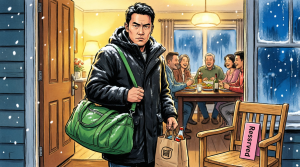
There are moments when humiliation doesn’t arrive as a flash of heat. It arrives cold. Quiet. It slips under the ribs and sits there, a neat blade turned sideways. That was what it felt like. Not rage, not yet. Just a sudden private understanding that everyone else in the room had already had a conversation about space, belonging, priorities, and I had not been part of it.
Brian was at the far end of the table, one arm slung over the back of his chair, looking infuriatingly comfortable. His fiancée sat beside the pink note chair in a sweater dress, cheeks pink from either wine or the heat in the house, smiling uncertainly like somebody who had walked into the middle of a story and sensed too late that she was on the wrong page. My sister had a glass in her hand and that expression she always wore when something awkward was happening and she had decided in advance not to help. Dad looked up from carving and then immediately looked back down as if the ham had suddenly become a matter of national security.
Nobody moved.
Nobody said, No, wait, let’s make room.
Nobody said, We thought you’d be later, let me grab a chair.
Nobody even looked embarrassed enough.
I heard my own voice before I felt it. “Sure,” I said.
I said it softly, politely, automatically. The same way I said fine when I wasn’t fine, no problem when there was absolutely a problem, don’t worry about it whenever worry was exactly what I was supposed to be causing. It was the voice I had trained them to expect from me. The voice of the one who absorbed.
My mother smiled, relieved by my compliance, already turning back toward the kitchen. “Good,” she said. “We’re just about ready.”
And something in me, maybe something that had been fraying for years, finally gave way.
I turned around. No speech. No confrontation. I picked up the duffel bag I had just set down by the entryway. Adjusted the strap on my shoulder. Took the gift bag with the whiskey still inside. Walked back out the front door and into the cold so fast that by the time anyone might have decided to stop me, I was already in the car.
I made it thirty-one minutes down the icy road before my phone buzzed.
I know the exact number because I watched the dashboard clock like it was keeping score. I had driven aimlessly at first, too furious to trust myself with directions, too hollow to cry. Snow collected on the windshield faster than the wipers could clear it. The heater blasted dry air into my face. Every mile marker felt both absurd and necessary, like I needed physical distance before I could understand what had just happened.
Then my sister texted.
So sensitive. It wasn’t a big deal.
No hello. No where are you. No are you okay. Just that. The entire family dynamic compressed into nine words and a period.
I stared at the message until the letters blurred.
What she meant, of course, was that my pain was an inconvenience. That my interpretation of events was the offensive thing, not the event itself. That the real problem was not that I had flown across the country and found no place for me at the table, but that I had made anyone feel bad by reacting like a human being.
I should have known that was what they would do. It was the oldest trick in the family. If Brian forgot your birthday, you were petty for remembering. If Dad made a cutting joke, you were humorless for flinching. If Mom overlooked you in favor of whichever person currently required the most theatrical amount of care, you were selfish for noticing. Reality in our family was always determined by the person least willing to examine their own behavior.
I didn’t answer my sister. Instead I opened my banking app.
My fingers were shaking hard enough that I mistyped the password twice. When the account finally loaded, there it was in clean rows and scheduled transfers, the silent architecture of everything I had been doing for them for years. Monthly support to my parents. Insurance premiums. Utility autopays. The contribution I sent to the family trust my father had wanted to build as his “retirement cushion.” Small amounts at first, then bigger ones. Little rescues that became standing obligations. Proof, if I had ever wanted it, that love can be slowly converted into infrastructure.
I paused the transfers.
No ceremony. No dramatic message. Just a few taps and a confirmation screen that glowed pale against the dark car interior.
Done.
At the time, that felt like the ending. The decisive act. The line crossed. But it wasn’t. It was only the first time I had allowed my hands to catch up to what my heart had known for a long time.
Because the truth is that Christmas Eve did not create the problem. It only made it visible.
I sat in the parking lot of a gas station a few miles farther down the road, engine idling, snow hissing against the windows, and started thinking about all the other times I had been asked to disappear in plain sight.
Not literally, not always. Sometimes it was financial. Sometimes emotional. Sometimes just the expectation that I would arrange myself around whatever crisis or comfort someone else needed, and do it with enough grace that they could pretend not to notice the cost.
When I got my first real tech job, I was twenty-four and still carrying the cheap confidence of someone who thought competence would buy him peace. I called my parents from the apartment I could barely afford and told them I’d been hired. Good salary, benefits, room to grow. My father listened, let me finish, and then said, in that deep serious tone that turned everything into obligation, “Good. Now you can finally take care of your family.”
He didn’t laugh after. That was the important part.
I remember holding the phone away from my ear for a second as if it might explain itself. I had expected congratulations. Pride. Maybe even a little joy. What I got instead was a job description that extended beyond my employer. Family provider. Safety net. Backup plan.
I told myself he didn’t mean it the way it sounded. I became very good at telling myself that about them.
At first it was little things. My parents’ internet bill because Dad said he could never figure out the service provider and I was “better with this stuff.” Their car insurance because Mom mentioned rates had gone up and worried aloud until I solved it for her. Extra money in winter to help with heating because the old house bled warmth and guilt in equal measure. They never exactly demanded. They simply left enough silence around a problem that I stepped in to fill it.
That was my role in the family long before I had money. I was the one who noticed what wasn’t being handled and handled it.
Brian, on the other hand, was the storm everybody gathered around. Charming when he wanted to be. Restless. Magnetic in that infuriating way some irresponsible people are, where every mess they create becomes evidence of how much they need care. He dropped out of college two semesters from finishing because he had “outgrown the system.” My parents said he was brave. He moved to Colorado with friends to launch some kind of ski gear startup despite knowing nothing about business, mountains, or delayed gratification. Dad said he had initiative. When the company folded and the friends bailed and Brian came back with debt, a bruised ego, and a story about betrayal that shifted depending on who was listening, my mother cried over how cruel the world had been to him.
I let him live with me for nine months after that.
Nine months in a one-bedroom apartment where I gave him the bedroom and slept on a futon because he said the couch hurt his back. Nine months of empty beer cans beside the sink, strange shoes by the door, promises that he was job hunting while he spent afternoons gaming with a headset on. Nine months of him calling me “bro” in that sheepish affectionate tone when rent was due, when his phone bill lapsed, when he needed gas money, when he discovered that adulthood, unlike family, expected receipts.
He swore therapy would help. He said he couldn’t get back on track without it. I paid for the sessions. He attended six, quit after the therapist suggested he might need structure, and then told everyone I was controlling because I’d asked whether he planned to continue.
I still sent my parents money that whole time.
When my mother needed dental surgery the year before Christmas Eve, insurance covered most of it but not enough. There was a three-thousand-four-hundred-dollar gap that arrived in the form of a panicked phone call and a statement she read aloud like she was reciting a death sentence. I paid it the next morning. She cried and called me her angel. Two weeks later, when I had to postpone replacing the bald tires on my own car because my checking account was thinner than I liked, she never knew.
When Dad’s Ford finally died in a church parking lot and he needed something reliable, he came to me for advice, then for help, then for a co-sign because his credit had softened under years of poor decisions disguised as generosity. He said it was only paperwork. He said he’d cover every payment. I knew better and signed anyway. For the next year and a half, every time the due date passed and the debit pulled from my account instead, I told myself it was temporary. Families help each other.
That is the sentence that ruins people like me. Families help each other. It sounds noble right up until you realize the traffic only runs one way.
I had skipped vacations because somebody needed something. Real trips I wanted to take. Places I had pictures of on my laptop from those nights when I couldn’t sleep and pretended someday was a dependable destination. Portugal. Oregon. Tokyo in cherry blossom season. A week in a cabin somewhere I couldn’t hear my phone. I had eaten embarrassingly cheap lunches at my desk while wiring money out to cover someone else’s late fee, someone else’s medication, someone else’s “just until next Friday.” I had watched coworkers with smaller salaries than mine take weekends in Napa and buy ridiculous sneakers and join wine clubs and generally spend their adulthood on themselves, while I nodded along and said things like, “Maybe next year.”
I never told my family any of that. Not because they would have thanked me if I had. Because I already knew they wouldn’t.
Sitting in that gas station parking lot on Christmas Eve, I scrolled through the family group chat with a kind of sick fascination. Months of messages. Years, really, if I’d wanted to go farther back. I wasn’t looking for evidence. I think I just wanted to see whether the pattern I suddenly felt burning under my skin had always been this obvious.
It had.
Every time I shared news, it landed with a tidy politeness that dissolved almost instantly. Promotion at work? Two thumbs-up emojis and Mom writing Proud of you, honey. Work trip to Seattle where I presented to senior leadership? Dad saying Nice. Brian not responding at all. Raise? My sister asking two hours later if I could maybe help with a deposit for her daughter’s summer camp.
Meanwhile Brian’s life, regardless of quality, generated noise. Brian’s new guitar. Brian’s idea for a food truck. Brian’s latest girlfriend bringing over cookies. Brian’s girlfriend, then fiancée, posting a photo of a pie with slightly burnt edges and my mother replying She’s such a keeper!!! with three heart emojis like she’d just been handed the crown jewels.
I remembered July, six months before Christmas, when I had flown in for my mother’s birthday as a surprise. I landed close to midnight, took a cab to the house, let myself in quietly, and found my old room occupied by Brian “temporarily,” meaning indefinitely. There was a mattress on the floor of the spare room for me. In the morning I woke to a silent house. On the fridge, a note in Mom’s handwriting: Gone wine tasting. Be back by 5. Make yourself comfortable.
They had taken Brian’s then-girlfriend, now fiancée, out for the day.
They did not wake me. Did not postpone. Did not save me cake from the dinner they had apparently had the night before. I remember standing in the kitchen in socks, reading that note with the same odd blankness I felt staring at the Post-it months later, and then doing what I always did. Making coffee. Shrugging it off. Telling myself they had gotten caught up in logistics. That it was nobody’s fault. That I was too old to care about birthdays and seating and being considered.
The next week I paid their gas bill.
That was the real problem. Not that they overlooked me. That I taught them overlooking me was safe.
The hotel I eventually found that night was exactly the kind of place you get when it’s Christmas Eve, you’re exhausted, and your standards have been replaced by necessity. Two stories. Harsh exterior lights. A lobby that smelled faintly of old coffee and cleaning product. My room was at the back facing a gas station, and the carpet had a pattern designed to hide everything. I should have hated it. Instead the anonymity felt medicinal.
I dropped my bags, sat on the edge of the bed still wearing my coat, and listened to the silence.
For the first time in years there was no immediate next step for them. No smoothing over. No returning to the house because that would be “the mature thing.” No apologizing for having feelings large enough to inconvenience anybody. I ordered Thai takeout, extra spicy, because nobody there knew me and because the petty part of me liked the idea of eating exactly what I wanted on Christmas Eve without consulting a single person. I opened my laptop. Put on something mindless. Didn’t watch it.
At 9:04 p.m., Dad called.
I almost let it ring out. The screen glowed on the cheap motel nightstand, his name stark and familiar, and I sat there looking at it as if the decision itself were a referendum on my whole life. Then I answered because some part of me was still hungry for the impossible. Maybe he would say the one thing I had been waiting to hear since I was a kid. You were wronged. Come back. We made a mistake.
“Hey,” I said.
He was quiet for a beat too long. Then, “You left.”
Not are you okay. Not where are you. Just an accusation wrapped in observation.
“Sure did.”
“Your mom’s upset.”
The room around me seemed to sharpen.
“She’s also the one who gave my chair away.”
Another pause. In the background I thought I could hear dishes. Muffled voices. The house continuing without me.
“She didn’t mean anything by it,” he said.
That sentence. That old family absolution. Harm without intent, therefore not harm at all.
“Sure,” I said. “Let’s say she didn’t.”
He exhaled slowly, impatient already. “You know how your mother is. She wanted Brian’s fiancée to feel welcome.”
“Right. More welcome than your son.”
“That’s not fair.”
I laughed once, with no humor in it. “No? Is it fair that Brian texted me two hours ago asking if I could help fund their wedding next summer?”
Silence.
He hadn’t known that part. I could hear it in the stillness.
“I see,” I said. “So you didn’t know.”
“It’s not like that.”
“It’s exactly like that.”
He shifted tactics. He always did when cornered. “Brian’s not as fortunate as you.”
Fortunate.
I leaned back against the motel headboard and looked at the stained ceiling as rage turned strangely clean inside me. “No, Dad. Brian is reckless. I am responsible. Those are different words.”
“He’s getting better,” Dad said, defensive now. “She’s good for him.”
“She’s sitting in my chair.”
“Don’t be dramatic.”
There it was. The old muzzle.
I closed my eyes and pinched the bridge of my nose. “You know what? I am done being the guy who works sixty hours a week so everyone else can play pretend. I’m done being your safety net.”
“We never asked for it.”
That was the moment I snapped.
It happened physically first, like my body got there ahead of my voice. I sat up so fast the bed creaked. “That is nonsense,” I said, louder than I meant to. “You expected it. You built your lives around it. You think because I never complained, I was okay with it. Well, here’s the truth. I’m not. I haven’t been for a long time.”
He went silent.
Then, softer than before, and somehow worse for it, he said, “Son, it’s Christmas Eve.”
I looked around the room. The buzzing mini fridge. The thin curtains. My coat slumped over a chair. The plastic bag of takeout sweating on the desk. The whiskey still unopened in its soggy gift bag by the door.
“Yeah,” I said. “It is. And I’m spending it alone in a motel next to a gas station because you needed Brian’s fiancée to feel welcome more than you needed your son at the table.”
He didn’t answer.
So I ended the call.
That was the last time I heard from him for four days.
People like to imagine estrangement as dramatic, but often it begins in administrative silence. The kind with receipts.
The morning after Christmas I woke earlier than I needed to because years of work and anxiety had trained my body to do that. For a few confused seconds I didn’t know where I was. Then I saw the motel curtains and remembered everything all at once, but the expected wave of grief didn’t come. What came instead was an almost frightening calm.
I made coffee in the tiny machine by the sink. It tasted metallic and terrible. I drank it anyway while sitting at the small desk and opening all the tabs I had avoided for years. Insurance accounts. Shared subscriptions. The trust paperwork. The vehicle lease. Tax documents. A sprawling ecosystem of quiet dependence that had grown so gradually I had stopped seeing it as something constructed and therefore something that could be dismantled.
I started taking my name off what no longer belonged to me.
Not with vindictiveness. That’s the part nobody would understand. I was not doing it to hurt them. I was doing it because the illusion had broken, and once something is visible you can’t pretend not to see it without violating yourself.
I called the accountant I’d used to help my parents structure their taxes and trust contributions. Told him I would no longer be handling their filings or making transfers into the retirement cushion Dad liked to boast about as if he had built it alone. He was professional, unsurprised in the way all professionals are when they sense family money drama but know better than to name it.
I moved the car lease paperwork back toward Dad as far as the process allowed. I checked timelines on the health coverage I had included them under when Mom’s medications became too expensive on their plan. Sixty days. Enough time that even I, fresh from Christmas Eve, could not accuse myself of cruelty.
Every click felt like taking my hand off a wire I had been gripping too long.
The messages began before noon.
My sister again first, because she had always been the family’s favorite courier of contempt disguised as realism.
You really left Mom crying all night. Nice.
Then, ten minutes later, as if she had sensed she’d overplayed, another one.
You know she didn’t mean anything. Why do you always make things bigger than they are?
I deleted both.
Brian didn’t text until later, and his message was almost worse because it was so nakedly practical.
Hey man, since you’re in town anyway can we talk wedding budget sometime?
I actually laughed out loud in that motel room. Not because it was funny, but because the audacity was almost beautiful in its purity. Only Brian could walk straight past injury into logistics. Only Brian could stand amid the smoking ruins of a family blowup and still see a funding opportunity.
I did not answer him either.
By the time I flew back to the city where I lived, the four-day silence from my father had become its own kind of statement. He wasn’t calling to apologize because in his mind apologies followed from intent, and intent was always where he hid. If he didn’t mean to minimize me, then I had no right to feel minimized. If he didn’t mean to use me, then the years of financial support weren’t proof of reliance but evidence of my generosity, freely offered and therefore immune from future resentment. It was a clever moral framework if you never wanted to be accountable for outcomes……………………………….

