“Who did this to you?”
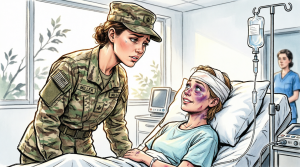
My hand tightened around the cold metal rail of the hospital bed until my knuckles turned bone white. The fluorescent lights above hummed with a dull electric buzz, the kind that drills slowly into your skull. The smell of antiseptic filled the room, sharp and sterile.
But none of that mattered.
All I could see was my daughter.
Clara lay in the hospital bed like a battlefield casualty. Her left eye was swollen shut, painted in shades of purple and black. Her arm was locked inside a heavy white cast. Dark bruises—distinctly shaped like fingers—ringed her throat.
I had seen injuries like this before.
In Afghanistan.
In Iraq.
In dusty military tents where soldiers bled onto folding cots.
But never on my child.
For a moment she didn’t respond. She stared blankly at the ceiling with that hollow thousand-yard stare that haunted veterans long after the shooting stopped.
Then her lips trembled.
“Mom…”
Her voice cracked like dry wood.
And suddenly she broke.
“It was Dustin,” she whispered.
My heart stopped.
“He lost at poker again.” Her voice shook violently. “His mother… and his sister… they held me down while he—”
Her words shattered.
She couldn’t finish the sentence.
She didn’t have to.
Something inside me went very still.
The grief that had been clawing through my chest drained away instantly. In its place came something colder.
Clearer.
Anger is loud.
Anger burns hot and reckless.
This was different.
This was the quiet, razor-edged calm of a weapon being loaded.
I gently brushed a strand of hair from Clara’s uninjured cheek.
“Very well,” I said softly.
Her good eye widened.
“Mom… please. No. You don’t understand. Dustin is dangerous. His family too. They’ll hurt you. They’ll hurt Laya.”
Laya.
My ten-year-old granddaughter.
My chest tightened again.
I leaned closer to Clara and lowered my voice to the tone that once commanded entire battalions.
“Trust me,” I said.
“I am not the helpless old woman they think I am.”
Six hours earlier, my day had begun like every other.
0500 hours.
My eyes opened before the alarm even buzzed.
Old habits never die.
The small room at Crestwood Meadows was silent except for the faint hum of the heating system. Outside my window, dawn was still a faint gray smudge over Boston.
I swung my legs over the bed and stood.
My joints complained. My back protested.
Sixty-nine years old is not kind to the human body.
But weakness?
Weakness is a choice.
I placed my palms against the wall.
Twenty push-ups.
My breathing stayed steady.
Fifty crunches on the carpet.
By the end my muscles were warm and my mind razor sharp.
Same routine I’d followed since boot camp in 1975.
Crestwood Meadows called itself a “luxury retirement residence.”
It had marble floors. Fresh flowers. Polite staff.
But to me it was something else.
A cage.
And the key belonged to one man.
Adam.
My stepson.
Two years earlier, after my husband’s funeral, Adam had come to me with that oily smile of his.
“You shouldn’t be alone, Shirley,” he’d said.
“You’re getting older. Let me handle the finances. Just temporary. A power of attorney.”
Temporary.
I had signed the papers.
Within six months my bank accounts were “managed.”
Within a year I was declared “medically fragile.”
And then one morning Adam had gently explained that living independently was “no longer safe.”
Now I lived here.
Under supervision.
With my own money paying the bill.
The irony would have been funny if it weren’t so pathetic.
I had spent thirty years as a Navy combat nurse.
Decorated officer.
Major Shirley Harris.
But Adam saw only a frail widow.
A harmless old woman.
His mistake.
At 6:10 AM I was pulling on my cardigan when the door burst open.
A young nurse rushed in carrying a tray of medications.
Jessica.
New hire.
Nervous.
Dangerous.
She nearly dropped the vial when she saw me already standing.
“Oh—Mrs. Harris, I didn’t realize you were awake.”
I glanced at the tray.
Then at the label on the vial.
My voice cut through the room like a scalpel.
“That is Metformin.”
Jessica blinked.
“Yes… it’s for Mr. Henderson in 4B.”
I shook my head slowly.
“No. Mr. Henderson is hypoglycemic this morning.”
She froze.
“If you give him that,” I continued calmly, “you will put him into a diabetic coma.”
The color drained from her face.
“Oh my God…”
She stared at her chart.
Her hands began shaking.
“You’re right.”
I nodded toward the door.
“Go fix it before someone dies.”
She practically ran out of the room.
I sat on the edge of my bed and sighed.
Even trapped in a retirement home, I was still doing triage.
Some habits never die.
The knock came at 6:15.
The receptionist looked apologetic.
“Mrs. Harris? There’s a call for you. From Central Hospital.”
My stomach tightened.
I picked up the phone.
The voice on the other end was clipped and professional.
“Is this Shirley Harris? Mother of Clara Rakes?”
“Yes.”
“Your daughter has been admitted after a fall. She apparently fell down the stairs.”
Fell down the stairs.
I closed my eyes.
I had heard that phrase too many times in my career.
Domestic violence victims always fall down stairs.
They always walk into doors.
They always trip.
It’s amazing how clumsy people become when someone else is beating them.
“I’ll be there in twenty minutes,” I said.
Then I hung up.
The problem was simple.
Adam had left strict instructions.
Shirley wanders.
Do not allow her to leave the building.
So I made one call.
“Connect me to Dr. Pete Rodriguez.”
There was a pause.
Then the receptionist asked cautiously, “The Chief of Staff?”
“Yes.”
Thirty seconds later a rough, familiar voice answered.
“This is Rodriguez.”
“Pete,” I said.
“It’s Shirley Harris.”
Silence.
Then a low whistle.
“Well I’ll be damned.”
“Shirley? From Kandahar?”
“The same.”
He chuckled.
“Hell of a way to start my morning. What can I do for you?”
“My daughter is in your emergency room.”
His tone changed instantly.
“Say no more.”
“I’m currently incarcerated at Crestwood Meadows thanks to my stepson.”
Another pause.
“You serious?”
“I need out. Now.”
Pete exhaled slowly.
“I still owe you for that night in Kandahar.”
I smiled faintly.
Three hours.
That’s how long I had held pressure on his femoral artery while insurgents fired at our medical tent.
Some debts never expire.
“Transport team will be there in thirty minutes,” Pete said.
“Official consult.”
When the ambulance arrived, the facility manager tried to protest.
“Mrs. Harris cannot leave without authorization from—”
The transport nurse handed him a signed transfer order.
“Emergency specialist consultation requested by the hospital chief of staff.”
The manager sputtered.
But paper outranked opinion.
I walked past him with my purse in my hand.
Back straight.
Head high.
For the first time in two years…
I was free.
And I was heading to war.
When I entered Clara’s hospital room, I already suspected the truth.
But seeing her…
That nearly broke me.
Nearly.
“Mom,” she whispered weakly. “You shouldn’t be here.”
I squeezed her hand gently.
“I’m exactly where I belong.”
She hesitated.
Then she told me everything.
The gambling.
The beatings.
The way Dustin’s mother and sister helped him.
How they locked Laya in her room when things got violent.
My jaw tightened.
“Where is Laya right now?”
“At the house,” Clara whispered.
“With them.”
That was enough.
I stood up.
“Mom?” Clara said weakly.
“I’m going to your house.”
Panic filled her eyes.
“No. Please. You don’t know what Dustin is like.”
I turned toward the door.
“Oh,” I said quietly.
“I think I do.”
I paused.
Then I looked back at her.
“And by tonight…”
“He’s going to know what I’m like too.”
Forty minutes later, the taxi pulled up outside a two-story house in Dorchester.
From the outside it looked normal.
White siding.
Blue shutters.
American flag on the porch.
But the moment I stepped inside…
I smelled it.
Rotting food.
Stale beer.
Dirty laundry.
The living room looked like a landfill.
Pizza boxes. Beer cans. Greasy carpets.
Two women sat on the couch watching reality TV.
Dustin’s mother, Brenda.
And his sister, Karen.
Brenda glanced at me lazily.
“Oh. It’s you.”
Cigarette smoke curled from her lips.
“Clara ain’t here. She fell down the stairs.”
Karen snorted.
“Clumsy idiot.”
My hands folded calmly behind my back.
From the hallway…
I heard a small sob.
A child.
My granddaughter.
And at that moment…
The war officially began.
The sob came again.
Soft. Fragile. Almost hidden beneath the blaring reality show and the lazy chatter coming from the television.
My heart recognized that sound instantly.
A child trying not to cry.
I walked past Brenda and Karen without saying a word.
My shoes stuck slightly to the greasy floor as I crossed the living room. The air smelled like cigarettes soaked into damp carpet. Every surface was cluttered with junk—half-empty beer cans, greasy takeout containers, ashtrays overflowing with cigarette butts.
Behind me, Karen laughed.
“Well look at that,” she said mockingly. “Grandma thinks she owns the place.”
Brenda didn’t even turn her head from the TV.
“If you’re staying,” she said lazily, “kitchen’s a disaster. Grab a sponge.”
I ignored them.
The sob came again, faint but unmistakable.
Down the hallway.
The house creaked under my footsteps as I followed the sound. Each step made my jaw tighten further.
The hallway was dim, the lightbulb flickering weakly overhead.
Three doors.
The first one opened into a filthy bathroom.
The second door revealed a cluttered storage room filled with boxes and broken furniture.
The third door—
I pushed it open slowly.
And there she was.
Laya.
My ten-year-old granddaughter sat on the floor in the corner of the tiny room. Her knees were pulled tightly to her chest, and in her hands she clutched a doll missing both legs and one arm.
Her hair was tangled and greasy. Her face pale.
When she looked up and saw me, her eyes widened.
“Grandma?”
Her voice trembled.
I felt something twist violently in my chest.
“Yes, sweetheart.”………………………………..