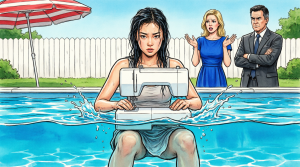
The sharp sound of a heavy splash tore through the stillness of the afternoon. For a moment, I thought maybe a chair had tipped over, or one of the dogs had fallen in. But then I saw it—the white and pink sewing machine, sinking beneath the rippling water, bubbles rising as sunlight glinted off the metal plate. My daughter’s scream came next.
“No!” she cried, sprinting toward the pool. Tears streamed down her cheeks before she even reached the edge.
“That’s mine! Mom, that’s my sewing machine!”
I froze in the doorway, grocery bags still hanging from my hands. Outside, my ex-husband Mark stood with his arms crossed, his expression blank, eyes avoiding our daughter’s. Next to him, Rachel—his new wife, Lily’s stepmother—smiled.
“She needed a lesson,” Rachel said, her tone like ice. “Maybe next time she’ll listen when she’s told to do her chores.”
Lily dropped to her knees beside the pool, reaching helplessly toward the water as her sewing machine disappeared beneath the surface. It had taken her six months to save for it—babysitting, selling handmade tote bags online, cutting every corner she could. That machine was her dream, her escape.
Mark started, “Rach, maybe that was—”
“Don’t,” she snapped. “You agreed she’s been spoiled.”
He said nothing. Didn’t move.
I slowly set the bags down, my pulse hammering in my ears. “So you both decided the right punishment was destroying her property? Because she didn’t sweep fast enough?”
Rachel’s smirk held. “It’s just a machine. She’ll get over it.”
Lily’s sobs tore something open inside me. I walked over, knelt beside her, and placed my hand on her back. Her body shook beneath my touch. The blue water shimmered, mocking in its calm. At the bottom, the machine sat like a grave marker for her hard work.
I looked up at Rachel. “You think this will teach her something?”
“Yes,” she said, arms crossed. “Respect.”
“Perfect,” I replied, standing tall. “Then you’ll understand when I teach you both how it feels to lose something that matters.”
Her smile faltered.
That night, I lay awake, staring at the ceiling fan as it sliced through the dark—slow, steady, and unrelenting. The scene replayed in my mind: Rachel’s sneer, Mark’s silence, Lily’s heartbreak. Each image stoked the fire burning in my chest.
Lily had cried herself to sleep in my bed, curled up small again, her pillow damp. I noticed the calluses on her fingers—tiny badges of her effort. All that work, undone in seconds for the sake of “discipline.”
I knew I couldn’t save the sewing machine. But I could restore something else: balance.
The next morning, I called Mark. “We need to talk.”
He sighed. “Anna, Rachel might’ve taken it too far, but—”
“But you stood there,” I cut in. “And now, you’ll both learn what that felt like.”
“Anna,” he groaned, “don’t turn this into a big thing.”
“Oh, it’s already a big thing,” I said, and hung up.
That weekend, I arrived unannounced while they were enjoying brunch by the pool—same setting, same smugness. Rachel lounged in sunglasses, sipping iced coffee, looking every bit the suburban queen. Mark looked uneasy.
“Anna,” Rachel said flatly, “we’re not doing this.”
“I’m not here for drama,” I smiled. “Just a demonstration.”
Before they could react, I walked inside, straight to the living room. I still knew every inch of that house—I’d decorated half of it once. I unplugged Rachel’s beloved Peloton bike, the one she bragged about every morning online.
Dragging it outside, I felt both of them tense.
“Anna, what the hell—” Mark started.
“Just teaching a lesson,” I said, my voice calm but firm. “You wanted Lily to know how it feels to lose something she loves, didn’t you?”
Rachel’s face drained of color. “Don’t you dare.”
Too late. The Peloton tipped, wobbled, and crashed into the pool with a mighty splash. Water erupted around us, soaking everyone. The silence that followed was absolute.
“Now,” I said quietly, “we’re even.”
Rachel shrieked, and Mark gaped at me. “You’ve lost your mind!”
“No,” I said, “I’ve found my balance.”
I turned and left, water dripping from my arms but my heart finally steady. For once, justice sounded like a splash.
The aftermath of that day felt almost surreal. The sound of the splash still echoed in my ears, as though the water had carried away every ounce of restraint I’d ever held back. Mark’s furious voice, Rachel’s shrill protest—none of it mattered now. It had been done. The lesson, as painful as it was, had been taught.
By the time I got home, the anger still simmered in my chest. The quiet of my house, without Lily here, made everything seem larger and more lonely. The house felt empty. There was no one to tell me I had gone too far. No one to tell me that I shouldn’t have done it. But I knew, deep down, I hadn’t.
The phone rang, shattering the silence. I didn’t have to look at the caller ID to know it was Mark.
I picked up the phone, my voice sharp. “Hello?”
“Anna,” Mark started, his voice clipped. “What you did was insane. You’ve crossed a line. You need to stop acting like this is some sort of revenge game.”
I leaned against the counter, my pulse racing. “I’m not playing a game, Mark. I’m showing you exactly what it feels like when you stand by and let someone destroy something that matters to someone else. You were there. You watched it happen.”
His voice softened, just barely. “I didn’t agree with Rachel’s actions, you know that. But this? You think throwing her bike into the pool will fix things? You think that’s the lesson Lily needs to learn?”
I closed my eyes, remembering the hurt in Lily’s face when she saw her sewing machine sink to the bottom of the pool. “You don’t get it. She worked for that machine, Mark. She earned it. And you just let Rachel throw it away like it meant nothing. But you know what? I won’t let anyone teach her that she’s worthless, not even you.”
Mark let out a heavy sigh. “You’re being irrational, Anna. This isn’t about Lily’s sewing machine. This is about you and Rachel. This is about us and how we deal with each other. If you think this—this stunt—helps anything, you’re wrong.”
“No, Mark,” I shot back, my voice shaking but firm. “What’s wrong is letting a child be punished with destruction, letting them be humiliated for something that doesn’t even deserve it. I had to teach you both what it feels like. If you can’t understand that, then maybe we’re further apart than I thought.”
There was a pause on the other end, and for a moment, I wondered if he was going to say something that would tear the wound open even further. But then, in a tone almost too calm, Mark finally said, “Rachel’s leaving. She said she can’t stay in a house with a man who lets his ‘crazy ex-wife’ get away with things like this.”
The words hit me like a punch to the gut, but I wasn’t surprised. It was only a matter of time before Rachel would twist the story in her favor, as she always did.
“Good luck with that,” I replied, the bitterness slipping into my voice. “Maybe now you’ll learn how to protect your daughter. Maybe now you’ll finally realize who you really should be standing up for.”
Without waiting for his reply, I hung up, my hand shaking as I set the phone down.
The next few days were a blur. Word spread quickly, as it always did. Rachel’s social media rant about “crazy exes” had been met with the kind of response I could only describe as karma. People weren’t asking for her side of the story—they were asking why she would destroy something precious to a teenager. Her post was taken down within 24 hours, replaced by a vague apology about “misunderstandings” and “tensions.”
But the damage had been done, and now the school, the neighborhood, and even some of our mutual friends were asking the same question: How could Rachel have done something like that?
It wasn’t just the physical destruction of the sewing machine. It was the way she had dismissed Lily’s dreams, the way she had used power to humiliate her stepdaughter. It was how she had tried to teach her “respect” by teaching her to lose everything she had worked so hard for. It was heartbreaking.
Meanwhile, Lily seemed to be handling it better than I had expected. Her quiet resilience was both humbling and heartbreaking. She didn’t say much about the incident, but every time I saw her pick up the fabric again, every time she sat down to sketch or work with the new sewing machine she had received, I saw the fire that had never truly gone out.
A few days after the incident, I received a call from Lily’s school. The teacher on the other end sounded almost giddy.
“Mrs. Matthews, I just wanted to call and let you know about an amazing opportunity for Lily. A local nonprofit organization that gives out creative grants to teens just reached out to us. They heard about her story and are offering her a grant to help fund her sewing business. They want to provide her with a new machine, a professional one, and give her the resources she needs to build her future.”
I felt my heart swell with pride. “That’s… amazing,” I said, my voice thick with emotion. “Please tell her. She’ll be thrilled.”
When I told Lily, she stared at me in disbelief for a moment, and then her eyes started to shine.
“But how? How did they even know about it?” she asked, her voice soft, as though afraid to get her hopes up.
“Your story spread, sweetie,” I said, kneeling beside her. “People heard what happened. They know how hard you’ve worked, and now they want to help you.”
Lily was silent for a moment, then a small smile broke across her face. “Good things can grow from bad people,” she whispered. “I guess you were right.”
I kissed her forehead gently. “Sometimes, it just takes someone to stand up for you.”
That night, as I lay in bed thinking about everything that had happened, I couldn’t help but feel a sense of peace. Rachel might have thrown Lily’s sewing machine into the pool, but she couldn’t drown Lily’s dreams. She couldn’t drown the fire inside her, the fire I had helped stoke and protect. And as for Rachel—well, she had learned a lesson she would never forget.
But I knew that, despite the chaos, everything had worked out the way it was meant to. Lily’s future was now in her own hands. The road ahead would be long, but it would be hers to carve.
A week after the phone call with Lily’s teacher, I watched my daughter with a newfound sense of pride. The sewing machine from the nonprofit had arrived, a professional-grade model that gleamed in the sunlight. It was everything Lily had dreamed of—a tool that would help her build her future, piece by piece. It wasn’t just the machine that mattered, though. It was what it represented: hope, resilience, and the acknowledgment that her hard work had been recognized, even when it seemed the world was bent on tearing it down.
We set it up together, and she spent hours experimenting with it, testing its features, making small, perfect stitches. She was so focused, so determined. It reminded me of the way she had worked to save every penny for her dream machine—her dream that had been nearly destroyed.
I smiled watching her, knowing that no matter what Rachel or anyone else threw her way, she would find a way to rebuild, to keep moving forward. This machine was just the beginning.
But as I watched her, something shifted in me. It wasn’t just about Lily anymore. I had been angry—so angry—and rightly so. But deep down, I knew that what I had done had pushed things to the limit. I had avenged the injustice, sure, but at what cost? How far would I go to teach a lesson?
A part of me wished I had handled it differently. Maybe I should have talked to Mark. Maybe I should have let Rachel and him realize the full impact of their actions before resorting to such drastic measures. But what had been done was done. I had found my balance, and I wasn’t going to apologize for it.
A few days later, Mark called again, but this time, his voice was different. Softer. Almost apologetic.
“Anna,” he said, his tone steady but hesitant. “I think we need to talk.”
I felt a familiar wave of tension rise in me, but I stayed calm. “About what, Mark?”
“I’ve been thinking,” he said, “and I realize… I realize that I didn’t handle things the way I should have. I stood there, and I let Rachel destroy Lily’s property, and I didn’t stop her. I should have. I should have done more.”
I sat down, absorbing the weight of his words. “You should have, Mark. You really should have.”
There was a pause. I could almost hear him gathering his thoughts, trying to find the right words. “I can’t undo what happened, but… I want to make things right, for you and for Lily.”
I frowned, unsure of where this conversation was going. “And how do you plan on doing that?”
He sighed. “I’m going to have a talk with Rachel. About respect. About how she treats you, about how she treats Lily. I didn’t stand up for you then, but I’m going to now. It’s time to put an end to this.”
I felt a strange mixture of emotions wash over me. Part of me wanted to yell at him—tell him it was too little, too late. But the other part, the part that had been quietly hopeful for some kind of resolution, felt a flicker of something: trust. Maybe this was the beginning of him finally realizing what he had neglected. What he had failed to protect.
“You should’ve done that before,” I said, my voice quiet but firm. “You could’ve saved us both a lot of pain.”
“I know. I know,” he muttered. “But I’m trying now. I’m trying to make it right. I’ve seen what Rachel’s capable of, and I won’t let her treat you or Lily like that anymore.”
I nodded, even though he couldn’t see me. “Good. I’m glad to hear it.”
After a long pause, Mark added, “I’m sorry, Anna. For everything. For letting this go on as long as it did. For standing by and watching.”
My breath caught in my throat, and I quickly exhaled. “It’s too late for apologies, Mark. But I appreciate the effort.”
“I’ll do better,” he promised.
I said nothing for a moment. “Just… do better.”
I hung up the phone, feeling both lighter and heavier at the same time. It wasn’t forgiveness—at least not yet—but it was something I hadn’t expected from him: a real attempt at change. And maybe, just maybe, it meant that Mark was finally starting to understand what it meant to protect his daughter. To protect her from the people who should have cared for her the most.
The next day, I received a message from one of Lily’s teachers, who had connected her with the nonprofit. The teacher had heard that Lily was preparing to enter a local fashion design contest and wanted to let us know that they were offering her a mentorship program—one that could help guide her through the next steps of her sewing journey, potentially even turning her passion into a career.
Lily read the email over my shoulder and her eyes widened. “Mom,” she said, voice filled with awe. “This is huge. I can’t believe this is happening. I—”
“You earned this,” I interrupted, my voice soft but full of conviction. “You’ve worked for it, Lily. Every stitch, every hour of work. It’s all paying off now.”
Tears filled her eyes as she looked up at me, and I could see the mix of emotions in her expression: disbelief, gratitude, and something else—something stronger. “I don’t even know what to say.”
“You don’t have to say anything,” I said, brushing a strand of hair from her face. “Just keep going. Keep working. Keep creating. This is your future now, and you’re the one in control of it.”
Over the next several weeks, Lily threw herself into the contest with everything she had. I watched her grow more confident with each passing day. She poured herself into the designs, sketching out ideas, selecting fabric, measuring, cutting, stitching—learning as she went. The new sewing machine was an extension of her ambition, and every time she sat down to work, I saw the fire in her eyes, the same fire that had first started when she saved up for her dream machine. That fire would never be extinguished.
The day of the contest arrived, and Lily was ready. She walked into the venue with her head held high, her confidence unwavering. I watched from the sidelines, heart swelling with pride as she presented her designs to the judges. The applause that followed was deafening, but it was the look on Lily’s face as she looked around at the crowd, her smile radiant, that told me everything I needed to know.
She had found herself. She had found her voice.
As we left the contest that evening, Lily slipped her hand into mine. “Mom,” she said softly, “I couldn’t have done this without you. Without you standing up for me.”
I squeezed her hand. “You don’t need me to fight your battles, Lily. You’re stronger than anyone gives you credit for.”
She smiled, her eyes shining with unshed tears. “I know now. You’ve shown me what it means to stand up for yourself. I’ve learned a lot from you.”
I pulled her close as we walked to the car, feeling an overwhelming sense of gratitude. The journey had been difficult—full of heartbreak and pain—but it had brought us here, to this moment. To this new beginning.
And somewhere, deep in my heart, I knew that no matter what life threw our way, we would face it together. Because in the end, that’s what family is about. Standing up for each other. Fighting when necessary. And finding strength even in the face of loss.
The weeks that followed the contest were a whirlwind of excitement and new opportunities. Lily’s designs were the talk of the local fashion scene, and she had been invited to intern at a local design studio. She was gaining recognition for her work, and her confidence soared higher with every compliment and offer that came her way. It felt like all her hard work, her sleepless nights, the struggle to keep going despite the odds, was finally paying off.
I couldn’t help but be amazed at how far she had come in such a short time. From the girl who had been devastated by the loss of her dream sewing machine to the young woman now creating designs that took my breath away, Lily had transformed. I wasn’t just watching my daughter grow up; I was watching her bloom into someone truly remarkable.
One evening, as we sat together at the kitchen table, I noticed the way her fingers lightly traced the edge of the fabric she had been working with. “What’s on your mind, sweetie?” I asked, sensing there was more to her quiet mood than I could see.
Lily looked up at me, her eyes soft but thoughtful. “It’s weird, you know? All of this is so much bigger than I ever imagined. It’s like… it’s happening so fast, and I don’t want to mess it up.”
I smiled, understanding her fear. “You don’t have to do it all at once, Lily. Take your time. Learn, grow, and if you make mistakes—so what? It’s all part of it.”
She nodded, but I could see the weight of the pressure she felt. Lily had always put a lot of pressure on herself, always wanted to prove that she could do it. But this was different. It wasn’t just about proving something to herself anymore. It was about proving something to the world—and more importantly, to the people who had doubted her.
“I just can’t believe everything that happened,” she said quietly. “The bike, the sewing machine… It’s like the world just wanted to keep pushing me down, but I didn’t let it. I kept going.”
I reached across the table and took her hand in mine. “You didn’t just keep going, Lily. You fought. You stood up for yourself. And that’s why you’re where you are now.”
She looked at me, her expression a mix of gratitude and vulnerability. “You were right. I had to stop being silent. I had to stop letting people walk all over me.”
“You always had that strength in you, sweetie,” I said softly. “You just had to realize it. And now, I can see it in everything you do.”
Her smile was small but genuine, a quiet affirmation of everything she had learned. “I won’t let anyone take my dreams again. Not ever.”
And I knew she meant it.
Over the following weeks, Lily’s momentum only grew. She started creating even bolder designs, experimenting with patterns and colors, finding her own voice as an artist. Her internship at the design studio became a real opportunity, one that opened more doors for her than she could have imagined. Her name started to circulate in the local fashion community, and soon enough, she had her first showcase, her very own collection displayed in a small but well-known gallery downtown.
The night of her first official showcase, I stood with her as she nervously adjusted the models’ outfits, making sure every detail was perfect. The gallery was filled with artists, designers, and critics—people who could open doors for her or shut them forever. But it didn’t matter. Lily wasn’t just showcasing clothes anymore. She was showcasing who she was—her talent, her passion, her determination to rise above everything that had tried to pull her down………………………………..