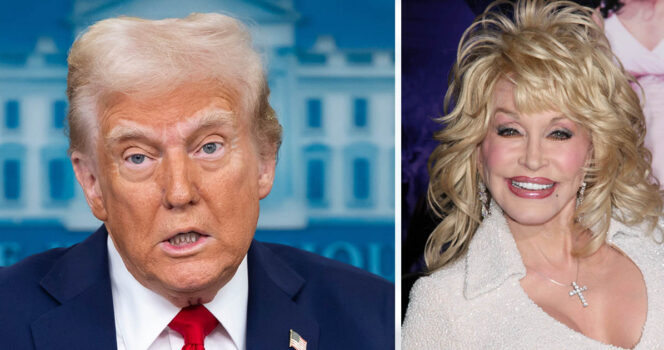
When given an opportunity to be publicly decorated by presidents from opposing parties, she preserved her distance from both.
PART NINE: THE DAY THE FLAGS CAME DOWN
The order to lower American flags transformed private grief into a national symbol.
Across federal buildings, military posts, naval stations, embassies, and other facilities, the flag moved downward.
The gesture was extraordinary for an entertainer.
It acknowledged that Dolly’s influence had traveled far beyond record sales.
Yet the flag itself carried a paradox.
It belonged to every American, including people who disagreed sharply about the president who ordered it lowered.
In that sense, the tribute became unexpectedly appropriate.
Dolly had spent her life belonging to people who disagreed with one another.
For several days, the lowered flag asked them to look in the same direction.
Some mourners thought of the young songwriter who arrived in Nashville with ambition larger than her suitcase.
Some remembered the movie “9 to 5” and its bright, defiant humor about women trapped beneath an arrogant boss.
Some remembered Whitney Houston’s voice rising through a song Dolly had written years earlier.
Some remembered a child opening a book at the mailbox.
Some remembered Dollywood, where entertainment and regional employment became parts of the same dream.
Some simply remembered laughing whenever Dolly laughed.
The symbol did not require agreement about Trump’s interpretation of her.
It required only recognition that something rare had been lost.
PART TEN: THE EMPTY CHAIR
At memorial gatherings, absence often becomes visible through ordinary objects.
An empty chair can speak more loudly than a stage.
A silent telephone can hold years of remembered conversations.
A guitar resting in its case can make a room feel unfinished.
For Dolly’s relatives, colleagues, and longtime team, the public icon was also a familiar human presence.
The world mourned a legend.
They mourned the person who had known family nicknames, remembered birthdays, worried over unfinished projects, laughed at private jokes, and carried the history of people she loved.
Public grief can be beautiful, but it can also be overwhelming for those closest to the person who died.
Millions of strangers begin telling stories at the very moment a family is trying to understand a new silence.
Dolly had prepared for parts of that moment.
Her team said she had planned projects and legacy celebrations that would continue after her passing.
That preparation did not make the loss painless.
It did, however, give grief somewhere to travel.
The work could continue.
The books could continue arriving.
The stage musical could continue moving toward audiences.
The businesses could continue employing people.
The songs could continue entering rooms she would never physically enter again.
PART ELEVEN: THE PROJECTS LEFT WITH A PULSE
Many artists leave behind archives.
Dolly left behind motion.
Her official team announced that projects already in development would keep moving forward.
That fact changed the emotional shape of the ending.
Her death was a conclusion to a life, but not to the work that life had set in motion.
The planned celebrations, museum experiences, hospitality projects, performances, and products were not merely commercial leftovers.
At their best, they became vessels carrying her creative voice into the future.
The danger, of course, would be turning memory into merchandise without preserving meaning.
Dolly had always understood the relationship between show business and business.
She did not apologize for spectacle.
She also anchored her spectacle in a recognizable story.
The rhinestones pointed back toward the mountains.
The theme park pointed back toward her community.
The books pointed back toward her father.
The songs pointed back toward emotional truths she had survived.
Anyone entrusted with her legacy would now face the same test.
Could the sparkle remain connected to the substance?
Could celebration avoid becoming exploitation?
Could the institutions bearing her name keep doing what Dolly had done so well—invite people in without asking them to surrender who they were?
PART TWELVE: THE CHILD AT THE MAILBOX
Far from Washington and Nashville, a child waited for the mail.
The child did not know about the radio interview.
The child did not understand why commentators were debating whether Dolly Parton had liked a president.
The child knew only that sometimes a package arrived bearing a book.
The package felt personal because the child’s own name appeared on it.
Inside was a new world that could be opened at the kitchen table.
That quiet scene had occurred in countless homes before Dolly’s death.
It would occur again afterward.
There was no television camera at the mailbox.
There was no applause when a parent began reading.
There was no campaign rally when a child asked for the same story again.
But this was where Dolly’s legacy became hardest to misuse.
A political argument could distort a quotation.
A headline could exaggerate a claim.
A social-media post could cut away context.
A book in a child’s hands remained a book in a child’s hands.
Its value did not depend on the voter registration of the family receiving it.
It did not care which cable-news channel played in the next room.
It offered language, imagination, closeness, and possibility.
This was an answer stronger than any posthumous endorsement.
PART THIRTEEN: WHAT “SHE LIKED ME” COULD NEVER CONTAIN
To say that Dolly liked someone was to say something believable but incomplete.
Dolly built much of her public life around the decision to search for something likable in people.
That generosity was one of her gifts.
It was also the reason no single person could claim exclusive meaning from it.
If she greeted a politician warmly, that warmth did not belong only to him.
If she comforted a struggling singer, her compassion did not become a contract.
If she welcomed fans who disagreed with one another, she did not become the property of either side.
Her affection was expansive rather than exclusive.
Trump’s comment may have reflected a sincere personal memory.
It may also have reflected the human desire to feel specially regarded by someone the whole world loved.
Both can be true without turning Dolly into a partisan figure.
The mistake would be treating kindness as evidence of submission.
Dolly’s life demonstrated the opposite.
She was kind because she was secure enough to remain herself.
PART FOURTEEN: THE WOMEN WHO HEARD THE MESSAGE
Behind Dolly’s glamorous public image were generations of women who recognized the harder story.
They knew what it meant to be underestimated because of an accent, clothing, poverty, age, or appearance.
They knew how often a woman’s friendliness could be mistaken for agreement.
They knew how easily politeness could be rewritten as permission.
Dolly offered another model.
She could smile while holding a boundary.
She could say no without pretending the decision did not hurt.
She could be grateful for an opportunity and still demand ownership of her work.
She could lean into femininity without allowing anyone to confuse femininity with weakness.
She could make people laugh and still control the negotiation.
For women watching her career, that combination mattered as much as any lyric.
Her example said that power did not have to wear a gray suit or speak in a joyless voice.
Power could arrive in high heels, tell a joke, remember everyone’s name, and still keep the publishing rights.
PART FIFTEEN: CARL, HOME, AND THE LIFE KEPT OFFSTAGE
Dolly’s long marriage to Carl Dean reminded the public that not every meaningful part of a famous life must become content.
Carl largely avoided the spotlight.
Their relationship survived inside a boundary the world was rarely permitted to cross.
That privacy became increasingly remarkable as celebrity culture demanded constant access.
Dolly told stories about him, teased about him, and made his absence from public events part of their shared mythology.
But she did not owe the audience their entire marriage.
When Carl died before her, the loss opened a deeply personal chapter of grief.
Her nephew’s announcement imagined Dolly reunited with Carl, her parents, and loved ones who had gone before her.
For fans who shared her faith, the image brought comfort.
For others, it carried a universal longing—that love might not be defeated by separation.
The woman who had written unforgettable farewells had now become the subject of one.
This time, the world had to sing the goodbye.
PART SIXTEEN: THE LAST GREAT REFUSAL
In death, famous people lose the ability to correct us.
They cannot object when strangers simplify them.
They cannot clarify a friendship.
They cannot reject an endorsement placed in their mouths.
They cannot explain that a complicated decision had more than one reason.
The ethical burden therefore falls upon the living.
We must resist making certainty out of speculation.
We must distinguish a documented quotation from someone else’s interpretation.
We must allow a person’s full life to outweigh a convenient headline.
Dolly’s last great refusal may now belong to those who remember her.
It is the refusal to let any party, politician, company, or commentator own her completely.
She belonged first to herself.
The songs, choices, businesses, jokes, boundaries, and acts of generosity all testified to that fact.
PART SEVENTEEN: A DIFFERENT KIND OF BOMBSHELL
The true bombshell was not that Dolly Parton may have liked Donald Trump.
The true bombshell was that she built a life in which liking another person did not require becoming identical to them.
She lived through decades of cultural conflict without turning cruelty into a personal brand.
She protected her beliefs without making humiliation her favorite weapon.
She understood that listening was not surrender and kindness was not endorsement.
That lesson feels almost startling now.
Modern public life encourages people to sort one another instantly.
A photograph becomes proof.
A handshake becomes allegiance.
A refusal becomes hostility.
A compliment becomes ownership.
Dolly’s life was too large for those small equations.
She could stand beside someone without standing for everything that person had ever done.
She could decline an honor without denying the humanity of the person offering it.
She could remain openhearted without leaving her judgment at the door.
PART EIGHTEEN: THE NIGHT THE MUSIC RETURNED
In the days after her death, performers stepped beneath familiar lights to honor her.
No tribute could reproduce Dolly’s presence.
Imitation would have felt too small.
The most meaningful performances did something else.
They allowed different voices to carry pieces of the work forward.
One singer found the ache inside a familiar melody.
Another found its humor.
A choir found faith.
A young performer who had never met Dolly found permission to dream more boldly.
The audience sang along, but the singing was uneven because grief interrupted breath.
For a moment, the words belonged simultaneously to the woman who had written them and to everyone who needed them.
That is the strange immortality of a song.
The writer leaves.
The song continues finding people.
PART NINETEEN: THE ROAD BACK TO THE MOUNTAINS
Every story about Dolly eventually returns to the mountains.
Not because she failed to escape them, but because she never treated escape as the goal.
She carried Tennessee into Hollywood, Broadway, theme parks, recording studios, boardrooms, and homes around the world.
Success did not require erasing the girl she had been.
It allowed that girl to speak more loudly.
Visitors to Sevier County will continue traveling roads tied to her story.
They will see the landscape that shaped her imagination.
They will encounter attractions bearing her name and businesses influenced by her vision.
Some will arrive because they love country music.
Some will arrive because their parents played Dolly’s records.
Some will arrive with children who know her first as the lady who sent them books.
And some will stand quietly, surprised by the intimacy of grieving someone they never met.
The mountains will not answer them in words.
They will offer the same ridgelines, changing light, and sense of endurance that had accompanied Dolly’s earliest songs.
PART TWENTY: THE ENDING SHE HAD ALREADY WRITTEN
The world looked for a final statement after Dolly Parton’s death.
Commentators searched interviews.
Fans replayed performances.
Politicians offered tributes.
Writers tried to compress eighty years into headlines.
But Dolly had already written her ending in thousands of choices.
It was there when she protected a song she believed in.
It was there when she turned childhood humiliation into art.
It was there when she created opportunities in the region that raised her.
It was there when she honored her father by helping children learn to read.
It was there when she declined to become a trophy for either side of a political divide.
It was there whenever she let people laugh at the surface while she quietly built the future beneath it.
Her ending was not a single quotation.
It was a pattern.
PART TWENTY-ONE: THE LETTER NO PRESIDENT COULD WRITE
Imagine a letter addressed not to a politician, but to the public that remained behind.
It would not need invented words from Dolly.
Her documented life had already supplied the message………

