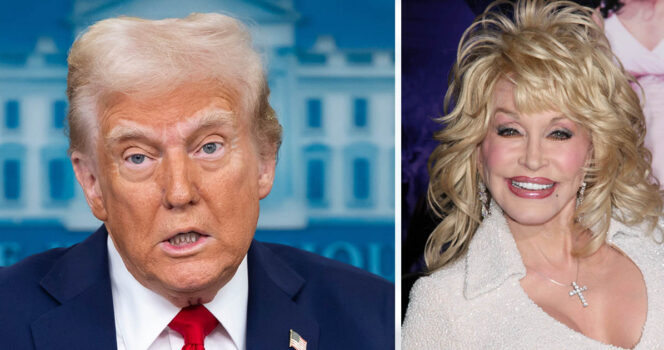
Dolly Parton’s death has shocked the entire world. Among those mourning the country legend is President Donald Trump. Just a day after her death, Trump made a bombshell claim about Dolly.
The legendary Dolly Parton has brought the entire world into mourning. Her nephew, Brian Seaver, shared the devastating news in an Instagram video on Tuesday, telling the world about Dolly’s death. She was 80 years old.
Her team later confirmed Dolly Parton had died after a brief battle with cancer.
“This video announcement is something Dolly asked of me years ago, before I fully absorbed it as a future reality. As her head of security for more than two decades, a role my father Larry held before me, I have imagined the heaviness of this moment but haven’t truly felt it until now,” Seavers said.
Dolly Parton dead at 80
“It is an honor, an honor that is mixed with absolute pride and great sadness. But sadness lies with us, not with Dolly. Dolly has lived in the light and is in the arms of Jesus, surely met by Carl, her parents, and countless others who have watched her and longed to meet her in the heavens.”
Trump also announced that “as a mark of respect” for Parton’s memory,” that “the flag of the United States shall be flown at half-staff at the White House and upon all public buildings and grounds, at all military posts and naval stations, and on all naval vessels of the Federal Government in the District of Columbia and throughout the United States and its Territories and possessions until sunset, September 1, 2026.”
“I also direct that the flag shall be flown at half‑staff for the same period at all United States embassies, legations, consular offices, and other facilities abroad, including all military facilities and naval vessels and stations,” Trump added.
Dolly Parton declined Presidential Medal of Freedom twice
Dolly Parton has never been much of a politician. She didn’t speak out on political issues, but instead took the initiative on her own to try to create a better world.
She even declined the Presidential Medal of Freedom from both Donald Trump and former President Joe Biden.
In 2021, she turned down the honor during Trump’s first term, citing her husband’s health and concerns about traveling during the COVID-19 pandemic. Later, she decided she could not accept the honor from Biden either.
Speaking on NBC’s Today show, Parton said, “I feel like if I take it, it’ll be doing politics, so I’m not so sure.”
Donald Trump was a big fan of Donald Parton. He used her song “Jolene” on his campaign playlist, but whether they had a personal friendship is unknown. However, on Wednesday, during an interview on Glenn Beck’s radio show, the president made a bombshell claim about Dolly Parton.
Donald Trump makes claim about Dolly Parton after her death
Donald Trump said Dolly Parton “really liked” him, according to the New York Post. He also claimed the country music legend stayed out of politics because she didn’t want to risk losing fans.
“She was unique. I mean, she was amazing,” Trump said. “And to lose her, it’s like you lose a member of the family, you know, we all knew her so well.”
The president added that he knew Dolly Parton “a little bit,” adding, “She really liked me, I will tell you.”
“She was of the opinion, you know, the 50% — who needs to lose, I don’t think it’s 50. I think it’s probably 20% of the fans, okay?” he continued. “But she was a great person, and she was just a nice person. You know, I liked her a lot, and I thought it was a natural thing to lower the flags.”
THE WOMAN BEHIND THE CLAIM — DOLLY PARTON’S FINAL LESSON TO A DIVIDED WORLD
But that final sentence did not settle the question.
It made the question larger.
Trump’s claim that Dolly Parton “really liked” him traveled quickly across television screens, radio programs, social media pages, and kitchen-table conversations.
Some people accepted it as a warm memory offered during a time of grief.
Others heard something more political in it.
They wondered whether Dolly, even in death, was being pulled toward the very kind of public division she had spent a lifetime carefully avoiding.
And somewhere between those two reactions rested the deeper truth of her extraordinary life.
Dolly Parton had never needed to tell America which side she was on.
She had spent decades showing America what she stood for.
PART ONE: THE SILENCE BEHIND THE HEADLINES
In the first hours after news of Dolly’s death spread, the internet filled with familiar images.
There was Dolly beneath a tower of blond hair, smiling beneath stage lights.
There was Dolly holding a guitar covered in rhinestones.
There was Dolly laughing beside younger artists who looked at her with the wonder of children meeting a favorite storybook character.
There were clips from old interviews in which she turned difficult questions into graceful answers without sounding rehearsed or afraid.
There were videos of her singing “Jolene,” “Coat of Many Colors,” and “I Will Always Love You.”
But there were quieter images too.
Parents photographed the books their children had received through Dolly Parton’s Imagination Library.
Adults held up worn copies of childhood books that had once arrived in the mail with their names printed on the package.
Teachers remembered students who had entered school already knowing the wonder of turning a page.
Families in East Tennessee remembered the jobs created by Dollywood.
Musicians remembered a handwritten note, an unexpected telephone call, or a moment when Dolly had made them feel less alone.
Those memories did not argue about politics.
They did not require a campaign sign.
They revealed the method Dolly had chosen long before presidents began praising her.
When the world demanded a declaration, she often answered with an act of kindness.
When people asked her to choose a team, she chose a person who needed help.
That choice was not weakness.
It was discipline.
PART TWO: A CLAIM THAT REVEALED MORE THAN IT PROVED
Donald Trump’s statement was presented as a bombshell, but the public evidence could only take it so far.
He said he knew Dolly “a little bit.”
He said she “really liked” him.
He suggested she avoided politics because she did not want to lose part of her audience.
The first two statements described his personal impression.
The third was an interpretation of her motives.
Dolly was no longer there to explain what she had felt in private, and no responsible storyteller could speak for her heart.
Yet her public words offered important context.
She had repeatedly resisted attempts to turn her into a political symbol.
When asked about receiving the Presidential Medal of Freedom, she explained that accepting it might appear political.
That answer was carefully balanced.
It was not an attack on Trump.
It was not an endorsement of Biden.
It was Dolly protecting the independence she had built across more than half a century.
She understood something that many public figures learn only after it is too late.
A person can spend a lifetime creating a legacy and lose control of its meaning in a single news cycle.
Dolly guarded that meaning without becoming cold.
She could be polite without surrendering her identity.
She could appreciate people without lending them every part of her reputation.
She could refuse an honor without humiliating the person offering it.
That rare ability was one reason people from sharply different backgrounds believed she understood them.
The essential question was therefore not whether Dolly had once been friendly to Donald Trump.
She was famously friendly to countless people.
The essential question was whether friendliness should be rewritten as political allegiance.
Her life suggested that it should not.
PART THREE: THE GIRL WHO LEARNED THE PRICE OF BEING HEARD
Long before presidents spoke about Dolly Parton, she was a girl growing up in the Great Smoky Mountains of Tennessee.
Her family had little money, but poverty did not mean the absence of imagination.
The mountains gave her stories.
The church gave her harmony.
Her relatives gave her characters whose strengths, wounds, humor, pride, and contradictions would later live inside her songs.
She learned early that a human being could be poor without being empty.
She also learned that dignity was not something wealth could grant.
It was something people carried, protected, and sometimes sang into existence.
Her father, Robert Lee Parton, worked hard and possessed practical intelligence, but he had not received the education that might have allowed others to recognize his abilities.
Dolly never forgot the pain hidden inside that injustice.
Years later, when she created the Imagination Library, she did not describe literacy as an abstract policy issue.
She made it personal.
She gave children books because she knew what opportunity could mean inside a family.
She called her father one of the smartest people she had known.
The program became a tribute written not in stone, but in millions of pages placed into millions of small hands.
That was Dolly’s politics in the broadest and most meaningful sense.
It was the politics of possibility.
It did not ask parents how they voted before sending a book to their child.
It did not divide a classroom into red seats and blue seats.
It simply opened a door.
PART FOUR: THE COAT THAT NEVER STOPPED GROWING
One of Dolly’s most enduring songs began with scraps of fabric.
Her mother stitched those scraps into a coat while telling her daughter the biblical story of Joseph and his coat of many colors.
Young Dolly wore the coat proudly.
At school, other children laughed at her.
The pain of that moment could have hardened into bitterness.
Instead, Dolly carried it into adulthood and transformed it into a song about love, shame, memory, and value.
The coat became more than clothing.
It became a way of seeing.
What looked worthless to one person could be priceless to another because of the love sewn into it.
Dolly would spend the rest of her career practicing that transformation.
She took mountain poverty, an experience outsiders might reduce to a stereotype, and revealed the richness within it.
She took the image of the “dumb blonde,” sharpened it, exaggerated it, and controlled it until the joke belonged to her.
She took heartbreak and made it singable.
She took rejection and turned it into independence.
She took the private details of a difficult life and made strangers recognize themselves.
The coat never stopped growing.
Every listener added another patch.
Every child who received a book added another color.
Every performer who found courage in Dolly’s example added another thread.
By the time the flags were lowered, the garment belonged partly to the nation.
PART FIVE: THE GOODBYE THAT BECAME TWO GREAT SONGS
Dolly’s departure from Porter Wagoner’s television program became one of the defining turning points of her career.
Porter had helped introduce her to a national audience.
Their partnership produced memorable music.
It also became complicated as Dolly’s ambitions expanded.
She wanted an independent career.
Leaving was emotionally difficult, and ordinary explanation had failed to express everything she needed to say.
So she did what she had always done.
She wrote.
“I Will Always Love You” was not written as a romantic farewell.
It was a compassionate goodbye to a professional partner and mentor.
The song carried gratitude and separation in the same melody.
It said that love does not always require staying.
Sometimes respect means walking away before affection turns into resentment.
Years later, Whitney Houston’s recording carried the song to another generation and turned it into a worldwide anthem.
Dolly could have treated that success as a threat to her ownership of the moment.
Instead, she celebrated Whitney’s magnificent interpretation.
There was room, in Dolly’s understanding of art, for another woman’s voice to make the song soar differently.
That generosity mattered.
It showed that Dolly’s strength did not depend on being the only woman in the room.
She wanted control of her work, but she did not need to control everyone who loved it.
PART SIX: THE WORD SHE WOULD NOT SURRENDER
For decades, Dolly’s appearance invited shallow judgment.
People saw the wigs, the makeup, the sparkling clothes, and the carefully exaggerated curves.
Some assumed the person beneath them could not also be a serious writer and formidable businesswoman.
Dolly understood the prejudice and used it.
She allowed people to underestimate her until the moment their underestimation became an advantage.
Her humor softened the confrontation, but it never erased the intelligence behind it.
She knew the value of publishing rights.
She knew the value of a recognizable image.
She knew how to negotiate without becoming someone else’s imitation of power.
One of the most famous examples came when Elvis Presley wanted to record “I Will Always Love You.”
Dolly was thrilled by the possibility until she learned that giving up a substantial share of the publishing would be part of the arrangement.
She refused.
The decision hurt because Elvis was one of her heroes.
It also protected the song that would later become one of the most valuable works in her catalog.
That refusal helps explain why neither affection nor prestige automatically purchased Dolly’s consent.
She could admire a powerful person and still say no.
She could feel honored and still protect what belonged to her.
This was the missing context whenever anyone attempted to convert her warmth into allegiance.
Dolly’s kindness was freely given.
Her independence was not.
PART SEVEN: WHY SHE STAYED OUT OF THE FIGHT
America often treats neutrality as an empty space.
If a celebrity does not endorse one side, both sides may try to claim the silence.
But Dolly’s public restraint was not empty.
It was filled with intention.
Her audience included rural families, city workers, churchgoers, drag performers, conservatives, liberals, immigrants, lifelong Tennesseans, and listeners who had never set foot in the United States.
They did not all hear her songs in the same way.
She did not demand that they do so.
Her work created a room large enough for contradictions.
That room could feel almost radical during years when outrage became a business model.
Yet avoiding partisan endorsement did not mean Dolly lacked principles.
Her songs spoke about working women, economic pressure, judgment, unequal power, forgiveness, faith, ambition, and survival.
Her philanthropy promoted literacy and supported communities after disasters.
Her public conduct repeatedly emphasized respect for people whose lives differed from her own.
She simply resisted reducing those beliefs to a campaign slogan.
That distinction is easy to miss in a culture that measures conviction by volume.
Dolly measured it through consistency.
PART EIGHT: THE MEDAL SHE COULD NOT ACCEPT
The Presidential Medal of Freedom is one of the highest civilian honors in the United States.
For many recipients, accepting it is an uncomplicated celebration of achievement.
For Dolly, the timing made the choice more delicate.
She explained that she had been offered the medal during Trump’s first administration but could not accept on the occasions it was proposed, citing family health concerns and pandemic circumstances.
She later said that the Biden administration had approached her as well.
By then, acceptance risked becoming a statement she did not intend to make.
Her response carried the familiar Dolly balance of gratitude and caution.
She did not insult the honor.
She did not attack either president.
She recognized that a medal could become a political costume placed over her life.
She declined to wear it.
That decision now stands beside Trump’s later claim in a revealing way.
Perhaps Dolly liked him personally, as he believed.
Perhaps she treated him with the warmth she offered so many others.
Perhaps their limited encounters left different impressions on each of them.
None of those possibilities proves a political endorsement.
The clearest evidence remains Dolly’s own choice…………

