My name is Irene Ulette, and for five years, I didn’t exist to my own family. Five years ago, my sister told my parents I had dropped out of medical school, and with one lie, she erased me. They blocked my number, returned my letters unopened, missed my residency graduation, and didn’t come to my wedding. For five years, I lived like someone who had died without a funeral, still breathing but no longer claimed. I told myself it didn’t hurt, that I was stronger than that kind of rejection, but the truth was quieter and heavier. It sat in my chest every night I came home to an empty apartment after a sixteen-hour shift, every holiday I spent alone, every time I reached for my phone and remembered there was no one left to call.
Growing up in Hartford, there had always been two daughters in our house, but only one who mattered. My sister Monica was three years older, brilliant in a way that had nothing to do with books. She knew how to read people, how to say exactly what they wanted to hear, how to turn any room into an audience. My parents adored her for it. She was easy to love because she reflected them back to themselves in a way that made them feel important. I was the opposite. Quiet. Observant. The kind of child who preferred a microscope to a conversation. I learned early that attention was not something I would receive, so I stopped asking for it.
I poured everything into school instead. If I couldn’t be the daughter they loved, I would be the daughter they couldn’t ignore. For a brief moment, it worked. The day I was accepted into medical school, my father looked at me differently. Not warmly, not proudly, but with something close to recognition. It felt like oxygen after years of holding my breath. My mother called relatives, her voice bright in a way I had never heard directed at me before. That night, at the dinner table, I glanced at Monica and saw something I didn’t understand at the time. A smile that didn’t reach her eyes. Calculation behind it. I thought she was tired. I didn’t realize she was already rewriting my life.
Medical school was brutal, but it was honest. You either showed up or you didn’t. You either knew what you were doing or you learned quickly. For the first time in my life, I couldn’t disappear, and I loved that. I worked harder than I ever had, survived on caffeine and stubbornness, and built something real out of sheer persistence. Residency was worse, but by then I had learned how to endure. Pain passes. Skill stays. By the time I finished my trauma fellowship, I wasn’t the invisible girl from Hartford anymore. I was Dr. Irene Ulette, Chief of Trauma Surgery.
And still, my family believed I had failed.
For five years, they never questioned it. Never asked for proof. Never reached out. That was the part that stayed with me the longest. Not the lie itself, but how easily they accepted it. How ready they were to believe I had become nothing.
Then one night, at 3:07 a.m., my pager went off. Level-one trauma. Motor vehicle collision. Female, thirty-five, unstable. Eight minutes out. I walked into the trauma bay the way I had a hundred times before, focused, detached, ready to do the work. The room exploded into motion around me—voices calling out vitals, machines beeping, blood everywhere. I reached for the intake chart, glanced at the name, and the world shifted.
Monica Ulette.
For a second, everything inside me went silent. Not outside. The team was still moving, still shouting, still saving a life. But inside me, something stopped. Because the person bleeding out on that table was the same woman who had erased me. The same woman my parents had chosen over me without question.
Someone called my name. I blinked, stepped forward, and did what I had trained my entire life to do. I operated. I didn’t hesitate. I didn’t allow myself to think about what she had done or what she had taken from me. She was a patient, and I was her surgeon. That was the only truth that mattered in that room.
The surgery lasted three hours and forty minutes. Her injuries were severe—ruptured spleen, torn liver, internal bleeding that threatened to overwhelm everything. It was controlled chaos, the kind that demands everything you have and leaves no room for anything else. My hands never shook. My voice never wavered. When it was over, I closed the final stitch, stabilized her vitals, and stepped back.
Only then did it hit me.
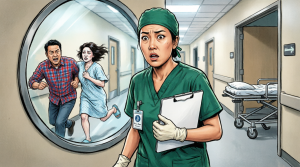
Everything I had buried for five years came rushing back all at once, not as anger, not even as grief, but as something heavier. Something final.
I walked into the waiting room still wearing my scrubs, my mask lowered, my name visible. My father stood up immediately, desperation written across his face.
“Doctor… how is my daughter?” he asked.
For a moment, I could have stayed invisible. I could have answered him like any other surgeon, given him the information he needed, and walked away. Stayed the ghost they had chosen to believe in.
But I didn’t.
I held his gaze, just for a second, then let his eyes drop to my badge.
DR. IRENE ULETTE, MD, FACS.
I watched the moment it registered. Watched the exact second his expression changed, the confusion giving way to recognition, then to something else entirely. Shock. My mother grabbed his arm so hard her fingers left marks.
“Irene…?” she whispered.
The room went still. Not completely, but enough that the moment held. For five years, they had lived in a version of the world where I didn’t exist. And now I was standing in front of them, alive, successful, holding their daughter’s life in my hands.
“She’s alive,” I said calmly. “We were able to stabilize her. The next twenty-four hours are critical, but she’s out of immediate danger.”
My father opened his mouth, but no words came out. My mother’s eyes filled with tears, her hand still gripping his arm like she needed something solid to hold onto.
“You’re… you’re a doctor?” he said finally, his voice unsteady.
I didn’t answer that question.
Instead, I met his eyes and said quietly, “I always was.”
Silence settled between us, thick and unavoidable. Five years of absence, of assumptions, of choices made without me, all collapsing into that one moment.
My mother stepped forward slightly, like she wanted to reach for me but didn’t know if she had the right.
“Why didn’t you tell us?” she asked, her voice breaking.
The question landed harder than anything else.
Because the answer was simple.
“I did,” I said.
She flinched like I had struck her.
“I wrote. I called. I tried to come home.” I paused, letting the words sit between us. “You didn’t answer.”
No one spoke.
Because there was nothing left to misunderstand.
In that moment, everything became clear—not just what Monica had done, but what my parents had chosen to believe. Not because it was true, but because it was easier than questioning her.
My father looked at the floor, then back at me, his face pale.
“We… we thought…” he started, then stopped.
I nodded slightly.
“I know what you thought.”
And for the first time in my life, I didn’t feel the need to explain myself further.
Because I didn’t need their understanding anymore.
I had built a life without it.
Behind me, the hospital continued its quiet, relentless rhythm. Nurses moved through the corridors, monitors beeped steadily, another case was already being prepped. Life didn’t pause for moments like this.
Neither did I.
“I have to go back,” I said.
My mother’s voice stopped me.
“Irene… can we—can we talk?”
I looked at her for a long moment.
Then I shook my head gently.
“Not tonight.”
Not like this.
Not because they suddenly needed me.
I turned and walked away, back through the doors, back into the place where I was known, where I was seen, where I had built something that couldn’t be erased by a lie.
And as the doors swung shut behind me, I realized something I hadn’t fully understood until that moment.
They hadn’t taken my life from me.
They had simply stepped out of it.
And now—
I was the one deciding whether they would ever step back in.

