THE NIGHT MY FATHER THREW ME INTO A DENVER BLIZZARD, HE SAID I’D NEVER CARRY THE HARPER NAME AGAIN—TWELVE YEARS LATER, I WALKED INTO MY BROTHER’S WEDDING OWNING THE ONE THING THAT COULD DESTROY THEM
The first thing my brother did when he saw me at his wedding was forget how to breathe.
I watched it happen from two feet away.
One second Mason Harper was standing in the center of the Crawford Hotel ballroom foyer with his arm looped possessively around Avery Langford’s waist, laughing for the photographer, looking rich and polished and invincible in midnight-blue velvet. The next, his face went blank so completely it was like someone had pulled a plug behind his eyes.
The laugh died in his throat.
His hand fell from Avery’s waist.
His mouth opened.
No sound came out.
I stopped in front of him and let the silence stretch long enough for him to understand that no, he wasn’t imagining me, and no, I had not come back weak.
I had come back finished.
“Congratulations, Mason,” I said softly.
My voice didn’t tremble. That alone would have shocked him once.
His stare flicked over me in pieces, like he couldn’t take in the whole picture at once. The dress first. Then my face. Then the logo embroidered in white silk thread over my heart—so subtle it was almost invisible unless the light hit it exactly right.
It hit it exactly right.
I saw the instant he recognized it.
Not just me.
What I had become.
Avery turned to him, smiling in that practiced bridal way people do when they think a moment is still under control. “Mason? Do you know her?”
He still couldn’t speak.
Then my mother saw me.
Laura Harper had been gliding across the marble floor holding two champagne flutes, diamonds flashing at her wrists and fingers, silver heels clicking like the woman she’d spent thirty years teaching herself to become. For a second she looked almost beautiful in that brittle, lacquered old-money way.
Then the glasses slipped out of her hands.
They hit the floor hard.
Crystal exploded across the marble.
Champagne splashed over her shoes.
The sharp crash cut through the string quartet and every conversation in the room like a gunshot.
That was how I announced my return to Denver.
Not with a speech.
Not with anger.
With my mother dropping both hands full of celebration because she’d just seen the daughter she helped erase walk back into the room wearing a dress worth more than her conscience.
Every head turned.
My father stepped out from behind her and froze so completely he looked carved there. Richard Harper had aged in the way powerful men always think they won’t—expensively, carefully, but unmistakably. His hair was thinner and silvered now. The jaw that used to tighten like a locked gate had softened into the loose heaviness of too much scotch and too little sleep. But the eyes were the same.
Cold. Assessing. Proud enough to confuse cruelty with discipline.
Only right then they weren’t cold.
They were terrified.
He looked at me the way men look at a fire they thought they had stamped out years ago, only to discover it had gone underground and spent all that time learning where the foundations were weakest.
I did not move.
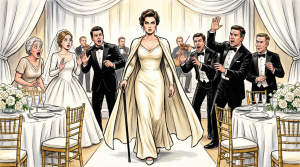
I stood in the middle of that silence with my shoulders back, my chin level, my white silk dress falling in one clean line to my ankles, and I let them look.
Because twelve years earlier, my father had pushed me out into a Denver blizzard with one suitcase, eight hundred dollars, and a sentence meant to follow me forever.
I don’t want you carrying my name anymore.
That night, as I stood in my brother’s wedding reception and watched his future collapse behind his eyes, I almost smiled.
Not because I am cruel.
Because some debts take twelve years to mature.
Three nights before my high school graduation, I was on my knees in the upstairs hallway yanking open the cabinet where my mother kept every document no one was allowed to lose. Insurance forms. Tax folders. Christmas card lists. Return labels. Half the family’s life compressed into accordion files and plastic bins.
I was looking for the stupid packet with my cap-and-gown order forms because the school office had called that morning and said if I didn’t bring them in by Friday, I’d be walking at graduation in borrowed robes like a last-minute transfer student.
I had one arm inside the cabinet and my shoulder pressed against the door when I heard my father’s voice drift out of his office.
The door was cracked open.
Not wide enough to invite interruption. Just open enough that it always meant he felt safe.
He was on speakerphone. I knew that because I could hear the faint echo underneath his words. I recognized the voice on the other end instantly too.
Mr. Caldwell.
The old-money investor who still held twenty-two percent of Harper Fashions and treated my father like a temporary steward of something that would always really belong to richer men.
Dad had a special tone for people like Caldwell. A smooth, quiet, almost intimate voice he never used on family because he didn’t believe anyone under his roof was worth persuasion. We got instructions. Men like Caldwell got charm.
“This is Richard Harper,” he said. “Look, Caldwell, Trinity’s dyslexia is worse than we thought. Severe. She still stutters under pressure. And next to Mason…” He paused, and I can still hear the little sigh he gave there, the one meant to sound regretful. “She just doesn’t photograph well. We can’t have the public face of the brand tied to that. We’ll handle it quietly after graduation. Clean break.”
For a second I didn’t understand what I was hearing.
Not because the words were unclear.
Because some part of me still believed there had to be a boundary even my father wouldn’t cross in front of strangers.
I was wrong.
I stood up too fast and hit my elbow on the cabinet frame. The pain barely registered. My hand was wrapped so tightly around the folder I’d finally found that the cardboard bent.
That was when I noticed Mason.
He was leaning against the wall just outside Dad’s office, half in shadow, arms folded like he’d been there long enough to get comfortable.
He was thirteen then. Already taller than me. Already carrying himself with that loose, lazy confidence boys wear when they know the entire house bends toward them. He’d heard everything. Every word. And he was enjoying it.
He looked straight at me and mouthed slowly, clearly, so there would be no possibility I could misread his lips.
Ugly disabled idiot.
Then he laughed.
Not loudly. He didn’t need to. Just one quiet, cutting little laugh like we were sharing the funniest joke in the world.
To this day, that laugh is worse in my memory than the insult.
The office door opened.
Dad stepped out, closed it behind him, and finally noticed me standing there with the bent folder in my hand and my brother’s laughter still hanging in the air between us.
His face didn’t change.
That was the part that damaged something in me I never got back. He didn’t flinch, didn’t try to explain, didn’t even look embarrassed that I had heard him discussing my speech and dyslexia like a defective product line that had to be withdrawn before launch.
“You heard enough,” he said.
I stared at him.
He looked at the folder in my hand, then back at my face, and said, as evenly as if he were announcing a meeting time, “I’m not saying it twice. I don’t want you carrying the Harper name anymore. One hour. Pack and leave.”
I remember everything after that with obscene clarity.
The banister under my mother’s hand when she appeared at the top of the stairs in her silk robe. Her eyes already swollen, as if she had been crying before I even got there. Or maybe that was just the lighting. With my mother, grief and performance often wore the same face.
She opened her mouth.
Closed it.
Opened it again.
Nothing came out.
It never did when money was on the table.
When it came to my father, silence was the shape of her loyalty.
Mason stayed where he was, arms still crossed, watching the scene like he had front-row seats to a show he’d been waiting all season to see. I walked past him and had to turn sideways so my shoulder wouldn’t touch his.
Upstairs, my room looked exactly the way it had looked that morning and exactly the way it would never look again. The pale blue walls my mother had insisted were more flattering than the green I wanted. My desk covered in sketchbooks and school papers. The mirror over the dresser with a crack in the corner where Mason had once thrown a baseball indoors and blamed me for not moving. My black suitcase in the closet, the same one I’d had since middle school.
I packed with the mechanical focus people mistake for calm.
Jeans. Hoodies. Underwear. Socks. My two decent dresses. My laptop, already old and half unreliable. My sketchbooks. Every dollar I had saved from babysitting and hemming neighbors’ pants and selling little designs online to girls at school who wanted custom dance-team warm-up jackets.
I couldn’t find my boots.
That detail matters because it’s the kind of ridiculous, stupid thing your brain grabs when the real thing is too large to hold. My father is throwing me out. My mother is doing nothing. My brother is enjoying it. But all I could think while I yanked clothes into the suitcase was Where are my boots?
I never found them.
I dragged the suitcase down the stairs in sneakers. The wheels rattled against every step loud enough for the whole house to hear.
Dad was waiting by the front door.
He had already taken my house key off the ring and placed it on the entry table like a dead insect.
Mom was standing ten feet away, arms wrapped around herself, eyes shining and useless.
Mason had moved to the living room archway for a better view.
I stopped in front of Dad.
“What do I tell people?” I asked.
Even now, I hate that those were the words that came out. Not Why are you doing this? Not How could you? Not Don’t. Something smaller. Practical. Embarrassingly hopeful in its own way.
What do I tell people?
Dad opened the door.
“Tell them whatever you want.”
Snow blew sideways into the entryway. The cold hit my face before I crossed the threshold.
Then he added, “Just don’t tell them you’re a Harper.”
I stepped outside.
It was twenty-two below with windchill. Snow hit my cheeks like thrown gravel. I had one glove in my pocket and no boots and a suitcase my fingers could barely feel the handle of before I was halfway down the front walk.
The door closed behind me with a soft click.
Not even a slam.
That somehow made it worse.
A slam would have admitted feeling.
The click said the decision had been settled long before I heard it.
I made it halfway down the driveway before my phone buzzed in my coat pocket.
Unknown Boulder number.
I answered with my teeth already chattering. “Hello?”
“Trinity, it’s Grandma Eleanor.”
I stopped breathing for a second.
She didn’t ask if it was true. Didn’t ask where I was. Didn’t even say hello properly.
“Don’t you dare get on a bus tonight,” she said. “Drive to Boulder. I’m leaving the porch light on and the garage open. You come straight here.”
That was the moment I broke.
Not when Dad threw me out. Not when Mason laughed. Not when Mom stood there and let it happen.
When I heard my grandmother’s voice telling me where the light would be.
I somehow got into the old Subaru Dad had bought me two years earlier because he couldn’t be bothered to drive me to school anymore. It was ten years old even then, dull blue, always smelling faintly of gas in winter, but it was registered in my name because he didn’t think I would ever need leverage against him and never imagined I might someday know how to use paperwork better than he did.
I drove to Boulder through a blizzard that should have had me in a ditch.
The wipers could barely keep up. The roads were slick and half vanished under the snow. More than once the tires lost traction and the whole car slid just enough to let fear sink its teeth in properly. I kept both hands locked on the wheel and stared at the red blur of taillights ahead like they were instructions from God.
I remember thinking, over and over, This would actually be easier if I died.
Not because I wanted to.
Because then at least there would be a shape to the ending.
When I pulled into Grandma Eleanor’s driveway forty minutes later, she was already standing in the doorway.
She was eighty-one. Tiny. Wrapped in a robe over one of her old quilted nightgowns. Her hair was pinned badly because she had clearly done it in a hurry. The porch light behind her turned the falling snow gold.
She opened both arms before I even shut the car door.
I walked into them still half frozen.
She did not ask a single question that night.
She pulled me inside, sat me on the couch, wrapped me in the same faded afghan she had covered me with when I was five and sick with the flu, and put a mug of cocoa in my hands as if the world had not just split in half.
Only when I could feel my fingers again did she touch my cheek and say, “You’re safe tonight.”
I stayed three days.
On the fourth morning, she made coffee, waited until I had taken the first sip, and slid a thick roll of bills across the kitchen table.
Eight hundred dollars. Rubber-banded. Mixed twenties and fifties.
“Everything I can spare without Richard noticing,” she said. “And before you open your mouth, we are not arguing about you staying.”
I tried anyway.
“Grandma—”
She lifted one hand and stopped me cold.
“You listen to me. The night he threw you out, Richard called me himself. He made it crystal clear that if I took you in permanently or spoke up publicly, he’d have me in assisted living by the next morning. Doctors. Lawyers. The whole show.”
I stared at her.
She held my gaze without blinking.
“He still controls the trust I live on,” she said. “One phone call and this house is gone. My accounts are frozen, and I’m drugged up in some facility where they won’t even let me have real coffee. I am not giving that bastard the excuse he wants.”
Her voice did not shake.
That was what made it sink in properly.
At eighteen, you still think injustice will look dramatic when it arrives. You expect screaming, maybe slaps, maybe obvious villainy. Not paperwork. Not legal leverage. Not a son threatening to institutionalize his elderly mother because she chose compassion over brand image.
“Then what do I do?” I whispered.
She pushed the money closer……………………….

