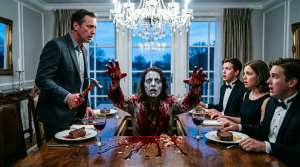
Blood dripped from my shattered fingers as my father casually returned the hammer to the drawer. My family kept eating steak while I collapsed to the floor in agony. They locked me in the dark basement that night, believing they’d finally crushed my spirit. But behind my tears, a dangerous fire ignited. For seven years I silently recorded every lie, every secret, every confession. Broken bones built an empire
Part 1
My father didn’t look angry when he swung the hammer.
That was the part that took me the longest to understand. Rage would have at least made sense. Rage would have made it feel like an accident of emotion, a lapse, a moment that could be regretted later.
But my father lifted the hammer the way he lifted a spatula. The way he reached for the salt. Casual. Certain. Like the decision had already been made and his body was just finishing the sentence.
The metal head came down on my left hand—two fingers caught against the edge of the workbench—hard enough that sound became a bright white flash inside my skull. Pain arrived a half second later, blooming outward with heat and nausea. I didn’t even register my own scream until it echoed off the concrete walls of the garage.
Blood pooled instantly, dark and thick. My fingers twisted wrong, not bent, broken. Shattered.
My father stared at my hand for a moment, then returned the hammer to the drawer. He slid the drawer shut with his foot.
“And that’s the last one,” he said, not to me exactly, more like to the air.
Behind him, through the open garage door, I could see the dining room window. The warm glow of the chandelier. My family’s silhouettes moving around the table like nothing had happened.
Steak night.
My mother’s favorite.
My little brother, Aaron, laughing at something on his phone. My aunt pouring red wine. Someone clinking glasses. The smell of meat and garlic floating out into the cold air as if the house itself didn’t know it was complicit.
I collapsed to my knees. The concrete bit through my jeans. My left hand throbbed in waves so intense my vision darkened at the edges. I tried to cradle it against my chest, but any movement made the broken bones grind, and I retched onto the floor.
My father stepped past me without looking down.
“Clean it up,” he said. “You’re bleeding on the concrete.”
Then he walked inside.
The door shut. The laughter continued.
I lay there on the garage floor, cheek pressed to cold concrete, listening to my family eat.
Not one person came out.
Not my mother. Not my aunt. Not my brother. Not even my cousin who always acted like he “hated conflict.” I heard forks scrape plates. I heard chairs shift. I heard someone say, “This steak is perfect,” and my stomach turned again.
I was seventeen. That was the age my father decided my spirit needed to be crushed the way my fingers had been crushed.
He didn’t say it out loud like that. He never did. He talked about discipline. Respect. The family name.
But I had started to see the pattern by then. Not clearly enough to escape, but clearly enough to understand that the violence wasn’t random. It was organized. It was a system. And systems don’t run on anger.
They run on permission.
When I finally managed to stand, my broken hand hanging uselessly, I stumbled into the kitchen. My mother glanced at me once—quick, annoyed, like a server noticing a spill in the corner.
“What did you do this time?” she asked.
I stared at her, waiting for shock, for concern, for the reflex of motherhood.
None came.
My father sat at the head of the table cutting his steak with slow precision. “He didn’t do anything,” he said calmly. “He got careless.”
Aaron smirked without looking up from his phone. “Classic.”
My aunt took a sip of wine. “You boys,” she said, as if my shattered hand was a teenage prank.
My mother gestured vaguely toward the hallway. “Bathroom’s that way. Don’t drip everywhere.”
I walked down the hall in a haze, each heartbeat sending a new surge of agony through my arm. In the bathroom mirror my face looked gray. Sweat plastered my hair to my forehead. Blood ran down my wrist in thick lines.
I ran cold water over the wounds because I didn’t know what else to do. The water turned pink, then red, swirling down the drain like something being erased.
I wrapped my hand in a towel and stared at my own reflection.
I didn’t cry.
Not because I was strong.
Because crying had never helped.
In our house, tears were currency. And my father was the kind of man who collected them like trophies.
That night, after dinner, after the dishes were done, after the TV turned on and the house settled into its usual rhythm of pretending, my father called me into the basement.
The basement door was at the end of the hallway, painted the same color as the walls so it blended in. It always smelled damp down there, like concrete and mold and old boxes.
My father opened the door and pointed. “Down.”
I stepped onto the stairs, my broken hand throbbing under its towel wrap.
“Tonight you’re thinking,” he said. “You’ve been getting too comfortable.”
“I didn’t—” I started.
He cut me off with a look. “You don’t speak unless asked.”
I went down.
The basement light flicked on, revealing the unfinished room: exposed beams, boxes of holiday decorations, an old couch with springs sticking out. A padlock hung on a hasp near the doorframe like it belonged there.
My father stepped back up the stairs.
“Dad,” I said, voice shaking now, “my hand—”
He looked down at me, expression blank. “You’ll live,” he said.
Then he shut the door.
I heard the lock click.
The light went off.
Darkness swallowed everything.
At first I panicked. That’s what the body does when it realizes you’re trapped. I pounded on the door with my good hand until my knuckles burned. I shouted until my throat hurt. I begged until the begging turned into nothing but ragged breathing.
Above me, I heard the muffled sound of the TV. Laughter from a sitcom. My family moving around upstairs as if locking a bleeding teenager in the basement was normal.
I slid down the door and hugged my injured hand to my chest, rocking slightly.
Tears finally came then. Silent, hot, useless.
And behind those tears, something else ignited.
Not rage. Not revenge.
A dangerous, cold fire.
Because in the darkness, I understood a truth I’d been avoiding.
No one was coming.
If I wanted out, I would have to build it myself.
Part 2
Morning came without sunlight in the basement.
I knew it was morning because the house shifted. Pipes clanked. Footsteps moved overhead. The smell of coffee drifted down through the vents. Somewhere upstairs, my mother laughed at something on the radio, a soft laugh like she had no idea she was the mother of a boy locked in a cellar.
When the door finally opened, my father didn’t apologize.
He stood at the top of the stairs with a mug in his hand. “You done?” he asked.
My throat was raw. My hand was swollen and purple beneath the towel, the fingers stiffening into shapes they weren’t meant to hold. I hadn’t slept. I’d sat in the dark listening to my own breathing and making plans without words.
“Yes,” I said, because it was safer than no.
My father nodded like a judge satisfied. “Good,” he said. “Get cleaned up. You’re going to school.”
School.
As if my life had two tracks: the public one where teachers thought I was quiet and polite, and the private one where violence was normal.
In the bathroom, I peeled the towel off my hand and nearly fainted. My two fingers were swollen to twice their size, bruised black-blue, the skin split where the hammer had crushed them. I could see bone through one gash. The sight was clean and horrifying, like a biology diagram drawn on my body.
I needed a hospital.
I knew it.
My father knew it too.
But we didn’t go.
At breakfast my mother slid a plate of eggs toward me without looking at my face. “Don’t embarrass us,” she said. It was her way of saying: Don’t tell anyone.
Aaron smirked. “What happened to your hand?”
My father answered before I could. “He shut it in the car door,” he said smoothly.
My mother sighed dramatically. “Always something,” she muttered.
And that was the lie the family agreed on. Car door. Careless. My fault.
At school, I kept my left hand in my hoodie pocket and wrote with my right. When a teacher asked why I wasn’t taking notes, I said I’d sprained my fingers playing basketball. When a friend asked why I looked pale, I said I hadn’t slept.
Nobody pushed. People rarely push. They accept the explanation that lets them stay comfortable.
That’s the first lesson my family taught me: silence is contagious.
Three days later, the swelling was so bad my skin looked stretched and shiny. Infection crept in, heat radiating up my arm. I started shivering in class even though the room was warm. My vision blurred.
I went to the nurse.
She peeled back the hoodie sleeve and saw my hand.
Her face changed. “Oh my God,” she whispered.
I waited for the next step: call my parents, call the police, call someone who would make this real.
Instead, she asked, “Did you do this at home?”
My stomach tightened. The question was gentle, but it was a key. If I turned it, a door opened. A door to help, yes, but also to consequences.
In my mind, I saw my father’s face if authorities came. I saw the calm he used like armor. I saw my mother’s tears, her “how could you do this to us?” I saw Aaron smirking, calling me dramatic. I saw the basement door closing again, only this time forever.
Help wasn’t free. In my family, help came with punishment.
So I shook my head. “Basketball,” I lied, and hated myself for it.
The nurse frowned, clearly not convinced. “This needs a doctor,” she insisted.
“I’ll go after school,” I promised.
After school, I didn’t go to a doctor.
I went home.
My father was waiting, as if he’d sensed the nurse had seen.
“Show me,” he said when I walked in.
I hesitated. He stepped closer. “Now.”
I showed him.
He stared at the swollen fingers, the bruising, the cut.
For a second—just a second—I thought I saw something flicker. Not remorse. Something like irritation, the way a person looks at a cracked tile.
He exhaled. “Wrap it,” he said.
“That’s it?” I whispered before I could stop myself.
His eyes hardened. “You want a hospital?” he asked, voice low. “You want people asking questions? You want to shame this family?”
The word shame landed like a chokehold.
My mother appeared in the hallway, drawn by the raised tone. She looked at my hand and flinched, but then her face tightened into the expression she wore when she decided reality was inconvenient.
“You’ll make a scene,” she said. “You always do.”
I stared at her. “I didn’t do anything.”
Her eyes went cold. “You made him angry,” she replied, as if anger was a natural disaster I had caused by existing.
That night, I sat in my room with my hand wrapped in gauze and duct tape because we had no proper bandages, and I made a decision.
If I couldn’t get help, I could get evidence.
Not loud evidence. Not dramatic. The kind of evidence that survived denial.
I found an old phone in a drawer—my mother’s from years ago, the one with a cracked screen she’d kept “just in case.” I charged it secretly and turned off all notifications. I downloaded an audio recorder app. I learned how to hide recordings in a file name that looked boring.
Homework 2016.
Math notes.
Spanish vocab.
I started recording.
Not immediately, not obviously. I recorded in the ways that didn’t get me caught: leaving the phone face down on my dresser, pretending to scroll while it captured my father’s voice in the hallway, placing it in my hoodie pocket during dinner.
At first, the recordings sounded like nothing. Normal family talk. Chores. School. Money.
Then the cracks showed.
My father’s casual threats. My mother’s quiet agreement. Aaron’s laughter when my father called me useless. The way my father talked about “keeping people in line” like it was a skill.
I kept everything.
Seven years is a long time to live inside a lie.
But lies have one weakness: they require consistency.
And people like my father, who believe they own the truth, are never as careful as they think.
Part 3
By the time I was nineteen, my fingers had healed wrong.
They worked, mostly. I could type. I could hold a steering wheel. But the joints were stiff in cold weather, and when I looked at my left hand, I saw a map of what my family had done.
I left for community college on a partial scholarship and a lie of my own.
“I’m taking classes while I work,” I told my father. “Cheaper.”
The truth: it was the fastest exit I could afford.
My father didn’t stop me because he didn’t see college as escape. He saw it as proof he had raised a “productive” son. He liked the story it gave him at church: my boy is studying business, my boy is disciplined.
He didn’t know I was building something else.
I studied finance because numbers don’t gaslight you. A ledger can’t claim it “didn’t mean it.” Interest doesn’t care about family loyalty. Contracts don’t care about tears.
During the day, I worked at a shipping warehouse. At night, I took classes and copied files.
I kept recording too, every time I went home. Holidays. Family dinners. My father liked those because he liked an audience. He drank whiskey and talked louder. He bragged about “keeping a household under control.” He joked about breaking me “back into shape.”
People laughed.
That was another lesson: cruelty becomes normal when it’s dressed as humor.
One Thanksgiving, my uncle—my father’s brother—pulled me aside in the garage while everyone else watched football.
He leaned close, whiskey on his breath. “Your dad’s hard on you,” he murmured, like he was offering sympathy. “But he means well.”
I stared at him. “Does he?” I asked.
My uncle shrugged. “That’s just how men are,” he said, and I felt something inside me turn colder.
That night, I recorded my father telling my uncle, laughing, “He’ll never leave. He’s got nowhere to go.”
I listened to that clip on repeat later, not because it hurt, but because it clarified.
My father believed I belonged to him.
So I made a new plan.
Not just escape.
Erasure.
I built credit quietly. I opened a bank account my family didn’t know about. I applied for a secured card and paid it off obsessively. I learned how to read loan agreements the way my father read people—looking for weak points, loopholes, leverage.
I also learned my family’s weaknesses.
My father had secrets. All loud men do.
He gambled. Not openly, not in casinos. He played “investments” that looked like business but were really bets. He borrowed money from relatives and lied about why. He used my mother’s name on lines of credit she didn’t understand.
And he was sloppy.
Because he thought no one in his house was smart enough to catch it.
I caught it.
I didn’t confront him. I documented.
I copied bank statements when my mother left them on the counter. I photographed letters from creditors. I recorded phone calls where my father told my mother, “If you ever tell anyone, I’ll make sure you have nothing.”
I saved it all.
By twenty-two, I transferred to a university. I studied harder. I networked. I took internships nobody in my family understood. I learned how power moved through rooms, how people listened to credentials more than truth.
And that’s when I realized something that changed everything.
Broken bones built an empire doesn’t just mean pain can motivate success.
It means the system that broke you often funds the escape without realizing it.
My father’s “investments” weren’t just risky. Some of them were illegal. He did favors for people who paid in cash. He ran side jobs that never got reported. He kept envelopes in the garage drawer where he’d once returned the hammer.
One night, visiting home during winter break, I heard him on the phone in his office.
“You’ll get your money,” he snapped. “Don’t threaten me.”
I stood in the hallway, my old phone recording in my pocket, heart beating steady.
“Because if you do,” my father continued, voice low, “I’ll remind you who’s got the receipts.”
Receipts.
That word stayed with me.
My father had always believed receipts were protection.
He didn’t realize I’d been collecting mine for years.
Part 4
At twenty-four, I got my first real job in the city.
Not glamorous. Just solid. A junior analyst position at a mid-sized firm. But it came with a salary, benefits, and the most valuable thing I’d ever owned: independence that didn’t depend on anyone’s permission.
I moved into a small apartment and bought a couch off Craigslist. I didn’t tell my family my address at first. I told them I lived “near work.” I kept everything vague.
My father hated that.
He called more often, his voice syrupy at first, then sharp.
“You think you’re too good for us now,” he’d say.
I let him talk. I recorded.
Because by then, the recordings weren’t just proof of abuse.
They were proof of fraud.
Evidence has a different weight when it can be translated into charges.
Seven years of files is not a diary.
It’s a case.
I didn’t wake up one day and decide to destroy my family. I didn’t want revenge for the sake of pain. I wanted one thing: to never be trapped again.
And trapped wasn’t just physical.
It was financial.
My father understood money the way he understood violence: as control.
So I built an empire on the only language he respected.
Leverage.
I started investing early. Small at first. A few hundred here, a thousand there. I read every book I could find. I built spreadsheets the way other people built prayers.
Within three years, I had enough saved for a down payment on a small duplex. I bought it under an LLC. My name wasn’t on the public-facing paperwork in an obvious way. I rented one unit and lived in the other. It wasn’t fancy. It was mine.
Then I bought another.
Then another.
Slow. Quiet. Compound interest doesn’t need applause.
Meanwhile, my family’s structure started to wobble.
My father’s gambling escalated. My mother’s anxiety increased. Aaron—still the golden boy—dropped out of school and bounced between jobs, always blaming someone else.
And every time there was a crisis, my father called me.
Not to ask how I was. To demand help.
“Your mother’s car needs repairs,” he’d say.
“Aaron needs a loan,” he’d say.
“We’re behind on the mortgage,” he’d say, voice low and urgent, pretending it was temporary.
I said no.
At first, my father tried anger. Then guilt. Then threats.
“You owe this family,” he snarled.
I recorded each call, labeled by date, saved in triplicate.
Because the closer I got to freedom, the more dangerous my father became.
One night, he showed up at my work.
He stood in the lobby like he belonged there, wearing his “respectable” jacket, the one he wore to church and court traffic tickets. When I walked out, he smiled like a man greeting a son he loved.
“Let’s talk,” he said.
“Not here,” I replied.
“Then where?” he asked, and his voice carried that same old undertone: I decide.
I looked at him and realized I wasn’t scared the way I used to be.
I was angry, yes.
But anger wasn’t controlling me.
I said, “In public,” and walked to a café across the street.
We sat by the window, the city moving outside like a different world.
My father leaned forward. “You think you can just cut us off,” he said quietly.
I met his eyes. “I already did,” I replied.
His jaw tightened. “You have money now,” he said. “I know you do. I can feel it.”
I almost laughed at how honest that was. My father didn’t ask if I was okay. He sensed resources like an animal senses blood.
He lowered his voice. “Aaron needs help.”
“Then you help him,” I said.
My father’s eyes narrowed. “Don’t be smart,” he warned.
I smiled slightly. “I am smart,” I said. “That’s why I’m not giving you anything.”
My father’s hand tightened around his coffee cup. “You think you’re untouchable,” he hissed.
I leaned back. “No,” I said. “I think you’re exposed.”
He froze. “What does that mean?”
I didn’t answer.
I just watched his face, the first flicker of uncertainty creeping in.
He left the café abruptly, muttering something about ungrateful children.
I stayed seated, heart steady.
Because the fire behind my tears had grown into something else over seven years.
Not a blaze.
A controlled burn.
And I was ready to light it.
Part 5
I didn’t take my father down with one dramatic move.
I dismantled him the way he dismantled me: slowly, deliberately, without mercy and without noise.
First, I secured my own safety.
I changed my phone number. I installed cameras at my duplex. I notified my workplace security team that my father might appear again and that he was not authorized access. I created a legal folder with everything organized by category: physical abuse, confinement, medical neglect, financial fraud, coercion.
Then I met with an attorney.
Not a family lawyer. A criminal defense attorney who also handled white-collar cases, someone who understood how to build a narrative prosecutors could use.
She listened to a few recordings. Just a few.
Her face didn’t change much, but her eyes sharpened.
“This is significant,” she said quietly.
“It’s all real,” I replied.
“I believe you,” she said. “But belief isn’t the system. Evidence is.”
I slid the hard drive across her desk. “Then here’s seven years,” I said.
She took a slow breath. “We need to consider strategy,” she said. “If we go directly to police with the abuse, you may run into statute limitations issues depending on jurisdiction and age at time. The financial fraud—especially identity misuse—might be the strongest lever.”
Leverage again.
I nodded. “That’s what I was thinking.”
We built the case in layers.
First, we verified my mother’s credit reports. There were accounts she didn’t recognize. Lines of credit in her name. A second card tied to an address she’d never lived at.
My mother was not stupid. She was controlled. There’s a difference.
Next, we pulled public records on my father’s LLCs. Two existed that he claimed were “side businesses.” They had no filings. No tax documents. No legitimate operations.
Then we cross-referenced the cash envelopes I’d photographed in the garage with bank deposits.
Patterns emerged.
And once patterns emerge, the system starts caring.
We submitted an anonymous tip to the state revenue department about unreported income. We filed a complaint with the consumer fraud unit about forged refinance signatures on my mother’s name. We sent documentation to a financial crimes investigator through my attorney, clean and organized, making their job easy.
I didn’t want a dramatic confrontation.
I wanted inevitability.
Two months later, my father received an audit notice.
He called me the same day, voice shaking with anger.
“Did you do this?” he demanded.
I held the phone away from my ear slightly, recording. “Do what?” I asked calmly.
“Don’t play dumb,” he snapped. “Someone’s coming after me.”
I smiled to myself. “Maybe you shouldn’t have done things worth being chased,” I said.
His breath hitched. “You ungrateful—”
I cut him off. “Don’t call me,” I said, and I ended the call.
A week later, investigators showed up at my parents’ house.
Not police with sirens. People with clipboards and calm voices who didn’t respond to intimidation. The kind of officials my father couldn’t bully with volume.
My mother called me that night, crying quietly.
“What’s happening?” she whispered.
I hesitated. Part of me wanted to comfort her. Part of me remembered her voice telling me not to drip blood in the hallway.
“You’re being audited,” I said.
My mother sobbed. “Your father says someone’s framing him.”
I closed my eyes. “He says a lot of things,” I replied.
My mother whispered, “Did you—”
I didn’t lie. “Yes,” I said softly. “I told the truth.”
Silence.
Then, in a small voice, my mother said something I never expected.
“I’m tired,” she whispered. “I’m so tired.”
So was I.
But my tiredness had turned into action. Hers had turned into collapse.
I didn’t rescue her. I couldn’t. Not anymore.
I gave her one sentence.
“When they ask you questions,” I said, “tell the truth.”
My mother didn’t respond.
Then the line went dead.
Part 6
The first time my father was handcuffed, it wasn’t because of the hammer.
It was because of the money.
That’s how the system works sometimes. It ignores bruises and basement locks, but it listens when banks speak.
My attorney called me on a Tuesday afternoon.
“They executed a search warrant,” she said. “They seized records. They have enough for charges.”
My stomach tightened. Even after years of planning, hearing it aloud made it real in a different way.
“What kind of charges?” I asked.
“Identity fraud, tax evasion, loan fraud,” she said. “Possibly coercion and unlawful restraint if your recordings are admitted.”
I gripped my phone. “What about my mother?” I asked.
“She’s being interviewed,” my attorney replied. “She’s considered a victim in the financial portion.”
Victim.
That word felt complicated. My mother was also a participant. But maybe the system needed labels. Maybe she needed one too to find a way out.
When my father called from jail, I didn’t answer.
He left a voicemail.
His voice sounded smaller, but still sharp. “You think you won,” he hissed. “You think you can destroy me. You’re nothing without this family.”
I listened once, then saved it in the folder titled Confessions.
Then I deleted it from my inbox.
Not because I wanted to erase him.
Because I didn’t want his voice living in my head anymore.
The court process moved slowly. Cases like this always do. But the neighborhood heard rumors quickly.
People who had always praised my father as “strict but fair” stopped making eye contact. My uncle who’d told me “that’s just how men are” suddenly didn’t answer calls.
Aaron texted me once.
You did this. You always hated Dad.
I stared at the message, then typed back.
I hated being hurt. There’s a difference.
Aaron didn’t reply.
My mother didn’t contact me for months.
Then one night, she showed up outside my duplex.
I saw her on the camera feed before I opened the door: small, hunched, hands clasped tightly around her purse strap like it was the only thing holding her upright.
I stepped onto the porch but didn’t invite her in.
She looked up at me with eyes that didn’t have anger in them anymore. Just exhaustion.
“I didn’t know,” she whispered.
I stared at her. “You knew enough,” I said quietly.
Her lower lip trembled. “I thought if I kept things calm,” she said, voice breaking, “he wouldn’t get worse.”
“And did that work?” I asked.
She flinched.
“I’m sorry,” she whispered, and the words sounded like someone learning a new language too late.
I didn’t forgive her in that moment. Forgiveness isn’t a switch.
But I didn’t slam the door either.
I said, “What do you want?”
My mother swallowed. “I want out,” she said. “I want… I want to be free.”
The words hit me harder than any insult.
Freedom.
The thing I’d built with broken bones.
I nodded slowly. “Then cooperate,” I said. “Tell them everything. Not to save me. To save yourself.”
My mother nodded, tears spilling. “Okay,” she whispered.
That night, she left without entering my home. Boundaries matter even when the person crossing them is crying.
A week later, my attorney told me my mother had given a full statement.
It corroborated mine.
Not out of love, maybe, but out of survival.
Either way, it mattered.
Part 7
My father took a plea deal.
Men like him rarely go to trial if they can avoid it. Trials require exposure. They require questions. They require other people to speak.
He pleaded guilty to financial crimes. He avoided the longest possible sentence, but he didn’t avoid consequences. Restitution was ordered. Assets were seized. The house—his proud “family home”—was placed under a lien and scheduled for sale.
The day the “For Sale” sign went up, I drove past once.
I didn’t stop. I didn’t gloat. I just looked.
The front porch light was off. The curtains were drawn. The yard looked unkempt for the first time in my memory.
It was strange to see the house without its armor.
Broken bones had built an empire, yes—but the empire my father built was fear and control, and empires like that collapse the moment their foundation is questioned.
Mine had been built quietly: credit, property, evidence, boundaries. It didn’t look like an empire from the outside. But it was stronger because it wasn’t built on anyone else’s silence.
Aaron didn’t contact me again after the plea. He stayed loyal to the myth of our father because myths are easier than grief.
My mother moved into a small apartment on the other side of town. She got a job at a florist, of all places. She sent me a text once a month at first. Simple things.
I’m okay.
I’m sorry.
I hope you’re okay.
I didn’t answer right away. Sometimes I didn’t answer at all.
Not because I wanted her to suffer.
Because I was learning that my peace didn’t require constant maintenance of other people’s feelings.
One evening, two years after the plea, my mother sent a photo.
It was my left hand, in a framed picture on a wall at her apartment. Not the bruised, broken one. A photo from when I’d first bought my duplex—my hand holding the keys, sunlight on my skin, fingers slightly crooked but strong.
Under the photo, she had taped a small note in her handwriting:
You built yourself.
I stared at the photo for a long time.
Then I typed back one sentence.
Yes. I did.
Part 8
I didn’t become rich overnight. I became stable.
That’s the kind of success that doesn’t make headlines but changes your life completely. Another duplex. Then a small four-unit building. Renovations done carefully, without debt that could choke me. Tenants who paid rent. A business that grew the way trees grow: slow, steady, deep roots.
People like my father had always mocked that kind of stability as boring. He wanted power that looked like intimidation. He wanted a household that obeyed.
I wanted a life that didn’t require anyone’s permission.
Seven years after the hammer, my left hand still ached when winter came, but I had learned to see it differently.
It wasn’t just damage.
It was evidence of what I survived.
And because I survived, I built.
Not just property. Not just money.
A boundary that nobody could lock from the outside.
One night, after a long day of work, I sat alone in my living room with the folder of recordings on my laptop. I hadn’t opened it in months. Maybe years.
I clicked one file at random.
My father’s voice filled the room, calm and cruel, saying, “He’ll never leave.”
I listened for five seconds, then closed it.
I didn’t need the evidence anymore.
The system had already listened.
The house had already been sold.
The hammer had already been returned to the drawer for the last time.
I shut the laptop and stared at my hands—one scarred, one steady.
Broken bones built an empire.
But the empire wasn’t revenge.
It was the life I built after I stopped waiting to be rescued.
Part 9
On a crisp autumn morning, I woke up to sunlight flooding my apartment and realized something simple.
I was not afraid.
Not of footsteps in the hallway. Not of a drawer sliding open. Not of a basement door locking.
I made coffee and stood at my window watching the city move. People rushed to work. A dog barked. Someone laughed on a corner.
Ordinary life.
The thing I had never been allowed to believe I deserved.
My phone buzzed.
A message from my mother.
I’m planting bulbs today. The tulips you used to like.
I stared at it, feeling something strange—warmth, maybe, or the shape of a possibility.
Then I typed back:
Plant extra. Spring comes either way.
I hit send and set the phone down.
And that was the ending.
Not a dramatic courtroom victory.
Not a revenge speech.
Just the quiet fact that the fire behind my tears had turned into a life that couldn’t be locked in a basement.
A life I owned.
A life that was mine.
Part 10
The first time I walked into a bank as the person in control, I almost turned around at the door.
Not because I was scared of the bank. Banks had always been the safest part of my life—numbers, policies, predictable outcomes. But the smell of polished floors and air conditioning triggered something older: the memory of contracts my father used like cuffs. The memory of signatures pressed out of people who didn’t understand what they were agreeing to.
I forced myself forward anyway.
The loan officer was young, crisp suit, polite smile. He asked about my portfolio, my debt-to-income ratio, my projected cash flow. He didn’t ask if I deserved it. He didn’t ask if I was loyal enough. He didn’t ask who my father was.
That was the relief of adulthood: the world didn’t care about your family mythology unless you kept dragging it along behind you.
When I signed the paperwork to close on my first small four-unit building, my left hand cramped halfway through.
The fingers that had healed crooked tightened like they were trying to remember the hammer. I paused, flexed, and kept writing. Not because I wanted to prove anything, but because I refused to let my body’s history stop my future.
I left the bank with keys in my pocket and a quiet, almost disorienting sense of victory. No applause. No celebration. No family dinner.
Just ownership.
I learned quickly that ownership wasn’t just buying things. It was maintaining them. Fixing leaks. Managing tenants. Navigating city inspectors. It was phone calls at 2 a.m. because someone’s heat went out. It was learning to hire contractors who didn’t overcharge because they assumed I was an amateur.
It was work.
The kind of work my father liked to pretend he valued, until it belonged to someone else.
Over time, my “empire” stopped being a dramatic word and became a practical one. A duplex became a four-unit. A four-unit became an eight-unit. A small storefront in a mixed-use building became a steady cash flow. My spreadsheets grew. My systems got tighter. I hired a part-time property manager. Then full-time.
I kept everything documented, not because I was paranoid, but because documentation was the opposite of gaslighting. It was the antidote.
And yet, even as my life stabilized, something inside me stayed wired for threat.
I would still wake up sometimes with my heart racing, convinced I’d hear the basement lock click. I’d still flinch if someone slammed a drawer too hard. I’d still feel that old nausea when someone spoke too calmly while being cruel.
My attorney had warned me that freedom comes in stages. The first stage is physical distance. The second stage is financial stability. The third stage is the hardest: teaching your nervous system that the danger is over.
It took me years to reach that third stage.
What helped, unexpectedly, wasn’t therapy alone—though it mattered. What helped was helping other people escape.
It started when one of my tenants, a woman named Marisol, knocked on my office door trembling.
“My boyfriend’s on the lease,” she whispered. “He’s not here anymore but he keeps threatening me. He says he’ll ruin my credit. He says he’ll make sure I’m homeless.”
I heard the words and felt the old fire flare.
“What do you need?” I asked.
Marisol swallowed. “I need him off,” she said. “But I’m scared.”
I didn’t promise miracles. I didn’t tell her to be strong. I did what I wished someone had done for me: I made a plan.
We documented. We filed. We got a protective order. We changed locks. We created a paper trail the way you create a lifeline.
When it was over, Marisol sat in my office and cried quietly, not out of fear this time, but relief.
“I thought no one would believe me,” she whispered.
“I believe you,” I said, and my voice didn’t shake.
That moment changed something in me.
Because for a long time, my fire had been purely survival—burning hot, contained, private. But survival can evolve. It can become purpose if you let it.
So I started a small fund through my LLC.
Not a flashy foundation. Not a press release. Just a practical fund: security deposits for people fleeing abusive homes, emergency hotel nights, legal filing fees, lock changes.
I called it the Drawer Fund, privately, in my own notes. A reminder that the same drawer that held the hammer had inadvertently forged my future.
I didn’t tell my mother about it. I didn’t tell anyone. I just did it.
Then one afternoon, my phone buzzed with a name I hadn’t seen in years.
Aaron.
I stared at it until it stopped ringing.
A voicemail arrived.
His voice sounded different. Older. Not cocky. Tired.
“It’s me,” he said. “I… I don’t know if you’ll answer. Dad’s getting out next month. Probation or whatever. Mom told me you’re doing… well. I just—call me back.”
I sat there in my office, staring at the wall.
Dad getting out.
The phrase felt like a door opening in my mind. Not a real door. A memory door.
My instinct was immediate: shut it.
But I had learned that shutting everything doesn’t always equal safety. Sometimes safety comes from deciding what you will and won’t allow, clearly, without fear.
I didn’t call Aaron back that day.
I wrote a boundary plan.
If Dad reached out, I would not meet alone.
If Dad showed up at my home, I would call the police.
If Dad threatened me, I would document.
If Dad apologized, I would listen—but apology would not equal access.
I didn’t know if my father would try to come back into my life. Men like him often did, not out of love, but out of desperation to reclaim control.
But this time, I wasn’t seventeen.
And I wasn’t locked in a basement.
Part 11
The day my father was released, rain fell like the sky was washing something it couldn’t clean.
My mother texted me in the morning.
He’s out today. I wanted you to know.
No plea. No guilt. Just information.
That was progress, in its own sad way.
At noon, Aaron texted again.
He wants to see you. Just talk. He says he’s sorry.
I stared at the message for a long time.
Sorry.
My father had never been sorry. He’d been annoyed when consequences arrived. He’d been offended when people didn’t obey. He’d been angry when he lost control.
But sorry?
I didn’t believe in miracles. I believed in motives.
I replied to Aaron with two sentences.
If he wants to talk, it’s in a public place, with my attorney present. One hour. No yelling.
Aaron responded almost immediately.
He agreed.
I chose the location: a café downtown with cameras and windows and enough foot traffic that nobody could pretend anything happened differently. My attorney, Dana, met me there fifteen minutes early. She didn’t offer comfort. She offered structure.
“He’s not here to heal you,” she reminded me. “He’s here to manage his own consequences. You don’t owe him closure.”
I nodded. “I know.”
But my hands still trembled slightly when the door opened and my father walked in.
He looked smaller than I remembered. Not physically—he was still broad, still heavy in the shoulders—but the certainty was gone. His hair had grayed. His eyes darted around the café, taking in exits, people, cameras.
He spotted me and stopped.
For a moment, we just looked at each other.
Then he walked over and sat across from me without being invited.
Dana sat to my left, notebook open, presence calm.
My father glanced at her, irritation flickering. “You brought a lawyer,” he said.
“Yes,” I replied.
He scoffed. “Always dramatic.”
Dana’s pen moved. She didn’t look up.
I held my father’s gaze. “You asked to see me,” I said. “This is the condition.”
My father’s jaw tightened. He looked older when he was forced to hold his temper.
“You did all that,” he said finally, voice low. “You turned me into a criminal.”
Dana’s pen paused. I didn’t.
“I told the truth,” I said.
My father’s nostrils flared. “You’re still blaming me,” he snapped, and the old tone tried to crawl back into the room like smoke.
Dana looked up. “Mr. Hale,” she said calmly, using his last name like a boundary, “if you raise your voice, this meeting ends.”
My father stared at her, stunned by the audacity of someone not afraid of him.
He swallowed hard and lowered his tone. “Fine,” he muttered.
I watched him carefully. “Why are you here?” I asked.
My father’s eyes flicked away, then back. “Because…” He hesitated, and the hesitation itself felt unnatural. “Because your mother said you built something. That you’re… successful.”
There it was.
Not remorse.
Inventory.
He wasn’t here because he missed me. He was here because he wanted to know what I had. What he could still take.
I leaned back slightly. “I’m not giving you money,” I said.
My father’s face twisted. “I didn’t ask.”
“You didn’t have to,” I replied.
His hand clenched on the table. “You think you’re so smart,” he hissed.
Dana’s pen moved again.
I kept my voice calm. “I am smart,” I said. “Smart enough not to be alone with you. Smart enough to keep you out of my life.”
My father’s eyes flashed, and for a moment I saw the old violence rise behind them like a wave. Then he glanced at the cameras, at Dana, at the people around us.
He exhaled sharply and forced himself back into control.
“I’m… sorry,” he said, and the word came out stiff, foreign.
My stomach didn’t soften. My chest didn’t warm. The apology didn’t land because it wasn’t attached to anything real.
I tilted my head. “For what?” I asked.
My father’s brow furrowed, annoyed, as if I’d asked him to solve an equation he hadn’t studied for.
“For… how things went,” he said.
I let the silence stretch.
Dana’s voice was neutral. “Be specific,” she said.
My father’s cheeks reddened. “This is ridiculous—”
“Be specific,” Dana repeated.
My father’s jaw worked. Then, grudgingly, he said, “For being hard on you.”
Hard on you.
That phrase was a joke next to the hammer.
I stared at him, then spoke slowly.
“You broke my fingers,” I said. “You locked me in a basement. You denied me medical care. You forged signatures. You threatened Mom. You built a house out of fear. Say what you did.”
My father went still.
For a moment, I thought he might stand up and leave. He hated being named. He hated reality spoken aloud.
Finally, his voice came out low and resentful.
“I hit your hand,” he said.
Dana shook her head slightly. “That’s minimizing,” she said calmly.
My father’s eyes widened with rage, but again, cameras, witnesses.
He swallowed and forced the words out like poison.
“I crushed your fingers with a hammer,” he said.
My throat tightened—not with relief, but with the strange sensation of hearing your own life validated after years of being told it was exaggerated.
I nodded once. “Good,” I said.
My father’s eyes narrowed. “So now what?” he snapped, frustrated. “You want me to beg?”
“No,” I said. “I want you out of my life.”
The sentence fell clean and final.
My father stared at me like he couldn’t compute a world where he didn’t get to negotiate.
Dana closed her notebook. “Meeting’s over,” she said.
My father leaned forward suddenly, voice sharp. “You think you won? You think you’re—”
I stood up.
My chair scraped back loudly, and the sound made him flinch.
“I didn’t win,” I said, looking down at him. “I survived.”
Then I turned and walked out, Dana beside me.
Behind us, my father stayed seated, trapped not by a basement lock, but by the simple truth that he no longer controlled the room.
Part 12
That night, I went home and slept like someone who finally believed in locks.
Not the kind my father used.
The kind I owned.
In the morning, I took my left hand and placed it flat on my kitchen counter. The fingers were still slightly crooked. The knuckles still thick. The scars still visible in the right light.
I didn’t hate the hand anymore.
For years, I’d looked at it like damage. Like evidence of weakness.
Now I looked at it like proof.
Proof that I had been broken and still built.
The empire I built didn’t look like my father’s. It didn’t demand obedience. It didn’t thrive on silence.
It was made of boring things: leases, repairs, spreadsheets, calm decisions.
And because it was boring, it was stable.
That week, I signed papers to formalize the emergency fund I’d been running quietly. Dana helped me set it up properly—legal protections, clear guidelines, transparency that prevented it from becoming another weapon someone could use.
I named it something simple.
The Basement Fund.
Not for drama. For truth.
Because there were people still in basements—literal or emotional—waiting for someone to notice, waiting for someone to believe them, waiting for a door to open.
I couldn’t open every door.
But I could build ladders.
On the day the fund launched, I didn’t post it online. I didn’t tell my coworkers. I sent a quiet email to three shelters, two legal aid offices, and one social worker Marisol had introduced me to.
Funds available for security deposits and emergency legal fees. No repayment required. Keep requests simple.
Within forty-eight hours, the first request came in: a young man trying to flee his family after being assaulted, needing a deposit for a room rental. He didn’t want to file a report yet. He just wanted out.
I stared at the request for a long moment.
Then I approved it.
Because I understood the terror of telling the truth before you’re safe.
A month later, my mother texted me again.
He asked about you. He’s angry. But he can’t reach you. I’m glad.
I paused, then typed back:
I’m glad too.
It was the first time I’d ever agreed with her without bitterness.
Aaron didn’t contact me again for a while. When he did, it was a short message.
I didn’t know. I thought you were just… difficult. I’m sorry.
I read it twice.
I didn’t reply immediately. Apologies didn’t erase years. But they could be a start, if they were attached to reality.
I typed back:
If you want a relationship, it starts with truth. No Dad excuses. No blaming. Just truth.
Aaron responded:
Okay.
Maybe it would go somewhere. Maybe it wouldn’t.
But that wasn’t my job to manage anymore.
The ending of my story didn’t need my family to become good people. It didn’t need them to understand perfectly. It didn’t need them to apologize in a way that made everything neat.
It needed one thing.
For the boy in the basement to become a man with keys.
And he did.
Seven years of recordings didn’t make me powerful because they hurt my father.
They made me powerful because they proved I wasn’t crazy, wasn’t weak, wasn’t imagining it.
Broken bones built an empire.
Not the kind made of fear.
The kind made of freedom.
And the most dangerous fire isn’t the one that burns a house down.
It’s the one that lights a path out.
THE END!
Disclaimer: Our stories are inspired by real-life events but are carefully rewritten for entertainment. Any resemblance to actual people or situations is purely coincidental.