PART 3 — THE CALL THAT CHANGED EVERYTHING
The radio exploded so loudly it made Emily jump.
“Unit 14 respond immediately.”
“Possible overdose.”
“Female unconscious.”
“Corner of Belmont and 8th.”
“EMS en route.”
Every officer develops a strange relationship with that sound.
Most people hear radio chatter as noise.
We hear possibility.
Car accidents.
Domestic violence.
Heart attacks.
Shootings.
The worst day of somebody’s life compressed into static and coordinates.
I grabbed the radio automatically.
“Unit 14 en route.”
Then I looked back at Emily.
She still stood on the sidewalk clutching the straps of her backpack with red eyes and windblown hair.
For a split second, I saw panic return to her face.
Not because of the emergency.
Because she thought I was about to leave her standing there alone again.
And honestly?
I hated that I recognized that expression.
The expression people get when life has taught them help is always temporary.
“I have to go,” I told her gently.
She nodded too quickly.
“Of course.”
“I’m sorry.”
“You already did enough.”
That sentence bothered me.
Did enough.
Like kindness had a limit.
Like compassion worked on a meter.
I reached into my pocket and pulled out a business card.
Not the official department card.
My personal one.
The one I only gave out when somebody genuinely needed help beyond a police report.
I wrote something on the back.
Then handed it to her.
“If you get stuck tonight, call me.”
She looked confused.
“I can’t do that.”
“Yes, you can.”
“But—”
“Emily.”
“Listen carefully.”
Her eyes lifted toward mine.
“You are not bothering me.”
“You are not ruining my day.”
“And you are not alone right now.”
The wind whipped around us for a second.
Traffic moved through the intersection nearby.
Somewhere across campus, students laughed loudly outside a coffee shop.
Normal life continued while this exhausted young woman stood one missed exam away from watching her future collapse.
Finally she whispered,
“Okay.”
Then I got back into the cruiser and hit the lights again.
The sirens screamed as I pulled away.
In the rearview mirror, I watched Emily standing there on the sidewalk alone beside her backpack until the university buildings swallowed her from sight.
I told myself that would probably be the last time I ever saw her.
I was wrong.
The overdose call turned out to be a nineteen-year-old girl unconscious in a gas station bathroom.
Fentanyl.
Narcan saved her.
Barely.
By the time EMS took over and I finished paperwork, it was nearly six in the evening.
I had officially been on shift for almost fourteen hours.
My back hurt.
My eyes burned.
And all I wanted was to go home, microwave leftovers, and sit in silence for thirty minutes before bed.
Instead, while pulling into the station parking lot, I looked down at my phone and saw one voicemail.
Unknown number.
Something told me exactly who it was before I even played it.
“Hi, Officer.”
“It’s Emily.”
“I’m sorry to bother you.”
There it was again.
Sorry.
People who are drowning apologize too much.
“I just…”
“My car repair estimate came back.”
A long pause.
Then quietly:
“I can’t afford it.”
I leaned back against the seat and closed my eyes.
She continued quickly, like she was embarrassed to still be speaking.
“They said the engine problem is worse than they thought.”
“And if I don’t pick up the car by tomorrow, storage fees start adding up.”
“I know this isn’t your responsibility.”
“I just didn’t know who else to ask.”
That last sentence sat heavily in the silence of the cruiser.
I just didn’t know who else to ask.
Do you know how bad things have to get before somebody calls a cop because they literally have nobody left?
I rubbed my forehead and asked,
“Where are you right now?”
“At the library.”
“You’ve been there this whole time?”
“I didn’t want to spend money.”
“Emily.”
Another pause.
Then softly:
“I bought one coffee six hours ago.”
Jesus.
I looked at the clock.
6:12 p.m.
“You eaten?”
Silence.
That was answer enough.
“Stay where you are,” I told her.
“You don’t have to—”
“I know.”
“Stay there.”
Twenty minutes later, I found her sitting alone on the fourth floor of the university library surrounded by nursing textbooks and empty notebook pages.
She looked exhausted.
The kind of exhaustion that reaches beyond being tired.
Survival exhaustion.
She stood immediately when she saw me.
“You really came.”
Something about the surprise in her voice made my chest tighten.
I held up a takeout bag.
“Sit down.”
Her eyes widened slightly when she smelled the food.
Burger.
Fries.
Soup.
Nothing fancy.
But the way she stared at it told me she had not eaten a real meal in longer than she wanted to admit.
“I can pay you back,” she said immediately.
“No.”
“I mean it.”
“I know.”
“No.”
She laughed weakly.
Then after a few seconds she finally sat back down.
I watched her try to eat slowly at first.
Then faster once hunger overpowered pride.
That told me everything I needed to know.
People who are truly struggling always try to hide how hungry they are.
Halfway through the meal, she stopped suddenly.
“What?”
She looked embarrassed.
“I forgot what hot food tasted like.”
That sentence nearly broke me.
I leaned back in the chair and studied this young woman more carefully.
Twenty-one years old maybe.
Dark circles under her eyes.
Hair pulled into a rushed ponytail.
Hands rough from work.
Nursing notes highlighted in three different colors across the table.
And somehow still trying.
Still studying.
Still showing up.
Still fighting.
“You work at the diner near campus?” I asked.
She nodded.
“Nights and weekends.”
“How many hours?”
“As many as they’ll give me.”
“And school?”
“Full-time.”
“When do you sleep?”
She gave a tired laugh.
“That’s funny.”
Not bitter.
Just honest.
Then she surprised me by asking,
“Why did you become a cop?”
I looked out the library window for a moment.
Nobody had asked me that in years.
Not really.
Most people assume they already know the answer.
“I grew up poor,” I admitted finally.
Emily looked surprised.
“My mom worked double shifts.”
“My dad left when I was eleven.”
“There were years we barely kept the lights on.”
Her expression softened slightly.
“I didn’t know that.”
“Most people don’t.”
I looked at the students moving across campus below us.
“When I was sixteen, my mom got robbed walking home from work.”
Emily’s eyes widened.
“She was okay.”
“But I remember the officer who responded.”
I smiled faintly at the memory.
“He stayed two hours after his shift ended.”
“Fixed our broken front door himself.”
“Bought groceries.”
“Never made my mom feel ashamed.”
I shrugged slightly.
“I think part of me spent the rest of my life trying to become that guy.”
Emily stared down at her food quietly.
Then she whispered,
“I think you already did.”
That hit harder than I expected.
The library lights dimmed automatically for evening mode.
Around us, keyboards clicked softly while exhausted students studied for futures they prayed would eventually pay off.
Then Emily’s phone buzzed.
The second she looked at the screen, all the color drained from her face.
“What?”
She swallowed hard.
“It’s my landlord.”
She answered immediately.
“Hello?”
I watched her expression crumble slowly during the conversation.
“No, please.”
“I just need until Friday.”
“I told you financial aid comes next week.”
Pause.
Then:
“I understand.”
“I understand.”
By the time she hung up, her hands were shaking again.
“He’s changing the locks tomorrow.”
The words barely came out.
My stomach dropped.
“When’s your rent due?”
“It already was.”
“How much?”
She hesitated.
“Emily.”
“Eight hundred.”
I exhaled slowly.
Not because eight hundred was impossible.
Because I could already see exactly what was happening.
Tuition.
Books.
Food.
Gas.
Repairs.
Life.
Each thing alone survivable.
Together?
Crushing.
Then she quietly admitted something worse.
“If I lose the car too…”
“I don’t know how I’ll get to clinicals.”
“What are clinicals?”
“Nursing training at the hospital.”
“And if you miss them?”
“I fail the semester.”
There it was.
The entire future balanced on a dying car and eight hundred dollars.
I looked around the library.
Hundreds of students.
Some stressed.
Some privileged.
Some lost.
Some brilliant.
And somewhere inside all that noise sat one exhausted girl trying to become a nurse while secretly living out of a failing car.
I asked carefully,
“Does anyone know?”
She shook her head immediately.
“My professors think I commute from an apartment.”
“My friends think I’m staying with family.”
“My mom thinks I’m fine.”
“You haven’t told your mother?”
“She’s sick.”
The words came out quietly.
“She already works too hard.”
“She thinks college is my way out.”
She laughed bitterly again.
“I can’t tell her I’m sleeping in a parking garage.”
I stared at her for several seconds.
Then finally asked,
“Where are you sleeping tonight?”
Her eyes immediately lowered.
“In the car probably.”
“No.”
She looked up.
“What?”
“No.”
Confusion crossed her face.
“You can’t stay there tonight.”
“I’ll be okay.”
“No, you won’t.”
“I’ve done it before.”
“That doesn’t make it okay.”
She looked trapped between pride and exhaustion.
Then quietly:
“I don’t have anywhere else.”
And suddenly I understood something.
This was the moment.
The dangerous one.
The moment where a struggling person either meets help…
or learns the world will watch them sink politely.
I pulled out my phone.
She looked nervous immediately.
“What are you doing?”
“Calling someone.”
“Who?”
“My wife.”
Emily froze.
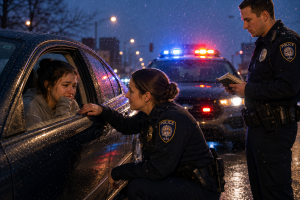
“No.”
“No, absolutely not.”
I ignored her and waited for my wife to answer.
“Hey,” she said immediately.
“You alive?”
“Barely.”
She laughed softly.
Then she heard my tone change.
“What happened?”
I looked at Emily sitting across from me clutching her backpack like it was armor.
Then I said quietly,
“I met a kid today who reminds me too much of us twenty years ago.”
Silence.
My wife understood faster than anyone else on earth ever could.
“Where is she?”
Across the table, Emily’s eyes widened.
“She?” my wife asked gently through the phone.
“Yeah.”
Another pause.
Then:
“Bring her home.”
Emily immediately shook her head violently.
“No.”
“No, I can’t.”
I held up one finger.
My wife continued,
“And before she says no, tell her I already made soup.”
Emily looked horrified.
“How does she know I’m saying no?”
My wife laughed through the phone.
“Because proud people always say no first.”
That almost made Emily cry again.
And honestly?
That was the moment everything changed.
PART 4 — THE NIGHT MY WIFE OPENED THE FRONT DOOR
Emily spent the entire drive to our house apologizing.
Not once.
Not twice.
Constantly.
“I’m sorry.”
“You really don’t have to do this.”
“I can leave after dinner.”
“I don’t want your wife thinking something weird.”
“I’m probably ruining your evening.”
By the fourth apology, I finally glanced over at her while stopped at a red light.
“Emily.”
She looked over nervously.
“You know what the worst part about survival mode is?”
Her fingers tightened around her backpack straps.
“What?”
“It teaches good people to feel guilty for needing help.”
She looked out the window after that.
The city lights reflected across the passenger-side glass while rain streaked downward in long silver lines.
I could practically see her trying not to cry again.
When we pulled into my driveway twenty minutes later, every light inside the house was already on.
Warm yellow light glowed through the curtains.
My wife always does that when someone’s coming over.
Makes the house look welcoming before they even step inside.
Emily stared at the front porch quietly.
“You don’t have to pretend everything’s okay in there,” I told her.
She laughed weakly.
“I wasn’t planning to.”
But the truth was, she already was.
People who survive by themselves become experts at pretending.
We walked up the porch steps.
Before I could even unlock the front door, it swung open.
My wife stood there wearing sweatpants, fuzzy socks, and one of my old college hoodies.
The smell of homemade soup drifted out behind her immediately.
And the second Emily saw her smile, something in her face changed.
Not relaxed exactly.
More like confused by kindness.
“You must be Emily,” my wife said gently.
Emily nodded awkwardly.
“Hi.”
My wife looked her over carefully.
Not judgmentally.
Mothers have a certain look when they spot exhaustion in someone young.
It bypasses logic entirely.
“You’re freezing,” my wife said immediately.
“Come inside.”
Emily stepped in slowly.
Then instantly looked down at her shoes.
“I can take these off.”
“You can if you want.”
Emily took them off anyway and lined them neatly beside the door.
That tiny detail hit me immediately.
Kids raised around unstable people learn how not to inconvenience anybody.
My wife noticed too.
I could tell.
“Soup’s almost done,” she said casually.
“And before you panic, yes, you’re staying the night.”
Emily’s head snapped up.
“No.”
“No, I can’t.”
“You can.”
“I really can’t.”
“You really can.”
Emily looked at me desperately like I was supposed to stop this.
I didn’t.
My wife folded her arms.
“Emily, how long have you been sleeping in that car?”
Silence.
Then quietly:
“Almost two weeks.”
“And when was the last time you slept in a real bed?”
Another silence.
That answer told us enough.
My wife softened immediately.
“Honey.”
“You’re staying.”
Honey.
That word nearly shattered Emily on the spot.
Because when was the last time somebody had spoken to her like she mattered instead of like she was a problem to solve?
She looked down fast.
“I don’t want to be a burden.”
My wife walked closer.
“You know something?”
“The people most afraid of being burdens usually carry the heaviest loads alone.”
Emily’s eyes instantly filled again.
I pretended not to notice and took her backpack gently from her shoulder.
It weighed almost nothing.
That bothered me more than I expected.
A whole life reduced to one exhausted backpack.
My wife led her toward the kitchen.
“Sit.”
“Eat.”
“And if you apologize one more time, I’m assigning you dish duty.”
That finally made Emily laugh a little.
Tiny.
But real.
The kitchen smelled like chicken soup, bread, garlic, and coffee.
Warmth.
Real warmth.
Not just temperature.
The kind people feel when they stop bracing for rejection.
Emily sat at the table carefully, like she still wasn’t convinced she belonged there.
My wife placed a huge bowl of soup in front of her.
Steam curled upward.
Emily stared at it for several seconds before touching the spoon.
“You don’t have to ration it,” my wife said softly.
Emily looked embarrassed immediately.
“I wasn’t.”
“Yes, you were.”
That silence again.
Then Emily admitted quietly,
“I’ve been trying to make food stretch.”
My wife sat across from her slowly.
“How bad is it really?”
Emily kept staring at the soup.
Finally:
“I had forty-three dollars left after tuition.”
“And family?”
“My mom lives three states away.”
“You can’t stay with her?”
Emily shook her head immediately.
“She’s sick.”
There was something in her voice when she said it.
Fear.
Protectiveness.
Guilt.
My wife noticed too.
“What kind of sick?”
Emily hesitated.
Then quietly:
“Kidney disease.”
The room went still.
“She works at a grocery store.”
“She keeps pretending she’s okay.”
“But I hear it in her voice now.”
She rubbed her hands together nervously.
“I can’t go back home.”
“If I quit school now, everything she sacrificed becomes meaningless.”
My wife looked toward me for one second.
That look.
The one married couples develop after years together.
Whole conversations inside one glance.
We both understood immediately.
This girl wasn’t stubborn.
She was terrified of becoming the reason her mother suffered for nothing.
Emily finally started eating.
Slowly at first.
Then faster.
Halfway through the bowl, she stopped suddenly.
“What?”
She looked embarrassed again.
“This is the first homemade meal I’ve had in months.”
My wife nearly cried right there.
Instead she stood up abruptly and cut more bread.
That’s what she does when emotions get too close to the surface.
She feeds people harder.
After dinner, my wife showed Emily the guest room.
Nothing fancy.
Just a small room with soft yellow walls, a bookshelf, and clean blankets.
Emily stood in the doorway frozen.
“You can close the door,” my wife told her gently.
Emily nodded.
But she still didn’t move.
Finally she whispered,
“I forgot rooms could feel safe.”
That sentence stayed with me long after she disappeared inside.
Around midnight, I got up for water.
The hallway light was still on.
As I passed the guest room, I noticed the door cracked slightly open.
Inside, Emily was asleep sitting upright against the headboard.
Fully dressed.
Shoes back on.
Backpack clutched tightly against her chest.
Like some part of her still expected to be told to leave at any moment.
I stood there quietly for several seconds.
Then my wife appeared behind me.
“She didn’t unpack,” she whispered.
“No.”
“She thinks this is temporary.”
I looked back toward the room.
“She’s probably learned everything is temporary.”
My wife’s eyes filled.
“She’s somebody’s daughter.”
That sentence hit me hard.
Because suddenly I pictured Emily’s mother lying awake somewhere three states away believing her daughter was safe at school while that same daughter had been sleeping in a freezing car trying not to lose everything.
My wife gently pushed the guest room door wider open.
Then quietly walked inside.
I watched her place an extra blanket over Emily’s shoulders.
The girl didn’t even wake up.
She was that exhausted.
The next morning changed everything.
I woke up around six expecting silence.
Instead I smelled coffee.
And heard quiet crying.
I walked into the kitchen.
Emily sat at the table holding her phone against her ear while tears rolled silently down her face.
“No, Mom.”
“I’m okay.”
“I promise.”
Pause.
Then:
“Yes, classes are fine.”
Another pause.
Emily looked up and saw me standing there.
She immediately turned away slightly.
Trying to hide the tears.
That told me the conversation wasn’t going well.
Then I heard a weak woman’s voice through the phone speaker.
“You sound tired, baby.”
Emily’s face crumpled instantly.
“No, I don’t.”
“You do.”
Silence.
Then the woman said something that made my stomach drop.
“Are you eating enough?”
Emily covered her mouth immediately.
Because mothers know.
Even across state lines.
Even through bad phone connections.
Even through lies.
They know.
Emily whispered,
“Yes.”
Her mother didn’t answer for several seconds.
Then quietly:
“You don’t have to protect me from the truth.”
The kitchen became painfully silent.
Finally Emily broke.
Not loud.
Not dramatic.
Just shattered.
“I’m trying so hard, Mom.”
That sentence nearly broke my wife beside me.
Emily cried into the phone while apologizing over and over.
“I didn’t want you worrying.”
“I didn’t want you getting sicker.”
“I thought I could fix everything.”
Her mother started crying too.
“I never wanted you carrying this alone.”
My wife stepped forward immediately and took the phone gently.
“Hi,” she said softly.
“My name’s Carol.”
Emily looked horrified.
But her mother sounded relieved instantly.
And suddenly I realized something heartbreaking.
This sick woman three states away had probably spent weeks terrified something was wrong but powerless to reach her daughter.
Carol smiled gently while speaking into the phone.
“She’s safe here.”
“She ate.”
“She slept.”
“And no, we’re not letting her disappear back into that car.”
Emily covered her face with both hands.
And for the first time since I met her…
She stopped trying to survive everything alone.
PART 5 — THE GIRL WHO NEVER ASKED FOR TOO MUCH
After the phone call with her mother, something inside Emily changed.
Not completely.
Trauma does not disappear overnight just because someone is kind to you once.
But the constant panic in her eyes softened slightly.
Like her body had finally realized it was allowed to stop running for a minute.
My wife made pancakes that morning.
Real pancakes.
Butter.
Syrup.
Blueberries.
Emily kept insisting she only wanted one.
My wife ignored her and gave her four.
By the second pancake, Emily started crying again.
At that point, my wife finally pointed a spatula at her and said,
“If you cry one more time over breakfast food, I’m making six more.”
That actually made Emily laugh hard enough to snort.
The poor girl looked horrified afterward.
My wife laughed too.
And suddenly the kitchen sounded normal.
Not tragic.
Not heavy.
Just human.
I stood near the coffee maker watching this exhausted nursing student slowly remember what safety sounded like.
And honestly?
That moment scared me a little.
Because once you start caring about somebody, you also become afraid for them.
Before leaving for class, Emily offered to clean everything.
Counters.
Dishes.
Floors.
She moved around the kitchen like someone trying to earn oxygen.
My wife finally grabbed both her shoulders gently.
“Emily.”
She froze immediately.
“You do not have to work for kindness here.”
That sentence hit hard enough that Emily could not answer.
She just nodded quickly and looked away.
At the university that afternoon, Emily texted me for the first time.
I almost laughed when I saw it because it was painfully formal.
“Hello Officer Reynolds.
Thank you again for your assistance.
I just wanted to let you know I made an A-minus on the exam.”
I stared at the message for several seconds.
Then replied:
“That’s great.
Also stop texting me like you’re filing a police report.”
Three dots appeared instantly.
Then:
“Sorry.”
I sent back:
“There it is again.”
A minute later:
“Okay.
Thank you.
And sorry for saying sorry.”
That one actually made me laugh out loud sitting alone in the cruiser.
Over the next few days, a strange rhythm developed.
Emily stayed in our guest room “temporarily.”
Temporary became four days.
Then seven.
Then two weeks.
Not because anyone officially decided it.
Because nobody could bring themselves to throw a drowning person back into deep water.
My wife started leaving small things outside the guest room door.
Clean towels.
A better pillow.
A sweatshirt when the weather turned colder.
One night I walked past and saw Emily asleep at the desk instead of the bed.
Nursing textbooks spread everywhere.
Flashcards.
Coffee cups.
Highlighted notes.
She had fallen asleep mid-sentence while studying.
My wife quietly placed a blanket around her shoulders.
Then whispered something I will never forget.
“She’s been surviving so long she forgot how to rest.”
That was exactly it.
Even safe, Emily still lived like disaster might kick down the door at any second.
She flinched whenever her phone rang late at night.
She apologized every time she used the washing machine.
She tried replacing groceries she barely touched.
She folded blankets so neatly it looked military.
One afternoon, my wife opened the fridge and noticed Emily had labeled a container:
“Please eat this before it goes bad.”
Inside sat half a sandwich.
Half.
My wife stared at it silently for several seconds.
Then she walked into the living room where Emily sat studying anatomy flashcards.
“Why did you save half a sandwich?”
Emily looked confused.
“I wasn’t that hungry.”
My wife folded her arms.
“Emily.”
Silence.
Then quietly:
“I’m used to saving food.”
That hit hard.
Because starvation changes people long after they start eating again.
Not just physically.
Mentally.
You begin treating food like uncertainty.
Like something temporary.
Fragile.
Dangerous to waste.
My wife sat beside her gently.
“How long were things bad before the car?”
Emily stared at the flashcards in her lap.
Then finally answered.
“Longer than I admitted.”
And slowly, piece by piece, the full story came out.
Her father had disappeared years earlier after gambling debts destroyed the family financially.
Her mother worked nonstop afterward trying to keep them afloat.
Emily became “the responsible one” early.
Too early.
Straight A’s.
Scholarships.
Part-time jobs.
Never causing problems.
She started working at fifteen.
Started helping pay bills at sixteen.
Started hiding stress from her mother at seventeen.
“Because she already looked tired all the time,” Emily admitted quietly.
Then came college.
Everyone celebrated like it was victory.
The smart daughter escaping poverty through nursing school.
But nobody talks enough about how expensive escaping poverty actually is.
Textbooks.
Scrubs.
Clinical fees.
Transportation.
Food.
Housing.
Every semester felt like balancing on ice one inch thick.
Then her roommate left unexpectedly after getting engaged.
Rent doubled overnight.
Emily picked up more diner shifts.
Then more.
Then overnight shifts.
Then stopped sleeping properly.
Then stopped eating properly.
Then started secretly sleeping in her car because tuition mattered more than rent.
By the end of the story, my wife was openly crying.
Emily immediately looked guilty.
“I’m sorry.”
“I didn’t mean to dump all this on you.”
My wife shook her head instantly.
“No.”
“No more apologizing for telling the truth.”
Emily stared down at her hands.
Then whispered something so quietly I almost missed it.
“I’m tired.”
Not physically.
Soul tired.
The kind that comes from carrying your entire future on your back while pretending the weight feels normal.
That night after Emily went to bed, my wife and I sat together quietly in the kitchen.
Rain tapped against the windows.
The clock above the stove ticked softly.
Finally my wife spoke.
“She reminds me of your sister.”
That surprised me.
My younger sister Rachel had died years ago.
Cancer.
But before that?
She had been exactly like Emily.
Too independent.
Too proud.
Too determined to carry pain privately.
“She does,” I admitted quietly.
My wife wrapped both hands around her tea mug.
“She’s been in survival mode for so long she thinks accepting help is weakness.”
I nodded slowly.
Then asked the question we were both avoiding.
“What happens when the semester ends?”
Silence.
Because we both knew.
Temporary safety still has expiration dates.
The next morning, something unexpected happened.
Emily got sick.
Not dramatic.
Not emergency-room sick.
But exhausted-body-finally-stopping sick.
She nearly fainted in the kitchen trying to make coffee.
One second she was standing there.
The next she grabbed the counter hard enough to knock over a mug.
I caught her before she hit the floor.
Her skin felt ice cold.
“Emily.”
“I’m okay.”
“No, you’re not.”
“I just stood up too fast.”
But her body was shaking.
My wife touched her forehead immediately.
“She’s burning up.”
Emily tried protesting again.
“I have clinicals today.”
“You have a fever.”
“I can’t miss clinicals.”
“You can barely stand.”
“I already missed one last semester.”
There it was.
Fear again.
Not fear of being sick.
Fear of falling behind.
Fear of losing momentum.
Fear that one pause could destroy everything she worked for.
My wife finally used her serious voice.
The one that even scares me sometimes.
“Emily Grace.”
Emily froze immediately.
My wife pointed toward the couch.
“You are not going anywhere.”
“But—”
“No.”
“I’ll fail attendance.”
“You’ll fail consciousness if you keep this up.”
Emily looked like she might cry from frustration.
Then suddenly she whispered:
“I don’t know how to stop.”
That sentence shattered the room.
Because underneath the grades and jobs and exhaustion was the real problem.
She genuinely did not know how to rest without feeling unsafe.
My wife sat beside her carefully.
“You know what happens when people spend too long surviving?”
Emily shook her head weakly.
“They stop believing they deserve care.”
Tears rolled down Emily’s face instantly.
Not loud tears.
Quiet ones.
The dangerous kind.
The kind people cry when they are finally too tired to pretend anymore.
For the next two days, Emily slept almost nonstop.
My wife made soup.
Tea.
Toast.
I watched this young woman slowly unravel from pure exhaustion like somebody who had been holding herself together through force of will alone.
At one point she woke up disoriented and apologized because she “slept too much.”
She had been asleep thirteen hours.
Thirteen.
That was not laziness.
That was collapse.
And during those quiet recovery days, our house began changing too.
Emily’s textbooks spread onto the kitchen table permanently.
Her shampoo appeared beside ours in the shower.
My wife bought extra coffee without thinking about it.
One evening I came home from shift and found Emily and my wife laughing together while baking cookies.
Flour everywhere.
Burned edges.
Smoke detector going off.
For the first time since meeting her, Emily looked young.
Actually young.
Not like a struggling student carrying a mortgage-sized amount of stress.
Just twenty-one.
That frightened me too in a strange way.
Because it revealed how much of her youth survival had stolen.
One Saturday morning, while helping my wife carry groceries inside, Emily suddenly asked:
“Officer Reynolds?”
“You can call me Tom, you know.”
She looked uncomfortable immediately.
“That feels illegal.”
I laughed.
“What’s up?”
She hesitated.
Then quietly:
“Why are you really helping me?”
There it was.
The question beneath everything.
Not:
What are you doing?
Why?………………………….