My son died, my daughter-in-law kept the four-million-dollar house, and told me to go die in the mountains.
If the story had ended there, I think the mountain would have swallowed me whole.
But grief has strange hands.
On the first night I slept in the ruin she sent me to, I found the thing my son had hidden for the day he feared most.
Nathaniel had been buried that afternoon.
The black dress I wore still smelled of church incense and cemetery flowers.
My stockings were damp at the hem, and my hands would not stop trembling, as if they still remembered the weight of his coffin.
I had not sat down.
I had not eaten.
I had not even managed to cry properly.
My mind had been moving too slowly to understand that my only child was gone forever.
My name is Eulalia.
For fifteen years, I lived in Nathaniel’s house as though endurance were a duty stitched into my skin.
After my husband died, Nathaniel asked me to move in.
He said the house was too large for just him and Celeste, and he did not want me alone.
I believed him.
At first, Celeste smiled.
She called me family in front of guests.
She kissed my cheek and asked for my recipes.
Then the smiles thinned.
The requests turned into expectations.
The expectations hardened into orders.
I became useful, then invisible, then inconvenient.
I cooked, cleaned, ironed, polished, hosted, and learned the art of shrinking myself.
I learned how to leave a room before an argument started.
I learned that silence can sound like obedience even when it is only exhaustion.
And every time Celeste’s tone cut deeper than the last, I told myself the same thing: Nathaniel is here.
As long as my son is here, I can bear it.
When we returned from the cemetery, Celeste did not go upstairs to change out of her black silk dress.
She went straight to Nathaniel’s study, returned with a ring of keys, and told me the house staff had been dismissed for the week.
Then she stood in the foyer beneath the chandelier I had dusted a thousand times and said, very calmly, “You won’t be staying here.”
I thought grief had made me mishear her.
I stared at her until she repeated herself, slower this time, as if speaking to someone dull.
She had papers, she said.
Nathaniel’s estate was now hers to manage.
The house, the furniture, the silver, the accounts, the cellar, the art.
Everything.
There was a cabin in the mountains.
I could take that if I needed somewhere to mourn.
She said it with a softness that made it crueler.
I asked for one thing only: a framed photograph of Nathaniel taken when he was seventeen, standing in front of a lake with his hair blown sideways by the wind.
She stepped between me and the side table.
“Everything in this house belongs to me now,” she said.
Then she opened the front door and pointed into the dark.
“Leave.
You wanted so badly to be his mother.
Now go mourn him somewhere else.” Those were her exact words.
Not shouted.
Not spat.
Just placed in the air between us like a verdict.
I walked the mountain road with two old
suitcases and Nathaniel’s photo pressed to my chest.
The dirt had turned slick from afternoon rain.
Pine branches knocked together overhead.
Once, I slipped so badly I went down on one knee in the mud and did not get up for nearly a minute, because it suddenly seemed possible that lying there might be easier than continuing.
By the time I reached the cabin, the light had almost vanished.
The place was worse than I had imagined.
The roof sagged in one corner.
The windows were veined with cracks.
The walls smelled of rot and damp plaster.
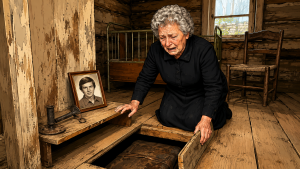
An old crib stood near the hearth, though there had not been a baby there in decades.
A chair with a missing leg leaned against the wall as if it had tried and failed to leave.
I understood at once that Celeste had not sent me there to live.
She had sent me there to disappear.
I laid Nathaniel’s photograph on the floor and sat beside it until the dark swallowed the room.
Then anger came, hot and ugly.
I was angry at Celeste for her cruelty, angry at the house for holding years of my labor without ever being mine, angry at God for being silent, and most of all angry at Nathaniel.
It is one thing to bury your son.
It is another to wonder whether he knew exactly what kind of woman he was leaving you behind with.
I almost burned his photograph that night.
I held a match between my fingers and watched the small flame tremble.
But when I lifted it toward the frame, I saw his eyes and broke.
I clutched the picture to my chest and cried until I fell asleep on the floor.
The next morning, I woke stiff with cold.
A broom lay in the corner under a collapsed shelf.
Something hard rose up in me then.
Not hope.
Hope felt too gentle for that place.
It was defiance.
If I was going to die in that cabin, I would not die defeated.
So I began to clean.
I swept dust, dragged broken crates outside, tore cobwebs from the walls, and forced the windows open to let in the smell of wet earth and pine.
In the far corner, beneath years of neglect, I found a small wooden altar Nathaniel had brought there long ago.
I remembered him carrying it in with an odd seriousness, saying he wanted to preserve a piece of family history.
I had thought little of it then.
Now it looked less like decoration and more like a marker.
I wiped it clean, set his photograph on top, and searched for a candle.
All I found was an iron candlestick, rusted and heavy.
It slipped from my hand and struck the floor with a hollow sound that did not belong to rotten boards.
I knelt, ran my fingers across the planks, and found a seam.
When I pried the floorboard loose, there was an oilcloth bundle hidden below it and an envelope on top in Nathaniel’s handwriting.
The envelope read, For when she sends you here.
My knees nearly gave out.
He had known.
Or at least feared.
Inside the envelope was a brass key taped to a single page.
The first sentence blurred because my eyes filled with tears:
Mother, if you are reading this in the cabin, do not trust anything Celeste tells you.
The house is not hers to take from you.
Under the letter lay copies of a recorded trust, a deed transfer, and instructions to see an attorney in town named Miriam Holt before speaking to anyone.
There was also a small black voice recorder wrapped in a handkerchief.
On it, Nathaniel had written, Play this only when you are alone.
I sat on the floor and pressed the button.
His voice filled that ruined cabin, thin and tired but unmistakably his.
“Mama, if you found this, it means I waited too long and Celeste did exactly what I was afraid she would do.
Listen carefully.
Six months ago, I transferred the house into the Eulalia Residence Trust.
It belongs to you for the rest of your life.
It is not part of my estate.
Celeste cannot inherit what is no longer mine.” I remember gripping the recorder so tightly my knuckles ached.
Then his voice broke in a way I had never heard.
“I should have protected you sooner.
I kept hoping I could fix this marriage and still keep you safe.
I was wrong.
The brass key opens safe deposit box 114 at First Valley Bank.
Miriam Holt knows everything.
Do not tell Celeste you found this.
Go straight to Miriam.”
I left for town at first light the next morning.
The walk down the mountain felt shorter because rage had replaced shock.
Miriam Holt’s office was above a hardware store on Main Street, and when I gave her my name, something in her face changed.
She had known Nathaniel was dead; she had not known I had already been thrown out.
She sat me down, read every page in silence, and then looked at me with a steadiness I will never forget.
Nathaniel had come to her six months earlier, she said, after learning that a heart operation he needed carried more risk than he had admitted to anyone.
He had not wanted me frightened before he knew whether the surgery would even happen.
But his fear of dying had forced him to look hard at the life he was leaving behind.
And what he saw in his own house had finally frightened him more than the hospital.
Miriam explained the documents slowly, because my hands still would not stop shaking.
The deed transferring the house into trust had been recorded properly.
The trust named me as lifetime beneficiary and exclusive resident.
Nathaniel had retained only limited control while alive.
When he died, that control ended.
The four-million-dollar house was not part of the probate estate.
Celeste could inherit his clothing, his watch collection, his business interests if the will allowed, but not the house.
Not the roof over my head.
Not the room where I had spent years making myself small.
From Miriam’s office, we went to First Valley Bank.
Box 114 contained the originals of every document in the cabin, plus far more than I was prepared to see.
There was a notarized affidavit from Nathaniel confirming he was acting of his own free will.
There were printed screenshots of text messages between Celeste and a friend named Bianca.
There were statements showing large transfers from Nathaniel and Celeste’s joint………………………..

