Part 1
The room was already quiet when I walked in.
Not normal quiet. Not people-checking-their-phones quiet. This was the kind of quiet that had edges. The kind that told you a decision had already been made and all that was left was the paperwork and the theater of pretending it hadn’t.
The briefing room at brigade headquarters always ran cold. It smelled faintly like old coffee, printer toner, and floor wax, like every serious room on every military installation I’d ever served on. The overhead lights were too white. The table was polished enough to show a warped reflection of the people sitting around it.
My sister sat at the head of the table.
Colonel Rebecca Carter looked exactly the way she always looked when she was about to cut something loose from the machine and call it necessary. Uniform perfect. Hair precise. Chin level. She had a file open in front of her, and to her right sat the brigade legal liaison with a yellow tab sticking out of the folder like a tiny warning flag. To her left sat the executive officer, staring down at his notes like they had suddenly become holy text.
I stopped at the chair across from her and stayed standing.
Rebecca did not look up immediately. That was deliberate. She liked to make people wait half a beat too long. It reminded them who controlled the rhythm.
“Captain Carter,” she said at last.
No warmth. No hesitation. No acknowledgment that when we were kids, she used to braid my hair too tight before school and tell me to stop squirming.
“Yes, ma’am.”
She gestured to the empty chair across from her.
I didn’t sit.
Sitting makes a thing feel mutual. This wasn’t mutual.
A tiny pause flickered through the room. Rebecca let it pass. “Effective immediately,” she said, reading from the paper in front of her, “you are relieved of command.”
There it was.
Just like that.
No buildup. No dramatic preamble. No mention of the months I’d spent stabilizing a company that had been churned through too many leaders too fast. No mention of readiness improvements, corrected maintenance timelines, fewer incidents, cleaner reports. Just one sentence, laid down like a blade.
I kept my face still. “Understood, ma’am.”
Her eyes lifted, cool and brief, checking for reaction.
She continued. “This decision was made due to ongoing concerns regarding your attitude.”
I waited for the rest.
It never came.
No dates. No examples. No documented incidents. Not a single phrase that meant anything concrete. Just attitude. A word broad enough to catch whatever somebody wanted it to catch. A word that sounded reasonable to outsiders and useless to anybody who had ever had to prove something on paper.
The legal liaison slid the folder toward me. “You’ll need to sign acknowledging receipt of the order.”
His voice had a careful, dry quality, like he already knew this would not age well.
I stepped forward and picked up the folder. The paper felt warm from somebody else’s hands. Standard format. Official seal. Authority cited. Effective date. Pending administrative review.
That phrase snagged in my head.
Not because it was shocking. Because it was interesting.
I read every line. I always did. My father had once told us there were two kinds of officers in the Army: the ones who signed because they trusted the room, and the ones who read because they trusted the record. Rebecca had learned to trust the room. I had learned the other lesson.
I signed where they told me to sign.
Initialed where they told me to initial.
Then I closed the folder and handed it back.
“That will be all,” Rebecca said.
I came to attention and saluted. She returned it automatically. Muscle memory. Then I turned and walked out without saying anything else.
The hallway felt longer than usual. My heels clicked against the polished floor, sharp little sounds that bounced off cinderblock and framed command photos. A captain from logistics stepped out of an office halfway down, saw me, saw my face, and immediately found something fascinating in the opposite direction.
Word would spread in under ten minutes.
That was fine.
I went straight back to my company area. My executive officer was already standing when I walked into the command suite. He was a good officer, careful and capable, and the look on his face told me he’d been informed but not briefed.
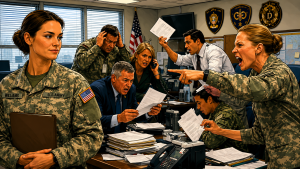
“Ma’am,” he said.
“Captain,” I corrected. “You have command. Effective immediately.”
He swallowed once and nodded.
We did the handover the way professionals do when the circumstances are ugly and nobody wants to pretend otherwise. Property access. Current taskings. Red status items. Training schedule adjustments. Open personnel actions. The hum of the fluorescent lights over our heads sounded louder than usual. Somebody down the hall laughed at something, then went abruptly quiet.
My senior enlisted adviser waited until we were done.
He had his arms folded over his chest, sleeves rolled, jaw set hard enough to show the outline of muscle under skin browned by two decades of field time. When he finally spoke, his voice was low.
“For what it’s worth, ma’am, this doesn’t make sense.”
“I know.”
He studied me for a second as if looking for the crack I was supposed to show him. When he didn’t find one, he gave one short nod.
I cleared my desk in ten minutes.
There wasn’t much to take. A notebook. A challenge coin from my first deployment. A black frame holding a photo I kept face down most days anyway—me in dress uniform between my parents, Rebecca smiling like the future already belonged to her.
I left the mug. Left the pens. Left the extra field notebook in the drawer.
I wasn’t going to give anybody the pleasure of saying I stripped the office on the way out.
Before I left, I stopped at the operations board and moved one last marker with the tip of my finger. Tiny plastic square. Current status. Green. The board smelled faintly like dry-erase ink and dust.
Habit.
Outside, the parking lot shimmered under a thin sheet of afternoon heat. Engines ticked as they cooled. Somebody was smoking near the far curb, the smell drifting bitter on the wind. I got in my car and sat with my hands on the steering wheel for a moment before starting it.
I did not cry.
I did not call anyone.
I drove home past rows of clipped grass, low brick buildings, and flags that moved lazily in the breeze like the day was as ordinary as any other.
The house was quiet when I got there. I put my keys in the bowl by the door. Set my bag on the kitchen chair. Poured a glass of water and drank it standing at the counter, the coolness of it almost startling after the stale chill of headquarters.
Then I opened my laptop.
Not to complain. Not to vent.
To read.
My personnel file loaded in neat, indifferent sections. Evaluations. Orders. Awards. Appointment documentation. Everything exactly where it should be. Clean evaluations. Strong command remarks. No counseling statements. No adverse actions. Nothing—absolutely nothing—that would support ongoing concerns regarding your attitude.
I clicked through the appointment order again, more slowly this time.
I didn’t need to understand the whole shape of it yet. I just needed to feel where the seams were.
By dusk my phone still hadn’t rung.
That was not unusual. These things often moved slower than the rumors around them. Offices closed. Staff went home. Systems kept processing because systems never cared whether you slept.
I made dinner I barely tasted. Chicken, rice, roasted vegetables. The kitchen smelled like garlic and black pepper. I washed the plate. Wiped the counter. Set my phone on the nightstand with the volume on.
When I turned off the lamp, the room went dim except for the screen’s pale rectangle.
I lay there listening to the base outside my window. A convoy rolled somewhere in the distance, low diesel rumble, then faded. A dog barked twice. The air conditioner clicked on and breathed cold over my bare arms.
Nothing felt finished.
That was the strange part.
Being removed from command should have felt like an ending. Instead it felt like the moment after a door shuts somewhere else in the building, when you cannot see what happened but you know somebody on the other side has just started reading more carefully than they meant to.
Right before I fell asleep, my phone lit up once.
Not a call. Not a text.
Just an automated update showing my access had been modified—and one line beneath it, dry and procedural, that made my pulse slow instead of speed up: administrative review pending.
If Rebecca thought this was over, why was legal already asking the system to look again?
Part 2
I woke before dawn because that was what my body did when my life started listing sideways.
The house was dark except for the soft green blink of the microwave clock. I laced my running shoes in the kitchen, the tile cold under my feet, and stepped outside into air sharp enough to sting the inside of my nose. The base looked half-finished in that hour before sunrise—streetlights still on, sky barely lifting from black to blue, long rows of buildings turned into silhouettes.
I ran the same route I always ran.
Past the parade field where wet grass smelled sweet and metallic under the sprinkler mist. Past the maintenance lot with its hulking shapes under canvas covers. Past headquarters, where one office window on the second floor was already lit.
I didn’t look up long enough to guess whose.
By the time I got home, my shirt clung damp between my shoulder blades and my phone had a new notification waiting.
Access permissions updated.
Nothing else.
No dramatic memo. No follow-up. No explanation. Just one more system quietly moving on the assumption that the action against me made sense.
I showered. Dressed in civvies. Made coffee so strong it bordered on medicinal. Then I sat at the kitchen table with my laptop and started reading my own life as if it belonged to somebody else.
Evaluation reports first.
Year after year of the same language in slightly different combinations: technically proficient, calm under pressure, trusted by subordinates, mission focused, clear communicator, strong leadership potential. No concerns about professionalism. No mention of temperament. No coded phrases. Nothing that could be stretched honestly into attitude issues.
Then counseling records.
None.
Letters of concern.
None.
Remedial guidance.
None.
I leaned back in the chair and stared at the ceiling fan as it turned, slow and lazy, above the kitchen light. You learn, after enough years in uniform, that what is not in a file matters almost as much as what is. A problem serious enough to remove somebody from command should leave tracks. Paper. Emails. Summaries. Something.
This had left a sentence.
A vague one.
Around midmorning I drove back onto base. The guard at the gate glanced at my ID, then at me, then waved me through with a look that said he knew something had happened but had no idea what kind. The administrative building was already busy. It smelled like copier heat and stale coffee. Phones rang in staggered bursts from behind half-open doors.
My former executive officer saw me halfway down the hall and straightened like he’d been caught doing something wrong.
“Ma’am,” he said automatically.
“Captain,” I said.
He winced. “Right. Sorry.”
We stood there in the narrow hallway, close enough to hear a printer running in the room behind him.
“They didn’t give me anything,” he said finally. “No explanation. Just the order.”
“I know.”
“Nobody was expecting this. Not like this.”
That mattered. More than he realized.
Justified removals get prepared in advance. Talking points circulate. Timelines get managed. People above and below the affected officer are briefed so the thing lands like procedure, not surprise.
This had landed like surprise.
I left him there and walked to the office of my senior enlisted adviser. His door was open. A pot of burnt coffee sat on the warmer behind him, and the room smelled like old paper, boot leather, and the peppermint gum he chewed by the pack.
He shut the door after I stepped in.
“They’re saying attitude,” he said.
“Yes.”
He made a face like he’d tasted something rotten. “That’s thin.”
“That’s generous.”
He folded his arms. “No counseling. No paper. No command climate issues. Nothing.”
“Correct.”
He let out a slow breath through his nose and looked past me at the closed door. “That’s not how it’s supposed to go.”
No, it wasn’t.
What bothered him, I think, was not loyalty to me. He liked me, but that wasn’t it. What bothered him was the unpredictability. Enlisted soldiers live with enough arbitrary nonsense from above; they rely on officers, at least the decent ones, to make the system make sense. If command could be taken away on a word nobody could define, everybody under that command learned the same ugly lesson.
I left his office feeling steadier, not because anybody could fix it, but because the wrongness of it wasn’t living only in my head.
On the walk back to my car, two lieutenants near the stairwell went silent when they saw me. One of them started to salute, then stopped halfway, hand twitching awkwardly at his side.
I spared him by nodding and moving on.
At home, I reopened the appointment order.
Not the summary page. The whole document.
Most officers skim appointment orders. They confirm dates, authority, who reports to whom, then they move on because nobody expects the lower paragraphs to matter unless something breaks. I had read them when I took command because I had a habit of reading things people assumed I would skim.
Now I read them again with a pen in my hand, not marking anything yet, just following the language carefully.
Authority to assume command.
Conditions of appointment.
Removal and review.
There.
Nothing flashy. No secret trap door. Just one clause nested in standard language, the kind of sentence written by lawyers who expected officers to ignore it right up until the day it became the only sentence in the document that mattered.
I read it twice. Then a third time.
I did not smile.
I did not feel vindicated.
I felt the click of something aligning inside my head.
The Army gives commanders broad authority. It has to. Units cannot wait around for perfect conditions before leaders act. But authority lives inside process. If command is removed without documented cause that meets the standard laid out by regulation, the action doesn’t disappear into the file system and die. It triggers review. Not because somebody complained. Because the order itself requires it.
Which meant one thing.
By signing that folder yesterday, I had not accepted Rebecca’s narrative.
I had moved it forward into the exact machine that would test whether her narrative could survive contact with the record.
I set the pen down very carefully.
Childhood flashed through my mind in one useless, vivid strip: Rebecca at sixteen helping our father press his dress uniform before a banquet, smoothing the fabric with reverent hands; Rebecca at twenty-two telling me, in the calm voice she used when she thought she was saving me from myself, that questions were only useful if you asked them in a way that left people comfortable answering.
She had built a career on making systems comfortable.
I had built mine on making systems accurate.
That difference had always been there.
Around four that afternoon, I drove to the administrative annex behind supply, the ugly one-story building most people only visited when something had gone mildly wrong with pay, orders, or benefits. The place ran on habit. Paper in. Stamps. Signatures. Paper out. A civilian clerk I’d known for years looked up over her reading glasses when I walked in.
“Captain.”
“Ma’am.”
She gave me the kind of small smile civilians on base develop after years of watching uniforms come and go. “Orders came through. Status updated.”
“I figured.”
She lowered her voice. “Those kinds of actions go through review, you know.”
“I know.”
“Sometimes they bounce.” She tapped the corner of a folder on her desk. “Not often. But they do.”
I thanked her and left without saying anything else.
Sometimes the most useful information is the kind nobody thinks they’re telling you.
Back home, I spread documents across the kitchen table. Orders in one stack. Evaluations in another. Emails by date. Not because I planned to accuse anybody. Because I believed in being ready when a system started asking questions, especially one that preferred not to be reminded of its own rules.
I did not draft a complaint.
I did not contact the Inspector General.
I did not send a single message to Rebecca.
That was important.
I wanted my fingerprints nowhere near the first stage of whatever came next.
Dusk turned the kitchen window into a dark mirror. My reflection hovered over the papers—hair pulled back, shoulders squared, expression flatter than I felt. I gathered everything, slid it back into folders, and put them away.
When my phone buzzed just after nine, I looked at it expecting another automated update.
It was not automated.
Unknown number. Base exchange.
I answered on the second ring.
“Captain Carter,” a man said. His voice was careful in the way legal voices often are when routine has just gone slightly off-script. “This is Major Lewis from the legal office. I have a few procedural questions regarding the administrative review initiated on your removal.”………………………………

