Part 1
I was stopped at the gate before I could even take a full breath.
The morning air in Annapolis had that sharp, wet chill that came off the Severn River and slipped under a coat like it had a personal grudge.
The stone archway ahead of me was draped with flags.
White chairs had been lined up inside the courtyard beyond the checkpoint.
Brass flashed in the sun.
Somewhere deeper on campus, a band was warming up, all clipped notes and snare taps, like the day itself was tightening its gloves.
The petty officer at the gate held his tablet in both hands the way a priest might hold a book of judgment.
“I’m sorry, ma’am,” he said, polite and professional and uncomfortable enough that I almost felt bad for him.
“I don’t have you on the family access list.”
He tilted the screen toward me.
Captain Thomas Stone.
Mrs.
Elaine Stone.
Lieutenant Marcus Stone.
Paige Stone.
No Sophia.
My name was not there between the familiar ones that had come before mine for most of my life, as if the omission itself had years of practice behind it.
I looked at the list, then at the young man’s face.
He couldn’t have been more than twenty-two.
Fresh shave, careful posture, the faint smell of starch and coffee rising off him.
He was doing his job.
The cruelty wasn’t his.
“That’s fine,” I said.
It wasn’t fine.
But I had spent enough years learning the difference between what was true and what was useful to say out loud.
The black SUV rolled up behind me so quietly I heard the tires over the gravel before I heard the engine.
Then came the expensive purr, the soft hiss of brakes, and the passenger door opening with the kind of smooth confidence money buys.
Marcus stepped out first.
He looked exactly like the kind of man photographers loved at military ceremonies.
Tall.
Clean white uniform.
Shoulders back.
Smile calibrated for cameras and senior officers.
The morning sun hit the ribbon bar on his chest and turned it into a neat row of colored knives.
Paige came around the other side in a pale blue dress that probably cost more than my first car.
My mother followed, one hand on her pearls.
My father came last, already wearing the expression he always used on bases and ships and ceremonies—a look that said he belonged anywhere the flag was flying.
Marcus saw me and gave a tiny pause, not enough for anyone else to notice unless they had spent their childhood memorizing the microclimate of his face.
Then he smiled.
“Wow,” he said, coming just close enough for the words to land.
“You actually came.”
Paige glanced at me, then at the gate.
“Maybe it’s a clerical thing,” she said, with all the sweetness of a paper cut.
“Though I thought guests had to be part of the official family party.”
Marcus let out a laugh through his nose.
“She still works in an office.
Maybe she thought all Navy events were open seating.”
He said it lightly.
That was always his favorite weapon.
Make it sound like a joke, and anyone hurt by it looked humorless.
My father didn’t look at me at all.
My mother did, but only for a second, and even then it was the look people give an item they forgot to pack and don’t have room for now.
The petty officer shifted his weight.
I could feel his embarrassment like heat.
Marcus turned back toward the gate.
“Come on,” he said to them.
“We’re already late.”
And then they walked past me.
Not in a rush.
Not with confusion.
Not like people who had been separated by an accident and were grateful to regroup.
They walked past me the way people move around a decorative bench.
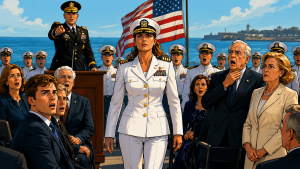
I stood there in my trench coat with my hands in my pockets and watched the four of them disappear through the ceremonial arch, into the place they believed had always been built for men like Marcus.
Not women like me.
Not daughters like me.
Not the quiet child who didn’t thunder in a room and therefore never counted as weather.
The petty officer cleared his throat.
“Ma’am, I’m going to have to ask you to step to the side.”
I nodded and moved away from the checkpoint.
My heels clicked against the concrete, a small precise sound.
Behind me, another family arrived in a burst of perfume and cologne and proud voices.
A little girl in a navy dress asked her mother if cannons would go off.
Her mother laughed and said no, baby, not today.
Not today.
I stared at the archway and thought, absurdly, of buttercream.
Marcus had been seventeen when his Naval Academy acceptance letter came.
My father grilled steaks big enough to qualify as architecture.
Men I barely knew slapped Marcus on the back so hard the deck railing rattled.
Blue and gold balloons dragged at the patio lights.
There had been a sheet cake from a fancy bakery with MIDDLESHIPMAN STONE piped across it in a script so delicate it looked embarrassed by the amount of attention it was getting.
That same week, I had won first place in the state mathematics competition.
My plaque was rectangular walnut with a brass plate on the front.
It had felt heavy in my hands, warm from the gym lights and the palms of teachers congratulating me.
I carried it into our backyard that night with the strange bright hope children have before life teaches them to inventory a room before speaking.
No one asked what I was holding.
My mother was busy refilling sweet tea for my father’s old Navy friends.
Marcus was demonstrating push-ups in the grass because one of the men had said plebes got smoked on day one.
My father had one hand on Marcus’s shoulder and the proud, hungry look of a man seeing his own reflection improved by a younger body.
I stood near the sliding screen door holding my plaque and a paper plate that smelled like barbecue sauce and warm plastic.
When I finally tried, when I said, “I won state,” my father looked over, distracted, nodded once, and said, “That’s great, Soph,” before turning back to explain to someone how discipline made the man.
That was the first time I understood that achievement and visibility were not the same thing.
Later that night, after the last truck had backed out of the driveway and the citronella candles burned down to ugly stubs, I took my plaque to my room and slid it into the back of my closet between an atlas and a box of winter scarves.
I didn’t cry.
I stood there staring at the brass plate until my eyes blurred, trying to figure out what kind of victory fit into darkness that easily.
At the gate, a gull screamed overhead.
I blinked back into the present and rolled my shoulders once beneath the coat.
The fabric was heavier than it looked.
Useful.
Protective.
My phone buzzed in my pocket.
Not my personal phone.
The secure one.
I took it out and read the message.
Remain outside main entrance.
Escort en route.
Timing unchanged.
No signature.
None needed.
I slipped the phone back into my pocket and looked again at the archway where my family had vanished.
I wasn’t on Marcus Stone’s list.
I was on the Navy’s.
And as the band inside struck the first clean note of the ceremony march, I had the sharp, electric feeling that the morning was about to split open in a way none of them saw coming.
Part 2
Being forgotten in my family was never loud.
That would have been easier, honestly.
Easier to fight.
Easier to name.
It wasn’t screaming or slammed doors or the kind of cruelty that left a bruise anyone else could point to and say, there, that’s the wound.
It was quieter than that.
More polished.
More respectable.
It lived in the way conversation bent around me at dinner tables.
It lived in how Marcus’s milestones became family mythology while mine became trivia.
It lived in the little pauses before my father introduced us to people.
“This is my son, Marcus,” he would say, voice warming by half a degree.
“Navy.”
Then, with a glance toward me as if trying to recall something from a filing cabinet, “And this is Sophia.
She works in D.C.”
Works in D.C.
As if I spent my days alphabetizing staplers under fluorescent lights.
The funny part was that I let them believe it.
At first, I corrected them.
Not in a dramatic way.
Just facts, laid out neatly like silverware.
No, I’m not in admin.
No, I’m not “basically civilian.”
No, I can’t tell you exactly what I do.
That last part was where the disrespect always found a place to sit.
Marcus would lean back in his chair, beer bottle balanced against his knee, and grin like he’d caught me bluffing at cards.
“Convenient.”
My father would make a noise in the back of his throat, not quite a laugh, not quite dismissal, but close enough to do the job.
And my mother, who hated conflict almost as much as she loved appearances, would say something smoothing and useless like, “Sophia’s always been private.”
Private.
As if I kept secrets for sport.
The truth was less glamorous and a lot more fluorescent.
I worked in rooms with no windows and no clocks.
Rooms where phones stayed outside and badges got checked three times and the air was always a little too cold because electronics ran hotter than people did.
I learned to read satellite movement the way some women learned to read a man’s face across a restaurant.
I knew the sound of an encrypted line locking into place.
I knew what stale coffee tasted like at 2:13 a.m. after a thirty-one-hour operational cycle.
I knew what it meant to carry lives in your headset and never get your name printed anywhere afterward.
To my family, that translated to desk job.
Marcus loved that phrase.
He used it at a Fourth of July cookout three summers before the ceremony, out in my parents’ backyard with the citronella smoke curling through the dark like thin ghosts.
Someone had brought a speaker.
Country music murmured from the deck.
My mother was carrying a tray of deviled eggs nobody needed.
Marcus wrapped an arm around my shoulders, all affection and performance, and said to two of his friends, “My sister’s in the Navy too.
If by ‘in the Navy’ you mean terrorizing spreadsheets at the Pentagon.”
His friends laughed.
My father laughed too.
Not a big laugh.
Just enough.
I can still remember the feel of condensation sliding down the neck of my glass and onto my fingers, cold and slick.
I remember the smell of lighter fluid hanging in the humid air.
I remember Paige’s earrings catching deck light when she turned her head to smile.
“And when are you getting a real assignment?” one of Marcus’s friends asked.
I smiled because by then I knew the cost of correction.
“I like my job just fine,” I said.
That answer annoyed Marcus more than defense would have.
He liked resistance.
Resistance gave him something to perform against.
Calm made him look childish.
He squeezed my shoulder once, too hard.
“There she is.
Always mysterious.”
Later that night, while fireworks thudded over the neighborhood and red sparks fell behind the oak trees, I stood alone by the fence and watched my father show Marcus’s friends an old deployment photo album.
He never once offered to pull out mine.
Not that he had many.
Most of my work never saw daylight, much less glossy paper.
By the time I was thirty, I stopped expecting fairness and started studying patterns instead.
My father respected visible service.
Uniforms.
Combat stories.
Metal you could pin to cloth and point at.
My mother respected whatever kept the family image clean.
Marcus respected admiration.
Paige respected proximity to power and the way rooms changed temperature when she entered them with the right man on her arm.
And me?
I respected facts.
Facts were solid.
They didn’t get insecure.
They didn’t need applause to remain true.
At the gate that morning, a petty officer in dress blues came out of the side entrance carrying a stack of programs tied with a gold cord.
He glanced at me, noticed the trench coat and the waiting, then looked away so quickly it made me want to laugh.
Everyone on a military base knows when someone is waiting under discipline.
They just don’t always know why.
My phone stayed silent in my pocket.
Inside the courtyard, the band shifted to a march.
I could hear voices over the speakers now, clipped and amplified, the warm-up announcements before dignitaries were introduced.
I thought of the last text Marcus had sent me before everything changed.
It had arrived on a Tuesday just after midnight while I sat in the operations center with my headset on and an open intelligence feed glowing across three screens.
The message had popped up on my personal phone, bright and smug against the dark.
In D.C. for forty-eight hours and somehow nobody has promoted you to queen of toner cartridges yet?
A second later another one.
Don’t stay too late fixing printers, Soph.
Some of us have real jobs in the morning.
I had stared at the screen for a beat too long, the stupid blue bubbles looking harmless enough to anyone who didn’t know how sharp casual contempt could become after years of repetition.
Outside our glass wall, analysts moved between stations with rapid, silent purpose.
Inside my headset, a voice crackled from the Gulf, low and controlled, carrying the kind of tension that dries your mouth from the inside out.
I turned my phone facedown and went back to work.
Marcus had no idea where he really was that night.
No idea how close the water was.
No idea how thin the line had become between his confidence and a folded flag.
And the truly astonishing part?
He had no idea that the voice holding that line was mine.
At the gate, my secure phone buzzed again.
Escort entering from east corridor in two minutes.
I slipped the phone away, adjusted my collar, and looked toward the arch.
For one long second, I could almost hear Marcus’s text again, smug and careless and certain.
Then I remembered what happened an hour after he sent it, and the old ache in my chest sharpened into something steadier.
He thought I pushed paper.
He had no clue I had once pulled his whole team back from the edge of a slaughter.
Part 3
The operations center always smelled the same at two in the morning.
Cold metal.
Reheated coffee.
The faint plastic heat of overworked processors.
There was no daylight in there, only layers of screen glow—green, blue, white, red—washing over people’s faces until everyone looked half-assembled, like we were made out of code and fatigue.
That night the room hummed with the kind of tension that never made anyone louder.
It made us quieter.
A commercial tanker had been hijacked in the Gulf.
Twelve civilian hostages.
Armed militants.
A boarding team in rough seas.
Bad weather moving in from the southwest.
Satellite windows narrow and shifting.
SEALs staged and ready.
Too many variables.
Not enough good ones.
I stood at the central console with my headset on, one palm braced against the edge of the desk, tracking three live feeds and an intercept channel.
To my left, Holt worked communications.
To my right, Singh had maritime traffic overlays spread across two monitors, her dark braid falling over one shoulder as she zoomed in and out of the grid with surgical speed.
“Thermal update,” I said.
“Coming,” Singh answered.
The tanker appeared on my main screen as a hard silver shape against black water, the heat signatures clustered at the stern and bridge like embers on a tray.
We had hostiles moving, but not cleanly.
They were mixing with the civilians in ways that made any breach messy.
Real messy.
In my ear, the team lead came on calm and clipped.
“Viper One in holding.
Two minutes from position.”
The way good operators talk right before a dangerous entry can fool civilians.
It sounds calm.
Simple, even.
But when you’ve heard enough voices in enough rooms, you start noticing the pressure in what isn’t said.
The microscopic dryness.
The careful breathing.
The way a man makes peace with risk in real time.
“Copy, Viper One,” I said.
“Stand by for revised approach.”
Revised, because I didn’t like the deck pattern.
Not because anything obvious was wrong.
That was the problem.
Everything looked almost correct, which in operations usually means it isn’t.
The hostiles on the stern were too visible.
Too clumped.
Too useful.
It felt staged.
“Bridge resolution,” I said.
“Enhancing,” Holt replied.
I leaned closer to the screen.
The image sharpened by degrees.
Grain.
Heat bloom.
Shapes separating from one another.
There was a coffee ring drying on the desk near my elbow.
I remember that stupid detail vividly because my body was recording everything.
The ache between my shoulders.
The headset pressing against my hair.
The stale bitterness at the back of my tongue.
High-stakes work always made the senses ridiculous.
Your brain starts preserving trash alongside history.
My personal phone buzzed against the inside pocket of my uniform jacket.
I ignored it.
Then it buzzed again.
I shouldn’t have looked.
I know that.
But fatigue and habit make idiots out of disciplined people in tiny private ways.
I pulled it out just enough to read the screen.
Marcus.
In D.C. for forty-eight hours and somehow nobody has promoted you to queen of toner cartridges yet?
Then: Don’t stay too late fixing printers, Soph.
Some of us have real jobs in the morning.
For half a heartbeat I just stared.
Then I locked the phone and shoved it away so hard the edge hit my palm.
“Ma’am,” Singh said, voice changing.
“I’ve got an anomaly.”
She pushed a feed to my main screen.
A small vessel without lights rode low off the tanker’s port quarter.
Too far for accidental proximity.
Too still for innocent traffic.
The heat signature was weak, partially shielded, but not enough.
Six bodies, maybe seven.
Weapons impossible to confirm.
Intent easy to guess.
My pulse hit once, hard.
There it was.
Not a deck defense.
A funnel.
The visible hostiles were bait.
The boarding team would breach toward the stern, get channelized by fire, and the hidden support boat would rake them from the blind side at close range.
“Abort current breach route,” I said.
Viper One answered immediately.
“Say again?”
“Abort current breach route.
You are being funneled.”
I pulled up the grid, pointed though no one could see me, my brain moving faster than speech.
“Shift forty degrees east, use tanker shadow, hold until we jam the side vessel comms.”
“Confirmed,” Viper One said, and the tiny change in his tone told me he believed me without needing proof first.
Good.
Trust saves time.
Time saves blood.
“Holt, burn their channel.”
“On it.”
“Singh, give me movement on the side vessel every five seconds.”
The room narrowed.
For the next three minutes I didn’t think about Marcus or my parents or the fact that the brother mocking me from a hotel room somewhere had no idea he was in the same operational ecosystem as the sister he treated like office furniture.
I thought about angles.
Wind.
Timing.
Hostage clustering.
Secondary blast risk.
I thought about how water changes everything—speed, sound, blood dispersal, the brutal simplicity of falling in the wrong place at the wrong second.
Then the jamming took.
The support vessel stuttered in place long enough for Viper One to flank under cover of the tanker’s shadow.
Flash.
Movement.
Comms noise.
One hostile down.
Two.
Three.
Another feed caught a man on deck pivoting the wrong way just as the team breached the bridge.
A hostage screamed.
Someone shouted in Arabic.
Metal rang.
Then a voice in my ear, breathless and hard and alive:
“Bridge secure.
Repeat, bridge secure.”
I closed my eyes for exactly one second.
“Hostages?”
“All twelve accounted for.”
“Friendly casualties?”
“Negative.”
The room exhaled.
Not dramatically.
Nobody cheered.
Nobody high-fived.
We weren’t amateurs.
We just moved into the quieter phase of saving lives, which is paperwork, confirmation, routing med support, updating command, preserving evidence, cleaning the timeline so the truth survives the adrenaline.
I sat down because my knees reminded me they existed.
Singh slid a cup of coffee toward me without looking up.
It tasted like hot asphalt and gratitude.
An hour later, after the hostages were transferred and the feeds cooled and the first reports were underway, Holt rolled back from his station and rubbed both hands over his face.
“Hell of a catch,” he said.
I looked at the dark screen of my personal phone lying facedown by my elbow.
Marcus’s last text still sat there beneath the silence.
Some of us have real jobs in the morning.
I almost laughed.
Instead, I deleted the messages.
At 0400, an aide I recognized from the Joint Staff appeared in the doorway and said, “General Miller would like to see you.
Now.”
Nobody in that building said now unless it mattered.
I followed the aide up two secured corridors and into General Miller’s office.
The room smelled like old books and black coffee, a smell so human it always surprised me after hours in the tank.
Miller looked up from a folder on his desk.
He didn’t waste words.
He never did.
“You saved lives tonight,” he said……………………………

