I paid my parents’ mortgage for two years while secretly saving $240,000.
Then I came home from vacation and found my belongings dumped on the lawn because my brother and his wife had given my room to their children.
My name is Zoya, and I was twenty-nine when I learned that being needed can look a lot like being loved if you are desperate enough to believe it.
For a long time, I believed it.
I believed it on the nights I transferred money from my checking account to the mortgage company while my friends posted photos from rooftop bars and weekend trips.
I believed it when I carried groceries into my parents’ kitchen and my mother hugged me a little too tightly, whispering that she did not know what they would do without me.
I believed it when my father looked embarrassed every time money came up, as if shame alone proved gratitude.
The house was the same one I had grown up in, a three-bedroom place on a quiet street where people mowed their lawns on Saturdays and complained about parking at block parties.
It had brown carpet, floral curtains, a leaky bathroom faucet, and the kind of kitchen table that seemed to hold every family crisis.
I had spent my childhood there believing the house was safety.
Then my father got sick.
He had worked construction for more than thirty years.
He was the kind of man who came home with dust in the creases of his neck, who could fix a cabinet hinge with a butter knife, who measured his worth in how tired he was at the end of a day.
When his hands started shaking, he ignored it.
When his back locked up, he blamed age.
When he nearly fell off a ladder because his legs went numb, even he could not pretend anymore.
The doctor said degenerative.
He said unsafe.
He said my father could not keep working the way he had worked before.
My father heard only one thing: useless.
He stopped leaving the house before sunrise.
His boots stayed by the back door, stiff and dusty, like evidence from another life.
He spent more time in his recliner, remote in one hand, pride slowly curdling into resentment.
My mother worked part-time at a department store.
She had always called it “just something to get me out of the house,” but after Dad stopped working, that little paycheck became the only steady money they had.
She tried to keep her voice bright when she talked about bills.
She tried to clip coupons like a hobby instead of a survival tactic.
But the mortgage did not care how hard she tried.
The first time she asked me for help, we were sitting at the kitchen table under the yellow overhead light.
She had papers spread out in front of her, the edges lined up neatly, as if organization could make the numbers kinder.
“We’re going to be short,” she said.
Dad stared at the table.
His jaw worked like he was chewing something bitter.
“How short?” I asked.
Mom’s eyes shined.
“This month? Almost everything.”
The silence after that was the kind that makes a daughter feel older in one breath.
I had a good job.
I worked remotely as a software engineer,
and I made more money than anyone in my family really understood.
I had my own apartment then, small but bright, with plants on the windowsill and towels that matched because I had chosen them myself.
I had a life that felt like mine.
Marcus, my older brother, lived twenty minutes away with his wife, Sandra, and their two children.
Marcus sold luxury cars and talked like success was a personal brand.
Sandra stayed home with the kids, managed their social calendar, and treated every inconvenience like an insult aimed directly at her.
When Mom called him, he said, “That’s terrible.
I wish I could help.”
Then he explained that the kids’ private activities were expensive, Sandra’s SUV payment was brutal, and they were “stretched thin.”
He offered sympathy in a voice that cost him nothing.
I offered money.
At first, I only meant to cover a few months.
Then a few months became six.
Six became a year.
Eventually I gave up my apartment because it seemed ridiculous to pay rent while paying their mortgage, too.
I told myself moving back home was practical.
I told myself it was temporary.
I told myself family shows up.
So I packed my dishes, my books, my desk chair, my favorite lamp, and the framed photo of me at graduation where my smile looked unburdened.
I moved back into my childhood bedroom, the one with the faint square marks on the walls from posters I had peeled off years earlier.
At first, my parents were careful with me.
Mom made my favorite soup.
Dad apologized every time a bill came in.
They asked before using my coffee creamer.
They thanked me constantly, almost too constantly, as if saying it enough could make the arrangement less humiliating.
I paid the mortgage directly.
Then I started covering groceries.
Then the electric bill.
Then the plumber.
Then Dad’s prescriptions when insurance did not cover enough.
There was always something.
I worked from the bedroom I used to escape as a teenager.
My laptop sat on a desk wedged beneath the window.
During meetings, I kept my camera angled so no one could see the old glow-in-the-dark stars still stuck to the ceiling.
I coded while my father watched game shows downstairs and my mother yelled up that dinner was ready like I was seventeen again.
Sometimes it felt sweet.
Mostly, it felt like shrinking.
Still, I had a private plan.
Every time I got paid, after covering their expenses and mine, I moved money into a high-yield savings account no one knew about.
Bonuses went there.
Stock payouts went there.
Refunds, extra consulting money, everything I could spare went there.
I was not saving because I planned to abandon them.
I was saving because some quiet, stubborn part of me refused to become trapped.
By the end of two years, I had saved $240,000.
No one knew.
Not my mother, who had started calling my paycheck “our blessing.” Not my father, who had grown comfortable telling neighbors I was “helping out for a while” without mentioning that I was the reason the bank had not taken the house.
Not Marcus, who had slowly stopped pretending he felt guilty.
Marcus came around more often once he realized I was the financial spine of the family.
He would slap my shoulder and say, “Look at you, big tech money,” like it was a joke.
Sandra would ask what kind of bonus I expected that year, then disguise the question as curiosity.
Their kids were sweet enough, but even they had learned to treat my room like a storage closet when they visited, dropping toys and tablets on my bed without asking.
I started noticing things.
My mother stopped flinching when the mortgage statement arrived because she knew I would handle it.
Dad stopped saying thank you every month.
Marcus began making suggestions about “family priorities,” which always somehow meant my money should solve everyone else’s problems.
Then came the Tuesday night that should have warned me.
We were all in the living room.
Dad sat in his recliner.
Mom perched on the couch with her hands folded.
I had just paid another month’s mortgage that morning, and the house had that strange calm that comes when a crisis has been postponed.
Dad looked over at me and softened his voice.
“Thanks for everything, sweetie,” he said.
“We couldn’t do this without you.”
I wanted to believe him so badly it embarrassed me.
Warmth spread through my chest.
For one moment, I thought maybe I had been too cynical.
Maybe they did see me.
Maybe they understood what I had given up.
Maybe this was love, imperfect but real.
Then headlights swept across the living room window.
Mom’s shoulders tightened immediately.
Marcus’s SUV pulled into the driveway.
It was large, black, polished, and expensive enough to make his “stretched thin” speeches feel like theater.
The engine shut off.
A car door slammed.
Sandra’s voice floated toward the porch before anyone even rang the bell.
“Unbelievable,” she said.
“The neighbors still have their trash cans out.
People have no standards.”
Marcus came in first, wearing his showroom smile.
Sandra followed with the children, her sunglasses on top of her head though the sun had already gone down.
The kids ran toward the stairs, but Sandra snapped her fingers and they stopped.
As Marcus stepped inside, he leaned toward her and muttered, “Just be nice for five minutes, okay? We still need her for next month’s payment.”
The room went quiet inside me.
I do not think he realized I heard him.
Or maybe he did.
Maybe the whole family had simply become so used to my silence that hearing did not matter.
I looked at my father.
He looked at the television.
I looked at my mother.
She looked down at her coffee mug.
Sandra smiled at me like nothing had happened.
“Zoya,” she said.
“You look tired.”
That night, I lay in bed staring at the ceiling.
The glow-in-the-dark stars above me had faded years ago, but I could still see their outlines.
I thought about Marcus’s whisper.
We still need her.
Not love her.
Not appreciate her.
Need her.
The next morning, I booked a ten-day vacation.
It was the first real break I had taken since moving back.
I told my parents I was going to the coast to clear my head.
My mother acted relieved, which hurt more than concern would have.
“Good,” she said.
“You deserve rest.”
Dad said, “Don’t worry about us.”
Marcus texted a thumbs-up emoji and nothing else.
Before I left,
I paid the mortgage one more time.
I filled the fridge.
I made sure Dad had his medication.
Then I packed a suitcase and drove away with the strange feeling that I was leaving a job site instead of a home.
For ten days, I slept late.
I ate breakfast overlooking the ocean.
I walked until my legs ached.
I ignored most calls, answered only short texts, and tried to remember what my own thoughts sounded like when they were not crowded by other people’s emergencies.
On the eighth day, my mother called twice and did not leave a message.
On the ninth, Sandra texted, “Hope you’re having fun! We should all talk when you get back.”
My stomach tightened.
Sandra did not send friendly texts unless there was a hook hidden inside them.
I came home on a Sunday afternoon, sunburned across my nose, carrying a paper bag of saltwater taffy for my parents because some habits die slowly.
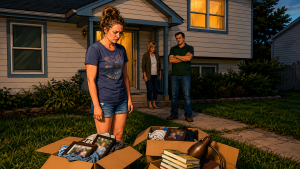
The first thing I saw was my blue storage bin on the lawn.
Then a cardboard box.
Then my desk lamp lying sideways in the grass.
For a few seconds, my brain refused to arrange the scene into meaning.
I parked at the curb and sat there, engine running, staring at my own belongings scattered across the yard.
Clothes were draped over boxes.
Books leaned in uneven stacks.
A framed photo of my graduation lay face down near the walkway.
My chest became hollow.
I got out slowly.
The front door opened before I reached it.
My mother stood there with one hand pressed to her throat.
“Zoya,” she said.
I looked past her.
From upstairs, I heard children laughing.
Not visiting-laughing.
Settled-in laughing.
I walked inside without asking permission.
The living room smelled like takeout and Sandra’s floral perfume.
Marcus came out of the kitchen holding a soda can.
He did not look surprised to see me.
“Hey,” he said too casually.
“You’re back early.”
“I’m back on the day I said I’d be back.”
He glanced toward the stairs.
“Right.
Well.
We need to talk.”
I did not answer.
I climbed the stairs.
My mother followed behind me, whispering my name, each time softer than the last.
At the top of the hall, the door to my room was open.
My bedspread was gone.
The desk I worked at every day had been pushed against the wall.
Two small mattresses sat on the floor.
A pile of children’s clothes filled my chair.
My old dresser had stickers on one drawer.
Sandra stood in the middle of the room, folding a pink blanket like she had every right to touch the air in there.
“Oh,” she said.
“You’re home.”
I could barely hear over the pulse in my ears.
“Why is my stuff on the lawn?”
Sandra sighed like I had asked why rain was wet.
“We needed the room for the kids.”
I stared at her.
“You needed my room.”
Marcus appeared behind me in the hallway.
“It makes sense, Zo.
The kids can’t sleep in the living room.”
“Why would they be sleeping here at all?”
Sandra’s mouth tightened.
Marcus looked annoyed that I was forcing him to say it plainly.
“We’re going to stay here for a while.”
“How long is a while?”
He rubbed his
jaw.
“We’re figuring things out.”
I laughed once, but it came out wrong.
“You moved into the house I pay for while I was gone?”
Dad’s voice came from the staircase.
“Don’t say it like that.”
I turned and saw him standing halfway up, gripping the railing.
He looked pale, angry, ashamed, and somehow still ready to blame me for noticing.
“How should I say it?” I asked.
Mom was crying quietly now.
“Your brother is having trouble.
They lost their rental.”
Sandra snapped, “We didn’t lose it.
The landlord was unreasonable.”
Marcus shot her a look.
I looked from one face to another.
“And no one thought to tell me?”
“We knew you’d make it difficult,” Marcus said.
That was when something inside me went very still.
Not loud.
Not dramatic.
Still.
“You put my belongings outside because you thought I would object to being removed from my own room.”
Sandra folded her arms.
“It’s not your house.”
The sentence landed like a slap.
No one corrected her.
The hallway seemed to narrow.
I looked at my mother.
She cried harder but said nothing.
I looked at my father.
His eyes shifted away.
Marcus stepped closer, lowering his voice like he was managing a customer.
“Look, you’re single.
You work on a laptop.
You can stay in the den………………………………….

