My grandfather flew six hours to attend my brother’s wedding, and my parents sat him behind the trash cans.
Even now, when I force myself to remember that afternoon from the beginning, that is the detail that burns the deepest.
Not the slap.
Not the jet.
Not even the moment my mother’s face turned white in front of two hundred guests.
It was the folding chair.
A cheap gray metal chair dragged over gravel by a catering server who looked embarrassed to be following the order, then set down beside two green bins that smelled like rotting fruit, coffee grounds, and stale champagne.
That chair was where my grandfather, a seventy-eight-year-old man who had crossed half the country to be there, was told to sit so he would not spoil the pictures.
Our family had chosen a vineyard estate for the wedding because my mother said elegance mattered.
She had said it for months.
Elegance in the flowers, elegance in the invitations, elegance in the guest list, elegance in the champagne.
She said it so often it stopped sounding like a preference and started sounding like a religion.
My brother Daniel had married into money, or at least into the kind of family that liked to look like money had never once been a struggle.
Vanessa’s parents owned hotels.
Their friends arrived in soft cashmere and summer silk.
They knew which fork to use without glancing down.
They hugged without wrinkling their clothes.
Even the way they laughed sounded curated.
My mother was in heaven.
She had spent the entire engagement treating the wedding like a final exam in social climbing.
She obsessed over flowers, menu cards, imported candles, chair fabrics, drone footage, welcome boxes, and which relatives could be displayed and which had to be managed.
Grandfather, apparently, belonged in the second category.
His name was Mateo Varela, though most people just called him Mateo.
He lived quietly in an old stone house near the coast, far from country clubs and gala dinners and all the people my mother wanted to impress.
He wore old coats because he liked the feel of them.
He kept his hair neatly combed.
He repaired things instead of replacing them.
He brewed tea in the same dented kettle he had owned for years and sent handwritten birthday cards even when nobody sent them back.
I had spent more time with him than anyone else in my family.
When I was twelve and got suspended for punching a girl who had mocked my stutter, my parents screamed about humiliation, school records, and disgrace.
Grandfather sat beside me in the garden and handed me a peach.
He did not ask what I had done first.
He asked why.
When I told him, ashamed and furious, he nodded once and said, “Next time, use words if they will work.
Hands only if they won’t.
But never let anyone teach you that silence is virtue.”
When I was sixteen and my mother told me I was too loud, too blunt, too intense, Grandfather told me fire frightened people who needed everything to stay cold and arranged.
“That doesn’t make the fire wrong,” he said.
He was not theatrical.
He did not give speeches.
He simply saw things as they were.
That was why I should have understood sooner that the quiet around him was never weakness.
He arrived forty minutes before the ceremony was due to begin.
I saw him first from across the lawn, moving slowly but steadily through the gate with his cane in one hand and his old brown leather bag in the other.
He had on his dark wool coat despite the mild weather, a white shirt buttoned neatly at the throat, and the same polished but worn shoes he always wore to formal occasions.
He looked exactly like himself.
Which was to say, he looked like truth in a place built for performance.
I hurried to him before anyone else could get there.
“Grandpa.”
He smiled as soon as he saw me, and the lines around his eyes softened.
“Mira.”
He opened one arm and drew me into a gentle hug.
“You look strong.”
I laughed.
“Not pretty?”
“Pretty is cheap currency,” he said.
“Strong lasts longer.”
I was still smiling when my mother came gliding across the lawn.
She wore pale silver satin that caught the light with every step.
Diamonds flashed at her throat and ears.
Her face was immaculate, not a hair out of place, not a sign that she had been terrorizing vendors and family members for three straight days.
“Elena,” Grandfather said politely.
She did not kiss his cheek.
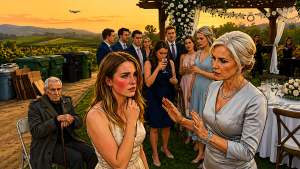
She did not welcome him.
Her eyes dropped immediately to the bag in his hand, then to his coat, then to his shoes.
“Not there,” she said sharply when he looked toward the front row.
He paused.
“Not where?”
“The family section.”
He studied her for a moment.
“I am family.”
Her smile was paper-thin.
“We don’t need the bride’s relatives asking questions.”
“Questions about what?”
She leaned in closer, lowering her voice just enough to pretend she was being discreet.
“About why Daniel’s grandfather looks homeless.”
I felt the shame of it hit my skin before my mind fully caught up.
Grandfather did not react the way I did.
He did not flare.
He did not defend himself.
He only looked at her for one still, searching second, and something in his expression changed, as if he had just found the answer to a question he had been asking quietly for a very long time.
Then he said, “I see.”
That was all.
The wedding planner came over at once, already eager to please whoever seemed most expensive.
My mother pointed toward the service lane as if directing table settings.
“Put him there for now.”
For now.
The phrase might have sounded temporary to anyone who did not know her.
I knew better.
“For now” meant until the important people stopped looking.
A server dragged over the folding chair.
Grandfather sat down without protest.
I could tell by the server’s face that he knew it was wrong.
But wrong is easy work for people who need tips and jobs and peace.
“Mom,” I said, “what are you doing?”
Her eyes snapped toward me.
“Protecting this family from embarrassment.”
“He is not embarrassing.”
“Mira.”
Her voice sharpened.
“Do not start.”
“I’m already started.”
That earned me a warning look, the kind that promised consequences later.
Then she turned on her heel and floated back to the guests.
I sat beside Grandfather behind the bins.
It is shocking what becomes visible from the edge of a celebration.
People reveal themselves most clearly when they think the important audience is elsewhere.
I watched Daniel laughing with Vanessa while a photographer adjusted his posture under the arch.
I watched my father making jokes with Vanessa’s uncle while avoiding even glancing our way.
I watched my mother greet guests with air kisses and gracious hands, receiving compliments on her taste as if she had personally invented white roses.
No one came to move Grandfather.
No one came to apologize.
After a while, Daniel looked over.
Just once.
Long enough to see exactly where his grandfather was sitting.
Long enough to know.
Then Vanessa leaned toward him and whispered something, and his mouth twisted into a tiny, ugly smile before he looked away.
That hurt more than I expected.
As children, Daniel and I had both loved Grandfather.
He used to build us toy boats from scrap wood and float them in the creek.
He taught Daniel how to tie fishing knots and me how to sharpen garden shears.
But somewhere along the line, Daniel learned that our mother’s approval came easier if he laughed at what she laughed at.
He became smooth where I became difficult.
Rewarded where I became exhausting.
By the time we were adults, he no longer needed to be told whom to ignore.
He anticipated it.
Grandfather rested his hands on the cane.
“You don’t need to burn for me,” he said quietly.
“I do,” I replied.
He looked at me with a calm that never felt passive, only measured.
“Good.
Fire has its uses.”
Then my mother came back.
She had been scanning the lawn and finally noticed what several guests had noticed before her: I was still sitting beside the man she had tried to hide.
Her perfume reached us first, expensive and suffocating.
“You always do this,” she hissed.
“You always choose the moment that hurts us most.”
I stood up so fast the folding chair scraped.
“Hurts you?
You put your husband’s father behind trash cans.”
She folded her arms.
“Do not make this bigger than it is.”
“He flew six hours to be here.”
She leaned closer.
“And he should have had the decency to understand the situation.”
“The situation?”
I could hear my own voice rising.
Guests had begun turning toward us.
“That the bride’s family is wealthy, so you’re pretending the old man who raised your husband is some filthy secret?”
Her face hardened.
“He is a stain.”
“No,” I said.
“He is the only decent person here.”
The slap came so fast I barely saw it.
It snapped my head to the side.
My earring tore free.
A gasp rippled across the lawn.
For a second all I heard was ringing.
Then my father’s hand clamped around my arm.
“Enough,” he said, his voice low and deadly.
“Leave.
Right now.
Do not come back and ruin your brother’s day.”
He shoved me toward the side path.
I stumbled, caught myself, and turned back.
Daniel stood near the altar in his custom tuxedo, rigid and silent.
Vanessa clung to his arm, not shocked so much as annoyed that attention had strayed from her.
My mother smoothed a hand over her hair and lifted her chin as though she had merely corrected a child.
Guests looked everywhere except directly at us.
Only Grandfather remained exactly where he was.
But his expression had changed.
The hurt was still there, somewhere very deep, but another thing had settled over it: stillness.
Not defeat.
Not even anger.
Recognition.
The kind of expression a man wears when the truth has finally become too plain to deny.
He bent slowly, picked up the leather bag, and opened it.
My mother laughed under her breath.
“What now?”
I expected medication.
A handkerchief.
Maybe travel papers.
Instead, Grandfather took out a sleek dark phone unlike anything I had ever seen him use.
Even my father looked startled.
Grandfather rose carefully with the aid of his cane, straightened his coat, and pressed the phone to his ear.
“Bring it in,” he said.
Just those three words.
Then he ended the call and slipped the phone back into the bag.
My mother gave a brittle, dismissive little smile.
“Really?
That’s your performance?”
Grandfather said nothing.
For several seconds, nothing happened.
The violin quartet began again uncertainly.
A waiter carried past a tray of champagne.
Someone in the second row muttered that the ceremony should start.
Then a low mechanical thunder rolled over the vineyard.
Guests looked up.
A white jet appeared beyond the hill and descended toward the private airstrip that belonged to the estate.
The same airstrip my mother had bragged about to everyone who would listen, though she said it was only used by the highest-level clients.
The plane touched down smooth as silk.
A minute later, two black SUVs came fast along the service road.
The first stopped near the arch.
A tall man in a dark uniform stepped out and opened the rear door.
Behind him emerged a woman in a navy suit carrying a leather portfolio and another man with an earpiece.
They walked directly past my parents.
Directly past Daniel.
Directly toward my grandfather.
“Mr.
Varela,” the tall man said with a slight incline of his head, “we’re ready whenever you are, sir.”
A visible tremor ran through my mother.
My father’s face had gone gray.
“What is this?” he demanded.
The woman in the suit looked at him briefly, then back to Grandfather.
“Sir, we also recovered the original transfer documents.”
She opened the portfolio with practiced calm.
“Including the unauthorized amendment signed by your son and countersigned by his wife.”
No one moved.
My father stared at the papers as if he recognized them.
My mother made a soft choking sound.
“What amendment?”
That was when I understood something was wrong on a level far deeper than cruelty or snobbery.
There was history here.
Money.
Betrayal.
Daniel stepped forward at last.
“Grandpa, I don’t understand.”
Grandfather turned to look at him.
There was no drama in his face, no desire to humiliate.
Only profound disappointment.
“Of course you don’t,” he said.
Then he looked at my father.
My father had spent years telling everyone that Grandfather had once owned a small shipping business and sold it long ago, that age had made him eccentric, that he lived on savings and sentiment.
I had never cared enough to question the story because Grandfather himself never spoke about money.
He paid for what he needed.
He gave quietly when he could.
That was all.
Now I watched my father’s mouth go dry.
The woman in the suit held out the first document.
“Shall I proceed, sir?”
Grandfather nodded.
She turned and addressed the gathering with the serene confidence of someone accustomed to reading statements that change rooms.
“For the sake of clarity,” she said, “Mr.
Mateo Varela is the founder and majority beneficial owner of Varela Global Freight, Varela Coastal Holdings, and the trust that purchased this estate twelve years ago.”
The vineyard went dead silent.
Even the wind seemed to pause.
My mother blinked as though the words could not be translated into anything real.
“That’s impossible.”………………………………..

