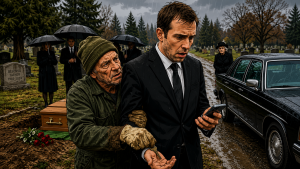
At my father’s funeral, the gravedigger caught my arm and told me the coffin going into the ground was empty.
By the time I reached Route 9, I had replayed those words so many times they no longer sounded like English.
The cemetery mud had dried in dark streaks on my shoes.
My tie was still pulled tight from the service.
My mother’s text—Come home alone—sat at the top of my phone like a threat pretending to be a request.
Route 9 Storage sat behind a chain-link fence and a flickering security light, half hidden between a tire shop and an abandoned diner.
The office was closed.
Rain tapped on the roof of my car hard enough to sound like fingers.
Unit 17 was in the back row.
The brass key Marcus had given me slid into the padlock as if it had been waiting years for that exact moment.
When the metal door rattled up, I braced for boxes, old furniture, maybe some last secret my father had kept from the family.
What I found was stranger.
A folding table stood in the center of the unit beneath a hanging bulb.
There was a metal lockbox, a sealed banker’s box, a duffel bag, and my father’s wristwatch laid in the middle of the table like a piece of evidence.
It was the same watch I had seen on him at the hospital.
The same scratched silver face.
The same cracked leather band I had begged him to replace for years.
My knees nearly gave out.
Then the small monitor on a shelf against the wall flickered to life.
Black and white.
Grainy.
Live.
It showed the living room of my parents’ house.
My mother walked into frame in the same black dress she had worn to the cemetery.
She wasn’t crying.
Not even close.
She crossed straight to the fireplace, dropped to her knees, and reached behind the mantel with frantic, angry movements.
A second later my uncle Raymond came into view, loosened tie, wet hair, face drained of patience.
“If Julian talked to the cemetery man first,” Raymond said, “we’re out of time.”
My mouth went dry.
The burner phone on the table started ringing.
I answered on the third buzz because my hand was shaking too hard to do it sooner.
“Say something,” a voice said.
I forgot how to breathe.
The voice was thinner than I remembered, worn raw by exhaustion, but it was still his.
My father had a way of clipping the ends of certain words, like he was always holding back a larger thought.
No impersonator would have known that.
No stranger would have known the sentence he said next.
“When you were eight, you hid a bluegill in your mother’s freezer because you thought keeping it cold would bring it back to life.”
I grabbed the edge of the table to stay standing.
“Dad?”
“Yes.”
The word broke something open inside me.
Relief hit first, then anger so sharp it made my vision blur.
“Where are you?”
“Somewhere safe for the moment.
Listen to me, Julian.
You don’t have time to be furious yet.”
“I buried you.”
“I know.”
“You let me bury you.”
“I know,” he said again, and this time his voice cracked.
“I’m sorry.
But if I had told
you, your face would have told her.
You never learned how to lie to your mother.”
I looked back at the monitor.
Evelyn was still searching behind the mantel.
Raymond had moved to the study doorway and was scanning the room like he expected me to step out of the walls.
“What is this?” I whispered.
“What am I looking at?”
“The truth,” my father said.
“Open the envelope first.
Then the banker’s box.
And don’t go home until you’ve seen enough that she can’t talk you out of it.”
His line went dead.
I stood there with the receiver pressed to my ear long after the call ended, as if keeping it there might bring him back.
Then I tore open the envelope with clumsy fingers.
Inside was a three-page letter and a flash drive taped to the back.
The first line read: If Marcus handed you this, then I failed to protect you by ordinary means.
I sat on an overturned bucket and read every word.
My father had spent the last year pretending to decline faster than he was.
Some of the weakness had been real.
Most of it had not.
He wrote that he had discovered missing money from Mercer Supply eighteen months earlier—small transfers at first, hidden across vendor accounts, then larger sums routed through shell companies he didn’t recognize.
When he traced the authorizations, every trail bent back toward two people: Evelyn and Raymond.
Raymond had worked beside my father for twenty years, first as his younger brother, then as CFO when the company grew.
My mother handled the family trusts.
Together they had access to every place a family keeps its power.
My father wrote that at first he assumed desperation, not betrayal.
Then he found hotel receipts, burner phones, and messages that made it impossible to pretend they were only stealing money.
They were having an affair.
Even after reading the words, I had to stare at them a second time.
My mother and my uncle.
Not by blood, but by marriage and years of shared holidays, shared tables, shared memories.
The kind of betrayal that makes the entire past feel contaminated.
My father wrote that when he confronted Evelyn gently, asking questions he hoped she’d answer honestly, she changed tactics.
She took over his medication schedule completely.
She insisted on handling his appointments.
She began telling staff, relatives, and even me that he was getting forgetful, suspicious, difficult.
Some of that had been true.
Some of it had been caused.
He had secretly tested several pills and found sedatives mixed into doses he had never been prescribed.
At the bottom of the second page he had underlined one sentence twice.
If she can convince everyone I am confused, then anything I say against her sounds like a symptom.
My stomach lurched.
Suddenly a dozen moments from the last few months rearranged themselves into a pattern I hadn’t wanted to see.
The way my mother answered for him before he finished speaking.
The way Raymond always appeared when financial documents needed signing.
The time my father gripped my wrist in the hospital and told me not to let her decide what I believed.
I had blamed the medication.
I had smiled, calmed him down, and told myself stress was making him dramatic
before the grief had even arrived.
I hated myself for that.
The banker’s box contained neatly labeled folders, copies of account statements, photos, pharmacy printouts, and a digital recorder.
Underneath those was a second envelope addressed to Detective Lena Ortiz, head of financial crimes in our county.
I knew the name.
She had investigated one of Raymond’s competitors years ago.
I pushed the flash drive into an old laptop sitting under the table.
There were six video files.
The first showed my father’s study, angle high, sound clear.
A hidden camera.
My mother stepped into frame, followed by Raymond.
This recording was dated three weeks before the funeral.
“He’s asking too many questions,” Raymond said.
“Then keep him tired,” my mother replied.
“He refused the new papers.”
“Not for long.”
“What about Julian?”
My mother’s answer came without hesitation.
“Julian does what love asks of him.
He always has.”
I stared so hard at the screen my eyes watered.
The next file was worse.
Raymond set a pill organizer on the desk.
“This much and he’ll sleep through the afternoon.”
My mother leaned against the bookshelf and crossed her arms.
“He doesn’t need to sleep.
He needs to sign.”
“And if he doesn’t?”
She was silent for a beat.
Then she said, “Then we wait for the funeral and bring Julian home alone.”
I rewound that line three times, each time wishing I had heard it wrong.
By the fourth file, I was no longer doubting anything.
There were forged signatures.
Fake minutes from a board meeting.
Drafts of emergency transfer documents that would move temporary control of Mercer Supply and the family trusts to my mother in the event of my father’s death, with me serving as the clean-looking legal bridge between old authority and new theft.
If I signed, even in good faith, my name would make the whole thing look legitimate.
That was why she wanted me home alone.
Not to grieve.
To use me.
A set of headlights washed across the open storage unit.
I stood so fast I knocked the chair over.
A woman in a dark coat stepped out of an unmarked sedan and lifted both hands where I could see them.
“Julian Mercer?” she asked.
I nearly laughed from the violence of the adrenaline still in my bloodstream.
“Who are you?”
“Lena Ortiz.” She nodded at the envelope in my hand.
“Your father said you’d need proof before you trusted anybody.”
She looked exactly like her file photos from the courthouse pages I half remembered—sharp eyes, no wasted movement, the expression of someone who had stopped being impressed by other people’s panic years ago.
I almost told her to leave.
Instead I handed her the recorder.
She listened to less than two minutes before her face hardened.
“How long have you had these?”
“About twelve minutes.”
“Is your wife with your mother?”
“No.
Claire took the kids to her sister’s after the service.”
Ortiz pulled out her phone immediately.
“Good.
Keep it that way.”
Within twenty minutes the storage unit was full of controlled motion—two plainclothes officers, evidence bags, quiet radios, one tech copying the drive.
I stood in the middle of it all with cemetery mud still on my shoes and my father’s apology burning in my pocket.
Ortiz came back to
me after reviewing the files.
“Your father wasn’t exaggerating.
This is conspiracy, fraud, likely elder abuse, and more if the pharmacy records hold.”
“Then go arrest them.”
“We will.” Her voice stayed level.
“But your father believes there’s an original ledger and signed transfer packet still in the house.
If we hit too early and miss those, Raymond will say the recordings were role-play, jokes, taken out of context, fabricated by a paranoid husband.
Bad argument, but people make bad arguments when millions are involved.”
I looked at the live feed on the monitor.
My mother and Raymond were gone from the living room now.
Somewhere inside that house, they were waiting for me.
“What does he want me to do?” I asked.
Ortiz didn’t answer immediately, which told me everything.
“No,” I said.
“Julian—”
“No.
Absolutely not.”
Then my father called again.
Ortiz put the phone on speaker.
“I wouldn’t ask if there were another way,” he said.
“They need something tonight.
Documents, keys, a signature, maybe all three.
They think time is their ally.
Use that.”
“You want me to walk into that house after this?”
“I want you to survive it,” he said quietly.
“Ortiz will have people outside.
You’ll be wired.
The second they start pushing for what they wanted all along, the mask comes off.”
I shut my eyes.
For a moment I was eight years old again, following my father down a pier at sunrise, trying to keep my feet in his footprints because I believed that was how boys became men.
I had loved him with the simple, absolute loyalty only children possess.
I had loved my mother the same way.
Realizing one of them had used that love and the other had weaponized it was enough to make me feel younger than either of them.
Ortiz waited.
So did the house on the monitor.
“Fine,” I said at last.
“Tell me exactly what to do.”
They fitted a recorder beneath my shirt and ran through instructions twice.
Keep my hands visible.
Don’t accuse too early.
Ask open questions.
Let them talk.
Stall if they push papers at me.
If Raymond gets physical, say his name loudly.
There would be officers in two unmarked cars, one across the street, one behind the neighboring property.
Claire and the kids were already being moved to a hotel under police watch, though Ortiz had told them only that there was a legal emergency involving the business.
I was grateful for that.
I wasn’t ready to hear this story in my own voice.
The drive home felt longer than the trip to the cemetery.
Every familiar street looked wrong.
The bakery where my mother used to buy my birthday cakes.
The red light where my father once taught me to drive stick in his old truck.
The little park where Claire and I pushed our daughter on the swings the day we told my parents we were expecting again.
All of it had happened inside a life that no longer existed.
The house glowed at the end of the cul-de-sac, every downstairs light on.
My mother opened the door before I could use my key.
“Sweetheart,” she said, and for one dangerous second she sounded like herself again.
Then she hugged me.
I went rigid.
Her perfume
was the same one she had worn my entire childhood.
Gardenia and powder.
Safe, familiar, impossible.
The scent nearly undid me more than the recordings had.
“You took so long,” she murmured against my cheek.
“I had to think.”
She pulled back and studied my face.
“About what?”
Inside, the house was spotless in the frantic way clean things become when people are trying to erase tension.
The crystal bowl on the entry table had been turned so the chipped side faced the wall.
My father’s framed photo from the service was already on the mantel, draped with a black ribbon.
Raymond stood in the dining room with two folders and a drink he hadn’t touched.
He didn’t look surprised to see me.
“Julian,” he said.
“Come sit down.”
I stayed by the doorway.
“Why did you text me to come alone?”
My mother’s expression softened with practiced injury.
“Because I needed my son.”
“Or because you didn’t want Claire here?”
Raymond’s jaw flexed.
“This is not the time.”
“No,” I said.
“Apparently it’s exactly the time.”
Silence stretched.
Then my mother let the sadness drop off her face like a coat sliding from someone’s shoulders.
Not all at once, but enough that I saw the woman from the videos instead of the one who bandaged my knees and packed my lunches.
“There are documents that need your signature tonight,” she said.
“There it is.”
“Your father left the business in a vulnerable position.
If we don’t move quickly, accounts freeze, vendors panic, employees hear rumors.
I need you to help me stabilize things.”
“By signing what?”
Raymond opened a folder and turned it toward me.
Emergency transfer of operating authority.
Interim trustee authorization.
Two signatures already there—my mother’s and Raymond’s.
A third line waited for mine.
My father’s forged signature sat on page three.
I stared at it without sitting down.
“When did he sign this?” I asked.
My mother answered too quickly.
“Last week.”
“Interesting,” I said.
“Because last week he could barely hold a pen.”
Raymond set his drink down harder than necessary.
“Your father understood the stakes.”
“My father also hated you touching company paperwork without legal review.”
“Julian,” my mother said, voice sharpening, “do not make tonight harder than it needs to be.”
The recorder against my chest suddenly felt hot.
I looked around the room deliberately.
“What are you really trying to find?”
Her face changed.
It was subtle.
Tiny.
But it changed.
Raymond saw it too and took over.
“What did Marcus give you?”
There it was.
I let two beats pass before answering.
“Who?”
My uncle moved closer.
“Don’t insult me.”
My mother’s eyes flicked to my coat, then to my empty hands, then back to my face.
“If the cemetery man said something to you, this is the moment to tell us.”
Us.
As if there were still an us.
“He told me to go home,” I said, and watched their shoulders loosen by half an inch.
“He said my mother needed me.”
Raymond looked unconvinced.
My mother did not.
She stepped closer, reaching for the old lever of intimacy.
“Julian, your father was not well,” she said softly.
“You know that.
In the last few months he became suspicious.
Cruel, even.
He saw enemies everywhere.
He would have destroyed this
family just to feel in control one more time.”
The lies would have landed once.
Maybe even yesterday.
Tonight they sounded rehearsed.
“Destroyed this family?” I said.
“Is that what you call it?”
Her eyes narrowed.
“What is that supposed to mean?”
I looked straight at her.
“How long have you been sleeping with Raymond?”
For one stunning second nobody moved.
My mother’s face drained of color.
Raymond swore under his breath and lunged for the folder.
I stepped back, but he caught my wrist before I reached the foyer.
“Let go,” I said loudly.
Somewhere outside, a car door opened.
But Raymond was too far gone to hear it.
“What did he show you?” he hissed.
“Where is it?”
My mother grabbed his arm.
“Ray, stop.”
“No,” he snapped.
“He’s bluffing.”
I yanked free and the folder hit the floor, papers sliding across the hardwood.
One sheet landed upside down at my feet.
I turned it over and saw a pharmacy printout with my father’s name and a dosage changed by hand.
My mother’s hand flew to her mouth.
Raymond realized what he’d dropped a second too late.
“So it was you,” I said.
My mother’s voice came out thin and ragged.
“It wasn’t supposed to become this.”
My chest felt hollow.
“What wasn’t?”
She looked at me then, truly looked, and some twisted part of her seemed to decide there was no reason to keep performing.
“Your father was going to leave me with nothing,” she said.
“Thirty-five years, Julian.
Thirty-five years of cleaning up his temper, his pride, his endless need to be obeyed.
Everything in this house existed because I kept it standing.
Then he finds a few missing lines on a ledger and decides I deserve humiliation? Ruin? No.”
“A few missing lines?”
Raymond laughed once, ugly and breathless.
“This isn’t about a few lines.
It’s about what belongs to the people who built it.”
“You didn’t build it,” I said.
“You stole it.”
My mother flinched, but only for a moment.
“We adjusted his medications.
That’s all.
He needed to be manageable long enough to sign what should have been signed years ago.”
“And after the funeral?” I asked.
“What was I for?”
Her answer came in a whisper.
“You were supposed to make it clean.”
The room went still.
Behind me, from the front doorway, a familiar voice said, “He already heard the dirty part.”
Every hair on my arms lifted.
My mother turned.
My father stood in the doorway, pale, thinner than he’d looked at the hospital, dressed in a dark wool coat damp with rain.
Detective Ortiz stood just behind his right shoulder.
Two officers moved past them in silence.
My mother’s glass shattered when it hit the floor.
“No,” she said.
Then louder, as if volume could correct reality.
“No.”
Raymond actually stumbled backward.
“Thomas—”
“Don’t.” My father’s voice was quiet, which made it worse.
“Don’t say my name like you’ve earned it.”
Everything in me wanted to run to him and hit him at the same time.
He was alive.
He was alive.
He was alive, and I had watched dirt cover a coffin because he decided that was the only way to expose the woman he’d married.
Ortiz stepped forward.
“Evelyn Mercer.
Raymond Mercer.
You’re under arrest for
conspiracy to commit fraud, financial exploitation, forgery, and related offenses pending further charges.”
Raymond bolted for the kitchen.
He made it three steps.
An officer took him down so hard the silverware drawer rattled.
My mother didn’t run.
She looked from the police to my father to me, and the first real fear I saw in her all night had nothing to do with handcuffs.
It was the fear of finally being seen without the story she had always controlled.
“Julian,” she said.
“Listen to me.”
I took one step back.
That hurt her more than the cuffs did.
She started crying then—real tears or useful ones, I’ll never know.
She said my name again.
She said she had done what she thought she had to do.
She said my father had pushed everyone too far.
She said Raymond had handled the money, the pills, the panic.
She said a dozen things, each one trying to spread guilt so thin that no single person would have to wear the whole weight.
My father didn’t look at her.
He looked at me.
“I am sorry,” he said………………………………

