The auctioneer’s voice carried across the Schroeder farmyard on a raw March morning in 1985, thin and sharp in the cold air.
Tom Schroeder stood behind the crowd with his arms folded tight against his chest.
He looked less like a man watching an auction and more like a man bracing himself for impact.
His wife, Linda, was not there.
Three days earlier, she had packed the children into the station wagon and driven to her sister’s place in Mankato.
She had said goodbye in the kitchen, touching the doorframe with one hand before she left, as if she was trying to memorize the grain of the wood.
She could not watch strangers pick through twenty-three years of their life.
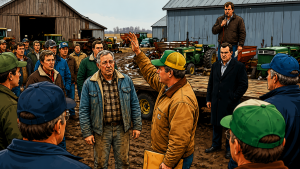
The crowd was larger than Tom expected.
Nearly two hundred people stood between the barn, machine shed, and driveway.
Some were neighbors who looked at him with pity and quickly looked away.
Some were dealers who had driven in with empty trailers and hungry eyes.
And near the machine shed stood three men from First Agricultural Bank of Blue Earth, wearing clean coats and polished shoes that looked wrong in a farmyard.
Tom knew why they had come.
They had not come for a tractor.
They had come for the land.
At the back of the crowd, nearly hidden behind a grain truck, Rick Palowski watched in silence.
He was forty-two, broad shouldered, sun-browned, and tired in the same way every farmer looked tired that year.
His John Deere cap was pulled low, and his hands were shoved deep into the pockets of his Carhartt jacket.
Nobody paid him much attention.
That would change before the afternoon was over.
The morning started with equipment.
The auctioneer called out Tom’s 1979 John Deere 4440, the tractor Tom had once been proud enough to park facing the road.
He had bought it new when interest rates were rising but land was still climbing and every banker in the county was telling farmers to grow or get left behind.
The bidding started at twelve thousand dollars.
Tom swallowed hard.
He had paid thirty-eight thousand for it.
The bids crept upward in small, reluctant steps.
A dealer from Worthington stopped at sixteen.
A farmer from Martin County stopped at seventeen-five.
The tractor finally sold for $18,200 to an implement dealer from Marshall who barely looked at Tom when he handed over the cashier’s check.
Tom knew what would happen next.
The man would clean the tractor, replace a few decals, park it on his lot, and ask ten thousand more by Monday.
The International 1086 brought less than half of what Tom had paid.
The planter sold cheap.
The disc sold cheaper.
Wagons, tools, gates, feeders, parts, and grease guns disappeared into other men’s pickups.
Each sale felt small by itself.
Together, they felt like a farm being dismantled bone by bone.
Rick Palowski did not bid on any of it.
He watched with a stillness that almost made him disappear.
At noon, during the break before the livestock sale, Tom’s brother found him sitting on the tailgate of his pickup.
“You all right?” his brother asked.
Tom stared toward the barn.
“No,” he said at last.
“But that does not matter much now.”
His brother sat beside him and said nothing.
After a while, Tom spoke again.
His voice was flat, the way a man sounds when he has spent all his anger and has only the truth left.
“The worst part is not even losing it today.
The worst part is they will sell this ground later for what it is really worth.
Maybe to some doctor from the Cities.
Maybe to an investor.
Maybe to one of those companies buying land through three different names.
And after they are done, I will still owe them a deficiency.
They take the land, and they keep the debt tied around my neck.”
His brother looked down at the gravel between his boots.
There was no comfort to offer.
Tom had not gambled the farm away.
He had followed advice that sounded responsible when it was given.
In 1979, the county extension office had urged expansion.
Economists spoke at meetings with charts that made land look safer than money in the bank.
Loan officers smiled across desks and told farmers leverage was not danger.
It was opportunity.
Tom bought the neighbor’s quarter section.
He upgraded equipment.
He borrowed against land everyone said would keep rising.
Then interest rates climbed until operating notes became impossible.
Grain prices fell.
Export markets shrank.
Land values collapsed.
The same banks that once pushed money across the desk suddenly demanded payment from men whose entire net worth was trapped in dirt no one wanted to appraise honestly anymore.
Tom had done what the experts told him to do.
That did not save him.
The livestock sale hurt worse than the machinery.
A tractor was metal.
A cow had breath, memory, habits, and trust.
Tom watched Holsteins he had raised from calves led into strange trailers.
He remembered one he had pulled in a February snowstorm while Linda held a lantern near the stall.
He remembered another that would always turn her head when he called her by name.
When the last trailer door latched shut, Tom stepped behind the barn for a moment and pressed both hands against the cold boards.
Rick saw him do it.
By 1:45, the crowd gathered again near the driveway.
This was what everyone had been waiting for.
The land.
Six hundred and forty acres in Faribault County.
Good soil.
Tile drained.
Close to a paved road.
The kind of land that used to be spoken of with respect, not measured for liquidation value.
The auctioneer climbed onto a platform and tapped the microphone.
“We will offer four parcels,” he announced.
“The home quarter, one hundred sixty acres including buildings and homestead.
The north quarter.
The south quarter.
And the west eighty.
We will sell them individually first, then offer the whole operation as a package.”
Tom felt his stomach tighten.
The bank men moved closer.
“Bidding on the home quarter will start at one thousand dollars per acre,” the auctioneer said.
“That is one hundred sixty thousand dollars for the home quarter with improvements.”
A local farmer raised his hand.
“One thousand,” the auctioneer called.
“Do I hear eleven hundred?”
One of the bank representatives lifted his hand.
“Eleven hundred.”
The local farmer dropped out immediately.
He knew what everyone knew.
When the bank wanted land at one of its own foreclosure sales, ordinary men did not fight it.
The bank had deeper pockets.
The bank had time.
The bank had no children crying in a borrowed bedroom in Mankato.
“Going once at eleven hundred,” the auctioneer said.
Then Rick Palowski raised his hand.
“Twelve hundred,” he said.
The entire crowd seemed to turn at the same time.
Tom looked at Rick as if he had misheard.
Rick had no business bidding.
He farmed eight hundred acres north of town, and everyone knew he carried debt too.
He was not a rich man.
He was not an investor.
He was another farmer trying to survive the same storm.
The bank representative’s expression hardened.
“Thirteen hundred,” he said.
“Fourteen,” Rick answered.
The auctioneer glanced between them.
“Fifteen hundred,” the bank man snapped.
“Sixteen,” Rick said.
A murmur spread through the yard.
Tom could hear men whispering behind him.
Somebody said Rick had lost his mind.
Somebody else said his lender must not know he was here.
The bank representative turned to a colleague and spoke through clenched teeth.
“Seventeen hundred,” he called.
Rick paused just long enough for Tom’s heart to drop.
Then he said, “Eighteen.”
The yard went still.
The bank pushed once more.
“Nineteen.”
Rick did not look at the bank.
He looked at the auctioneer.
“Two thousand.”
The number landed like a dropped gate.
Two thousand dollars per acre.
Three hundred twenty thousand dollars for the home quarter alone.
More than the bank wanted to risk.
More than anyone expected land to bring in that market.
More than enough to make the bank’s quiet plan suddenly look very different.
The bank men huddled.
Tom could see anger on their faces now.
Not concern.
Not calculation.
Anger.
At last, the lead representative stepped back.
“I have two thousand dollars per acre,” the auctioneer said.
“Do I hear any advance?”
No one moved.
“Going once.”
A strip of loose tin rattled on the machine shed roof.
“Going twice.”
Rick stood motionless.
“Sold.”
For a second, there was no sound at all.
Then the bank representative pushed through the crowd toward the auctioneer.
“You need to verify funds,” he said loudly enough for everyone to hear.
“Right now.”
Rick walked forward.
He did not argue.
He did not raise his voice.
He reached into his jacket and removed a thick envelope, then handed it to the clerk beside the platform.
“Ten percent earnest,” Rick said.
“Cashier’s check.
Financing letter is behind it.”
The clerk opened the envelope, looked once, then looked again.
The bank man’s face changed.
That was the first time Tom understood Rick had not made a reckless bid in the heat of the moment.
Rick had come prepared.
But the auction was not over.
The north quarter came next.
The bank tried to reset the room by bidding low and fast.
This time, another hand rose before Rick’s did.
It belonged to Walt Jensen, a quiet widower who farmed land across the section line.
The bank bid.
Walt answered.
The bank bid again.
Rick raised his hand once, not to take the parcel, but to keep the price moving.
The north quarter sold to Walt at a price that made the bank men stop smiling.
The south quarter followed.
A younger couple, the Millers, who had been renting land for years and had never been able to buy, stepped into the bidding.
They looked terrified, but they did not back down.
When the bank tried to push them out, Rick bid once behind them, then stopped the moment the bank withdrew.
The west eighty sold last to a retired schoolteacher named Mary Koenig, whose late husband had once worked harvests for Tom’s father.
She had stood near the driveway all morning holding a small purse in both hands.
No one had expected her to bid on anything.
By the time the individual parcels were finished, the mood in the yard had changed completely.
The bank had not captured a single acre.
But there was still the package offering.
The auctioneer cleared his throat.
Everyone knew the rule had been announced at the beginning.
The land could still be offered as one complete farm.
If someone bid more than the total of the individual parcels, the whole operation could be sold together………………………….

