My son told me to come after the presents were opened, after breakfast was finished, after the family part of Christmas had already happened.
The message arrived while I was standing in my apartment kitchen with my reading glasses low on my nose and a measuring cup in my hand.
I had been checking the sweet potatoes, wondering if I still had enough brown sugar, when my phone lit up beside the sink.
Morning is just going to be us and the boys this year.
Come around three for pie if you want.
For a long moment, I did not move.
The measuring cup stayed in my hand.
The little kitchen clock ticked over the stove.
Outside my window, a maintenance man pushed a gray cart down the sidewalk between the apartment buildings, and somewhere down the hall, someone’s television played a Christmas commercial too loudly.
If you want.
Those three words kept blinking in my mind long after the screen went dark.
I was seventy-eight years old.
I had buried my husband, sold the farmhouse we built together, and learned how to wake up in a room that no longer held another person’s breathing.
I had endured the kind of losses people lower their voices to talk about.
But that text had a different kind of blade.
My name is Ruth, and for forty-two years Christmas happened at my table.
Not because I was wealthy.
We counted grocery money more than once.
Not because our house was perfect.
The old farmhouse creaked in the winter, the back door stuck when it rained, and one corner of the living room floor dipped so badly that a marble would roll by itself.
But on Christmas morning, that house came alive.
The windows fogged from the oven.
The hallway smelled like coffee, ham, and cinnamon.
The wrapping paper crackled under everyone’s feet.
Someone was always asking for scissors, batteries, tape, a trash bag, a clean fork, a clean sock, or a minute to breathe.
My husband, Walter, always insisted he knew how to string the tree lights, and every year he somehow left one dark patch in plain sight.
He would stand back with his hands on his hips and say, “Looks fine to me,” while the children groaned.
Our daughter, Ellen, wrapped gifts like she was sealing evidence, using so much tape that people needed a steak knife to open them.
Daniel, my youngest, stole bacon from the breakfast tray before anyone sat down.
When I caught him, he would widen his eyes and blame the dog, even after the dog had been gone for three years.
That house was never peaceful on Christmas morning.
It was full.
It was loud.
It was mine in the way a life is yours when everyone you love leaves fingerprints on it.
Then Walter died on a rainy Tuesday in March, and the farmhouse became too large overnight.
At first, I stayed because leaving felt like betraying him.
His jacket still hung by the back door.
His coffee mug still sat in the cabinet with a chip on the handle.
The garage smelled like sawdust and oil, and sometimes I would stand there just to feel close to the man who used to hum while fixing things.
But grief does not shovel snow.
It does not climb stairs for you.
It does not carry laundry baskets or tighten loose railings or chase mice out of pantry corners.
My knees got worse.
My balance got unreliable.
One winter morning, I slipped on the porch steps and sat there in my coat for fifteen minutes before a neighbor saw me from across the road.
After that, Daniel used the word “safe” a lot.
“Mom, it isn’t safe for you out there alone.”
He was not wrong, which made it harder to argue.
So I signed papers, packed boxes, and sold the house where my children had measured their heights on the pantry door.
Daniel said the apartment would be easier.
Ellen lived in Arizona by then, and she agreed over the phone with the guilty cheerfulness people use when distance protects them from the work of helping.
Now I lived in a one-bedroom apartment in a senior complex outside Columbus.
Beige carpet.
Beige walls.
A small electric fireplace that clicked when I turned it on.
A hallway that smelled faintly of laundry detergent and medicine.
When people asked how I liked it, I said, “It’s cozy.”
The truth was simpler and sadder.
It stayed clean because no one came around often enough to mess it up.
The week before Christmas, I waited for Daniel to call.
Every year before that, even after I moved, he had called with the same question: “Mom, what time can you get here?”
I would pretend to be overwhelmed.
I would say, “Oh, Daniel, I’m not as young as I used to be.”
Then I would hang up and immediately start making a grocery list because being needed has a way of putting strength back into old hands.
This year, the call never came.
On December 23, I told myself he was busy.
On Christmas Eve morning, I told myself he would call after lunch.
By four o’clock, I had checked my phone so many times that the battery was down to seventeen percent.
Finally, pride gave way to longing.
What should I bring tomorrow?
I can still make the sweet potato casserole if the boys want it.
I set the phone on the counter and pretended not to wait.
I wiped down a surface that was already clean.
I straightened a towel.
I moved Walter’s old recipe box two inches to the left and then back again.
Ten minutes later, the reply came.
Don’t wear yourself out.
Kara wants to keep the morning simple.
Just us in pajamas.
Come later for dessert.
No pressure.
No pressure.
That phrase sat in my chest like a stone.
It is a strange thing, being old enough to understand what people mean underneath what they say.
Daniel had not said I was a burden.
Kara had not said I disturbed the picture.
Nobody had been cruel enough to give me the dignity of open cruelty.
They had simply made Christmas smaller, and somehow I was the thing that no longer fit.
I typed, Sounds good, honey.
See you then.
Then I stood there with the phone in my hand and whispered, “I thought I was us.”
No one heard me.
That may have been the worst part.
I made the casserole anyway.
I peeled the sweet potatoes slowly, sitting on a kitchen stool because my knees complained if I stood too long.
I added butter, brown sugar, cinnamon, and a little orange zest the way Walter liked it.
I crushed pecans for the topping and remembered Daniel at ten years old, sneaking marshmallows from the bag when he thought my back was turned.
“You’ll ruin your supper,” I used to say.
“It’s Christmas,” he would answer, as if Christmas itself was a legal defense.
When the casserole went into the oven, the apartment filled with the smell of every Christmas I had ever survived.
For a little while, I could almost pretend.
Christmas morning, I woke at 5:47.
For one foolish second, my body forgot my life had changed.
I nearly threw back the blanket with purpose, thinking there was coffee to start, a ham to check, cinnamon rolls to warm, stockings to set upright after the children dragged them across the floor.
I expected to hear Walter muttering in the hallway because he had misplaced his slippers again.
Then the silence arrived.
It came all at once.
No footsteps.
No cartoons.
No voices.
No laughter from the living room.
No husband coughing softly into his hand before calling, “Ruthie, where’d you put the tape?”
Just the hum of the refrigerator and the empty click of the electric fireplace in the corner.
I made one scrambled egg, one piece of toast, and one cup of coffee.
I used the small plate because the dinner plates made the meal look lonelier.
Then I sat at my tiny kitchen table and watched steam rise from my coffee as if it had somewhere better to go.
At nine, I made another mistake.
I opened my phone.
Pictures filled the screen almost immediately.
Friends from church with grandchildren in matching pajamas.
A woman from my old street surrounded by three generations in front of a crooked tree.
Someone’s kitchen island covered with flour, orange juice, and half-eaten rolls.
Then I saw Kara’s post.
The picture was bright and pretty.
Daniel’s living room glowed with white lights.
Wrapping paper covered the floor in red and green heaps.
My grandsons sat cross-legged in their pajamas, holding new game controllers, their hair sticking up from sleep.
Daniel wore reindeer antlers.
Kara stood behind him with a mug in one hand, smiling in flannel pants and a soft gray sweater.
The caption said: Perfect quiet Christmas with my whole world.
My whole world.
I read it again.
Then again.
The phone screen dimmed and went black, leaving my own face reflected back at me.
Small.
Pale.
Older than I felt inside.
That was the moment I understood something I wish more people would admit.
You can be loved and still be moved to the edge.
You can be remembered and still not be welcomed.
You can be included in a way that lets everyone feel kind, while your heart knows you were invited only after the memories had already been made.
It does not always happen with shouting.
Sometimes it happens politely.
Sometimes it happens with careful phrases, soft voices, and smiling photos posted for everyone to admire.
Nobody has to slam a door.
Sometimes they simply stop opening it wide enough for you to walk through.
By noon, I could not sit in the apartment anymore.
The walls felt closer than they had the day before.
The little fireplace clicked and clicked until I wanted to unplug it.
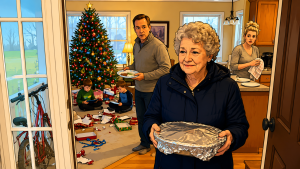
I wrapped foil over the casserole, put on my navy coat, and carried the warm dish to the car with both hands.
I was not due at Daniel’s house until three.
But I was afraid if I stayed alone any longer, something inside me would disappear for good.
The roads were mostly empty.
Christmas decorations hung on streetlights.
A plastic Santa leaned in someone’s yard, waving to no one.
I drove slower than necessary because the casserole was on the passenger seat, tucked against a folded towel so it would not slide.
Halfway there, I pulled into a diner off the highway.
I did not need food.
I needed voices.
Inside, a few people sat at scattered tables.
A truck driver ate pancakes at the counter.
An older couple shared a plate of fries.
The waitress who came to my table looked no more than twenty-two, with tired eyes and a red holiday headband slipping out of place.
“Coffee?” she asked.
“Yes, please.”
She poured it carefully, then glanced at the casserole dish beside me.
“Heading to family?”
I smiled so quickly it hurt.
“My son’s house,” I said.
“My grandsons.”
Her face softened.
“Lucky boys.”
I looked down at the coffee, watched the steam blur, and had to press my napkin to the corner of my eye before she saw.
When I reached Daniel’s neighborhood, every driveway seemed full.
Children’s bikes lay on lawns.
Trash bags stuffed with wrapping paper leaned against garage doors.
Christmas had happened everywhere.
At Daniel’s house, two new bicycles rested near the porch, their tires still clean.
A basketball hoop had been installed above the garage since my last visit.
Torn strips of red paper were caught in the bushes, fluttering in the cold wind.
I sat in the car for a minute with the casserole in my lap.
The dish was warm against my knees.
It felt heavier than ceramic and sweet potatoes.
It felt like evidence.
Like proof that I had once been necessary…………………………

