At my nephew’s birthday party, while silver balloons dragged against the ceiling and relatives carried paper plates of cake through my parents’ living room, I found my four-year-old daughter hiding behind the toilet.
At first, my mind refused to understand it.
Rosie was wedged in the narrow space between the toilet and the sink cabinet, her knees pulled tight to her chest, one tiny hand pressed over her mouth like she had been ordered not to make noise.
The bathroom smelled like hand soap, hairspray, and something faintly sour from the trash can.
Outside the door, everyone was laughing.
Someone shouted for more ice.
Someone else clapped when my nephew blew out his candles for the second time because my sister wanted a better video.
Inside that bathroom, my daughter looked like she had disappeared from the world and was waiting to be found by the only person she still trusted.
Rosie?’ I said.
Her eyes snapped up to mine.
The left side of her face was swollen.
It was not the kind of mark a child gets from running too fast or tripping over a toy truck in a crowded house.
Purple had begun to bloom beneath her skin, dark and heavy, spreading from her cheekbone toward her eye.
The sound was barely a word.
It was a breath.
A plea.
I dropped to my knees so fast the tile stung through my pants.
‘Baby, what happened?’
She shook her head.
Not because she did not know.
Because she was afraid to say.
But when my hand came near her shoulder, she flinched.
My daughter flinched from me.
‘It’s me,’ I said.
‘It’s Daddy.
She let me lift her, but she made a small sound when her arms wrapped around my neck.
I felt her trying not to cry.
Then her sleeves slid up.
I saw the marks.
Round.
Blistered.
Red at the edges.
Scattered in small clusters along her forearms.
For one impossible second, I stared at them without breathing.
My mind tried to bargain with what my eyes were showing me.
Maybe she brushed against something hot.
Maybe it was some awful accident in the kitchen.
Maybe, maybe, maybe.
But there were too many.
They were too neat.
They were placed with intention.
I pressed her closer to me, shielding her arms as if hiding them could undo what had been done.
The whole party outside continued as if nothing in the world had changed.
Forks scraped plates.
A beer cap clicked against a countertop.
My mother’s voice floated down the hall, bright and hostess-sweet, telling someone there was more potato salad in the fridge.
I stood up with Rosie in my arms.
She buried her face in my shirt.
‘Please don’t make me go back,’ she whispered.
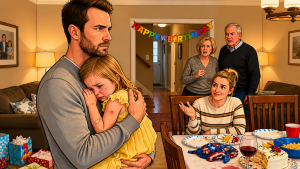
The hallway seemed longer than it ever had before.
I walked past framed photographs of birthdays, graduations,
Christmas mornings, the polished museum of a family that had always cared more about being seen as good than actually being safe.
There was a picture of Bethany and me as kids, arms slung around each other, grinning with missing teeth.
There was one of my late wife holding newborn Rosie, her face pale and exhausted and radiant.
When I stepped into the living room, conversations slowed.
My father was standing beside a cooler near the back door, one hand wrapped around a bottle.
Bethany sat near the window in a cream sweater, wine glass in hand, her lipstick bright against the rim.
My nephew, six years old and oblivious, was trying to peel tape off a new toy box.
‘Who did this?’ I asked.
No one answered.
My mother’s eyes darted to Bethany, then down to the knife in her hand.
My father exhaled through his nose and looked away.
‘Who touched my daughter?’ I said.
Bethany lifted her eyes.
Then annoyed.
Then, when she saw that everyone was watching her, she let out a small laugh.
‘Oh, for God’s sake,’ she said.
‘Don’t start.’
‘What did you do?’
Bethany leaned back in her chair, as if I had interrupted her evening with something inconvenient.
Crying over everything.
Hiding under the table, whining for you, acting like she owned the place.
Rosie’s fingers dug into my collar.
‘Her face,’ I said.
Bethany rolled her eyes.
‘It was a joke.’
The room changed shape around those words.
Even the children went quiet.
My mother whispered, ‘Bethany.’
Not in horror.
Not in condemnation.
In warning.
Bethany waved one hand, the one holding the wine glass.
‘She’s fine.
She’s always dramatic.
You baby her so much that she can’t handle anything.
I barely did anything.’
Barely.
The word hit me harder than if she had denied it.
Because denial would have meant she knew it was monstrous.
Barely meant she knew and wanted credit for restraint.
My mother set the cake knife down.
‘Everyone calm down.’
I stared at her.
‘You knew?’
She did not answer.
My father shifted his weight.
‘This is a family party.
Don’t make a spectacle.’
The absurdity of it almost made me laugh.
My child was clinging to me with injuries on her body, and he was worried about a spectacle.
I crossed the room before anyone could stop me.
The slap landed across Bethany’s face with a crack that sliced the living room in half.
Her wine glass tipped.
Red spilled over the white tablecloth, soaking into paper napkins, creeping toward the edge.
Bethany’s hand flew to her cheek, her eyes wide with genuine shock, as if she could not believe pain had found its way back to her.
‘You psycho,’
she hissed.
My mother screamed my name.
My father lunged forward.
‘Gladly,’ I said.
I turned toward the front door.
It shattered inches from my ear.
Rosie cried out and tucked herself tighter against me.
I turned just enough to see my father standing with his arm still extended, face red, not with shame, not with horror at what had been done to his granddaughter, but with rage at my disobedience.
‘You don’t walk out with my granddaughter,’ he said.
‘Watch me.’
Hands reached for my jacket as I pushed through the crowd.
Someone said Bethany had been drinking.
Someone else mumbled that little kids exaggerate.
Minimize it.
Blur it.
I shoved the front door open with my shoulder and stepped into the cold night.
The air felt violent after the heat of that house.
Rosie was shaking harder now, little bursts of breath against my neck.
I carried her to the car, opened the back door, and set her gently into her seat.
She grabbed my sleeve.
‘Daddy, don’t go.’
‘I’m right here.’ I buckled her in with hands that would not stop trembling.
‘I’m not leaving you.
I promise.’
She watched my face as if promises were things that had to be tested now.
At the emergency room, the waiting area was washed in fluorescent light and the low murmur of late-night misery.
A man coughed into his sleeve.
A teenager held a towel to his chin.
A woman bounced a feverish baby against her shoulder.
When the triage nurse saw Rosie, her expression changed.
She did not ask us to sit.
She opened a door.
‘Come with me.’
Inside the exam room, Rosie sat on the paper-covered bed wrapped in my jacket, her eyes fixed on my hands.
A nurse asked permission before touching her.
A doctor entered with a voice so gentle it made me want to fall apart.
‘Hi, Rosemary,’ he said, crouching so he was not towering over her.
‘I’m Dr.
Keller.
I’m going to make sure your body is okay.
Your dad can stay right here.’
Rosie looked at me.
I nodded.
‘I’m here.’
They checked her slowly.
Every time they found another mark, they became quieter.
A bruise near her shoulder.
A mark on her back.
Smaller bruises on her legs that I had not seen because she had been wearing tights under her party dress.
Her little dress was yellow with white daisies on it.
I had helped her choose it that morning because she said it made her look like sunshine.
Now it lay folded in a hospital bag as evidence.
A pediatric specialist came in.
Then a social worker.
Then a police officer whose name I forgot the second he said it, because my whole world had narrowed to Rosie’s small fingers gripping a hospital blanket.
They photographed everything.
They asked me what happened.
I told them about the party.
The bathroom.
The swelling.
The round marks.
Bethany’s laugh.
Her words.
‘She said it was a joke,’ I said.
The officer stopped writing for a second.
Just a
second.
But I saw his jaw tighten.
The doctor used careful language.
He said suspicious injuries.
He said consistent with deliberate harm.
He said mandatory reporting.
He did not say what his eyes said, which was that no one in that room believed this was a misunderstanding.
Rosie barely spoke.
When the social worker asked who had scared her, she looked at me first.
You can tell the truth,’ I said.
‘You are not in trouble.’
Her lower lip trembled.
‘Aunt Bethany got mad,’ she whispered.
The room went still.
‘What was she mad about?’ the social worker asked.
Rosie picked at the edge of the blanket.
‘I cried because I wanted Daddy.
She said crying girls are ugly.’
I put a fist against my mouth.
‘Then what happened?’
Rosie’s eyes filled, but no tears fell.
That was worse.
She had already learned how to stop them.
‘Grandma said not to make Bethy upset.’
My mother’s nickname for my sister.
Soft.
Permanent.
The social worker looked at me, and something passed between us without words.
This was bigger than one cruel moment.
By the time we left, dawn had begun to stain the sky gray.
Rosie fell asleep in the back seat under a hospital blanket, one hand still wrapped around a corner of it.
At every red light, I saw my wife.
Not as she looked before cancer, laughing in the kitchen with flour on her cheek.
As she looked at the end.
Thin.
Pale.
Determined.
Her hand cold in mine in a hospital room that smelled like antiseptic and lilies someone had sent too late.
‘Promise me,’ she had whispered.
‘Anything.’
‘Protect her.
Even from people who think love gives them permission.’
At the time, I thought she was speaking in fear, the way dying people try to build walls around the future.
I did not know she had seen more clearly than I had.
After her funeral, my parents became insistent.
They said I should not isolate Rosie.
They said she needed family, routine, cousins, grandparents, noise.
My mother brought casseroles and folded laundry without being asked.
My father fixed a loose railing on my porch.
Bethany offered to babysit when court deadlines ran late at the firm…………………..