The blue and red lights of the patrol car painted our Honda Civic in alternating waves of color as Officer Martinez approached the driver’s side window. It was a routine traffic stop on Route 35, the kind that happens thousands of times every day across America—wife driving slightly over the speed limit, husband in the passenger seat, both of us hoping for nothing more than a warning and the chance to continue our Saturday afternoon drive to visit her mother in Millbrook.
Sarah had been doing seventy-eight in a sixty-five zone, not reckless but enough to catch the attention of the state trooper who had been running radar from behind the overpass. She handed over her license and registration with the practiced calm of someone who had received exactly two speeding tickets in her entire driving history, both of them minor infractions that had resulted in nothing more than small fines and a brief lecture about road safety.
“Good afternoon, ma’am,” Officer Martinez said politely, accepting the documents through the partially lowered window. “Do you know why I stopped you today?”
“I assume I was going a little fast,” Sarah replied with the rueful smile that had charmed me during our first meeting twelve years ago at a coffee shop near the university where we had both been graduate students. “I wasn’t paying attention to the speedometer. I apologize.”
Officer Martinez was a man in his early forties with graying temples and the patient demeanor of someone who had conducted thousands of similar interactions without drama or incident. He returned to his patrol car to run Sarah’s license through the system, a routine procedure that typically took two or three minutes and resulted in either a ticket or a warning, depending on the driver’s record and the officer’s mood.
But something went wrong during those routine minutes.
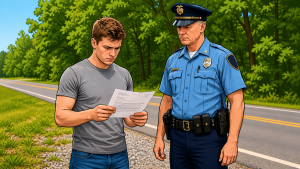
I watched in the rearview mirror as Officer Martinez sat in his car, apparently reading information on his computer screen with unusual intensity. His relaxed posture had shifted to something more alert, more focused. After what seemed like an unusually long time, he stepped out of his patrol car and walked back toward our vehicle, but instead of approaching Sarah’s window, he moved to my side of the car and tapped gently on the passenger window.
“Sir, could I speak with you privately for a moment?” he asked, his voice carrying a tone I hadn’t heard before—not authoritative or suspicious, but something approaching concern.
I glanced at Sarah, who looked as puzzled as I felt. Traffic stops were her department; I was just the passenger along for the ride. “Is there a problem, Officer?”
“Just for a moment, sir. If you could step out of the vehicle.”
I opened the passenger door and followed Officer Martinez to a position about ten feet behind our car, far enough from Sarah’s open window that our conversation wouldn’t be easily overheard. The late afternoon sun was warm on my shoulders, and the sound of traffic rushing past on the highway created a constant white noise backdrop that made the officer’s next words seem even more surreal.
Officer Martinez looked directly into my eyes with an intensity that made my stomach clench with sudden apprehension. When he spoke, his voice was low and urgent, the tone of someone delivering information that could be a matter of life and death.
“Sir, I need you to listen to me very carefully,” he began, glancing quickly toward our car where Sarah sat waiting. “Do not go home tonight. Get somewhere safe. A hotel, a friend’s house, somewhere she doesn’t know about.”
The words hit me like cold water, completely incomprehensible in the context of what I had assumed was a routine traffic violation. “What are you talking about? Is Sarah in some kind of trouble?”
Officer Martinez’s jaw tightened, and I could see him weighing his response carefully. Instead of answering directly, he reached into his shirt pocket and pulled out a small piece of notepaper, folded it quickly, and pressed it into my hand.
“Read this later, when you’re alone,” he said quietly. “And sir? Be very careful who you trust.”
I stared at the folded paper in my palm, my mind struggling to process what was happening. “Officer, I don’t understand. Sarah and I have been married for ten years. We’re just driving to visit her mother. What could possibly—”
“Sir,” Officer Martinez interrupted, his voice carrying a note of urgency that silenced my questions. “I can’t explain everything right now, but your wife’s name triggered some alerts in our system. Alerts that suggest she may be involved in activities that could put you in danger.”
I looked back toward our car, where Sarah was adjusting the rearview mirror and checking her appearance, completely unaware of the conversation taking place behind her. In the flickering light of the patrol car’s emergency beacons, I noticed something in her reflection that I had never seen before—a tension around her eyes, a wariness that seemed inconsistent with someone simply waiting for a speeding ticket to be resolved.
“This is impossible,” I said, but even as the words left my mouth, I realized they sounded less certain than I had intended. “Sarah works in marketing for a pharmaceutical company. She travels for client meetings, works late on presentations. There’s nothing dangerous about her job.”
Officer Martinez studied my face carefully, as if trying to determine how much I could handle hearing. “Sir, when was the last time you verified the details of your wife’s employment? When was the last time you visited her workplace or met her colleagues?”
The question struck me with unexpected force because the honest answer was never. In ten years of marriage, I had never been to Sarah’s office building, never met anyone from her marketing team, never attended a company Christmas party or summer picnic. She had always explained that her company maintained strict security protocols that limited visitors, and that their social events were limited to employees only due to confidentiality concerns related to pharmaceutical research.
At the time, her explanations had seemed perfectly reasonable. Now, standing on the shoulder of Route 35 with a police officer who was suggesting my wife might be living a double life, I realized how little I actually knew about how Sarah spent her days.
“I need to get back to the car,” Officer Martinez said, glancing toward Sarah again. “She’s going to wonder what we’re talking about. But sir, please read that note tonight, and please take my advice seriously. Your safety may depend on it.”
He walked back to Sarah’s window, returned her license and registration, and issued her a standard speeding warning with the same professional courtesy he had shown throughout the stop. But as we pulled away from the shoulder and merged back into traffic, I could feel the weight of the folded paper in my pocket like a lead sinker, dragging my thoughts into dark waters I had never imagined existed.
Sarah was unusually quiet during the remainder of our drive to her mother’s house, her hands gripping the steering wheel more tightly than necessary and her eyes checking the rearview mirror more frequently than traffic conditions warranted. When I asked if she was upset about the ticket, she smiled and shook her head, but the smile didn’t reach her eyes, and I found myself studying her profile with the uncomfortable awareness that I might be looking at a stranger.
The visit with Sarah’s mother passed normally on the surface—dinner, conversation about family news, the comfortable rituals of extended family relationships that had become familiar over the years. But I found myself watching Sarah more closely than usual, looking for signs of the mysterious danger that Officer Martinez had warned me about. She seemed perfectly normal, laughing at her mother’s stories, helping with dishes, discussing plans for upcoming holidays with the same enthusiasm she had always shown for family gatherings.
Yet something felt different, though I couldn’t pinpoint exactly what had changed. Perhaps it was my own paranoia, triggered by the afternoon’s strange encounter, but Sarah seemed to be performing the role of devoted daughter and loving wife rather than simply being those things naturally. Her laughter was slightly too bright, her attention slightly too focused, as if she were consciously managing the impression she was making rather than simply enjoying the evening with family.
We stayed the night at her mother’s house, sleeping in the guest bedroom that had become familiar territory during our years of regular visits. I waited until Sarah was asleep, her breathing deep and regular beside me, before slipping quietly into the bathroom to read Officer Martinez’s note by the light of my phone.
The paper was small, torn from what appeared to be a standard police notepad, and the message was written in the block printing that suggested urgency rather than careful consideration. Seven words that turned my world upside down:
“She isn’t who she says she is.”
Below that devastating statement was a phone number with a local area code and a single word: “Detective.”
I stared at the note for what felt like hours, reading and rereading those seven words as if repetition might change their meaning or reveal some alternative interpretation that didn’t imply that my wife of ten years had been living a completely fabricated life. But the message was unambiguous, and the phone number suggested that whatever Officer Martinez had discovered was significant enough to warrant investigation by someone with more authority and resources than a patrol officer conducting routine traffic stops.
I didn’t sleep that night. I lay in the narrow guest bed beside Sarah, listening to her breathe and watching the shadows move across the ceiling as cars passed on the street outside, wondering who exactly I had been sharing my life with for the past decade. Every memory I had of our relationship suddenly felt suspect, every conversation we had shared potentially tainted by deception I had been too trusting or too naive to recognize……………….