The first thing I noticed on my graduation day was not the orchestra, or the rows of faculty in ceremonial robes, or the way the stadium lights made everything look a little unreal.
It was the emptiness.
Four front-row seats, reserved under my name, untouched and glaring against a sea of flowers, cameras, and families who had shown up ready to celebrate the people they loved.
I had bought those seats months earlier.
I knew exactly where they were.
I had pictured my parents there so many times that I could almost see their bodies in them from memory alone.
My father leaning back with that satisfied smile he wore when he wanted to look important.
My mother dabbing at her eyes just enough for surrounding strangers to notice she was emotional.
My younger sister Tiffany holding her phone up, probably recording herself more than me, but at least being there.
Instead, there was nothing.
Just four smooth chairs under the hot morning light, each one looking like an accusation.
Around me, classmates were laughing, adjusting velvet sleeves, hugging parents over railings, accepting bouquets before the ceremony had even begun.
One girl two seats down had both grandmothers, three siblings, and a sign with her face printed on it in glitter.
A guy behind me kept turning to wave at a whole cluster of relatives wearing matching shirts.
Everywhere I looked, somebody belonged to somebody.
I folded my hands in my lap and tried to breathe through the sting building behind my eyes.
I had known my family might do this.
I had known it in the same way you know a storm is moving toward you even while the sky is still blue.
My parents had been vague for weeks, talking about schedules, flights, and how hard it was to coordinate everything.
Tiffany had posted countdown videos about an upcoming brand trip, but I had not asked questions.
Part of me still wanted to believe they would surprise me.
Part of me still wanted to be wrong.
Then my phone buzzed inside my robe.
I looked down and saw my mother’s name.
For one stupid second, hope rushed in.
Maybe they were outside.
Maybe traffic had been awful.
Maybe they were about to tell me to look toward the tunnel entrance and watch them run in at the last minute like a scene from a sentimental movie.
I opened the message.
Have fun today, Clara.
We’re having margaritas by the pool.
Don’t be too dramatic about us missing the ceremony.
It’s not like you’re really a doctor yet anyway.
You still have residency.
I stared at the screen until the words stopped feeling like language and started feeling like impact.
My mother had always known how to be cruel without raising her voice.
She had the rare skill of making contempt sound casual, as if the ugliness were my fault for noticing it.
I locked my phone and sat very still.
My name is Clara Evans.
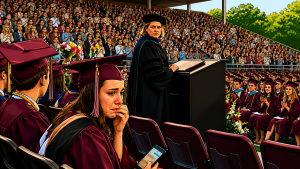
I am twenty-eight years old, and that morning I was graduating from one of the best medical schools in the country.
I should have felt victorious.
Instead, I felt like a child again.
A child in a pressed dress standing in a gymnasium, scanning the bleachers to see if her parents had come.
A child learning over and over that effort and affection did not always travel together.
Everything in my family had always been about presentation.
My father, David, admired whichever version of success could be explained in one flashy sentence at a country club table.
My mother, Valerie, treated social approval like oxygen.
They liked visible things, photogenic things, things that made them feel admired by association.
Tiffany fit that ecosystem perfectly.
She was beautiful, bright, loud, impulsive, and born with a face that seemed made for front cameras and filtered sunlight.
I was not made for display.
I was serious.
Private.
The daughter who color-coded her notes and asked for library time instead of birthday parties.
I learned early that quiet excellence did not photograph as well as charm.
When Tiffany placed third in a middle-school talent contest, my parents rented a private room at a restaurant, ordered a cake, and made toasts about her star quality.
When I graduated first in my high school class with a full scholarship, my mother hugged me in the parking lot and then told me my speech probably went over people’s heads.
When Tiffany announced she wanted to open a lifestyle boutique at twenty-one, my father called her entrepreneurial and wrote checks before she had a business plan.
When I got into medical school and asked him to co-sign the loans so I wouldn’t lose my seat, he said no.
Not because they were struggling.
Because, as I later learned, they had just put fifty thousand dollars into Tiffany’s boutique launch and a branded photoshoot to support it.
That was when I stopped confusing their preferences with accidents.
They were not unfair in random ways.
They were consistent.
Tiffany was possibility.
I was burden.
So I did what people like me do when nobody cushions the fall.
I worked.
I took out private loans with terms so ugly they made me nauseous.
I picked up overnight ambulance shifts.
I studied anatomy with dried coffee on my cuff and twelve-minute naps behind me.
I learned how exhaustion can become a climate.
There were nights I sat in the back of an ambulance under fluorescent light, still in scrubs, reviewing pharmacology flashcards while my body shook from adrenaline after a call.
I missed birthdays, weddings, holidays, and the soft ordinary rituals other people used to stay sane.
The person who changed the trajectory of my life found me in a hospital break room at four in the morning.
Dr.
Caroline Pierce was already a legend by then.
Head of pediatric surgery.
Conference headliner.
Journal cover story.
The kind of physician younger doctors quoted with reverence and older doctors tried not to envy.
She was also exacting, unsentimental, and not known for wasting energy on people who wasted theirs.
I had fallen asleep at a table with a textbook open under my cheek and ambulance radio static still echoing in my head.
When I woke up, she was standing over me with a paper cup of coffee in one hand and my notes in the other.
—You either have no idea how hard this is, she said, —or you know exactly how hard it is and you’re doing it anyway.
I was too embarrassed to answer.
She looked at my notes again, then at the name
badge clipped crookedly to my scrub top.
—Clara Evans.
I’ve seen your evaluations.
You’re good.
That morning turned into a conversation.
The conversation turned into a research assistant role.
The role turned into mentorship.
She did not rescue me from the work.
She did something more meaningful.
She treated my effort like it mattered.
She recommended me, challenged me, pulled me into rooms I had not imagined I belonged in, and never once asked me to shrink so anyone else could stay comfortable.
Because of her, I finished at the top of my class.
Because of her, I matched into pediatric surgery.
Because of her, on the morning my family abandoned my graduation for a Caribbean cruise celebrating Tiffany’s social media milestone, I still walked into that stadium with my shoulders back.
Then Dr.
Pierce was announced as the keynote speaker.
The whole stadium rose for her.
The applause rolled like weather.
She crossed the stage in dark academic regalia, placed a leather folder on the podium, and waited for the room to settle.
I remember the exact sequence because it lives in my body now.
She looked over the crowd.
She smiled once at the faculty row.
Then her gaze moved toward the graduates.
It passed over clusters of family signs and bouquets and waving hands.
And then it stopped.
On my row.
On the four empty seats beside me.
Something in her face changed.
She put both hands on the podium, looked down at the folder, then closed it without opening a single page.
The little rustle of paper through the microphone seemed to travel through the entire stadium.
When she spoke, her voice was calm.
But it was not the voice of someone about to deliver a polished ceremonial address.
—I came here with a speech, she said.
—A very good one, according to the dean.
It has all the expected ingredients.
Resilience.
Innovation.
The future of medicine.
But I just looked out at this stadium and was reminded that some truths matter more than prepared remarks.
The crowd went very still.
—Many of you arrived here carried by families who have loved you loudly.
That is a beautiful thing.
Some of you arrived here another way.
You got here despite being underestimated, dismissed, neglected, or treated like your sacrifice was an inconvenience rather than a triumph.
And those graduates deserve to be seen too.
My pulse began hammering so hard I could feel it in my throat.
Then Dr.
Pierce looked directly at me.
—Clara Evans, would you please stand.
A thousand heads turned at once.
I wanted the floor to crack open under me.
I wanted to disappear.
But she held my gaze, and there was nothing performative in her expression.
Only certainty.
I stood.
—This young woman, Dr.
Pierce said, —worked overnight ambulance shifts while attending medical school in the daytime.
She studied in break rooms, hallways, call rooms, and moving vehicles.
She outperformed classmates who had every advantage she did not.
She matched into pediatric surgery because talent combined with discipline is a force that almost nothing can stop.
I heard someone near the front gasp softly.
Around me, people were leaning in, listening.
Dr.
Pierce continued.
—I once found her asleep over a textbook at four in the morning after a shift……………

