My wife had been dead for five years when I heard her laugh.
Not in a dream.
Not in my memory.
Not in one of those moments when grief tricks your body before your mind can catch up.
I heard it in the middle of the afternoon, with salt air blowing through an open window, on a street in the coastal village where everyone had told me she grew up.
That laugh stopped me so hard I nearly walked into a flowerpot.
But I am getting ahead of myself.
For five years, three months, and two days, I sent three hundred dollars to my former mother-in-law on the first day of every month.
I never missed it.
Sometimes I sent it before my mortgage.
Sometimes before I bought groceries for myself.
It did not matter what my own month looked like.
That transfer went out.
I told people it was to help Margaret Collins—Maggie—with food and medication.
The truth was, I sent it because it was the only promise I had left.
Emily used to worry about her mother constantly.
She would call her twice a day, argue with her about taking her pills, remind her not to carry laundry down the steps, send her money even when we were trying to save for a kitchen remodel.
“She won’t ask for help until she’s desperate,” Emily told me once while folding towels.
“And by then she’ll act like she’s fine.
That’s her favorite hobby.
Being quietly miserable.”
Then she laughed and said, almost like a joke, “If anything ever happens to me, don’t let her struggle.
Promise me.”
I promised without looking up from the drawer I was fixing.
I had no idea I was agreeing to something that would chain me to a lie.
They said Emily died in a car accident on the highway outside her mother’s village.
The report was brief.
Wet road.
Poor visibility.
Vehicle went off the shoulder.
Fire involved.
Identification made through personal effects and local confirmation.
I did not see her body.
The coffin was sealed.
By the time I realized how strange that should have felt, the funeral was over.
Grief has a way of making other people seem more certain than you are.
When officers speak gently, when a funeral director uses a low voice, when family members cry in the right places, you stop asking questions because the world has already moved on to the next step.
Maggie was inconsolable at the funeral.
She clung to me and trembled so violently I thought she might collapse.
I held her up.
I held everyone up.
That was my role then.
The husband.
The son-in-law.
The man expected to continue breathing because everyone else could not.
At the graveside, with dirt still dark and damp, I told Maggie I would help her every month.
She gripped my hands and cried harder.
“Emily would want that,” she whispered.
I believed her.
My best friend, Mark, stopped believing any of it much sooner than I did.
“I know you’re trying to honor her,” he said one night over beers.
“But this thing with the money? At some point, you have to ask whether you’re helping her mother or punishing yourself.”
“It’s not punishment,” I said.
“Then why do you look guilty every time you
hit send?”
I had no answer.
Or maybe I did, and I hated it.
The answer was that loving a dead person can curdle into ritual.
If the ritual survives long enough, it starts to feel like evidence.
Proof that your love was real, your grief was sincere, your marriage meant something.
So I kept paying.
Then one Tuesday my bank called to say Maggie’s rural branch had closed and they needed updated account information.
I dialed her landline.
Disconnected.
I called the cell phone I had bought her two Christmases before Emily died.
Straight to voicemail.
I waited, called again, left messages, sent a text.
Nothing.
That night I sat at my kitchen table staring at my phone and felt something cold settle in my chest.
Not fear.
Not yet.
More like a quiet rearranging of the room inside me.
A sense that I had been standing on rotten floorboards for years and had finally heard the crack.
The next morning I requested vacation days, threw an overnight bag in the car, and drove six hours toward the coast.
By the time I reached the village, the sky was pale and windy, the kind of afternoon that made every painted porch look faded.
Emily had described the place to me a hundred times.
The bakery with the crooked blue awning.
The church bell that rang too early.
The narrow roads where everyone knew who had bought a new lawn mower before the family did.
I parked outside the address I had on file for Maggie.
The house was empty.
Not recently empty.
Properly empty.
The curtains were gone.
The mailbox hung open.
Weeds pushed through the gravel path.
A weather-beaten sign leaned crooked in the front window.
FOR RENT.
I read it three times.
An older woman from the neighboring porch watched me long enough that I finally walked over and asked if Margaret Collins still lived there.
The woman frowned.
“Maggie? Not for a while now.”
“Do you know where she went?”
She shrugged once.
“Other side of the village for a bit, I think.
Then gone.
Moved in with family maybe.”
“What family?”
Her expression changed—subtle, but enough.
“Her daughter was back, wasn’t she?”
My stomach dropped so suddenly I felt it in my knees.
I actually smiled.
Not because it was funny, but because the alternative was falling apart in front of a stranger.
“Her daughter Emily died five years ago,” I said.
The woman stared at me as if I had spoken nonsense.
“No,” she said slowly.
“I saw Maggie’s daughter with my own eyes.
Maybe a year ago.
Dark hair.
Tall.
Pretty thing.
She looked tired, but it was her.
Folks said she had been away.”
People remember the exact second their world splits in two.
Mine was on a porch that smelled like old wood and sea air, while a neighbor I had never met casually suggested my dead wife had been shopping for oranges last summer.
I thanked her because shock makes people polite, then walked back to my car and sat there gripping the steering wheel.
Emily was not alive, I told myself.
This was a village.
Villages confuse things.
Someone resembled her.
Someone started a rumor.
Someone saw what they expected to see.
Then I looked across the street and
noticed the bakery.
A crooked blue awning.
Exactly as Emily had described it.
The woman had been right about that.
Which meant she might be right about the rest.
Inside the bakery, the girl at the register could not have been older than twenty.
I bought coffee I didn’t want and a pastry I never touched.
Then I asked whether she knew Maggie Collins.
“Sure,” she said.
“Sweet lady.
Comes in sometimes.
Not as much lately.”
My fingers tightened around the coffee cup.
“Lately?”
“Maybe a couple months ago.”
“Did she come alone?”
The girl hesitated.
“Sometimes.”
“Sometimes with who?”
She leaned back, studying me in the careful way people do when they sense they are one answer away from stepping into something ugly.
“A woman,” she said finally.
“Around your age, maybe.
Brown hair.
They looked alike.
Mother and daughter, I assumed.”
I left the coffee untouched on the counter.
The clerk called after me, but I was already outside, breathing too fast.
My chest felt hollow and packed with concrete at the same time.
I sat in my car and searched old messages from Maggie.
Thank you, Ethan.
Bless you, dear.
Medicine is expensive this month.
The doctor changed my tablets.
God will repay your kindness.
All of it suddenly looked staged.
Not because of what was written, but because of what wasn’t.
No specifics.
No stories.
No details only a grieving mother would volunteer.
At the bottom of one message thread, I found a photo she had sent me two years earlier: a close-up of prescription bottles on a kitchen table.
I had barely glanced at it then.
Now I zoomed in.
On the wall behind the table hung a framed print of wildflowers.
I knew that print.
Emily and I had bought it at a home store the first year we were married.
It had hung in our hallway until three months before her accident, when she said she wanted to give it to her mother because the yellow flowers reminded her of childhood summers.
But Maggie’s old kitchen, the one I had visited once before the wedding, had green cabinets.
The kitchen in the photo had white ones.
I started the car.
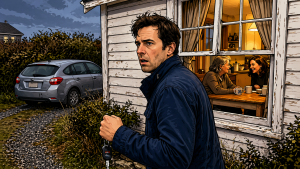
The next two hours became a chain of doors and half-answers.
A pharmacist remembered Maggie paying in cash once, then whispered that she was often with “the daughter.”
A cashier at a hardware store said Maggie rented a cottage on the north side of the village for nearly a year.
The church secretary gave me the address after I lied and said I was a relative.
The cottage stood near the cliff road, tucked behind a hedge and a leaning wooden gate.
It looked modest from the front.
White paint peeling, narrow windows, flower boxes in need of water.
There was a second car in the drive.
A silver hatchback.
I knew that car.
Or rather, I knew the dealership sticker on the back windshield.
Emily had bought the car two months before she died.
The police told me it had been destroyed in the crash.
I don’t remember getting out.
I remember the sound of gravel under my shoes and the rush of blood in my ears.
I remember the front window being partly open.
I remember a laugh from inside.
Emily’s
laugh.
Some sounds live in your bones.
That was one of them.
There was no mistaking it.
It had the same lift at the end, the same breathy catch after the first burst, the same warmth that used to fill our kitchen when she caught me dancing badly while making pasta.
I went cold all over.
Voices drifted through the window.
One was older—Maggie.
The other was unmistakably hers.
“He’s still sending it?” the younger voice asked.
“Every month,” Maggie said.
“I told you he would.”
Then a man spoke.
I did not know his voice.
“You should have stopped this a long time ago.”
Emily answered him.
“We needed time.”
I stood frozen beneath that window while the last five years of my life rearranged themselves into something unrecognizable.
She was alive.
She was alive, and she had let me grieve her, bury her, defend her memory, send her mother money, and rot beside a sealed casket that apparently did not contain my wife.
I should have burst through the door right then.
Instead I backed away.
There is a strange dignity in not wanting the people who ruined you to watch the first moment you understand it.
I got into my car, locked the doors, and shook so hard I could barely hold my phone.
The first person I called was Mark.
He answered on the second ring.
“You all right?”
“No,” I said.
It came out like a broken laugh.
“No, I’m really not.”
He was silent for half a second, then his tone changed.
“What happened?”
I told him everything in fragments.
Neighbor.
Bakery.
Cottage.
Window.
Her voice.
When I finished, he said, “Call the police.
Right now.”
I did.
The officer who took my statement sounded skeptical for the first thirty seconds, then less skeptical when I explained the sealed coffin, the car supposedly destroyed in a fire, the ongoing bank transfers, and the fact that I was looking at a car the police report had listed as totaled.
Two local officers arrived within twenty minutes.
They asked me to wait in my car while they approached the cottage.
I watched them knock.
No answer.
They knocked again, louder.
Then the door opened.
Even at that distance, I knew it was her.
She looked older, thinner, sharper around the mouth.
Her hair was shorter.
Her face was not the one frozen in my memories anymore.
But it was Emily.
My wife.
The woman I had buried.
I thought anger would be the first thing I felt.
It wasn’t.
It was humiliation.
A deep, searing humiliation so complete it made me feel transparent.
Every condolence.
Every sleepless anniversary.
Every transfer.
Every defense I had made on her behalf.
I had built a shrine around a person who was standing barefoot in another life, opening a cottage door for the police.
The officers went inside.
A few minutes later Maggie emerged, pale and unsteady, followed by a man in his forties with a drawn face and expensive jacket.
The kind of man who looked like he had once trusted his own charm too much.
One officer came to my car.
“Mr.
Hayes,” he said, “we need you to confirm identities.”
I stepped out because there was nothing left to protect.
Emily saw me halfway across the yard.
For one raw second, she looked exactly as shocked as I had hoped she would.
Then she recovered and pressed a hand to her mouth.
“Ethan—”
That was the first word I had heard from her in more than five years.
It made my skin crawl.
“Don’t,” I said.
The officers separated us, but not before I looked at Maggie.
She wouldn’t meet my eyes.
That hurt almost as much.
At the station, the story came apart in pieces.
Emily had been having an affair before the supposed accident.
Not with some temporary thrill, but with the man from the cottage, Daniel Mercer, a contractor with debt problems and a talent for promising escape when he meant destruction.
She wanted out of the marriage but did not want to be “the villain.” Those were her exact words later, spoken with a kind of desperate shame that only made them crueler.
She did not want the social fallout in the village.
She did not want to start over as the woman who left a devoted husband for another man.
She wanted a clean break without wearing the blame.
Daniel’s brother owned a salvage yard.
A burned vehicle from an unrelated crash became the foundation of their plan.
Emily left her personal effects in the car, disappeared before dawn, and called Maggie from a motel hours away.
Maggie panicked at first, then agreed to help after Emily swore she would eventually explain everything.
Eventually became years.
The sealed coffin contained remains from the unrelated crash that had not yet been publicly identified when paperwork was rushed through a chain of errors and quiet local corruption.
That part turned into a larger criminal investigation than mine.
The funeral director had relied on the report.
The report relied on assumptions.
Someone signed what should never have been signed.
And the money?
Maggie cried when she admitted that part.
At first, she said, she intended to refuse it.
Then her pension failed to cover medication after a surgery, Daniel lost work, Emily was ashamed to contact me, and every month the transfer became easier to accept.
“I told myself it was temporary,” Maggie said, twisting a handkerchief in her hands.
“Then I told myself you were healing.
Then I told myself I needed it.
There was always another excuse.”
Emily finally spoke when an officer asked why she never came back.
She looked at me, really looked at me, and I saw then that she had expected tears, maybe rage, maybe bargaining.
What she had not expected was the total absence of love.
“I was scared,” she said.
“Of what?” I asked.
She swallowed.
“Of facing what I did.”
I laughed once.
It sounded ugly in the room.
“So you let me think you were dead.”
Her eyes filled, but I felt nothing for those tears.
“I didn’t think it would go this far.”
That sentence stayed with me more than any other.
Not because it explained anything.
Because it explained exactly who she was.
A person who believed disaster was only disaster once it inconvenienced her.
There were charges.
Fraud.
Identity deception.
Related financial crimes.
The investigation into the false death expanded for months.
The money I sent was documented, along with Emily’s access to it and Maggie’s withdrawals.
Restitution was ordered later, though
everyone warned me I might never recover much of it.
I did not care as much as people expected me to.
The money was never the real loss.
The real loss was time.
Five birthdays.
Five anniversaries.
Five years spent speaking gently about a woman who had chosen my grief because it was easier for her than honesty.
Mark drove down to get me that night because the officers did not want me on the road in my condition.
On the drive home, we rode mostly in silence.
Somewhere after midnight he said, “You know this wasn’t your fault, right?”
I kept staring out the window.
“I know it in theory,” I said.
He nodded like that made perfect sense.
The practical aftermath was ugly but manageable.
I met with lawyers.
I closed the transfer route.
I reopened parts of the investigation I had never known could be reopened.
I had a headstone removed because it carried a lie I could no longer bear to look at.
Weeks later, I packed Emily’s remaining things into boxes.
Not because I still needed them.
Because I didn’t.
That felt like the first honest act of mourning I had done.
There was one item I kept.
A note she had left on the fridge years before all of this.
Buy milk.
Don’t forget Mom’s vitamins.
Love you.
I did not keep it out of sentiment.
I kept it because of the ordinary cruelty of it.
How easily a life can look real from the outside even as the truth is preparing to leave through a side door.
Months after the arrest, Maggie wrote me a letter from a legal aid office.
No excuses this time.
No pious phrases.
Just a few crooked lines admitting that I had shown her more loyalty than her own daughter had, and that she would live the rest of her life knowing what she did with that loyalty.
I never answered.
People ask what hurt more: learning Emily was alive, or learning she had watched me grieve and said nothing.
The second one.
Always the second one.
Because betrayal is not the moment someone leaves.
It is the decision they make every day after, while letting you live inside a false version of reality.
I am better now than I was then.
Not healed in the neat way people like to imagine, but steadier.
Less interested in being the good man in someone else’s story.
More interested in being honest in my own.
Sometimes I still think about the first of the month.
The alert.
The transfer.
The little ritual I once believed made me faithful.
Now I know faithfulness without truth is just another form of captivity.
And the part people argue over whenever they hear this story is never the fraud, or even the fake death.
It is the mother.
Some say Maggie was a desperate old woman trapped between survival and loyalty to her child.
Others say the moment she took that first payment, knowing the truth, she stopped being a grieving mother and became part of the theft.
I know where I landed.
Emily destroyed my marriage.
But Maggie watched my grief up close, accepted my promise with both hands, and let me kneel at a grave that should never have existed.
Between the
liar who ran and the person who stayed to bless the lie, I still don’t know which betrayal was colder.