Part 1
My name is Bianca Gonzalez. I’m forty years old, and for most of my life I believed endings were loud.
I believed marriages ended the way movies promised: an argument that cracked the house in half, a confession that scorched the air, a door that slammed so hard a picture frame fell off the wall. I pictured screaming. Tears. Drama.
Mine ended with a suitcase.
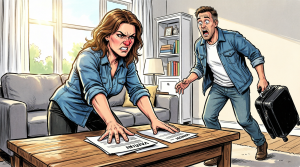
It sat on our bed like a sleek black monument, the expensive leather still unscarred after years of closet dust. Calvin had bought it for our honeymoon back when we still had that bright, careless way of touching each other in passing, like the future couldn’t possibly harden.
Now he was packing it again, and he did it with the careful precision of someone handling something fragile, not because he treasured it, but because he wanted it done right. Shirts folded into clean rectangles. Socks rolled into tight pairs. Toiletries sealed into a clear pouch like evidence.
“I’m taking a long weekend,” he said, not looking up.
His voice had the same tone he used when he told me he’d be late picking up groceries. Normal. Casual. Almost bored.
“Rachel and I are doing that wellness retreat in Vermont,” he added. “The one I mentioned.”
Rachel. As if that name should mean nothing to me.
I leaned against the doorframe and watched him pack a fitted black shirt he hadn’t worn in months, the one he used to save for anniversaries, for dates, for moments when he wanted to look like the best version of himself. He added a bottle of designer cologne, then a pair of silk sleep shorts I’d given him last Christmas. None of it looked like meditation and herbal tea. It looked like intent.
“Do they do cologne workshops now?” I asked lightly.
Fifteen years in warehouse management taught me something that surprised people: calm gets answers. Anger makes liars tighten up. Calm makes them careless.
His hands paused for a fraction of a second, then continued.
“A man likes to feel good about himself,” Calvin said. “You wouldn’t understand.”
His phone buzzed on the nightstand. The screen lit up in the dim bedroom: a heart emoji, then a kiss emoji.
Rachel Monroe.
Not an unknown number. Not a coworker’s name. Not even subtle.
I nodded toward the phone. “Is Rachel texting you about… wellness?”
Calvin snatched it too fast, nearly knocking the lamp. “Spam,” he said.
I let my eyebrows lift, just slightly. “Spam that knows your full name?”
He finally turned to face me. And in his eyes I saw something I hadn’t seen before. Not guilt. Not fear. Not even anger.
Distance.
The look of someone who had already checked out and was waiting for the paperwork to catch up.
“If you’re going to make a problem out of me taking a weekend for myself,” he said, voice sharpening, “maybe you should just get a divorce.”
There it was. Five years married. Ten years together. Reduced to a suggestion tossed across the room like an old receipt.
I expected the moment to hurt like a punch. Instead, something quieter happened in my chest. Not a crack. A click. Like a lock sliding into place.
“Don’t wait up,” I said.
Calvin zipped the suitcase with more force than necessary, the sound sharp against the hardwood floors we’d chosen together when we bought the house. The house I’d worked overtime to afford while he “pursued investment opportunities” that never seemed to pay off.
“I won’t,” he said, and walked out.
I stood at the kitchen window with my hands wrapped around the counter edge. Twenty minutes later, a silver Tesla pulled into our driveway.
Not Calvin’s truck. Not a rideshare. A Tesla Model S that cost more than my yearly bonus.
Rachel Monroe stepped out first.
Tall. Polished. A cream coat draped over one shoulder like she’d stepped out of a magazine. She didn’t come to the door. She honked twice, impatient, entitled, like my driveway belonged to her.
Calvin emerged with the suitcase rolling behind him. He didn’t hesitate. He didn’t look back at the house. He didn’t look back at me.
He slid into the passenger seat, leaned across the console, and kissed her.
Not awkwardly. Not cautiously. With familiarity.
The Tesla backed out and disappeared down Maple Street, taking my husband and whatever soft illusions I’d been carrying with him.
I finished making my turkey sandwich. The same lunch I’d eaten every Saturday for two years.
Routine has a strange way of keeping you upright when your life tilts sideways. I washed it down with a beer, set the bottle in the sink, and sat at the dining table with my laptop.
If Calvin wanted a divorce, I would treat it like any other process: assess, plan, execute.
I logged into our joint checking account.
Thirty-seven thousand dollars stared back at me. Money I had saved from overtime shifts. Money meant for renovations, for a vacation, for the “someday” he always waved at but never reached for.
I opened a new account in my name only and transferred every penny.
The confirmation email arrived within seconds. Clean. Legal. Final.
Then I called Jim Morrison, my attorney friend from high school. He answered on the second ring.
“Bianca? Everything okay?”
“I need to file for divorce first thing Monday morning,” I said.
Silence. Then, softer: “What happened?”
“He told me to get one,” I replied. “I’m taking his advice.”
While Jim talked me through the basics—documentation, timelines, protecting myself—I walked upstairs and opened Calvin’s jewelry box. I knew exactly where to look.
Behind a pair of cufflinks I’d given him, tucked like a secret he was proud of, sat a second phone.
The password was our wedding date.
Romantic, if it hadn’t been used to coordinate betrayal.
The messages went back eight months. Hotel confirmations. Tuesday nights. Pet names that made my stomach turn. Little jokes about how I “would never catch on.” Photos I refused to study for more than a second, but still burned into my mind like an afterimage.
Rachel Monroe was married. She’d cut ribbons at charity events and smiled for local news cameras and posted about community development, all while renting a motel room under cash payments like she was in a cheap spy movie.
My phone rang while I scrolled.
Mrs. Larkin from next door. Seventy-three years old and the unofficial commander of the Riverside Neighborhood Watch Facebook group.
“Bianca, dear,” she said gently, “I saw Calvin leave in a fancy car. That wasn’t his truck, was it?”
I stared at the second phone on my table, at the way betrayal turns ordinary objects into weapons.
“No, ma’am,” I said. “It wasn’t.”
“Everything all right?”
I closed Calvin’s secret phone and set it neatly beside my laptop.
“Oh,” I said, voice steady. “Everything is about to be.”
By midnight, I had printed every message, every receipt, every screenshot. I arranged them in a folder, labeled cleanly like a work project.
Exhibit A.
I changed passwords. I checked deeds. I made notes.
Calvin thought he’d already left the marriage.
He hadn’t realized I was still inside it, hands on the controls, ready to turn the lights on.
Part 2
Saturday morning, I went to the Rusty Anchor just after sunrise.
It wasn’t much to look at—cracked vinyl booths, a coffee pot that had probably been replaced once since the Clinton administration, and a smell of old wood soaked in years of secrets. But it was the kind of place where people talked honestly because no one expected anything respectable to happen there.
My cousin Frank Delgado ran his unofficial meetings in Booth Three. Frank was built like someone who’d spent his life lifting things that refused to move—concrete, steel, stubborn men. He slid in across from me and studied my face.
“You look like hell,” he said.
“Feel worse,” I replied. “Calvin’s cheating.”
Frank didn’t flinch. He didn’t launch into advice. He just held out his hand.
I slid my phone across the table. He scrolled slowly through the screenshots. The longer he read, the more his jaw tightened.
“Rachel Monroe,” he muttered. “That real estate shark.”
“The one who smiles for charity photos,” I said, “and bulldozes small businesses for condos.”
Rita, the bartender, drifted over with two mugs of coffee like she’d been waiting for her cue. Rita had been at the Anchor for twenty years and knew more about Riverside than the town council ever would.
“You two talking about Rachel Monroe?” she asked casually, wiping the table with a cloth that looked older than my marriage.
Frank looked at me. I nodded.
Rita leaned closer. “She’s been bringing Calvin to the Skylark Motel every Tuesday since January,” she said. “Room 237. Always pays cash. Thinks it makes her mysterious.”
My coffee stayed steady in my hands, but something inside me went cold and clear.
“January,” I repeated.
Rita shrugged. “My nephew works the front desk. Hard not to notice when someone acts like they’re starring in their own scandal.”
“What else do you know?” I asked.
Rita took a slow sip. “She’s married. Husband’s name is Andrew Monroe. Two kids. Big lifestyle. Word is her business partner, Derek Martinez, has been asking questions about money missing from one of their condo projects.”
Frank and I exchanged a look.
Betrayal was one thing. Fraud was another. And when people mix the two, they tend to get sloppy.
By late morning, I was parked across from Monroe Development’s downtown office, a glass building with a top-floor suite and a lobby that smelled like expensive perfume and money that didn’t come from overtime shifts.
Rachel’s white Mercedes sat in a reserved spot.
Ten minutes later, Calvin’s truck pulled into the garage.
So much for Vermont.
I followed at a distance, calm as a metronome. They met on the third level of the parking structure, near the elevator lobby where the cameras had blind spots and the walls held sound like confessionals.
They didn’t even pretend.
Rachel leaned against her car, chin tilted like she was granting Calvin access to her time. Calvin closed the distance and kissed her like it was routine, like his mouth belonged there.
I took photos from three angles. Clear. Undeniable.
When they disappeared into the elevator, I walked to Rachel’s Mercedes.
I didn’t slash tires. I didn’t key paint. I wasn’t interested in vandalism charges.
Instead, I let the air out of all four tires—slow, deliberate, a quiet hiss like a secret leaving a room.
Then I opened her glove compartment.
Inside, I placed a printed screenshot from Calvin’s second phone.
She doesn’t suspect anything.
No signature. No threats. Just truth.
Back home, I started what I thought of as Phase Two.
Calvin had always reused passwords the way he reused excuses. Anniversary dates. Pet names. Combinations of nostalgia and laziness.
Within thirty minutes, I was inside his work email.
And there it was—Tuesday motel visits billed as “client dinners.” Receipts uploaded. Expenses reimbursed. Fraud layered on top of infidelity.
I copied everything into my own folder.
Frank texted: Send it to his boss.
Not yet, I replied. I want timing.
So I scheduled a calendar invite from Calvin’s account to his entire department for Monday at 9:00 a.m.
Subject: Weekend Debrief: Vermont Retreat Highlights
Attached: a shared folder link labeled Wellness Evidence.
I didn’t include anything explicit. Just enough screenshots—dates, receipts, motel confirmations—to let the truth assemble itself in other people’s minds.
Then I packed Calvin’s belongings.
Not with tenderness. With efficiency.
Contractor-grade garbage bags. His shirts. His shoes. His stupid, smug cologne.
By Sunday afternoon, the bags sat stacked neatly on the front porch.
I changed the locks.
Legally, I could. The deed and mortgage were in my name only. Calvin had always said it made sense for “credit reasons.” I realized now it was just another shortcut he took without thinking about what it gave me.
I canceled his credit cards. Removed his name from the utilities. Changed the Wi-Fi password to something he’d never guess because it had nothing to do with him.
At 7:42 p.m., Calvin’s truck pulled into the driveway.
He tried the key once. Twice. Then harder, like force could rewrite reality.
I opened the door before he could knock.
I held divorce papers in one hand and a calm expression in the other.
“Trip go well?” I asked.
His eyes flicked to the garbage bags, then back to me. “What is this?”
“It’s what you suggested,” I said. “Divorce.”
“You can’t just throw me out.”
“Actually,” I replied evenly, “I can.”
His face drained as I laid out the facts like inventory: house ownership, account transfers, credit cancellations, the divorce filing Jim had ready for Monday morning.
“You went through my phone,” he accused, scrambling for outrage like it could save him.
“You left it behind cufflinks,” I said.
His jaw clenched. He pulled out his second phone—the one he thought I didn’t know existed—and dialed Rachel.
“Bianca knows,” he said urgently. “What do you mean you can’t drive? What’s wrong with your car?”
I closed the door before I could hear her answer.
Inside my quiet house, I set my papers on the table and took a slow breath.
Calvin had smiled when he told me to get a divorce.
Monday morning was going to wipe that smile clean off his face.
Part 3
Monday arrived with crisp air and a sky so blue it looked painted, the kind of day that makes small towns seem charming until you remember how quickly charm turns into gossip.
At 9:05 a.m., my phone started buzzing.
At 9:12, Mrs. Larkin’s Neighborhood Watch group had screenshots of Calvin’s calendar invite.
At 9:20, Calvin’s supervisor had called him into a conference room.
And at 10:03, Rachel Monroe’s Mercedes was being towed out of the Monroe Development garage, all four tires flat, a printed message sitting on the dashboard for anyone curious enough to lean in.
By lunchtime, Riverside had chosen sides.
Small towns always do, and they choose loudly.
Nothing explicit circulated. Nothing that would count as libel. Just dates aligned with receipts, motel bookings aligned with expense reports, the truth laid out like a connect-the-dots puzzle people were thrilled to solve.
At 8:17 a.m., Calvin texted me for the first time since he’d found his bags on the porch.
We need to fix this.
Not I’m sorry. Not I made a mistake. Fix this.
I didn’t respond.
At 9:02 a.m., Derek Martinez—Rachel’s business partner—called an emergency board meeting.
By 10:30, someone forwarded Derek a PDF that cross-referenced Calvin’s expense claims with Skylark Motel bookings and corporate reimbursements tied to Monroe Development.
I didn’t even have to send it directly. Truth travels fast when it’s carrying receipts.
By Tuesday evening, Calvin walked into the Rusty Anchor looking like a man who’d been stripped of his script. His shoulders were tight, his eyes scanning the room as if he expected sympathy to appear in a corner.
Conversations dimmed but didn’t stop.
Rita didn’t greet him. She poured him a water without asking, the same way you might hand a napkin to someone bleeding.
Calvin spotted me at the far end of the bar and marched over.
“This is your fault,” he said, keeping his voice low but vibrating with anger. “Rachel’s accounts are frozen. Derek’s talking about criminal audits. You ruined her.”
I didn’t blink. “I didn’t charge motel rooms to corporate accounts,” I said. “You did.”
He leaned closer. “You hacked my email.”
“You used our anniversary as a password,” I replied. “I didn’t hack anything. I logged in.”
The words landed. He didn’t deny the fraud. He didn’t deny the motel. He just stared at me like I’d broken a rule he thought protected him.
“I’m losing everything,” he muttered.
“I lost everything,” I said, “the day you told me to get a divorce. I’m just catching up.”
Rachel’s collapse moved faster than Calvin’s.
By Wednesday afternoon, Monroe Development suspended her pending investigation into misappropriated project funds. Derek held a brief press conference with careful corporate language: internal audit, irregularities, commitment to transparency.
The local business journal ran a restrained piece about executive ethics. The comment section was not restrained. Someone linked Mrs. Larkin’s group, and the internet did what it always does when it smells scandal: it gathered.
Wednesday night, Frank texted me a photo from Rachel’s gated community.
He and his crew had used biodegradable chalk paint on the sidewalk: ROOM 237.
No property damage. No broken windows. Just a message that would wash away.
Reputation doesn’t wash away so easily.
Thursday afternoon, Calvin showed up at my warehouse.
I was on the floor doing inventory checks—clipboards, pallets, the steady rhythm of work that had always made sense even when people didn’t—when I saw his truck skid into the lot too fast.
He jumped out before the engine stopped and came toward me like a storm.
“You think this is funny?” he demanded, grabbing my arm.
I didn’t yank away right away. I just looked at him.
“I think consequences are educational,” I said.
His face twisted, and then he swung.
It wasn’t graceful. It wasn’t planned. It was desperate.
But I spent my days moving freight and avoiding heavy machinery. Reflexes are part of survival.
I stepped back.
Calvin’s momentum carried him forward into a stack of empty pallets. They crashed down around him with a loud, humiliating clatter that echoed through the warehouse.
Several coworkers froze mid-motion, eyes wide.
Calvin shoved pallets off himself, breathing hard, trying to recover dignity the way you try to scoop water back into a cup.
I lifted my phone from the workbench beside me.
It had been recording.
Not because I wanted drama. Because I learned, fast, that documentation wins.
“Calvin,” I said calmly, “you’re embarrassing yourself.”
He stormed off without another word, and by 6:00 p.m. the video had circulated enough to cement the narrative: angry husband confronts calm wife, loses both balance and status.
Friday morning brought a new headline.
Rachel Monroe’s Mercedes was repossessed from her driveway.
Bank notices began popping up online for one of her secondary properties. A waterfront condo project stalled under investigation. Andrew Monroe—her husband—filed for legal separation before noon.
By Friday evening, Calvin was sleeping in his truck.
He appeared at my door Saturday at 7:14 a.m., wearing yesterday’s shirt and sunglasses big enough to hide swollen eyes.
“Bianca,” he said quietly. “Please.”
I kept my coffee steady in my hand. “What do you want?”
“They suspended me,” he admitted. “Rachel’s facing fraud charges. I have nowhere to go.”
“You had somewhere to go,” I replied. “Room 237.”
His shoulders sagged as if the number itself weighed him down.
“I made a mistake.”
“No,” I corrected softly. “You made a choice for eight months.”
He tried tears. They arrived late, like an apology that missed the train.
“I’ll do counseling,” he said. “Therapy. Whatever you want.”
I watched him for a long moment, and what I felt wasn’t satisfaction.
It was clarity.
“I want you to feel for one week what I felt for eight months,” I said.
His eyes narrowed. “You planned all this.”
“I responded,” I said. “There’s a difference.”
I closed the door gently.
That afternoon, Riverside Park began setting up for the annual Founders Day Festival. Food trucks. Live music. Fireworks. The whole town would be there, and desperation has a way of pushing people into crowds.
By evening, I knew exactly where I needed to stand.
Part 4
Founders Day always made Riverside feel like a postcard version of itself.
The park filled with families and folding chairs, kids with glowing bracelets, teenagers pretending they were too cool to care while filming everything anyway. The smell of funnel cake and grilled onions drifted through the warm dusk. Someone’s dad tried to clap along to a cover band and missed the beat by a full second.
It was wholesome in a way that almost hurt.
Because I knew what was about to happen.
At 6:23 p.m., I sent a text from a prepaid phone I’d bought with cash.
8:00 p.m. Fountain. Last chance to settle this privately.
I didn’t sign it. I didn’t need to. They’d know it was me.
They showed up at 7:58.
Rachel Monroe looked like someone had drained her from the inside out. No polished makeup. No immaculate coat. Just a woman in a simple blouse that clung too tightly to her shoulders because stress had changed her posture.
Calvin stood half a step behind her, uncertain, like he didn’t know which side of her shadow was safest anymore.
Mrs. Larkin was already positioned near the fountain with her phone held high, battery fully charged. Frank hovered near the funnel cake stand with his arms folded, pretending he wasn’t watching. Derek Martinez stood farther back, blending into the crowd the way powerful people do when they want to witness consequences without being blamed for them.
The band was halfway through Sweet Caroline when I stepped forward.
Rachel’s eyes locked on me. Calvin’s mouth tightened.
“You’ve taken this too far,” Rachel said, voice low.
I smiled, but it wasn’t friendly. “Too far?” I repeated. “You drove into my driveway and kissed my husband like my front yard was your stage.”
Calvin flinched at the word husband.
Rachel lifted her chin. “What do you want?”
I spoke clearly enough that the nearest people could hear. In a small town, the nearest people always become everyone.
“I bought your waterfront property this morning,” I said.
Rachel’s face went blank. “What?”
“The foreclosure auction,” I continued. “Cash. The bank prefers stable buyers.”
A ripple moved through the crowd. Phones tilted. Heads turned.
“You can’t,” Rachel whispered.
“I can,” I said. “And I did.”
Calvin stepped forward, angry panic rising. “Stop humiliating us.”
“You humiliated yourselves,” I said. “I just turned on the lights.”
He lunged toward me.
For a split second, I thought he might actually grab me again. But desperation makes people clumsy.
I pivoted, stepping aside the way I’d stepped away from heavy machinery a thousand times.
Calvin’s shoes hit the fountain edge. His foot slipped on the damp stone, and he went forward with a dramatic, ungraceful splash that sent water flying up like applause.
The first row of spectators gasped, then started laughing—one of those unstoppable, contagious laughs that turns a crowd into a single creature.
Rachel rushed forward, reaching for him, and her own heel slid.
She went down into the fountain beside him.
For a moment, the two of them flailed together in murky green water, soaked and furious, surrounded by raised phones and delighted whispers. Fireworks cracked overhead, red and gold bursts exploding above the treeline like the sky itself was mocking them.
Mrs. Larkin’s voice carried clearly from behind her screen. “Oh my.”
Calvin scrambled up first, dripping and shaking, his face twisted with humiliation. Rachel stayed kneeling in the water, mascara streaking down her cheeks in uneven lines. For the first time since I’d learned her name, she didn’t look powerful.
She looked exposed.
“I hate you,” she whispered.
“I know,” I said quietly. “But I’m finally free of you both.”
Behind us, Derek Martinez stepped forward with two uniformed officers.
“Rachel Monroe?” one officer called.
The crowd parted in that automatic way people do when authority enters a scene. Rachel’s head snapped toward Derek.
Derek’s face was almost sympathetic. Almost.
“You didn’t think the audit would end quietly,” he said under his breath, “did you?”
Calvin tried to step between Rachel and the officers, but one firm hand against his chest stopped him.
“This doesn’t concern you, sir,” the officer said.
“Oh, it concerns him,” Derek replied calmly, loud enough for Calvin to hear. “He’s in the documentation.”
Calvin’s head whipped toward him. “What documentation?”
The officer read the charges like a grocery list: financial misconduct, fraud, misappropriation of development funds, pending formal review.
Rachel didn’t scream. She didn’t fight.
She just stared at me as they guided her out of the fountain and toward the patrol car waiting at the park’s edge.
“I didn’t do this alone,” she said quietly.
“No,” I agreed. “You didn’t.”
She looked at Calvin.
Calvin didn’t look back.
The patrol car door shut, and the fireworks reached their crescendo overhead. Red and gold light spilled across the crowd like judgment.
Calvin stood in the grass, soaked, shaking, his eyes wide with the realization that he was no longer aligned with power.
He was aligned with fallout.
“You ruined everything,” he muttered, but it sounded less like accusation and more like confusion.
“I exposed everything,” I corrected.
He looked around at the crowd—neighbors whispering, parents tugging kids closer, teenagers filming without shame. Whatever authority he thought he still had evaporated under those stares.
Then he walked away.
No one followed him. No one offered a towel. No one asked if he was okay.
By 9:42 p.m., the fountain video had thousands of views in Mrs. Larkin’s group.
By midnight, a regional blog had picked it up.
Local developer detained at Founders Day Festival amid fraud investigation.
Rachel’s name trended first.
Calvin’s came second.
Sunday morning, I slept in.
The house felt different—not quieter, clearer, like something heavy had finally been removed from the air itself. Sunlight fell across the hardwood floors, and for the first time in months, my chest didn’t feel tight.
My phone buzzed at 10:13 a.m.
Calvin: They froze my accounts too.
No apology. No reflection. Just consequence.
I didn’t respond.
I brewed coffee slowly, deliberately, and watched steam curl toward the ceiling.
The story had started with a suitcase.
It wasn’t over yet, but the ending was finally moving in my direction.
Part 5
Divorce isn’t dramatic in real life.
There’s no swelling music. No final monologue. Just signatures, notarized stamps, and quiet rooms where people who once shared a bed now negotiate like business partners dissolving a failed company.
Three weeks after Founders Day, I sat across from Calvin in Jim Morrison’s office.
Calvin looked thinner. The sharp edge he used to carry in his posture had softened into something permanently defensive, like a man bracing for impact even when no one raised a hand.
His attorney did most of the talking, flipping through documents as if reading them twice might turn them into mercy.
“Given the ongoing financial investigation,” his lawyer began carefully, “my client is willing to concede primary property rights in exchange for a reduced claim on shared assets.”
Jim didn’t even glance at me before replying. “There are no shared assets.”
Calvin’s attorney blinked. Jim slid a folder forward.
“The house is solely in Bianca’s name,” Jim said. “The down payment was hers. The mortgage is hers. The accounts were funded primarily by her income. We have documentation.”
Calvin stared at the table. He didn’t look up when he signed.
The pen moved, ink drying on paper, and that was it. No shouting. No door slamming. Just the quiet snap of a legal thread dissolving.
Outside the office, Calvin paused on the sidewalk.
“I didn’t think you’d actually go through with it,” he admitted.
“I know,” I said.
He nodded once, almost respectful, then walked away like a man leaving a job he’d been fired from but still didn’t understand.
Rachel Monroe’s case moved faster.
The audit uncovered discrepancies in three development projects: funds rerouted into “client entertainment,” ghost contractors, inflated invoices that paid out to shell companies. Calvin’s name appeared on two authorization emails.
Not as mastermind. Not as architect.
As a participant.
In courtrooms, intent matters less than signature.
Rachel posted bail. Andrew Monroe finalized his separation. Their kids stayed out of the public eye as much as possible, though in a small town privacy is more of a wish than a reality.
I finalized the purchase of the waterfront property through a holding company.
Not because I needed it. I didn’t.
Because symbols have value in places like Riverside, where stories become currency.
A week later, I met Casey Whitmore at the Rusty Anchor.
Casey had been Rachel’s longtime friend—the name Calvin used as cover when he talked about Vermont. She sat in a back booth with a mug she hadn’t touched and eyes that looked exhausted in a way sleep couldn’t fix.
“You wanted to see me,” I said, sliding in across from her.
Casey nodded. “You deserve to know how this really started.”
I didn’t blink. “You’ve been feeding information.”
Her eyes widened slightly. “Yes.”
“How long?”
“Six months.”
I let the number settle between us like a weight.
“The motel tip,” I said. “Mrs. Larkin’s Tesla sighting. The little breadcrumbs.”
Casey nodded again, slow and controlled. “Rachel framed a senior accountant last winter,” she said quietly. “Blamed her for a petty cash discrepancy to cover one of Calvin’s birthday trips. The woman almost lost her pension. Rachel laughed about it.”
“And you decided to intervene,” I said.
“I decided she shouldn’t get to keep winning,” Casey replied.
I leaned back, studying her face. She didn’t look guilty. She looked resolved.
“So you orchestrated half of this,” I said.
“No,” she corrected gently. “You did. I just opened doors.”
The difference mattered.
“And Calvin?” I asked.
Casey hesitated, then exhaled. “He knew about the misallocated funds,” she admitted. “He helped move some of it.”
That landed harder than I expected—not because it shocked me, but because it confirmed what my calm had already suspected.
This had never been just about sex or attention.
It was about character.
“He thought it was temporary,” Casey continued. “He thought he could ride the wave and step off before it crashed.”
I stared at my coffee. “Waves don’t work like that.”
Casey’s mouth twitched, almost a smile. “No. They don’t.”
Over the next month, warrants expanded. Calvin was called in for questioning. Rachel’s arraignment date was set. Monroe Development removed her permanently.
Calvin’s attorney negotiated a reduced charge tied to falsified expense claims. Probation. Community service. Restitution.
Rachel took a plea deal: financial penalties, a suspended license, public disgrace that would follow her longer than any sentence.
None of it made me feel triumphant.
It made me feel finished.
One evening in December, I walked through Riverside Park alone.
The fountain had been drained for cleaning, the stone basin empty and harmless in the cold air. The spot where Rachel and Calvin had splashed and flailed now looked ordinary, like it had never held a scene at all.
Kids ran past me, bundled in winter coats, unaware of the spectacle that had unfolded there weeks earlier. I stood near the fountain’s edge and looked up at the trees lit with holiday lights.
For the first time in years, there was no tension under my ribs. No suspicion. No waiting.
Calvin had told me, smiling, to get a divorce.
I had given him exactly what he requested—thoroughly.
And I realized something simple as my breath fogged in the air.
Peace doesn’t come from revenge.
It comes from reclamation.
Part 6
The first snowfall of the season turned my driveway into a clean sheet of white.
I stood at the kitchen window with my coffee and watched it fall, slow and quiet, covering old tire tracks, old footprints, the place where the Tesla had idled like it owned my life.
The house felt fully mine now.
Not just legally. Emotionally.
The hardwood floors no longer echoed with tension. The air no longer carried the electric charge of unspoken suspicion. I could walk from room to room without imagining a second phone buzzing in a hidden drawer.
Frank stopped by that night with a six-pack and the blunt concern of someone who loves you enough to be annoying about it.
“You ever think about dating again?” he asked, settling at my table like he belonged there.
“Eventually,” I said.
He lifted an eyebrow. “Why not now?”
“Because I finally like the quiet,” I answered.
That was the truth. Peace isn’t loud. It doesn’t arrive with fireworks or viral videos. It settles like snow, soft and steady, covering old wounds until they stop catching on everything.
A month later, the town council started talking about installing better traction tiles around the fountain. Someone joked about putting up a sign: No Running, No Cheating.
Mrs. Larkin continued to record everything. Rita continued to pour drinks with the same dry commentary. Riverside moved on the way small towns always do—fast, hungry for the next story, but never quite forgetting the ones that entertained them the most.
I returned to routines.
Warehouse reports. Early shifts. Sunday groceries. Morning coffee without checking someone else’s phone.
One afternoon, while cleaning out a filing cabinet, I found an old honeymoon photo tucked into a folder.
Calvin and I stood on a beach, suitcase between us, smiling like the future was a guarantee and not a gamble. The ocean behind us looked endless.
I didn’t tear it up. I didn’t cry.
I slid it into a box and labeled it Archived.
That’s what it was. Archived. Not sacred. Not haunting. Just a record of who I’d been before I learned better.
In late January, I did something impulsive and practical at the same time.
I sold the waterfront property.
Not to a developer. Not to someone like Rachel.
I sold it to a local conservation group for less than I could’ve gotten, with one condition: the land would stay public. A walking trail. A small park. Something open.
Frank called it petty philanthropy.
I called it closing a loop.
Riverside didn’t need another gated slice of privilege. It needed spaces where people could breathe without proving they deserved it.
When the paperwork finalized, I drove out to the property alone and walked the shoreline. The lake was frozen in places, cracked like glass. Wind cut across my face, sharp and honest.
For a minute, I pictured Rachel standing here, imagining it as hers forever, imagining money as armor.
Armor rusts.
I shoved my hands deeper into my pockets and kept walking.
In February, my warehouse hosted a volunteer day as part of a community outreach program. It wasn’t glamorous—sorting donated supplies, loading trucks for a regional food bank—but it felt good in the way real work always does.
That’s where I met Noah Kline.
He wasn’t my type in any way I would’ve described a year earlier. He wore a beat-up beanie and a hoodie with paint stains. His hands were rough, his smile easy, and he had the calm presence of someone who didn’t need to be the loudest person in the room to be noticed.
He offered to carry a heavy box I already had under control.
“I got it,” I said automatically.
He grinned. “I know you got it. I’m offering anyway.”
I almost laughed, caught off guard by how normal that felt.
We worked side by side for two hours, talking about nothing important—best diners in town, which highways to avoid, the way Riverside seemed to have two seasons: winter and construction.
When the volunteer day ended, he didn’t ask for my number like it was an entitlement.
He just said, “If you ever want to grab coffee, I’m usually at McKenzie’s Market café on Sundays. No pressure.”
No pressure.
It was such a small phrase, but it landed in me like a gift.
I didn’t go the first Sunday. Or the second.
Not because I was afraid of Noah.
Because I was learning how to live without bracing for betrayal.
But on the third Sunday, I found myself at McKenzie’s Market café anyway, coffee in hand, looking around until I spotted the beat-up beanie and the paint-stained hoodie.
Noah looked up and smiled like he’d hoped I’d come but hadn’t required it.
And something inside me loosened—not in a dramatic way, not in a movie way.
In a quiet way.
The kind that lasts.
Part 7
By spring, Riverside had mostly filed my story under Local Legend.
People still referenced Room 237 when they wanted to make a joke about someone’s “late meetings.” The fountain had new traction strips that glinted in the sun. Mrs. Larkin’s group found fresh scandals to feast on: a zoning dispute, a stolen lawn gnome, someone’s teenager sneaking into an abandoned shed with a vape.
I kept my head down and my life steady.
Noah and I took things slowly. Coffee turned into walks by the river. Walks turned into dinner at the only decent Mexican place in town. He never asked for details about Calvin unless I offered them.
That alone felt like safety.
One afternoon in April, I spotted Calvin outside the courthouse.
He was thinner than before, his posture slumped like a man permanently tired. He wore a bright orange vest over his jacket—community service. He was picking up litter along the sidewalk with a plastic grabber, his face red with either sun or shame.
Our eyes met for a brief second.
Calvin opened his mouth like he wanted to say something.
I didn’t stop walking.
It wasn’t cruelty. It was boundary.
Some doors, once closed, don’t need to be reopened for a final speech.
Later that week, Casey Whitmore called me.
“Rachel’s getting released early,” she said. “Work release program. She’s trying to rebrand.”
I leaned against my kitchen counter and looked out the window at my quiet street. “Of course she is.”
“She wants to meet you,” Casey added. “To apologize. Or to… I don’t know. To feel like she’s done something noble.”
I almost laughed. “Tell her no.”
Casey hesitated. “You sure?”
“I’m sure,” I said. “Her apology doesn’t change what she did. And I’m not interested in being part of her rehabilitation story.”
After I hung up, I realized how different I’d become.
A year ago, I would’ve needed to confront Rachel, to hear words, to demand explanations like explanations could patch holes in trust.
Now I understood something calmer.
Closure isn’t something other people hand you.
It’s something you build when you stop asking for scraps from people who already proved they don’t have anything worth eating.
In May, the conservation group held a small opening ceremony for the waterfront trail. A few benches. A simple wooden sign. Wildflowers planted along the edge.
Frank came with his crew, all of them acting like they weren’t proud while clearly being proud. Rita showed up in sunglasses, pretending she didn’t care while definitely caring. Even Mrs. Larkin attended, recording the whole thing.
A town council member asked me to say a few words.
I didn’t plan a speech. I just stepped up to the little microphone and looked out at the lake.
“I bought this land because I was angry,” I said honestly. “I sold it because I wanted something better than anger.”
People shifted, listening.
“Sometimes when you lose something—someone—you realize the space they leave can either rot or become room for something new,” I continued. “This trail is my reminder that I get to decide what grows in my life.”
I stepped back, heart steady.
Noah squeezed my hand once, quick and quiet, like punctuation.
That night, after the ceremony, I went home and opened my closet.
The black suitcase was still there, pushed to the back like an old story I didn’t want to touch.
I pulled it out and set it on my bed.
For a moment, I saw Calvin packing it, his careful hands, his cold eyes, the way he’d said, got a problem? get a divorce.
Then I opened it.
Not to pack his things.
To pack mine…………………….

