I drove back to the hospital with the documents locked in my trunk, and Grandpa’s eyes sharpened when I told him what I’d found. He didn’t smile. He just closed his eyes and said, “Good. Now we do it the right way.”
That’s when I realized the note on the counter wasn’t the beginning of this story.
It was the moment my parents finally got careless enough to be caught.
For a long time after that, I sat beside Grandpa Richard’s hospital bed and listened to the machines do what my family had refused to do: keep him alive.
There was a rhythm to the room. A thin hiss from the oxygen line. The low beeping of the monitor. The occasional squeak of rubber soles in the hallway. Nurses moved in and out with the quiet efficiency of people who had seen every version of human failure and still chose kindness for a living. Every time one of them checked Grandpa’s temperature, adjusted his blankets, or asked if he needed water, I felt something hard and hot twist inside my chest.
It was not only anger. Anger was too clean a word.
It was grief with teeth.
I kept seeing that note on the kitchen counter. WE TRAVELED ON A CRUISE. YOU TAKE CARE OF GRANDPA. It had not been written in panic. It had not been written with shaking hands. My mother’s handwriting had been neat, straight, almost cheerful, the way she wrote grocery lists and Christmas card envelopes. She had placed it where she knew I would find it, then she and my father had walked out of the house, locked the door behind them, and left an eighty-one-year-old man in a freezing room with no phone, no heat, no food within reach, and no way to call for help.
That was the part my mind kept circling back to. The quietness of it. The planning.
People think cruelty announces itself. They think it shows up shouting, slamming doors, throwing plates. But I had learned that night that some cruelty wears a soft sweater, books a cruise months in advance, turns the thermostat down to save money, and writes a note on a kitchen counter before driving to the airport.
Grandpa slept for most of the afternoon. His color was better than it had been when I found him, but not enough to make me relax. His face still looked smaller than I remembered, as if the cold had taken something from him and tucked it away where I couldn’t reach. I watched his chest rise and fall beneath the heated blanket and tried not to imagine what would have happened if my flight had been delayed, if I had stopped for dinner, if I had gone to see an old friend before coming home.
A few more hours.
That was all the difference between a hospital bed and a funeral home.
At around four-thirty, the door opened and the social worker came in again. Her name was Denise Wallace. She was in her late forties, with tired eyes, silver hoops in her ears, and the kind of calm voice that made you feel she could carry bad news without dropping it on your feet. She pulled the privacy curtain halfway around the bed and asked if we could speak in the small family consultation room down the hall.
Grandpa was asleep, and the nurse promised to stay close. I followed Denise with the envelope from Grandma’s Bible tucked under my arm like it was evidence in a war crimes trial.
The consultation room had two chairs, a fake plant, a box of tissues, and a framed print of a sailboat on a lake. I stared at that sailboat and thought of my parents standing on the deck of an actual cruise ship somewhere warm, holding fruity drinks, maybe laughing at some dinner show while Grandpa’s body struggled to climb back from the edge of hypothermia.
Denise sat across from me and folded her hands.
“Emma,” she said, “I need to ask you some direct questions.”
“I’m used to direct.”
“I figured you might be.” Her eyes flicked briefly to my Marine Corps uniform jacket hanging over the back of the chair. “Do you believe your parents intentionally left your grandfather without care?”
I opened the envelope and slid the note across the table.
She read it once. Then again. Her face did not change much, but her jaw tightened.
“They left that on the counter,” I said. “No caregiver. No phone number. His phone line was shut off. The house was freezing. He was in bed with no blankets pulled up. He couldn’t get to the bathroom. He couldn’t call anyone.”
“Had they been his primary caregivers?”
“Yes. Supposedly. I was stationed out of state. They told me Grandpa was fine. They told me he was forgetful but comfortable. They sent photos from Thanksgiving where he looked…” I stopped, because the Thanksgiving photo came back to me suddenly—Grandpa sitting in his recliner, smiling too hard, a blanket over his knees, my father standing behind him with one hand on his shoulder. I had looked at that photo in my barracks and felt homesick. Now I wondered how much of that smile had been staged.
Denise took notes.
“And the financial documents?”
I showed her the bank statements, the transfers, the copies of the deed, the handwritten letter from Grandma Elizabeth. Denise did not pretend to be a lawyer. She did not tell me what would happen. But she told me what she could do.
She would file a mandatory report with Adult Protective Services. The hospital would document Grandpa’s condition on arrival. The attending physician would note suspected neglect. The police could be notified. If there was evidence of financial exploitation, that would be separate but connected. If Grandpa was competent, he could revoke any power of attorney. If he was not, the court might need to appoint someone to protect his interests.
“He is competent,” I said too quickly.
Denise looked at me gently. “He may be. We’ll need the doctors to assess him formally. Capacity can fluctuate after a medical event. But from what you’ve told me, he knew enough to direct you to those documents.”
“He knew exactly where they were.”
“Then that matters.” She put her pen down. “Do you have somewhere safe to stay tonight?”
I almost laughed.
Home was not safe. Not the way I had thought it was. The place where I had learned to ride a bike, where Grandma made cinnamon rolls, where Grandpa taught me how to sharpen a pocketknife and clean a fish—my parents had turned it into a crime scene.
“I’ll stay here,” I said.
“You should sleep.”
“I can sleep later.”
Denise nodded, not arguing. People like her knew when sleep had become impossible.
Before I left the consultation room, she said, “Emma, one more thing. When your parents come back, they may try to make this about you. They may say you overreacted. They may say your grandfather is confused. They may say they had arrangements you didn’t know about.”
“They didn’t.”
“I believe you. But belief is not what protects him. Documentation protects him.”
That sentence became my orders.
Documentation protects him.
So I documented everything.
I drove back to the house after the nurse promised to call me if Grandpa woke up. I did not go alone this time. A Cedar Falls police officer named Miguel Ortiz met me in the driveway, along with Denise’s colleague from Adult Protective Services, a woman named Carla Henderson who wore a dark green coat and carried a clipboard in gloved hands. Snow had started again, thin and dry, skating sideways under the porch light.
The house looked innocent from the street. A two-story colonial with pale blue siding, white shutters, and the same brass mailbox Grandpa had installed when I was eight. There were no Christmas lights, no wreath on the door, no warm glow from the windows. It looked less like a home than a house that had given up pretending.
I unlocked the door and stepped inside.
The cold hit us immediately.
Officer Ortiz pulled a small digital thermometer from his pocket and held it up. “Forty-eight degrees,” he said after a moment.
Carla wrote it down.
I showed them the kitchen counter. The note was still there. Officer Ortiz photographed it from several angles before sliding it carefully into an evidence bag. That was the first time the weight of everything truly landed. My mother’s sentence, sealed in plastic, labeled like something recovered after a burglary or a shooting.
We moved through the house slowly.
In the guest room, the bed was still rumpled from where Grandpa had been lying. The thin blanket at the foot of the mattress was twisted, useless. His slippers sat crooked on the floor, one of them turned on its side. A glass of water on the nightstand had a skin of dust on the surface. There was an empty pill organizer, but not empty in the right way. Several days were still full. Others had pills missing from the wrong slots. Carla photographed that, too.
In the bathroom, we found the towel rack pulled halfway from the wall. Grandpa must have tried to grab it. There was a dark bruise-colored smear near the sink where his hand had dragged across the counter. I stood in the doorway and stopped breathing for a second.
“Ma’am?” Officer Ortiz said softly.
“I’m fine.”
But I wasn’t. I was imagining him alone in that hallway, cold and confused, gripping the towel rack with shaking fingers, trying to make it back to bed because no one had bothered to check on him before leaving for paradise.
In the kitchen, Carla opened the refrigerator. There was a carton of milk two weeks past expiration, half a loaf of bread hard as a brick, three apples gone soft, and a plastic container of casserole with gray fuzz blooming at the edges. In the pantry, there were canned goods Grandpa could not have opened without help and a box of crackers shoved onto the highest shelf. His walker was folded in the mudroom behind a laundry basket.
Carla said nothing for a long time.
Then she looked at me. “Your parents knew he used the walker?”
“Yes.”
“And they stored it here?”
“Yes.”
Officer Ortiz’s expression darkened.
Upstairs, my parents’ bedroom looked like a hotel suite abandoned after checkout. Drawers left half open. A cruise brochure on the dresser. My mother’s jewelry case empty except for a few cheap earrings. My father’s closet missing all his dress shirts. A printed itinerary lay in the trash can under a tissue.
Caribbean Holiday Cruise. Miami departure. Seven nights. Balcony suite.
Carla photographed that, too.
In my father’s office, things got worse.
At first glance, it was just a messy room—bills, envelopes, receipts, sports memorabilia, a framed photo of Dad shaking hands with a local bank president at some charity golf event. But when Officer Ortiz opened a drawer looking for emergency contact information, he found a folder labeled RICHARD CARE. Inside were invoices that had never been paid, notices from the phone company, a warning letter about a missed property tax payment, and printed bank confirmations showing transfers from Grandpa’s account to my parents’ joint account.
Some transfers were for $500. Some were for $1,200. One was for $8,000, labeled “home repair,” though the only thing in that house that looked recently repaired was my mother’s smile in the cruise photos pinned to the corkboard.
Carla looked at the papers and said, “Do not touch anything else in this drawer.”
Officer Ortiz called for a detective.
That was when I understood the shape of the thing. It was not a moment of neglect. It was not a bad decision made by overwhelmed caregivers. It was a system. They had been draining Grandpa in pieces, turning his life into withdrawals, excuses, and locked doors. They had moved his walker. They had shut off his phone. They had let the house decay around him while spending his money on a balcony suite and shore excursions.
And the whole time, they had told me he was fine.
Detective Aaron Pike arrived an hour later in a wool coat dusted with snow. He had the exhausted politeness of a man called away from Christmas dinner. He walked the house, took statements, and asked careful questions. Not dramatic ones. Not television detective questions. Real questions. Dates. Names. Who had access to accounts. Who handled medications. When I had last spoken to Grandpa. What my parents had told me. What Grandma’s letter said.
I showed him the tin from the den.
He did not open everything on the kitchen table like a treasure chest. He put on gloves and looked through the documents one by one. When he got to the bank statements, he went still in a way that told me he had seen this before.
“Financial exploitation cases can be complicated,” he said.
“They left him to freeze.”
“That part is less complicated.”
He asked if Grandpa had an attorney. I gave him the number from Grandma’s letter.
By then, it was after nine at night. The house had warmed up physically, but it still felt cold in the places that mattered. I packed a bag for Grandpa: clean pajamas, socks, his glasses, his old Navy sweatshirt, the framed photo of Grandma he kept on the dresser. Then I packed the documents into a file box Detective Pike gave me and watched him seal it with evidence tape.
Before I left, I stood in the den and looked at Grandma’s chair.
She had died two years earlier, and the house had changed the day she stopped breathing. Not all at once. That was the trick. The decline had been gradual enough to disguise itself as grief. The curtains stayed closed longer. The garden went weedy. Grandpa stopped going to church. Dad said he was “slowing down.” Mom said he was “difficult.” I had believed them because I was far away and because believing your parents is easier than asking whether they are lying.
On the small table beside Grandma’s chair was a ceramic angel I had painted for her when I was six. The wings were uneven. The face looked more like a potato than an angel. She had kept it there for twenty-one years.
I picked it up, and underneath it, folded once, was another piece of paper.
Emma, it said.
My knees nearly gave out.
I unfolded it with numb fingers.
My dearest girl,
If you found the first envelope, you already know that something is wrong. If you found this one, then you came back to the den, which means you are thinking clearly. Good. That is what your grandfather will need most—not rage, though you will have plenty of it, and not pity, though people will offer too much of that. He will need someone who can see the whole board.
Your father has always believed that love is measured by what he is owed. Your mother has always believed that comfort is a reason to look away. I am sorry to write those words. A mother should not have to warn her granddaughter about her own parents. But I have watched them circle your grandfather’s accounts since before my diagnosis, and I did what I could while I still had strength.
Do not let them convince you this is a misunderstanding.
Do not let them convince you that Richard wanted this.
Do not let them convince you that you are being disloyal.
Sometimes loyalty means standing between the innocent and the people who share your blood.
Call Margaret Whitfield. Trust her. Trust Denise if she is still at the hospital. Trust the documents. Your grandfather’s mind is sharper than they think, but he is tired. Protect him without stealing his voice. That matters.
And Emma, when the time comes, do not seek revenge the way angry people understand it. Make the truth so clear that lies have nowhere left to stand.
All my love,
Grandma Elizabeth
I read the letter three times.
Then I sat down in Grandma’s chair and cried so hard I had to press my fist against my mouth to stay quiet.
I cried for Grandpa, who had been treated like a burden by the son he raised. I cried for Grandma, who must have spent her final months hiding papers and writing warnings because she knew death would leave her husband exposed. I cried for myself, for the little girl who thought her parents were busy and practical and occasionally selfish, but not monstrous. I cried because some part of childhood does not die until the day you are forced to look at the people who made you and admit they are capable of doing unforgivable things.
Then my phone buzzed.
It was the hospital.
Grandpa was awake and asking for me.
I drove back through the snow with Grandma’s second letter folded inside my jacket.
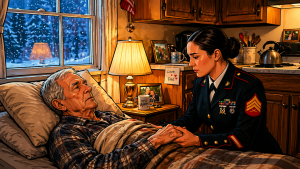
When I entered his room, Grandpa turned his head. His eyes were clearer now, though his face was still pale. The nurse had propped him up slightly, and the photo of Grandma was on the table beside him. When he saw it, his chin trembled.
“You found her,” he whispered.
“I found both letters.”
His eyes closed.
For a moment, he was not the man who had whispered about revenge. He was a widower lying in a hospital bed on Christmas Eve, hearing proof that his wife had protected him even after death.
“She knew,” he said.
“Yes.”
“She always knew before I did.”
I pulled the chair close. “Grandpa, the police came to the house. Adult Protective Services, too. They documented everything. Detective Pike has the financial records. Denise is filing reports. I called the attorney’s office, and Margaret Whitfield is coming in the morning.”
Grandpa listened without interrupting. His fingers moved slightly on top of the blanket. I took his hand.
“I need to ask you something,” I said. “Did Dad have power of attorney?”
His mouth tightened.
“I signed something after your grandma died. Mark said it was for convenience. Bills. Taxes. Doctor forms. I didn’t want to think about paperwork. I trusted him.”
“He used it?”
“I think so.” Grandpa’s voice was thin, but the shame in it was heavy. “At first, he asked. Said he needed help. Business was slow. Your mother had medical bills. Then he stopped asking. He told me I was confused when I questioned him. Said I’d promised. Said I didn’t remember.”
“Grandpa.”
“I know.” His eyes opened, wet and furious. “I know now.”
There are few things more painful than watching a good man realize he has been robbed not only of money, but of dignity. Money can be counted. Dignity has to be rebuilt from ruins.
He looked toward the window. Snow tapped softly against the glass.
“I heard them talking,” he said. “Last week. They thought I was sleeping. Your mother said the cruise was nonrefundable. Your father said you were coming home anyway. She said, ‘What if Emma doesn’t get there in time?’”
My throat closed.
Grandpa turned back to me.
“And your father said, ‘Then it becomes God’s decision.’”
For a few seconds, the room disappeared.
The machines kept beeping. The hallway kept moving. Somewhere nearby, a nurse laughed quietly at something another nurse said. The world continued in all its ordinary ways while my father’s sentence detonated inside me.
Then it becomes God’s decision.
Not a mistake. Not stress. Not caregiver burnout. A calculation.
I stood so abruptly the chair scraped back.
“Emma,” Grandpa said.
“I need a minute.”
“No.”
I stopped at the door.
His voice, though weak, carried the old command I remembered from childhood—the one he used when a storm was coming and he needed everyone inside.
“Come here.”
I came back.
“Sit down.”
I sat.
He looked at me until my breathing steadied.
“Your grandmother said truth,” he whispered. “Not rage.”
“I know.”
“No, you don’t. Not yet. You’re young. You think rage makes you strong because it gets you moving. But rage is a terrible driver. It will take the wheel and put you in a ditch.”
“They left you to die.”
His eyes flashed. “And I am still here.”
That stopped me.
He squeezed my fingers with surprising strength.
“I want them held accountable,” he said. “Every dollar. Every lie. Every hour they left me in that cold room. I want all of it in daylight. But I don’t want you becoming what they are. Promise me.”
I looked at his hand in mine. The skin was thin, the veins raised, the knuckles swollen from arthritis. This hand had baited hooks for me, held my bike seat while I learned balance, slipped twenty-dollar bills into my birthday cards, waved from the bleachers at my high school graduation, saluted me with trembling pride when I came home from boot camp.
“I promise,” I said.
I meant it.
Mostly.
Margaret Whitfield arrived Christmas morning wearing a gray wool coat, snow boots, and an expression that made me understand why Grandma had trusted her. She was in her sixties, tall, elegant, with short white hair and a leather briefcase that looked older than me. She did not waste time on sentimental greetings. She walked into Grandpa’s room, took his hand, and said, “Richard, Elizabeth told me you would wait too long.”
Grandpa gave a weak laugh that turned into a cough.
Margaret smiled sadly. “Still stubborn, I see.”
“Still expensive?” he rasped.
“Extremely.”
That made him smile for real.
She asked everyone but me to leave while she spoke with him privately. Even Denise stepped out. I stood in the hallway beside a vending machine and watched families pass with gift bags and poinsettias. Christmas morning in a hospital has a strange sadness to it. People try harder than usual to be cheerful, which only makes the fear underneath more visible.
After twenty minutes, Margaret opened the door and waved me in.
Grandpa looked tired but alert. Margaret had a yellow legal pad on her lap.
“Your grandfather has capacity,” she said. “I have spoken with his attending physician, and a formal assessment will be placed in his chart. He understands his assets, his family relationships, the nature of the documents we discussed, and the consequences of his decisions.”
I nodded, though my heart was pounding.
“First,” Margaret continued, “he is revoking the financial power of attorney previously granted to your father. Immediately. I’ll prepare the notice and send it to the bank, the county recorder, and any relevant institutions.”
Grandpa stared at the ceiling like hearing that out loud cost him something.
“Second,” she said, “he is appointing you as his healthcare proxy and limited financial agent, subject to accounting requirements. That means every transaction will be documented. No informal arrangements. No gray areas.”
“Good,” I said.
“Third, we are petitioning the court for a protective order preventing your parents from removing property, accessing accounts, or contacting Richard except through counsel until the court reviews the matter.”………….

