At my daughter’s funeral, the woman sleeping with her husband leaned into my ear and whispered, “I won.” She said it with such quiet certainty that, for one second, I believed cruelty had finally reached its purest form.
Then Lucía’s lawyer rose from the side aisle, asked the church for silence, and announced that my daughter had left instructions that were to be carried out before the burial.
That was the moment the room changed.
The lilies still smelled the same.
The candles still burned.
But suddenly grief was no longer the only thing standing beside the coffin.
The service was being held at St.
Michael’s, a stone church with high ceilings and cold marble floors that made every footstep sound more important than it really was.
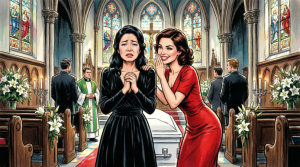
That morning, the whole place smelled of wax, polished wood, and the suffocating sweetness of funeral flowers.
Lucía’s white coffin stood before the altar under a spray of roses I had chosen myself because they were the only flowers she used to say looked brave.
I remember thinking that even the flowers were doing more for her than her husband was.
We had already reached the part of the ceremony where the priest lowered his voice and people bowed their heads.
It was that suspended, aching stretch of a funeral when everyone is pretending dignity can keep sorrow under control.
Then the doors opened.
The sound cut through everything.
First the hinges.
Then the hard click of heels.
Then a man’s low laugh.
I turned before I even knew why, and there he was.
Álvaro walked in like a man arriving late to a cocktail party, not to the funeral of the woman he had sworn to love.
His suit was perfect.
His hair was immaculate.
Nothing about him looked sleepless, ruined, or human.
Draped over his arm was a young woman in a fitted red dress, her lips curved into a smile too comfortable for the setting.
She did not look confused.
She did not look guilty.
She looked curious, almost triumphant, as if she had spent the entire ride over imagining this exact scene and was pleased that reality had met expectations.
When they passed me, she leaned close enough for me to smell her perfume over the lilies.
I expected some fake softness, some poisonous version of sympathy.
Instead she whispered, “I won.” Two small words.
No trembling.
No shame.
She delivered them like a verdict.
I think something inside me split open right then, because I remember wanting to do things that did not belong in a church.
I wanted noise.
I wanted disgrace.
I wanted the whole polished room to crack open and show the ugliness beneath it.
But my daughter was in that coffin, and I would not turn her farewell into their spectacle.
So I stood still and stared at the white wood while my mind ran backward through the years.
Back to the first time Lucía introduced Álvaro to me, handsome and charming and so attentive that half the room mistook control for devotion.
Back to the way he always answered questions for her.
Back to the small corrections disguised as jokes.
The first year of marriage, I told myself they were learning each other.
The second year, I told myself marriage had rough seasons.
By the third, I had started recognizing fear even when my daughter refused to name it.
She began visiting me in long sleeves during July.
At first it was one night, then another.
I would make tea, pretend not to notice how carefully she reached for the mug, and let her decide whether she wanted truth or denial.
Usually she chose denial.
“I’m cold, Mom,” she would say.
Or, “I bumped into a shelf.” Or my least favorite lie of all: “Álvaro’s just stressed.” That sentence became the bandage she wrapped around every wound he left.
Stress.
Pressure.
Deadlines.
His temper always had a respectable excuse.
The bruises were bad enough.
What frightened me more was the shrinking.
Lucía had once been the kind of woman who filled a room with warmth before she even opened her mouth.
After marrying Álvaro, she began apologizing for things that required no apology.
She lowered her voice.
She checked her phone every few minutes.
She stopped laughing with her whole body.
By the time she got pregnant, the daughter I knew seemed to live inside her own life like a guest who had overstayed.
And still she hoped.
Women in pain often do.
She placed one hand over her stomach and told me, more than once, that things would calm down once the baby arrived.
“He’s scared,” she said.
“He doesn’t know how to be a father yet.” I looked at her and thought the cruelest thing about men like Álvaro was not that they lied.
It was that they made good women build entire futures out of those lies.
Lucía wanted so badly to believe that a child could soften a man who enjoyed being hard.
When my granddaughter Sofía was born, I waited for the promised miracle.
It never came.
Álvaro did not become gentler.
He became more entitled.
He spoke about the baby as if she were proof that Lucía belonged to him permanently.
He monitored the house accounts.
He controlled who came by.
He decided which relatives were welcome and which ones were a problem.
He also became increasingly interested in the inheritance Lucía had received from her late father: an apartment downtown, investment accounts, and a minority stake in a family logistics company.
He asked questions that had nothing to do with love and everything to do with access.
One rainy night, about six weeks before Lucía died, she came to my house after dark with Sofía asleep in the car seat.
Her mouth was split at the corner.
She told me she had slipped getting out of the shower.
I stared at her until she looked away.
Then, instead of repeating the lie, she asked me for the name of the lawyer who had handled my husband’s estate.
That was the moment I knew she had finally stopped waiting for Álvaro to change.
She was still frightened.
Still conflicted.
But somewhere inside her, the spell had cracked.
I wrote Javier Morales’s number on the back of a grocery receipt.
She tucked it into her wallet like it was contraband.
Before she left, I begged her to stay the night.
She almost said yes.
I saw it in her face.
Then her phone buzzed, and with that single sound all the fear came rushing back into her eyes.
She picked up Sofía’s carrier and whispered, “Not yet, Mom.
But if something happens… don’t let him raise her.” I never forgot those words.
Mothers don’t forget the sentences that arrive wearing prophecy.
After that, things began moving under the surface.
I know that now because Javier later told me Lucía met with him three times in secret.
She brought copies of account statements, photographs of bruises, notes she had written after fights, and screenshots of messages from a woman named Valentina.
I did not know Valentina then.
I would meet her in the red dress, smiling beside the coffin.
Lucía knew the affair before I did.
She knew about hotel bookings, hidden numbers, and late-night lies.
More importantly, she knew Álvaro had started pressuring her to sign documents that would have given him easier access to her inherited assets.
Two days before her death, Lucía called me from her car.
She sounded breathless, as if she had gone outside to speak without being overheard.
She said she had met Javier again.
She said she was putting everything in order.
She said she was finally ready to leave.
I remember gripping my kitchen counter so hard my fingers hurt.
I told her to come straight to my house and not stop for anything.
She said she needed one more night to collect some papers and Sofía’s medical records.
“Tomorrow,” she promised.
“Tomorrow I’ll bring the baby and I won’t go back.”
Tomorrow never came.
The police told me her SUV struck the guardrail on the northbound highway after a sudden brake failure.
They called it a tragic accident.
Álvaro cried in the hospital hallway with his face in his hands and strangers patted his back.
I watched him through numb eyes and felt something bitter moving beneath my grief.
He cried too neatly.
He accepted sympathy too easily.
And when I asked where Sofía had been during the crash, he answered too fast: with the nanny.
Safe at home.
As if fate had been selective enough to spare the one person who complicated his plans.
At the funeral, looking at him seated in the front pew beside Valentina, I knew he believed the difficult part was over.
He thought public grief would wash him clean.
He thought the coffin gave him control of the narrative.
He had no idea that Lucía, even dead, had arrived at the church before he did.
That was when Javier Morales stood.
He had been sitting near a pillar in a gray suit, silent, steady, holding a sealed envelope in both hands.
He walked to the altar with the calm of a man who knew everyone in the room was about to see something they could never unsee.
When he cleared his throat, the whispers softened.
When he said Lucía had left explicit legal instructions to be carried out before burial, even the priest stepped back.
Álvaro laughed.
It was a small laugh, dismissive and arrogant.
“A will?” he said.
“My wife didn’t have anything I didn’t know about.” I will remember Javier’s face until the day I die.
He did not glare.
He did not perform outrage.
He simply looked at Álvaro the way a surgeon looks at an X-ray that confirms the disease.
“I will begin,” he said, breaking the seal, “with the
first named beneficiary.” Then he lifted his eyes and spoke the words that made my knees weaken.
“María Gómez, mother of the deceased, is appointed sole trustee of the Sofía Lucía Protective Trust and designated emergency guardian of the minor child named herein.”
For a second, nobody moved.
The church absorbed the sentence slowly, like a body recognizing pain after shock.
Then the murmurs began.
Álvaro stood so abruptly the pew scraped against the floor.
“That’s absurd,” he snapped.
“I’m her husband.
I’m the father.” Javier did not flinch.
He continued reading.
All assets Lucía had inherited in her sole name had been transferred into a protected trust for Sofía before her death.
The downtown apartment.
The investment accounts.
Her company shares.
The insurance proceeds attributable to her separate estate.
None of it passed to Álvaro.
None of it could be controlled by him.
The woman in red was no longer smiling.
Then Javier unfolded a second document.
“The deceased also left an additional instruction,” he said, “to be activated if Mr.
Álvaro Reyes contested this will or arrived at her funeral accompanied by an extramarital partner.” A sound passed through the church that did not quite become a gasp.
It was larger than that.
It was the sound people make when indecency loses its mask in public.
Javier removed a smaller sealed packet from the envelope.
On the front, in Lucía’s handwriting, were the words: Open in front of everyone if he brings her.
Valentina took one step away from Álvaro.
My hands were shaking now, but not from helplessness.
From the unfamiliar, dangerous feeling that the truth had finally decided to stand up.
Javier opened the second packet.
Inside were photographs, copies of bank requests, hotel confirmations, and a flash drive.
“Lucía Gómez left sworn statements documenting repeated physical abuse, coercive control, and financial intimidation,” he said.
“She also left instructions that if this packet was opened, an audio recording was to be played in the presence of witnesses.”
Álvaro moved toward him then, fury breaking through his polished surface.
“You can’t do this here.” Two of Lucía’s cousins stepped into the aisle before he got far.
The priest called for calm, but no one was calm anymore.
Javier handed the flash drive to a younger associate standing near the organ.
A portable speaker had already been set on a side table.
Even that detail was Lucía’s.
She had anticipated denial.
She had anticipated chaos.
She had prepared for both.
Her voice filled the church.
The first sound nearly dropped me to my knees.
Lucía sounded tired, but clear.
Not broken.
Not hysterical.
Clear in the devastating way people become when fear has finally turned into decision.
“If you are hearing this,” she said, “it means Álvaro has done exactly what I thought he would do.
He has either challenged what is mine, or he has come here with Valentina, the woman he has been seeing while telling everyone he is a devoted husband.” The room remained frozen.
Even the baby somewhere in the back stopped fussing, as if the whole church understood it was listening to the dead.
Then the second voice came through.
Álvaro’s.
Angry.
Sharp.
Undeniable.
The recording was from a fight.
I could hear glass clink somewhere, and Sofía crying faintly in another room.
“Sign it, Lucía,” he said.
“You don’t need your mother in our business.
You don’t need that trust protected from me unless you think I’m the enemy.” Lucía’s voice answered, shaking but steady: “You are the enemy when you put your hands on me.” There was a silence, then his laugh.
I will hear that laugh until my own funeral.
“Careful,” he said.
“Accidents happen when people get emotional.”
Valentina’s face turned white.
Javier let only a portion of the recording play before stopping it.
He did not need more.
The church had heard enough.
But he continued speaking, and each sentence landed like a stone.
Lucía had photographed bruises and emailed them to him with timestamps.
She had written out a chronology of assaults.
She had documented Valentina’s calls.
She had collected copies of attempted transfer forms Álvaro pressured her to sign.
Most damning of all, she had forwarded Javier an email from a mechanic she had contacted the morning of the crash.
According to the message, her brake system showed signs of deliberate tampering and the vehicle should not be driven.
The church, already silent, became unearthly.
I watched the meaning travel across faces row by row.
Shock first.
Then horror.
Then that final, ugly recognition that the grieving widower in the front pew might not be a widower at all in the moral sense.
He might simply be the last person to have benefited from my daughter’s fear.
Álvaro tried to speak, but the words came out scattered and wrong.
Lies never look elegant once evidence enters the room.
Javier was not finished.
He announced that copies of all documents had been delivered that morning to the district attorney’s office, family court, and the detectives assigned to review Lucía’s crash.
As if on cue, two investigators standing near the back of the church stepped forward.
I had noticed them earlier without understanding why they were there.
Now I knew.
Lucía had arranged witnesses, documents, timing, and exposure so carefully that even death had not silenced her.
She had turned her funeral into the one courtroom Álvaro could not control.
One detective addressed Álvaro by name and asked him to come with them for questioning regarding financial fraud, domestic assault allegations, and the reopened investigation into the circumstances of Lucía’s death.
He began shouting then.
Not grieving.
Not confused.
Shouting.
He pointed at Javier.
At me.
At Valentina.
He said everyone was conspiring against him.
He called Lucía unstable.
He said postpartum depression had made her dramatic.
Every word only proved how completely he had mistaken manipulation for intelligence.
By then no one was listening to him the way they had listened to the recording.
Valentina finally spoke, but not to defend him.
She stared at him as though the church lights had turned him into a stranger.
“You told me she was leaving you,” she said, her voice thin with panic.
“You said the marriage was over.” He reached for her arm.
She recoiled.
In that tiny movement, all her earlier triumph collapsed.
She had arrived at the funeral dressed like the future.
Now she looked like a woman realizing she had walked into someone else’s crime scene.
I did not move while they led him up the aisle.
I could have stepped aside.
I could have
watched him pass without a word.
Instead, I looked directly at him.
For the first time since Lucía married him, I saw fear on his face unsoftened by charm.
He knew the room had turned.
He knew the story he had planned to tell about himself had been destroyed by the one person he believed he had already buried.
Sometimes justice does not arrive as a verdict.
Sometimes it arrives as the loss of control.
After they were gone, the church remained suspended in a strange, painful quiet.
The priest closed the prayer book against his chest and said we would continue the service for Lucía.
For Lucía.
Not for scandal.
Not for the man who had nearly hijacked her goodbye.
People sat down slowly.
Some were crying.
Some could not meet my eyes.
I could not blame them.
Most people want abuse to arrive looking monstrous from the first day.
They do not know how often it arrives polished, admired, and well-dressed.
When the burial was over and the last condolence had been offered, Javier asked if he could walk me to the car.
My sister had taken Sofía home before the service began because I could not bear to expose that child to a room full of whispers.
Outside, the afternoon had gone gray and cold.
Javier handed me one final sealed envelope.
“This is from Lucía,” he said.
“She instructed me to give it to you only after the reading.” My fingers trembled so badly I could hardly break the seal.
I read the letter that night with Sofía asleep against my chest.
Lucía’s handwriting slanted the way it had when she was tired.
She wrote that she was sorry for every time she made me pretend not to see.
Sorry for every lie I had to swallow with her.
She wrote that loving someone cruel had made her doubt her own mind, and that was the part she hated most.
Not the bruises.
Not the insults.
The doubt.
She wrote that she had finally understood something too many women learn late: love that requires silence is not love.
It is captivity with a softer name.
Then came the line that broke me open in a different way than grief had.
“If I did not make it out in time,” she wrote, “please raise Sofía where no one teaches her to confuse fear with devotion.” I pressed the paper to my mouth and cried without making a sound because the baby was sleeping.
There are tears that come from helplessness.
These did not.
These came from the unbearable dignity of a daughter trying to protect her child even as her own life narrowed.
The months that followed were a blur of hearings, statements, and days measured in bottles, naps, and lawyers’ calls.
Valentina eventually cooperated after detectives confronted her with messages, hotel receipts, and transfers Álvaro had concealed.
The crash investigation was formally reopened.
Financial records revealed attempted access to trust accounts and a life insurance policy update Álvaro had made just weeks before Lucía died.
Family court suspended his parental rights pending criminal proceedings.
The words were clinical.
The impact was not.
Each development felt like another stitch closing a wound that could never truly disappear.
Sofía grew.
Babies do that even while adults are still
standing in the ruins.
She learned to grip my finger.
Then to laugh.
Then to say a crooked little version of Nana when she wanted to be picked up.
I put Lucía’s photograph beside her crib and told her every day about the mother who loved her fiercely enough to prepare a shield in advance.
I told her that her mother was not weak because she stayed too long.
She was strong because, once she saw clearly, she used every bit of strength she had left to protect her child and expose the truth.
Sometimes people still ask me what I felt when that woman in red whispered, “I won.” The answer is complicated.
In that instant, I felt destroyed.
Humiliated.
Wild with grief.
But when I think of the whole day now, what I remember most is not the whisper.
It is the way her face changed when Javier opened the second packet.
It is the way Álvaro’s confidence cracked under the sound of Lucía’s own voice.
It is the way truth, once invited into a room, makes arrogance look small.
My daughter did not get the long life she deserved.
She did not get the peaceful home she kept promising herself would come tomorrow.
I cannot change that.
There are things no mother can undo, no matter how fiercely she loves.
But I can say this: at her funeral, the people who thought they had won discovered that Lucía had written the final scene herself.
And when the dead are brave enough to leave the truth behind, the living no longer get to bury it.

