My phone rang at 2:17 p.m., the kind of weekday hour when nothing dramatic is supposed to happen.
I was sitting at my desk, pretending to be interested in a spreadsheet that had already been revised three times, watching the numbers blur into each other while the office carried on around me. Keyboards clicked. Someone laughed too loudly at something on a screen. The air conditioning hummed with the steady confidence of a building that assumed all emergencies could be handled politely.
Unknown number.
I stared at it until the second ring, and then the third, my thumb hovering like I could feel the future through the glass. I almost ignored it. Almost. The kind of almost that turns into an anchor in your stomach months later, when you’re awake at three in the morning replaying a decision you didn’t realize mattered.
I answered.
“Anna Walker?” a man asked.
“Yes.”
“This is Officer Miller. Your daughter, Lucy Walker, has been brought to Mercy General. She’s stable, but you need to come immediately.”
The word stable landed wrong, like the chair you sit in at a restaurant and it shifts underneath you, the moment when your body understands something before your mind catches up.
“Stable?” I repeated, because my brain wanted to rewind and listen again. “What happened?”
“We’ll explain when you arrive,” he said, voice measured, professional. The kind of calm that only exists when something has already gone very wrong and everyone in the room is focusing hard on keeping it contained. “One more thing— the vehicle involved is registered to you.”
The call ended before I could ask what that meant.
For a full second I sat there with my phone pressed to my ear, listening to nothing. The office didn’t change. It kept going, oblivious. My body, though, felt like it had slipped out of alignment. My hands began shaking so sharply I had to lock my fingers together under the desk.
Lucy.
My chair scraped back with a sound that cut through my own head. I stood so fast it tipped over, and someone two desks away looked up as if I’d committed a social offense. I didn’t care. I grabbed my bag, my keys, my jacket I didn’t need, anything that made me feel like I was doing something.
“I have to go,” I told my manager, already walking.
“Anna— are you okay?” he started, his voice shifting into that careful tone people use when they want to be supportive but don’t want to get pulled into the gravity of your crisis.
“Emergency,” I said. I don’t even remember if the word came out clearly. My throat felt tight, full of cotton. I was already gone.
The elevator took forever. Every floor it stopped on felt like an insult. When the doors finally opened into the parking garage, the air was hotter than it should’ve been, thick and stale. Outside, the city was in the middle of a heatwave that had been building for days. The weather app had been sending warnings like a parent: Stay hydrated. Avoid prolonged sun exposure. Check on vulnerable people.
I ran anyway.
My footsteps slapped the concrete, echoing between the pillars. Halfway to my spot I saw it— not my car, but the empty space where it should’ve been.
I stopped so abruptly my body lurched forward. For a moment I just stood there breathing too hard, staring at the painted lines as if they might rearrange themselves into an explanation.
Then it clicked. Of course.
I had loaned my car to my sister, Amanda, that morning. She had called right after breakfast with that tone of casual need she used when asking for something she already assumed she’d get.
“Hey,” she’d said, cheerful. “We’re taking the kids to the Lakeside Fun Park today, but our second car’s not available. Can we borrow yours? It’ll be easier to fit everyone in one vehicle.”
I’d been packing Lucy’s lunch, listening to her chatter about a craft project at school. My first instinct had been to hesitate. It was a weekday. I had work. But my parents were off, Amanda was off, and they’d said they were taking Lucy too. My mother had even chimed in over speakerphone, sweetly: “It’ll be good for her to have cousin time.”
And I— because I am who I’ve been trained to be— had said yes.
“Yes, sure. Of course.”
I didn’t have time to think about the morning now. I pulled out my phone, ordered a taxi with fingers that couldn’t keep still, and paced like an animal trapped in a too-small cage while the app told me cheerfully that my driver was three minutes away.
Three minutes is nothing. Three minutes is a song on the radio. Three minutes is how long it takes to boil water if you’re paying attention.
Those three minutes stretched like taffy.
I checked the time. Checked it again. My heart kept trying to climb into my throat. My palms were slick with sweat, but the sweat didn’t feel like heat— it felt like fear.
When the taxi finally pulled in, I yanked the door open so hard the driver flinched.
“Mercy General,” I said, voice tight. “My daughter’s there.”
He nodded, unbothered in the way only strangers can be when your world is on fire. “Traffic’s heavy today.”
Of course it was. Of course the city chose today to be itself.
We crawled through streets that seemed designed to punish urgency. Red lights stacked up ahead of us like a wall of denial. A bus pulled out in front of us, lumbering. A delivery truck double-parked. A cyclist darted between cars with the confidence of someone who didn’t have a child in a hospital.
I kept calling my mother. No answer.
My father. Nothing.
Amanda. Ringing. Ringing. Ringing.
I stared out the window at the brightness of the day, the cruel normalcy. People walked with iced drinks. Someone stood outside a café laughing. A dog trotted along a sidewalk, tongue out, happy.
My mind tried to build scenarios, and each one was worse than the last. Lucy fell. Lucy got hit. Lucy swallowed something. Lucy—
The hospital doors slid open with a soft, polite whisper, and that sound made me want to scream. Inside, everything was too bright, too clean, too controlled. The air smelled like disinfectant and faint coffee. People moved in straight lines, speaking quietly. A child with a bandaged arm sat near the entrance eating a popsicle as if hospitals were ordinary.
I went to the front desk.
“I’m Anna Walker,” I said, barely recognizing my own voice. “My daughter, Lucy— I was told she was brought in.”
The receptionist looked at her screen and then at me with a kind of practiced compassion. “Yes, Ms. Walker. She’s here. She’s stable.”
Stable again. Like the universe had decided that word would be my new enemy.
“She’s in Pediatrics,” the woman continued. “We’re running some checks. A nurse will come speak with you.”
“A nurse?” I echoed. “I need to see her.”
“I understand.” The receptionist’s expression didn’t change, but something in her eyes told me she had seen this kind of panic before. “We just need you to fill out these forms. And I’ll need your ID.”
My hands fumbled in my wallet. My ID card felt like a joke. A tiny rectangle that proved my name while my child sat behind doors I couldn’t open fast enough.
A nurse appeared a few minutes later— or maybe it was longer; time had stopped obeying rules. She introduced herself, her tone gentle but careful, as if she were walking on glass.
“Ms. Walker,” she said, “your daughter is doing okay. She’s awake.”
I exhaled so hard it made my chest ache.
“She was found alone in a vehicle,” the nurse continued, and every word after that seemed to tilt the world. “Given the circumstances, this has been reported.”
“Reported,” I repeated, my mouth dry.
“It’s standard,” she said quickly, as if she could soften the impact by naming procedure. “Because of her age and the nature of the situation, we’re required to notify authorities.”
Authorities. Police. The man on the phone. The registered vehicle.
My knees felt weak. I had to grip the counter to steady myself.
“Where is she?” I asked.
The nurse nodded toward a hallway. “Come with me.”
We walked past rooms and curtains, past the beep of monitors and the squeak of shoes. Every step felt like a delay. When we reached Lucy’s room, the nurse paused, and for a split second I was afraid she’d stop me.
Then she opened the door.
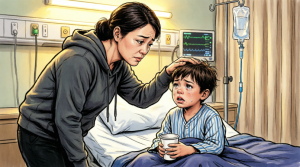
Lucy was sitting upright on the bed, clutching a paper cup in both hands as if it might disappear. Her cheeks were flushed, her hair damp at the temples. Her eyes— those enormous brown eyes that normally looked mischievous and warm— were too wide, too fixed.
She saw me and her face crumpled.
“Mom,” she said, and then she burst into tears so abruptly it sounded like her body had been holding them back with sheer force until she saw me.
I crossed the room in two steps and wrapped myself around her, pulling her into my chest, feeling how small she was, how tightly she clung. Her whole body shook. She smelled like sweat and hospital soap. She pressed her face into my shoulder so hard it hurt.
“I’m here,” I whispered. “I’m here, baby.”
She sobbed and sobbed, the kind of crying that comes from fear, not pain. She clutched my shirt with fists that looked too tiny to hold that much terror.
I didn’t say anything else for a moment. I just held her and let her cry. Because whatever came next, whatever explanation, whatever rage, I needed this one pocket of time where she was only my child and I was only her mother and she was alive.
A nurse hovered by the door, giving us a minute and not giving us a minute at the same time.
When Lucy’s sobs finally slowed into hiccups, I leaned back just enough to see her face. Her lashes were wet. Her lower lip trembled. There were faint red marks on her forehead where she’d pressed against something— glass, maybe. She looked exhausted, but her eyes kept scanning me like she needed to be sure I wasn’t going to vanish.
“Are you hurt?” I asked, hands moving over her arms, her shoulders, her hair.
She shook her head quickly. “I was thirsty,” she whispered. “And it was hot.”
I swallowed hard. “I know.”
Her grip tightened again. “I waited,” she said, voice tiny. “I thought they were coming back.”
The nurse stepped forward gently. “Ms. Walker,” she said, “I’m going to explain what we know.”
“Okay,” I said too fast. My voice sounded like it belonged to someone else.
The nurse kept her tone precise, calm— the tone of someone who has delivered information like this before and has learned that facts are safer than emotion.
“Lucy was found in a parked car in a public lot,” she said. “A passerby noticed a child inside, knocking on the window and crying. They contacted security, who called 911.”
Lucy’s fingers curled into the fabric of my sleeve at the word passerby, as if imagining the stranger who had saved her. I felt a strange, sudden gratitude toward someone I would never meet.
“Emergency services arrived,” the nurse continued, “and they got her out. She was conscious, very upset, and overheated. EMS brought her here for evaluation.”
I stared at the nurse. “How long was she in the car?” I asked.
The nurse hesitated, then shook her head. “That’s still being confirmed by police. Based on the information we have so far, it wasn’t a short period.”
Not short. My chest tightened until it felt like my ribs were closing in.
“She kept asking where you were,” the nurse added quietly. “She was scared.”
I nodded because my body still knew how to nod even though my mind was splintering.
“Physically, she’s doing well,” the nurse said. “We’re monitoring her temperature and hydration. But because of her age and how she was found— we had to report it. That’s standard.”
Standard. That word again. Like this could ever be standard. Like a six-year-old alone in a sealed metal box during a heatwave could be routine.
Officer Miller appeared in the doorway a few minutes later. He didn’t look rushed or angry. He looked neutral, which somehow felt worse— as if he’d seen this so many times that surprise had burned out.
“Ms. Walker,” he said, “when you have a moment, I need to ask you a few questions. We can step into the hall.”
Lucy stiffened. Her whole body tightened against mine.
“It’s okay,” I told her softly. “I’ll be right outside. Dad’s here too— Chris is here, okay? You’re not alone.”
Chris had arrived while I was with the nurse, his face pale and furious, his eyes going straight to Lucy like he needed to check she was real. He stood now by the window, jaw clenched, hands fisted at his sides.
Lucy nodded, but her grip tightened before she let go.
In the hallway, Officer Miller opened a notepad.
“This is just initial information,” he said. “We’ll do a formal statement later. Where were you today?”
“At work,” I said.
“And your daughter was with—?”
“My parents,” I said, the words tasting bitter. “And my sister, Amanda.”
“The vehicle she was found in is registered to you,” he said. “Can you explain that?”
“I loaned my car to them this morning,” I said. “They said they needed it to fit everyone.”
He wrote something down. “Did you give permission for Lucy to be left alone in the vehicle at any point?”
“No,” I said immediately. The word came out sharp. “Never.”
He looked up at that, his eyes narrowing just a fraction. “All right,” he said. “We’re still establishing a timeline and speaking with everyone involved. We’ll be in touch to schedule a full statement. For now, I need you to remain available and not contact anyone involved about the case.”
My stomach dropped. “Not contact?” I repeated, because the idea of not calling my family felt impossible.
“It’s best for the investigation,” he said. “You can communicate about your daughter’s medical needs, but avoid discussing details.”
I nodded, though my mind immediately leapt to a single thought: If I didn’t contact them, I wouldn’t know what happened. But maybe that was the point. Maybe the police already suspected what I was afraid to name.
When I went back into Lucy’s room, she was calmer, sipping from her cup with small, careful sips. She watched me like a hawk.
“Did you talk to him?” she asked.
“Yes,” I said, sitting beside her. “I talked to him.”
“Am I in trouble?” she whispered.
My heart cracked. “No,” I said firmly. “No, baby. You didn’t do anything wrong.”
She blinked hard, as if she couldn’t quite accept that.
Chris sat in the chair on the other side of the bed, leaning forward, his hands clasped so tightly his knuckles were white. “Hey, Lu,” he said softly. “We’re right here.”
Lucy’s eyes flicked to him and then back to me, and she gave a tiny nod.
I knew I wasn’t supposed to contact anyone about the case. I also knew I couldn’t sit there in that sterile room with my child’s hair still damp from heat and not demand answers from the people who had been responsible for her.
So I did what I’ve always done: I broke the rules for my family— not to protect them, but to protect my daughter.
I called Amanda.
It rang. Once. Twice. Three times. On the fourth ring she answered, and her voice was bright, breathless, full of background noise— laughter, music, the clatter of something fun.
“You should have seen the place,” she said immediately, like she’d been waiting to share. “Logan didn’t want to leave— he went on the big slide twice. Ella cried when we told her we were going home. Total meltdown.”
I gripped the phone so hard my hand ached. “Where is Lucy?” I asked.
There was a pause, not alarm, not confusion— just the subtle sound of someone deciding how much effort to invest in the answer.
“She’s in the car,” Amanda said finally. Casual. As if she were talking about a jacket left on a seat.
“In the car,” I repeated.
“Yeah,” she said, and I heard something like a shrug in the way her voice shifted. “We told her to stay there.”
My stomach dropped so hard it felt like falling.
“Why?” I asked.
“Oh, come on,” Amanda said, already irritated. “She was acting up all afternoon. Complaining about everything. She wouldn’t stop whining. We needed a break.”
“A break,” I repeated, because my brain couldn’t make it real.
“Yes,” Amanda said. “Anna, you know how she gets. And it was embarrassing. People were staring.”
“So you left her in the car?” My voice shook now, and I hated that. I hated how my body responded to her like she still had authority over my nervous system.
“For a bit,” she said, like this was reasonable. “She needed to cool off.”
“In the car,” I said again. “In a heatwave.”
“Anna,” she sighed, long and theatrical. “Don’t do that thing where you twist my words. We parked in the shade. The window was cracked.”
“Was it locked?” I asked.
Another pause. “Well, obviously,” she said. “I’m not leaving the car unlocked with our stuff in it.”
I stared at the wall across from Lucy’s bed. The paint was that hospital beige meant to be calming, but it suddenly looked like the inside of a coffin.
“How long has she been there?” I asked.
“I don’t know,” Amanda said, impatient now. “We’re busy. The other kids are having a great time.”
Then she laughed— not cruelly, exactly, but carelessly. Like someone laughing at an inconvenience.
“We had such a great time without the drama,” she said. “Honestly, it was kind of nice.”
That was when I said, very clearly, “Lucy is in the hospital.”
Silence.
“What?” Amanda said, her voice flattening.
“She’s in the hospital,” I repeated. “Police called me. I’m here with her.”
“That’s not possible,” Amanda said immediately, the way people deny reality when it threatens them. “We parked in the shade. The window was open. She was fine.”
“She was alone,” I said. “A stranger had to call for help.”
A different silence now. Heavier.
“She’s— she’s fine, though, right?” Amanda asked, and there it was— not concern, not horror, but calculation. “I mean, she’s not actually hurt.”
I closed my eyes. “Define fine,” I said.
“She’s alive,” I said, because I needed to say it aloud.
Amanda exhaled, audible through the phone. And then— like flipping a switch— her fear evaporated and was replaced with irritation.
“So nothing really happened,” she said quickly. “See? You always do this. You always blow things out of proportion.”
“She was locked in a car for hours,” I said, my voice low.
“But she’s okay,” Amanda insisted. “You said it yourself.”
The nurse in the room glanced over, her eyes narrowing slightly, as if she could sense the shape of the conversation.
Amanda’s voice hardened. “We didn’t do anything wrong,” she said. “You’re turning this into a crisis for no reason.”
I ended the call before I could say something that would shatter whatever fragile control I still had.
For a moment I just sat there, phone in my lap, listening to the distant beep of a monitor down the hall. It sounded like proof. Like time continuing whether anyone deserved it or not.
Lucy looked up at me from the bed, watching my face with that careful, searching gaze kids get when they sense the adults are lying with their expressions.
“Are we going home?” she asked.
“Yes,” I said, forcing steadiness. “Very soon.”
I took her hand. It fit entirely inside mine.
They hadn’t forgotten her for a minute. They hadn’t made a quick mistake and fixed it. They had left her long enough for a stranger to notice. Long enough for police to arrive. Long enough for my six-year-old to believe no one was coming back.
And once Amanda knew Lucy would live, the only thing she cared about was whether the story could be made smaller. Whether it could be dismissed. Whether she could keep her life intact.
I stared at the wall and felt something inside me shift— not into grief, not yet, but into a sharper, steadier shape.
This wasn’t the first time my family had decided something awful wasn’t a big deal.
It was just the first time they’d done it to my child.
That changed everything.
If you want to understand how my parents and my sister could leave a six-year-old alone in a car during a heatwave and then treat it like an overreaction, you have to understand how inconvenience has always been handled in my family.
It was always assigned to me.
Amanda is three years older than I am, and that number has been treated like a crown for as long as I can remember. When we were kids, it meant she was the leader and I was the follower. It meant she was “more mature,” “more sensitive,” “more complicated.” It meant her feelings were important and mine were manageable. It meant she could lash out and it was considered passion, while I could flinch and it was considered drama.
“She’s strong,” my mother used to say about me. “Anna can handle it.”
I learned early that strong meant quiet. Strong meant swallowing. Strong meant smiling politely when someone else took the larger slice of cake.
There’s a memory I keep circling back to now, one I hadn’t consciously thought about in years. It wasn’t a headline memory— not the kind you tell at dinner parties. It was more like a bruise under the skin. You forget it until someone presses, and then suddenly you remember exactly where it is.
Amanda’s birthday party. I was seven. She was ten, old enough to understand cruelty and still choose it. I’d been excited for weeks, the way kids get excited— counting days on fingers, planning what to wear even when you only have three acceptable outfits. Our house was loud and crowded that day, full of the smell of cake and cheap balloons. Music played too loud. Adults talked over each other. Kids ran through the hallway with sticky hands.
I remember feeling— for a moment— like I belonged to something joyful.
Amanda found me in the hallway while my mother was distracted and my father was pretending not to hear anything over the music. She stood there with that particular smile she used when she had a plan.
“Come here,” she said. “I want to show you something.”
I followed her because that’s what younger sisters do. Because a part of you always believes there’s a chance this time will be different. That this time she will include you, like you’ve always wanted.
She led me toward the back of the house, to the storage room near the laundry area. It was a narrow space filled with boxes and old coats and holiday decorations shoved into corners. The air smelled like dust and detergent. She pointed to a shelf high up.
“Can you grab that for me?” she asked, pointing to a plastic tub.
I stood on my toes and reached. My fingers brushed the edge of the lid. I leaned forward.
The door closed.
The lock clicked.
I remember the sound more than anything else. Sharp. Final. Like the snap of a trap.
At first I thought it was a joke. I laughed and knocked on the door. “Amanda!” I called, giggling because I still believed in the rules of play. I waited for her to laugh back, for the door to open, for her to say Got you and for us to run back to the party together.
She didn’t laugh.
The music from the party thumped through the walls. Voices rose and fell. Someone shrieked with delighted kid laughter somewhere down the hall, and it felt like the sound of a world I was suddenly locked out of.
I knocked harder. “Amanda!” I called again, this time with a thin edge of panic. I tried the handle. It didn’t move.
Time does something strange when you’re a kid and you realize no one is coming. It stretches. It gets heavy. You start bargaining with it. If I’m quiet, maybe she’ll open the door. If I cry, maybe someone will hear me. If I knock just right, maybe the lock will magically break.
I don’t know how long I was in there. Ten minutes can feel like an hour when you’re seven and the dark is pressing in and the air feels thick.
I started to cry. Loud at first, then quieter when I realized the noise wasn’t bringing anyone. Eventually, I sat on the floor with my knees pulled to my chest, listening to the party I was missing, trying to swallow my sobs so I wouldn’t choke on them. I remember staring at a spiderweb in the corner, mesmerized by how something so delicate could survive in a place like that.
When the door finally opened, the sudden light made me blink hard. Amanda stood there, bored, as if she’d just remembered where she’d left me.
“What took you so long?” she asked, as if I’d been the one delaying her.
I ran past her and straight to my parents, sobbing so hard I could barely form words.
“She locked me in,” I cried. “She locked me in the storage room. I couldn’t get out.”
Amanda followed at a leisurely pace, her face already arranged into innocence.
My mother looked at me with irritation first, not concern. That’s what I remember most. Not fear, not alarm— annoyance, like I’d spilled juice on the rug.
Amanda rolled her eyes. “She’s lying,” she said.
My mother frowned at me. “Why would you lie on your sister’s birthday?” she asked, and I can still hear the disappointment in her voice— not toward Amanda, but toward me.
“I didn’t,” I said. “She did it.”
Amanda crossed her arms. “She didn’t want to come to the party,” she said. “She said it was stupid and she wanted attention.”
My father sighed, the way he always did when something interfered with his comfort. “Enough,” he said. “Don’t start drama. Not today.”
I stood there shaking, watching the story settle into place without me. Watching my reality get rewritten because it was more convenient for everyone if Amanda stayed the beloved daughter and I stayed the problem.
I got grounded. Not Amanda. Me. For “lying,” for “ruining the mood,” for “making everything about myself.”
That was the moment I learned the main rule of my family: the truth only mattered if it was convenient.
After that, I stopped pushing. Every time I tried to explain myself, it was used as proof that I was too sensitive. Every time I protested, I became the one “making a scene.”
So I adapted. I became agreeable. Reliable. The one who smoothed things over. The one who apologized first. The one who fixed what other people broke.
Amanda, meanwhile, was encouraged to “express herself.” Her storms were treated like weather— something you couldn’t hold against her. She changed majors in college twice, chasing passions. Every time she stumbled, it was framed as bravery. Every time she demanded, it was framed as confidence.
When I chose a practical degree and a stable job, it was framed as luck. “Anna’s just good at those things,” my mother would say, as if effort didn’t count if it wasn’t artistic. I married Chris— steady, kind, someone who saw me clearly and loved me anyway. We built a life that worked. We had Lucy. Our world got smaller in the best way: bedtime stories, Saturday pancakes, little routines that held everything together.
Amanda married Jason and had Logan and Ella. She drifted between jobs, always on the verge of finding her calling. Recently she’d decided to retrain as a teacher— art, of course, something with children, something she liked to describe with big noble words. My parents treated it like a heroic journey. “She’s so good with kids,” my mother would say, ignoring the fact that being entertaining at family gatherings and being responsible are not the same thing.
My parents retired— or tried to. They didn’t have the savings they’d planned, and their pride made them allergic to admitting it. They talked about how time was precious, how they deserved to enjoy their later years, how they’d sacrificed so much.
So I helped.
Every month, money left my account and landed in theirs: help with the mortgage, help with utilities, help with “unexpected expenses.” It had started small and then turned into a standing expectation. I told myself this was what families did. One person carried more weight so everyone else could breathe.
Amanda couldn’t help. She had kids. She was retraining. She needed support. Everyone said it like it was a law of physics.
And now my daughter had been left alone in a car and the same system— the same logic— was already shifting into place, ready to make it my job to absorb the consequences.
As I sat in that hospital room, listening to Lucy sip water in small careful swallows, the memory of the storage room pressed in on me like a hand on a bruise.
The same pattern, the same cruelty wrapped in convenience.
Someone makes a choice. Someone else pays.
And if I don’t cooperate, I become the problem.
When we were discharged just after sunset, the word discharge sounded calm, orderly. In reality, it felt like walking out of a burning building and being told the air is safe now.
Lucy walked beside me clutching my hand with both of hers, her small fingers locked around mine as if she believed letting go could pull her back into that car. She didn’t chatter the way she usually did. She didn’t ask questions about the hospital or point out interesting signs. She moved like a tiny soldier.
The doctor had said all the reassuring phrases: her vital signs were good, no lasting physical injury apparent, keep an eye on her hydration, follow up with her pediatrician, watch for behavioral changes. The phrases looked stable on paper. They felt flimsy in my hands.
Chris had arrived in his car, and we drove home with Lucy in the back seat, staring out the window so intensely it was like she was memorizing the streets in case she ever needed to find her way alone. Chris kept glancing at her in the rearview mirror, his face tight.
“You okay, kiddo?” he asked softly.
Lucy nodded once without looking at him………..

