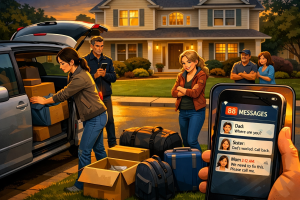
The first thing I saw when my headlights swept across the yard was my own winter coat lying half in the flower bed like somebody had shot it and left it there. For one suspended second, my brain refused the meaning of what my eyes were reporting. The lawn was wrong. The porch light was wrong. The whole front of the house looked jagged and disturbed, as though a storm had targeted only the visible evidence of my life. Then the rest of it came into focus all at once: my duffel bag unzipped in the grass, one of my scrub tops spilling out into the dew; a cardboard box of childhood photographs split open in the dirt; an old veterinary anatomy textbook in the driveway with its spine bent backward and pages fanned across the concrete; my high school debate trophy on its side near the porch steps, brass plate catching the light from my car.
And my father was standing in the porch glow with his phone raised, filming me.
My mother stood behind him with her arms locked across her chest in that specific posture I knew too well, the posture of a woman who had decided that enduring was easier than interrupting. My sister Tessa sat at the edge of the front walk with one leg crossed over the other and a smile on her face, and as I stared she nudged one of my storage bins with the toe of her sneaker and sent a stack of framed certificates skidding into the street.
Across the road, the neighbors were on their porch.
No one looked away.
My name is Savannah Brooks. I was twenty-eight years old that night. I had just come off a twelve-hour shift at Red Valley Emergency Animal Hospital, and I still smelled like antiseptic, singed fur, and the panic-sweat that dries into your skin when you’ve spent hours helping keep something alive. I had wanted a shower and leftovers and six hours of unconsciousness. Instead I sat in the driver’s seat of my own car, engine running, and looked at the contents of my adult life scattered over my parents’ lawn while my father documented it like evidence in a case he intended to win.
What strikes me now is how quickly the body will adapt to humiliation if it believes adapting improves the odds of survival. I didn’t cry. I didn’t gasp or climb out of the car demanding explanations. I just sat there, both hands gripping the steering wheel, and felt something inside me go very cold.
Not broken.
Cold.
There is a difference.
My father had a voice built for accusation. Even when he was speaking at a normal volume, it carried a charge that made people in neighboring rooms tense without meaning to. That night he didn’t bother with normal volume. He wanted the neighbors to hear. He wanted the phone to capture. He wanted the story already taking shape in his head—ungrateful daughter, burden daughter, unstable daughter, daughter finally facing consequences—to begin with spectacle.
“There she is,” he called across the yard in a tone halfway between contempt and triumph. “Twenty-eight years old and still sucking us dry.”
Tessa laughed.
“Get your stuff,” he said. “You’re gone tonight.”
My mother said nothing.
That silence hit me harder than his voice.
My father had been loud for most of my life. My mother had been quiet with equal force. He erupted. She absorbed. He broke things open. She sealed around the damage and called it coping. I had grown up between those two methods of survival and learned, far too early, that if one person in a family decides to be chaos and another decides to be endurance, the third child in line usually becomes organization. That had been me. Useful, competent, available, the one who made systems where no one else wanted to think in systems. If I had a religion before that night, it was utility.
And suddenly all of it—every grocery run, every refill request, every bill reminder, every invisible thing I had carried because no one else could be relied on to remember—was spread in damp cardboard and broken glass under my headlights while my father called me a drain.
I got out of the car.
The night air was cold enough that the smell of cut grass and wet soil reached me clearly under the hospital odors still trapped in my scrubs. My knees felt unreliable for a second, but only for a second. Then the training kicked in. Emergency medicine teaches you that control is often just the art of moving one step at a time while everything around you wants a bigger reaction. So I walked to the lawn and picked up my winter coat first. I shook dirt from the sleeve. I folded it over one arm.
My father laughed softly into his phone. “Look at that. Now she wants to act dignified.”
I did not look at him.
I picked up the photographs next, one by one. Christmases, school portraits, a blurry picture of me at nine holding a rabbit I once begged to keep and was told no because “we don’t need one more thing depending on us.” My fingers were numb by the time I got through the box. The corners of some of the pictures had gone muddy. I pressed them gently against my coat and stacked them flat.
Tessa kicked the anatomy textbook farther into the driveway with her foot and said, “Hurry up, Savannah. Some people are trying to sleep.”
The neighbors heard that. I know because I saw one of them shift and look down.
I kept moving.
There is an art to denying cruel people the reaction they have already imagined on your behalf. My father wanted tears. He wanted an argument. He wanted the kind of public pleading that would turn his rage into righteous frustration and my humiliation into proof. My sister wanted entertainment. My mother wanted, as always, for the moment to pass with as little friction as possible so she would not have to feel responsible for its shape. I gave none of them what they wanted.
Load after load, I carried my things to the car. My old books. The bag with my work shoes. A tote of winter sweaters. The storage box where I kept paperwork and small important objects. One frame had shattered completely, scattering glass through a pile of paperbacks. I crouched in the grass and picked the shards out slowly, dropping them into an empty coffee can someone had thrown onto the lawn with the rest of my things.
My father kept filming.
At one point my mother made a tiny movement, one step forward and then no more. I saw it out of the corner of my eye and almost hated her for that half-second of almost.
When the trunk was full and the back seat layered in cardboard, duffels, books, and the soft collapse of a life that had apparently always been provisional in that house, I closed the driver’s door and walked back toward the porch.
My father still had the phone up.
Tessa still had that little smile.
My mother was staring at the porch steps like they contained the answer to some question she had given up asking years earlier.
I stood close enough that my father’s camera probably couldn’t catch my words clearly and said, “I hope you all sleep well tonight. Because one day none of you are going to sleep at all.”
My father barked out a laugh.
Tessa rolled her eyes.
My mother looked away.
Then I got in my car and drove.
I did not go to a friend’s house. I did not call anyone from the driveway because my throat was so tight I didn’t trust whatever would come out if I tried to speak. I drove three exits south on the interstate and parked behind a twenty-four-hour gas station where the fluorescent sign hummed and the dumpster smelled like stale sugar and fryer grease. Then I sat there with both hands on the wheel and let the tremors move through my forearms.
That was when I remembered the voice memo app.
I had opened it at work that afternoon while dictating post-op notes on the burned Labrador because Dr. Shah talks so fast after surgery that if you don’t record him you’ll miss half the medication plan. I had forgotten to close it before driving home.
I opened the app.
It had recorded the whole thing.
The yard. My father. Tessa laughing. The long rustle of me moving through the grass. My mother’s voice, flat with exhausted practicality: Just let her go, Richard. She brought this on herself.
I listened once and sat very still.
Then I listened again.
Then a third time.
Not because I wanted to hurt myself. Because I knew exactly what happened in families like mine after a rupture. The revision process would start before dawn. By morning, I would be told he didn’t mean it that way. By afternoon, my mother would explain he’d been under stress. By the end of the week, Tessa would tell people I had “stormed out.” By Christmas, if I let them, the night would become a misunderstanding so polished by repetition that even I might start doubting its edges.
But a recording is a hard thing. It doesn’t smooth. It doesn’t protect. It doesn’t perform loyalty to the people it captures. It just tells the truth.
I needed that truth somewhere outside my own body before guilt got hold of it.
I spent the first night in an extended-stay motel with a flickering bathroom light and two vending-machine granola bars. The room had a quilted bedspread patterned with blue leaves and a window that looked onto the brick wall of the next building. The heater clicked all night and made the room alternately oven-hot and then cold again. I put the box of photographs on the table by the bed and my duffel against the door like a barricade I knew was mostly emotional.
Before I closed my eyes, I made one hard rule.
I was never going back.
The messages started around one-thirty in the morning.
My father: Where the hell are you.
My mother: You’re acting unstable.
Tessa: have fun paying for your own everything.
I screenshotted each one and made a folder in my phone called THURSDAY NIGHT. When people humiliate you publicly and then move quickly to rewrite the story, documentation is not pettiness. Documentation is the difference between memory and gaslighting.
I slept in torn pieces and woke before sunrise to the sound of an ice machine emptying itself down the hall. For one disoriented second I thought I was still in my old bedroom and about to hear my father’s footsteps in the hallway outside. Then the motel ceiling sharpened into focus and I remembered where I was.
The first thing I felt was relief.
Not grief. Not even anger at first.
Relief.
Sharp and specific and almost shameful in its intensity.
That alone told me something important about the house I had left.
I called Noah Carter at six-thirty in the morning.
He answered on the second ring like he had been half awake already, which wasn’t unusual. Noah was a paramedic. He lived in a world of interrupted sleep, cold coffee, and people making decisions too late. We had met two years earlier when he brought a seizing beagle into the emergency clinic at three in the morning. He’d found her tangled in a roadside fence after a pileup on the interstate and refused to leave her there. He came in with blood on one sleeve, mud on his boots, and the kind of calm people only wear when they have been through enough disaster to stop believing panic helps.
He’d stayed with the dog until the seizures stopped, sitting on the floor by her cage with one palm against the bars like his presence mattered. Maybe it did. Some people move through crisis without making it about themselves. Those are my favorite people.
“Tell me exactly what happened,” he said after I said his name.
So I did.
Every detail…………….
Click the button below to read the next part of the story.⏬⏬
PART 2-My Family Dumped My Life on the Lawn—Ten Days Later They Sent 88 Messages

