My mother gave me twenty-four hours to leave the house like she was reminding me to pick up dry cleaning.
She stood in the front doorway with her arms folded across her chest, shoulders square, chin lifted in that hard little angle she used whenever she wanted to sound righteous instead of cruel. Behind her, almost artfully arranged, were my younger sister Kendra and Kendra’s husband, Mark. They wore matching expressions—soft-eyed, solemn, fake-compassionate. The kind of faces people practice when they want to do something ugly while still feeling like good people.
“Be out by tomorrow,” my mother, Linda Dawson, said. “I’ve let this go on long enough.”
I stood in the hallway with a grocery bag in one hand and my keys in the other and looked past all three of them into the living room. Dad’s chair sat where it had always sat, near the lamp by the window. The old mantel clock ticked over the fireplace. The rug I vacuumed every Saturday after his radiation treatments lay perfectly straight because I had fixed the corner that morning before going to the store.
For a moment, all I could hear was that clock.
Not my mother’s voice.
Not Kendra shifting her weight dramatically like this was painful for her too.
Not Mark clearing his throat in fake support.
Just that clock.
Since my father’s funeral, I had paid the mortgage, the taxes, the insurance, the electric bill, the water bill, the furnace repair, and the plumber when the upstairs bathroom backed up in November.
My mother called it mooching.
Kendra called it squatting.
I called it keeping the house from falling apart while they discussed my life like it was an inconvenience attached to an address.
“Did you hear me?” my mother asked.
I looked at her then.
Her hair had been freshly colored. Her lipstick was perfect. She wore the navy cardigan she always put on when she wanted to look respectable in conflict, like cloth alone could turn meanness into authority. She had not looked that put together in the last six months when I was the one sorting out insurance forms and signing hospice papers and sleeping on the den sofa so Dad wouldn’t be alone at night after his breathing changed.
“Yes,” I said. “I heard you.”
Kendra stepped forward just enough to make the diamonds in her ears catch the light. “We’re trying to make this easier, Ava.”
That was my sister. Always performing concern just loudly enough for witnesses.
“This house is too much for Mom to manage,” she continued. “Mark and I are in a better position to take over. We have kids, we need the space, and honestly you’ve been here long enough.”
Long enough.
I almost laughed then.
I had been there for eighteen months straight before Dad died. Moved back in when his first round of chemo flattened him and Mom announced she “couldn’t handle medical things.” I handled his pills, his meals, the nausea, the appointments, the late-night panic when his temperature spiked, the insurance fights, the blood pressure logs, the quiet terror in the kitchen when he fell asleep too hard in the recliner and I stood there counting his breaths before touching his shoulder.
Kendra visited twice during treatment, once with flowers and once with a photographer friend because she wanted “nice family pictures while Dad still looked like himself.”
Mark came once and asked whether Dad planned to sell the house after “all this” was over, because mountain properties were appreciating again.
I said none of that.
I just asked, “So that’s the plan?”
My mother’s mouth tightened. “Don’t start with that tone.”
“What tone?”
“The one where you make yourself the victim.”
That almost took my breath away.
Victim. Such a useful word when you want to erase labor. Such a convenient word when someone has already decided your pain is manipulative.
“I’m not making myself anything,” I said. “I’m just asking if this is really what you’re doing.”
Kendra gave a soft sigh, the kind that always used to work on our mother when we were kids. “Ava, nobody wants a fight. We’re trying to move forward. Dad is gone. The house needs to stay in the family. Mark and I can take care of it. Mom can finally relax. It makes sense.”
And there it was.
The script.
Dad was gone. I was emotional. They were practical. The house needed stewardship. They had children. I had one suitcase in my room and a remote accounting job and too much grief to perform nicely on command.
I looked at Mark.
He leaned one shoulder against the doorframe like this whole conversation bored him. Mid-thirties, gym-built in a deliberate, mirror-aware way, expensive watch, polished boots that had never touched anything dirtier than country club parking lots. He had entered our family six years earlier smiling too quickly and asking too many questions about money. My father disliked him on sight, which should have told all of us something. Dad was not a suspicious man by nature. Careful, yes. Observant, absolutely. But not mean-spirited. For him to quietly decide someone was wrong meant that person had shown him something ugly behind the charm.
Now Mark shrugged when I met his eyes.
“You heard Linda,” he said. “Tomorrow.”
My mother lifted her chin. “And if you refuse, I’ll have you physically removed. I’m not bluffing.”
I thought then, absurdly, of the first time I ever got sent to my room in this house. I was nine. Kendra had knocked over a pitcher of sweet tea in the kitchen and cried before Mom got there, so somehow I was the one punished because I “should have been watching her.” I remember standing in the upstairs bedroom furious and confused, hearing Kendra laughing ten minutes later downstairs while Mom comforted her. Dad came up an hour after that, sat on the edge of my bed, and said in a very quiet voice, “Sometimes the loudest person gets believed first. Don’t let that teach you the wrong lesson.”
I didn’t know what that meant then.
I understood it perfectly standing in that doorway.
Because Kendra had always been loudest.
My mother had always rushed to the louder story.
And I had finally gotten old enough to stop being surprised by it.
“Okay,” I said.
Just that.
Okay.
Something flickered across Kendra’s face, and I knew instantly she had expected more. Tears, maybe. Begging. Anger. An argument she could retell later to make me sound unstable and herself necessary. My mother, too, looked almost thrown off balance by the calm in my voice.
That should have frightened them more.
But people who mistake kindness for weakness almost always miss the moment the balance of power changes.
I carried the groceries into the kitchen without another word. Behind me, I heard Kendra whisper, “See? That was easier than I thought.”
My mother answered in a low murmur I couldn’t quite catch, and then the front door closed.
I stood alone in the kitchen with a bag of apples, a carton of eggs, a loaf of bread, and my own pulse suddenly loud in my ears.
Then I laughed once under my breath.
Not because anything was funny.
Because a month earlier, in a county office with fluorescent lights and gray carpet, I had already learned what my father signed.
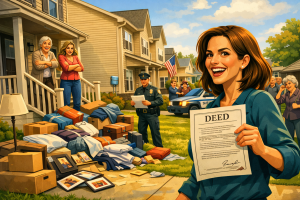
And by tomorrow morning, they were going to learn it in front of the whole street.
A month earlier, I hadn’t gone looking for legal truth because I was clever.
I went looking because I overheard Kendra say something she thought I wouldn’t hear.
It was a Thursday evening, one of those cold almost-spring nights when the wind moves through the pines behind the house and makes them sound like waves. My mother had gone to bed early after complaining all through dinner that the chicken was dry. Mark was on the back deck with Kendra, both of them smoking those expensive cigarettes they pretended were “just social,” their voices slipping through the cracked kitchen window while I rinsed dishes.
Kendra laughed first. Then she said, very clearly, “By spring I’m taking possession. I am not letting Ava sink roots into that house.”
I froze with a plate in my hands.
Mark said something too low to catch.
Then Kendra again, sharper. “No, Mom won’t back out. She’s finally done pretending. Once Ava’s gone, we move in fast. I want the kids settled before school lets out.”
I stood there with soap running over my fingers and the dish half clean and understood, in one cold clean flash, that none of this hostility was spontaneous grief behavior.
It was a plan.
They had already discussed my removal like a scheduling problem.
I didn’t confront them. That is the thing people who underestimate me almost always get wrong. They think because I’m not loud, I’m not dangerous. Because I don’t make scenes, I don’t make moves. What I actually do, when I’m scared enough, is get very quiet and start gathering facts.
The next morning, I drove to the county recorder’s office.
If you’ve never gone looking for the legal skeleton under your own family, let me tell you what it feels like. The building was beige and airless and too bright. The woman at the counter wore reading glasses on a chain and smelled faintly of hand lotion and old paper. I asked for a certified copy of the property records for my father’s address. She asked for the parcel number. I had it. I had started writing things down months earlier because after Dad died I no longer trusted any conversation in my mother’s house to remain harmless.
She typed, frowned slightly, typed again, then asked me to wait.
Three minutes later she handed me a stack of printouts clipped together at the top.
The first page was the current tax record.
The second was the recorded deed history.
The third page changed everything.
My father had signed a transfer-on-death deed eight months before he died, recorded two weeks later, witnessed, notarized, and complete.
When he died, the house transferred automatically to me.
Me.
Not to his estate.
Not to my mother.
Not jointly.
Not “to be divided among family.”
To me alone.
I remember staring at my own name on that document until the letters stopped looking like language and started looking like evidence from someone else’s life.
The clerk asked if I needed another copy. I said yes. Then yes again when she asked if I wanted it certified.
My hands shook carrying those papers back to the car.
I sat behind the wheel for almost fifteen minutes without turning the key.
Dad had never told me outright.
Or maybe he had, in the only way he thought I would accept.
About three weeks before he died, when the morphine had not yet clouded the edges of his mind and he still insisted on reviewing mail from his recliner, he had asked me to bring him the blue file box from the office. I did. He sorted through papers slowly, set some aside, signed something with a hand that trembled but remained deliberate, then looked up at me and said, “There are some things you won’t need until you do.”
I thought it was another one of his grief-soaked riddles.
By then he had started talking like that sometimes, not because his mind was failing, but because he was a man facing the end of his own life and trying to hand off pieces of understanding faster than his body could handle paperwork.
I put the file box back where he asked. I never looked inside.
I should have.
But then again, if I had known right away, I might have confronted my mother too soon, and she would have had time to regroup.
Instead, I took the certified copy straight from the county office to Michael Turner.
Michael’s office sits on the second floor above a bakery downtown, and most days the whole hallway smells like butter and sugar and practical human comfort. The contrast between that smell and the conversation we had that morning has never stopped feeling strange to me.
He read the deed twice. Then he leaned back in his chair, took off his glasses, and asked, “Has anyone else seen this?”
“No.”
“Did your father have a will?”
“Yes, but I haven’t seen the full file. Mom kept saying the estate attorney would handle everything.”
Michael gave me a look that meant he had already stopped trusting my mother on principle. “This deed bypasses probate for the house. If it was validly executed and recorded—and it appears to be—then title passed to you immediately upon your father’s death.”
“So my mother doesn’t own the house.”
“Not based on this.”
“And Kendra definitely doesn’t.”
“No.”
He steepled his fingers. “The larger question is whether you want to reveal this now or later.”
That was why I hired him.
Not because he knew statutes.
Because he understood timing.
“I don’t know,” I admitted. “If I tell them now, they’ll contest it. They’ll say I manipulated Dad. They’ll call me greedy. They’ll tell everyone I went behind Mom’s back while she was grieving.”
Michael’s expression didn’t change. “They may do that anyway.”
“I know.”
He was quiet for a moment.
Then he said, “What is your goal?”
Not what is fair.
Not what do you deserve.
What is your goal.
That question steadied me more than sympathy would have.
“My goal,” I said slowly, “is not to get pushed out of a house my father intentionally left to me.”
“Good. Then for now we do three things. One, secure multiple certified copies. Two, pull the full estate file and any related attorney documents. Three, wait. If they make a move, we answer it with paper, not emotion.”
So that is what I did.
I got more copies.
Michael pulled the related documents.
And the related documents made my father’s intentions even clearer.
The house, it turned out, had never legally belonged to my mother.
Dad bought it ten years before he married her, back when he was a union electrician with rough hands, a secondhand truck, and just enough stubbornness to sign a thirty-year mortgage on a place everyone else said was too old, too creaky, too much work. It had been his before it was ever “the family home.” In our state, inherited assumptions mean nothing next to title history, and the property remained separate through the marriage because Dad never added my mother to the deed.
He had, however, provided for her elsewhere.
Life insurance.
Retirement accounts.
A small investment fund.
A vehicle.
And, tucked into the estate file, one handwritten memorandum to his attorney:
Linda is financially protected. The house goes to Ava. She kept this place alive while I was dying. Kendra and Mark see it as an acquisition. I refuse to reward appetite and call it family.
I read that sentence three times in Michael’s office and had to look out the window until my eyes stopped burning.
My father knew.
Not just about the house.
About the way the currents ran under our family.
He knew who stayed.
He knew who waited.
He knew who counted square footage while he still had chemo tape on his arm.
And he had made his choice.
Michael asked if I wanted to confront them then.
I said no.
Not because I was afraid.
Because I wanted the truth to arrive when it would matter most.
So I kept living there.
I kept paying the bills.
I kept documenting everything.
Every mortgage payment from my account.
Every repair invoice.
Every threat, insult, or loaded comment.
My mother called the house “hers” more often after that, especially in front of neighbors. Kendra started dropping by with increasing frequency, always with some excuse—checking on Mom, bringing dinner, discussing schools, walking through rooms with the assessing eye of someone already arranging furniture in her head. Mark measured the garage one Saturday with his phone out like he was already planning where his tools would go. I said nothing. I watched. I took pictures when useful. I sent copies to Michael.
And then, eventually, my mother made her move.
Be out by tomorrow, she said…………………..
Click the button below to read the next part of the story.⏬⏬
PART 2-My Mom Gave Me 24 Hours to Leave the House for My Sister—Then the Whole Street Learned What Dad Had Signed

