My Daughter Whispered, “Daddy Says It’s a Game”… One Look Inside That Bathroom Destroyed My Marriage
Part 1
You tell yourself there has to be a reasonable explanation.
That is what mothers do when the truth feels too ugly to touch. You take the small details, the long baths, Lily’s silence, the way she clutches her stuffed rabbit afterward, and you force them into harmless shapes because the alternative is a cliff your mind refuses to step off. For weeks, maybe longer, you live on that cliff.
Your husband, Daniel, always has an answer ready.
He says Lily is sensitive. He says bath time calms her down. He says you should be grateful he is such a hands-on father when so many men barely know how to braid a ponytail or pack a lunch. He says all of it with that steady smile that makes you feel foolish for even noticing the clock.
But the clock keeps noticing for you.
An hour. Sometimes more. The sound of water running long after it should have stopped. Lily coming out wrapped so tightly in a towel it looks less like drying off and more like armor. The tiny flinch when you touch her shoulder. The way her eyes slide away when you ask simple questions.
Then comes the sentence that changes everything.
“Daddy says I’m not supposed to tell you about the bathroom games.”
After that, nothing in your house feels the same. The hallway seems narrower. The walls feel thinner. Even Daniel’s voice at dinner sounds different, like there is something sharp hidden under every word. You lie beside him that night with your eyes open, staring into the dark, and realize you are no longer trying to prove yourself wrong. You are trying to decide how much truth you can survive.
The next evening, when Daniel takes Lily upstairs, you do not follow right away.
You wait until you hear the bathroom door click. You wait until the water starts. You wait until your pulse is pounding so hard you can feel it in your throat. Then you step into the hallway barefoot, every board under your feet sounding louder than thunder.
The door is cracked just enough.
You move closer and look inside.
Lily is standing outside the tub in her pajamas, fully dressed and crying quietly while Daniel kneels in front of the sink with a bottle in one hand and a washcloth in the other. At first, your brain cannot make sense of what you are seeing. Then you notice the dark bruises on Lily’s upper arm, half-covered by soap suds, and Daniel’s voice, low and cold, not gentle at all.
“You don’t tell Mommy you slipped again,” he says. “You understand me? If you tell her, she’ll just get upset and ruin everything.”
Lily nods because she is terrified.
For one frozen second, neither of them sees you.
Then Daniel looks up and the expression on his face is not guilt. It is annoyance. Like you are the one interrupting something important. Like you are the problem in the room.
“What exactly do you think you’re doing?” he asks.
You do not answer him.
You rush to Lily, grab a towel, wrap her in it, and pull her behind you. Your hands are shaking so badly you nearly drop your phone, but not badly enough to stop you from dialing 911. Daniel stands up too fast, soap splashing across the tile, and starts talking the way liars always talk when they believe confidence can erase facts.
“She slipped,” he says. “You’re overreacting. She fell earlier. I was cleaning her up.”
But now that you are close enough, you can see more.
Not one bruise. Several. Fading yellow ones under newer purple marks. A thin red line near her shoulder. Fear written all over your daughter’s face so clearly it makes you sick that you ever let yourself miss it. Lily clings to your waist and buries her face in you like she has been waiting for this exact moment, this exact rescue, for longer than you can bear to imagine.
Daniel hears you telling the dispatcher your address and his whole body changes.
The mask drops. His jaw tightens. His eyes go flat. He takes one step toward you, then another, and suddenly the man you married is nowhere in the room. In his place is someone calculating, cornered, and dangerous.
“Hang up,” he says.
You don’t.
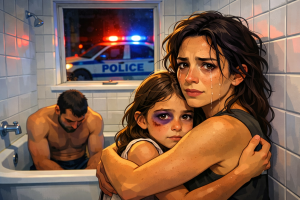
That is when he reaches for the phone, and that is when Lily screams.
It is a raw, terrified sound that slices straight through the house, and you move without thinking. You shove Daniel back with both hands, lock the bathroom door, and drag the laundry hamper in front of it while the dispatcher tells you officers are on the way. Daniel pounds once, hard enough to rattle the mirror, and then starts shouting that you are crazy, hysterical, trying to destroy his life.
You hold Lily against your chest and keep your voice steady for her.
“Baby, listen to me. You did nothing wrong. None of this is your fault. I need you to keep breathing with me, okay? Nice and slow. Just like that.”
Outside the door, Daniel keeps talking.
He says you’ll regret this. He says the police will laugh at you. He says he is the one who pays the bills, the one everyone believes, the one who knows how to make sure you lose everything if you keep going. Each word lands like another brick falling off the house you thought you lived in.
But something inside you has already shifted.
Fear is still there, but it is no longer steering. It has made room for something tougher, cleaner, impossible to bargain with. By the time the sirens hit the driveway, you are not wondering whether you misunderstood. You are wondering how many lies he told to build this life around you.
When the officers force the door open downstairs and order Daniel away from the bathroom, Lily trembles so hard you can feel it through the towel.
A female officer kneels to Lily’s height and speaks softly, while another takes photos of the bruises. Daniel keeps insisting it is all a misunderstanding, but his story changes every two minutes. First Lily slipped in the tub. Then she fell on the stairs. Then she bruises easily. Then maybe you did not notice them before.
The officer writing notes stops looking neutral.
By the time paramedics check Lily and Child Protective Services is called, Daniel is no longer talking like an innocent man. He is talking like a man losing control of the script. And when one of the officers asks Lily, very gently, whether Daddy ever hurt her before, she presses her rabbit to her chest and whispers one word.
“Yes.”
That word blows your old life apart.
Daniel is taken out of the house in handcuffs still yelling your name, still promising lawyers, revenge, explanations, anything that might drag you back into doubt. The flashing red and blue lights paint the front yard in broken colors while neighbors peek through curtains. You stand on the porch with a blanket around Lily’s shoulders and realize you do not care who sees. Shame belongs to him now.
At the hospital, the doctor is careful with Lily.
Careful with you too. They document every bruise. A child forensic interviewer is arranged for the next day. A social worker sits beside you in a too-cold room and explains protective orders, emergency placement rules, trauma counseling, and the ugly machinery that wakes up when a child has been harmed inside her own home.
You sign papers with numb fingers.
Then you call your sister, the only person you know who will come without questions first. She arrives at 2:17 in the morning wearing jeans, a hoodie, and fury on her face. She brings coffee you do not drink, clean clothes you forgot to pack, and the kind of silence that holds instead of collapses.
In the days that follow, truth comes in pieces.
Not all at once. Not neatly. Not in a way that makes you feel better.
Daniel had been using “bath time” as cover for punishments whenever Lily cried, spilled something, moved too slowly, or did anything that irritated him. Cold water. Grabbing too hard. Threats disguised as games. Orders to keep secrets so Mommy would not “break up the family.” Lily had not known how to describe it. She had only known it made her scared.
That knowledge nearly crushes you.
You replay every evening, every smile, every excuse, every moment you let Daniel explain away what your instincts were trying to say. Guilt becomes a second skin. It follows you into courtrooms, therapy offices, grocery store aisles, and the dark hour before dawn when sleep gives up on you completely.
But guilt is not the end of your story.
It cannot be, because Lily is still here, and she needs a mother who keeps moving.
So you do. You file for emergency custody. You get the restraining order. You change the locks. You sit through interviews and hearings and endless paperwork while Daniel’s attorney tries to turn concern into paranoia and bruises into accidents. You learn how often the system asks mothers to prove they are not inventing the nightmare they are trying to escape.
And then Daniel makes a mistake.
One of the detectives pulls you aside after a hearing and tells you they found deleted videos on Daniel’s old tablet, recovered through a warrant. Not of the bathroom, thank God, but of him raging at Lily for childish mistakes, grabbing her hard enough to leave marks, forcing her to stand in corners and apologize for things she did not understand. In one clip, his voice is calm in that terrifying way some cruel people master.
“If you tell Mommy,” he says, “you’ll be the one who gets in trouble.”
The prosecutor plays that clip in court three months later.
Daniel does not look untouchable anymore. He looks small. Pale. Ordinary in the worst way. The kind of man people defend right up until evidence peels the mask off him in public.
When the judge grants your permanent protective order and restricts all contact pending criminal proceedings, you do not feel victorious.
You feel tired enough to sink through the floor.
But when you look down, Lily is drawing at the edge of the courtroom coloring book the victim advocate gave her. For the first time in months, she is not chewing her lip or scanning the room for danger. She glances up at you and gives you a shy, uncertain smile, as if she is checking whether it is safe to have one.
You smile back.
That is the moment that matters.
Not the headlines Daniel’s family tries to bury. Not the calls from relatives begging you to “handle this privately.” Not the reputation he loses or the job he is forced to leave. What matters is that your daughter begins, slowly, stubbornly, to understand that home is not supposed to feel like fear.
Healing is not dramatic.
It does not arrive with one speech, one verdict, or one brave night in a hallway. It shows up in smaller ways. Lily sleeping through the night with the bathroom light off. Lily letting you wash her hair without flinching. Lily laughing so hard at a cartoon one Saturday morning that she snorts juice through her nose and looks offended when you laugh too.
You learn to treasure those ridiculous, ordinary miracles.
A year later, the house looks different. Not because you moved, though you almost did. Because it belongs to the truth now. The upstairs bathroom has been repainted pale blue. The old rabbit Lily clung to that night sits on a shelf in her room beside newer toys and library books and a framed drawing of the two of you standing under a giant crooked sun.
In the drawing, both of you are smiling.
One evening, after her bath, Lily pads into the kitchen in dinosaur pajamas and asks whether people who do bad things always get caught. You are slicing strawberries at the counter, and the question lands softly but heavily, like so many questions children ask when they are trying to understand the architecture of the world.
“Not always right away,” you tell her.
She thinks about that. “But sometimes?”
You set down the knife and kneel so you are eye level with her.
“Sometimes because somebody brave tells the truth,” you say. “Even when they’re scared.”
Lily is quiet for a second, then nods like she is storing the answer somewhere important.
“I was scared,” she says.
“I know.”
“But I told.”
Your throat tightens. “Yes, baby. You did.”
She wraps her arms around your neck, warm and fierce and very, very alive. You hold her there in the middle of the kitchen while the strawberries wait on the cutting board and the evening light slips gold across the floor. For a long time, neither of you says anything else.
You do not need to.
Because the ending is not that you were almost too late.
It is that you weren’t.
But that is only the ending people like to tell.
The neat version. The courtroom version. The one strangers can survive hearing over coffee without choking on it.
The real ending starts in the middle, when everything that breaks has to be touched with your bare hands.
The hospital releases Lily just before dawn.
Maya drives because your hands are unreliable and your eyes feel packed with sand. The sky outside has that bruised color of almost-morning, and every traffic light seems too bright. Lily is asleep in the backseat with her rabbit under her chin, her mouth slightly open, the way she slept as a toddler after feverish nights. You keep turning around to make sure she is still there.
Maya notices by the third red light.
“She’s breathing,” she says quietly.
“I know.”
But you keep checking anyway.
At the house, two officers wait while you gather what you need. Daniel’s arrest means he cannot come back tonight, but the word tonight does not comfort you. Words like temporary and pending and preliminary have suddenly become dangerous words. They mean the story is still moving. They mean not safe enough.
The front door is still slightly off its frame from where officers came through. One of Daniel’s loafers sits overturned in the foyer, ridiculous and harmless-looking. A mug he left on the coffee table still has coffee rings drying inside it. The TV remote is where he always dropped it. The house looks like a photograph taken half a second before a bomb.
You head upstairs with a duffel bag and a list the social worker made for you on the back of a brochure: medications, favorite toy, school clothes, comfort items, phone chargers, important papers.
You do not expect grief to ambush you in Lily’s room.
Her nightlight glows a warm moon shape over the dresser. Her favorite books are stacked crookedly on the rug. A half-finished bracelet of plastic beads lies beside an uncapped purple marker. The normalness of it almost knocks you to your knees.
Maya steps into the doorway and waits.
“I should have known,” you whisper.
She does not give you the lie people give because they think it sounds kind. She does not say no, you couldn’t have. She says, “You know now.”
Which is somehow the only thing that lets you keep moving.
In the bathroom, the one at the center of the whole nightmare, the air still smells faintly of lavender soap and something metallic beneath it. You stand in the doorway staring at the white tiles, the blue fish bathmat, the frosted glass on the shower door. Nothing in the room looks monstrous. That feels like its own kind of violence.
Cruelty, you realize, does not require a lair. It can happen in a room with cartoon towels.
You open the cabinet under the sink and find the bottle Daniel held, then another, then a stack of folded washcloths. Ordinary things. Things that can be turned into ritual. Things that can be used to make fear feel like routine. Your stomach twists.
There is also a yellow rubber duck Lily stopped playing with months ago.
You sit on the closed toilet lid and cry into your hand so quietly Maya does not hear.
By sunrise, you are at her apartment across town, in the spare bedroom she clears for you without ceremony. Lily wakes disoriented and panicked until she sees you on the floor beside her mattress. Then she reaches for your sleeve and keeps one fist curled in it even after she falls asleep again.
That becomes your first new rule. If she reaches, you stay.
The second new rule comes from the social worker. No contact with Daniel. None through text, none through relatives, none through messages passed along by “concerned” friends. Lock down social media. Screenshot everything. Assume charm can be weaponized as easily as rage.
The messages begin before noon.
From his mother first. Then his sister. Then a cousin you have met twice. Each one dressed in a different costume, but all delivering the same performance. Daniel is devastated. Daniel would never hurt Lily. Daniel had a stressful week. Daniel said you are unstable. Daniel says you were always too emotional. Daniel says you’re misinterpreting discipline. Daniel says, Daniel says, Daniel says.
You mute the thread and throw the phone onto the couch like it burned you.
Maya reads one over your shoulder and snorts without humor. “Interesting how every family has at least one woman trained to become a cleanup crew for the worst man in it.”
You wish she were exaggerating.
At the child advocacy center the next day, the building is painted cheerful colors that make you want to scream. There are murals of forest animals in the waiting room. There are tiny chairs and soft blocks and a bowl of peppermints on a receptionist’s desk. Someone has put enormous effort into making trauma look less terrifying, and you are grateful for it and furious at the need for it at the same time.
A forensic interviewer takes Lily into another room while you sit behind glass with a detective and a CPS caseworker and learn a new kind of helplessness.
You are not allowed to go in because your presence could shape her answers. You know the rule is meant to protect the truth, but every cell in your body rebels against being separated from her while she tells strangers what happened. On the monitor, Lily swings her legs from a chair too high for her feet to touch the floor. Her rabbit sits in her lap like a witness.
The interviewer is gentle in the exact way trained people are gentle, warm without leading, patient without pity. She asks Lily about home. About school. About who lives with her. About what happens when people get mad.
Lily shrugs at first. Then speaks. Then stops. Then starts again.
At one point she says, “Daddy says games are secrets.”
The detective beside you exhales through his nose and writes something down.
At another point Lily says, “If I cried loud, he said Mommy would hear and leave because I was bad.”
You make a sound you have never heard from yourself.
The caseworker touches your arm just long enough to anchor you. Nothing more.
By the end of the interview, the monitor blurs because you are crying too hard to see. Not because Lily collapses. She does not. She is almost matter-of-fact. That is worse. It means fear became routine enough to file itself under ordinary.
Afterward, she runs to you in the hallway and says, “Did I do it right?”
The question tears something open in you that may never fully close.
“You did it so right,” you tell her, kneeling, cupping her face. “You were so brave.”
She studies your face carefully, checking for danger the way she has learned to do. “Are you mad?”
“No.”
“Not even a little?”
“Not at you. Never at you.”
She throws herself against you then, all thin arms and trembling, and you understand in a bone-deep way that love is sometimes just the repeated act of saying the same true thing until a scared child can finally believe it.
That night Daniel gets bail.
The prosecutor warned you it might happen. Nonfatal injuries, first formal charge, no prior convictions on paper. The facts the law weighs and the facts a mother carries in her body are not the same facts.
You are granted an emergency temporary restraining order, but paper is a weak-looking thing when your nervous system has not yet learned the difference between caution and terror.
You jump at elevator dings. At barking dogs. At footsteps in parking lots. You scan the rearview mirror for his truck every time you drive. Twice you are sure you see him. Twice it is someone else. The relief feels humiliating…………………

