The Powder Keg: How My Sister’s “Prank” Cost Her 30 Years
I still remember the exact moment the world tilted on its axis, dividing my life into “before” and “after.”
My daughter, Lily, had just turned six months old. She was at that delicious age where everything was a discovery—her own toes, the ceiling fan, the sound of my voice. Her laugh was a bubbling, perfect sound that erased the exhaustion of sleepless nights. It was a Tuesday afternoon, the kind of mundane, gray day you never expect to be the setting of a tragedy.
I laid Lily on the changing table. She cooed, kicking her legs, trusting me implicitly. I reached for the container of baby powder on the nursery shelf. It felt familiar in my hand, the weight unchanged. I popped the cap and sprinkled a cloud of white dust across her soft skin, just as I had done hundreds of times before.
Thirty seconds. That is all it took.
Lily’s eyes went wide. The cooing stopped abruptly, replaced by a terrible, wet gasping sound. Her tiny chest heaved, fighting against an invisible weight. Her face flushed red, then deepened into a terrifying shade of violet.
I snatched her up, panic clawing at my throat. “Lily? Baby, breathe! Breathe for Mommy!”
Her body went limp in my arms, a dead weight that stopped my heart cold.
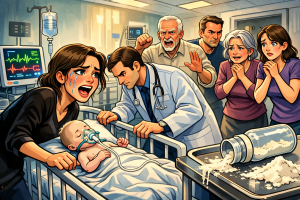
My hands shook so violently I dropped my phone twice before dialing 911. The operator’s voice sounded like it was coming from underwater as I screamed my address, sobbing between breaths. Those seven minutes waiting for the ambulance stretched into an eternity. I sat on the floor, rocking my unconscious child, feeling her heartbeat flutter like a trapped bird against my chest.
When the paramedics burst through the door, the air in the room changed. One medic took Lily, working rhythmically on her chest. Another picked up the powder container. I watched his expression shift from professional urgency to confusion, and then to something darker.
He didn’t say a word. He just bagged the container as evidence.
St. Mary’s Hospital became my purgatory for the next three days.
Lily lay in the Pediatric ICU, a tiny figure swallowed by technology. A ventilator breathed for her. Four lines snaked into veins that were impossibly small. Machines beeped and hummed, a mechanical symphony keeping my daughter tethered to this world.
I sat in a hard plastic chair, unable to eat, unable to sleep. Every time I closed my eyes, I saw her turning purple. I felt her go limp.
My parents arrived on the second day. My mother’s face was pinched with performative worry, but it was the look in my father’s eyes that unsettled me—he looked annoyed, as if this were an inconvenience to his schedule. Trailing behind them was my sister, Natalie.
My blood ran cold.
“How is she?” Natalie asked. Her voice didn’t tremble. It dripped with a casual curiosity, as if asking about the weather.
I couldn’t look at her. I stared at the floor tiles. “She’s in a coma.”
Mom reached out, her hand hovering over my shoulder. “Sweetheart, we heard what happened. The flour in the baby powder… it was just a silly prank. Natalie feels terrible.”
My head snapped up so fast my neck cracked. “What?”
“It was supposed to be funny,” Natalie said, actually rolling her eyes. She shifted her weight, looking bored. “I switched it out when I was over last week. I didn’t think it would be such a big deal. Babies breathe in dust all the time. You’re being dramatic.”
The rage that flooded my body was unlike anything I had ever known. It wasn’t hot; it was ice cold.
“You switched my baby powder with flour?” I whispered, my voice rising. “My daughter almost died.”
Dad’s hand clamped down on my shoulder, his grip punishing. “Keep your voice down. This is a hospital. People are staring.”
“She could have died!” I screamed, shoving his hand away.
“She’s been unconscious for two days, but she didn’t die,” Natalie snapped, inspecting her fingernails. “She’s going to be fine. You always have to make everything about you, don’t you? Always the victim.”
I stood up, my chair screeching against the linoleum. “Get out. All of you. Get out of my room.”
Mom’s face crumbled into a mask of martyrdom. “Please, you can’t mean that. Natalie made a mistake. She didn’t mean any harm.”
“A mistake?” I was shaking now, vibrating with the force of my adrenaline. “This wasn’t a mistake. This was reckless. It was cruel. Get out!”
“You need to forgive your sister,” Dad said, his voice dropping into the commanding baritone he used to silence us as children. “Family forgives family. We do not hold grudges over accidents.”
“This wasn’t an accident!”
Dad moved faster than a man his age should. His hand flashed out, and the sound of the slap rang through the ICU like a gunshot.
My cheek burned. The shock silenced the room. I stared at him, my hand flying to my face.
“Don’t you dare overreact and ruin this family,” he hissed, a vein pulsing in his forehead. “Your sister made a joke that went wrong. You will forgive her, and we will move past this. Do you understand me?”
Before I could breathe, Mom grabbed a fistful of my hair and yanked my head back. Pain exploded across my scalp. “Listen to your father! Natalie is sorry! The baby is fine! Let it go!”
I wrenched myself away, stumbling back until I hit the rail of Lily’s bed. “You’re defending her? She almost killed your granddaughter!”
“Stop being so dramatic!” Natalie shouted, stepping into my personal space. Her eyes were cold, void of any empathy. She shoved me hard. My shoulder blades slammed against the painted concrete wall with a dull thud. “Natalie is upset enough without you making her feel worse! Grow up and stop being such a baby!”
“Security!” A nurse appeared in the doorway, eyes wide. “I need you all to leave immediately. You are disturbing the patients.”
My family filed out, straightening their clothes as if nothing had happened. But before he left, Dad pointed a finger at me. “We will talk about this when you have calmed down and can be reasonable.”
I slid down the wall and sat on the floor, hugging my knees. My cheek stung. My scalp ached. But the physical pain was nothing compared to the sickening realization that my parents had just assaulted me to protect the person who nearly murdered my child.
I didn’t know it then, but the flour was just the beginning.
Dr. Patricia Morrison came in an hour later. She was the head of Pediatrics, a woman with kind eyes but a spine of steel. She sat down across from me, holding a tablet.
“We got the toxicology and blood test results back,” she said carefully. “There is something we need to discuss.”
My heart hammered against my ribs. “Is Lily okay?”
“She is stable,” Dr. Morrison said. “But the findings are… concerning.”
She turned the tablet toward me. It was a flurry of charts and numbers that meant nothing to my untrained eye.
“Your daughter has critically elevated levels of heavy metals in her system,” she explained. “Lead. Mercury. Arsenic. And microscopic silicates.”
The room tilted. “I don’t understand.”
“The levels suggest prolonged exposure,” Dr. Morrison said, her voice grave. “This wasn’t a single incident with the powder. Someone has been poisoning your daughter for months.”
I couldn’t breathe. The air in the room felt too thin. “Poisoning? But… I’m with her all the time. I’m the only one who feeds her, who changes her…”
And then it hit me. Like a freight train in the dark.
Natalie.
Natalie had been visiting every week since Lily was born. She had volunteered to babysit so I could shower. She brought “homemade” baby food in cute little jars. She brought painted wooden toys. She insisted on helping with feedings.
I had thought she was finally stepping up. I thought she was trying to be a good aunt.
“Oh my god,” I whispered, bile rising in my throat. “My sister.”
Dr. Morrison nodded grimly. “We tested the residue in the powder container the paramedics brought in. It wasn’t just flour. It was mixed with crushed glass.”
My world went black for a second. Crushed glass.
“I’ve already contacted the police,” Dr. Morrison said. “They are on their way. Hospital security has been notified that no one—absolutely no one—is allowed in this room without your explicit permission.”
The next forty-eight hours were a blur of police interviews, forensic testing, and watching my daughter fight her way back to consciousness. When Lily finally opened her eyes, confused and frightened by the tubes, I broke down and wept until I had nothing left.
Detective James Rodriguez took over the case. He was a tired-looking man who had seen too much evil, but his anger on my behalf was palpable.
“We executed a search warrant on your sister’s apartment,” he told me in a quiet conference room. “We found the grinder she used for the glass. We found the receipts for the heavy metals, purchased from industrial suppliers online.”
He paused, looking down at his notes. “We also recovered her text messages and social media DMs. It appears your sister has harbored a deep resentment toward you for years. The birth of your daughter was the trigger.”
“Why?” I asked, my voice hollow.
“Jealousy,” Rodriguez said simply. “She messaged a friend saying that the baby was ‘stealing her spotlight.’ She wanted to hurt you. She wrote that she wanted to see you suffer by watching the thing you loved most slowly fade away.”
She hadn’t wanted to kill Lily quickly. She wanted it to be slow. She wanted me to watch my child wither. The glass in the flour was just an escalation because she wasn’t getting the reaction she wanted fast enough.
“We have a warrant,” Rodriguez said. “We’re picking her up now. The District Attorney is charging her with attempted murder, aggravated child abuse, and assault with a deadly weapon.”
I should have felt relief. Instead, I felt a terrifying clarity. My sister was a monster. My parents were her enablers. And I was the only thing standing between them and my daughter.
The arrest did not silence my family. It weaponized them.My phone became a grenade of notifications. Mom and Dad demanded I drop the charges. They threatened to disown me. They threatened to sue for grandparents’ rights.
Natalie sent me one text from a burner phone before she was booked: “You’ll regret this.”
I blocked them all. Detective Rodriguez helped me file emergency restraining orders against all three of them.
Three weeks later, I sat across from Jessica Thornton, the prosecutor. She was sharp, aggressive, and specialized in crimes against children.
“Your sister is trying to cut a deal,” Jessica said. “Her lawyer is arguing mental instability. They want to plead down to reckless endangerment. No jail time, just probation and therapy.”
“No,” I said, my voice steel. “She planned this for months. She fed my baby batteries and arsenic. No deal.”
Jessica smiled, a predatory glint in her eyes. “Good. Because we have enough evidence to bury her. But I need to warn you: your family will testify for her. It’s going to be ugly.”
“Let them,” I said. “I don’t have a family anymore.”
The months leading up to the trial were a siege. My parents launched a smear campaign that would have made a politician blush. They contacted distant relatives, old friends, even my church. They painted me as vindictive, mentally unstable, and jealous of Natalie…………………..

