Part 1
The garage sale had been my idea, which felt noble when I said it out loud and stupid every second after.
Mom had been dead for twenty-three days, and her house still smelled like vanilla hand cream, lemon furniture polish, and the faint powdery perfume she wore on church Sundays and dentist appointments. I’d spent the first week walking room to room with a legal pad, writing down things like casserole dishes, winter coats, lamp from guest room, silver bracelet with missing clasp. By the second week, I stopped writing object names and started writing memories instead. Blue Pyrex mixing bowl—used every Thanksgiving. Floral scarf—wore this when she picked me up from college. Cookie jar with chipped lid—hid five-dollar bills in it for “emergencies,” which meant gas money, school pictures, and once, a last-minute science fair volcano.
By the third weekend, grief had turned into sorting.
My sister Dana helped the first Saturday. She wore leggings, sunglasses on top of her head, and that pinched look like she was already late for something better. She lifted three boxes, cried once over a stack of recipe cards, then spent forty minutes on the patio smoking and texting. The next morning she sent me, Can’t do today. Too hard. After that, she stopped answering my calls.
My brother Eric showed up once in greasy work boots, hugged me with one arm, and said he was sorry about everything in the flat voice people use when they are already thinking about leaving. Then he spotted Mom’s old power tools in the garage, asked if anyone had claimed them, and loaded the good ones into his truck before lunch. He said he needed them for side jobs. He said he’d be back to help tomorrow. He wasn’t.
So I did it alone.
I unfolded tables in the driveway at six in the morning while the air still had that cool wet feel before a hot day. I priced Mom’s vintage dishes with blue painter’s tape. I laid out her jewelry in a tackle box lined with felt. I shook out blouses that still held the shape of her shoulders and arranged them by color because it seemed disrespectful not to. People came with coffee cups and bargaining smiles. They ran their fingers over her life and asked me if I’d take three dollars instead of five.
I smiled until my cheeks hurt.
By Sunday afternoon, almost everything was gone. The sun had moved across the street and turned the windshield of my car into a sheet of white glare. I was hot, sticky, and numb in that special way grief makes you numb—like every feeling has a towel wrapped around it. But I’d sold nearly everything. Mom’s dishes. Mom’s sewing basket. Mom’s winter coats. Even the ugly ceramic rooster she’d kept on the kitchen windowsill for no reason I ever understood.
Under my folding chair sat a gray metal lock box with $1,847 inside.
I knew the amount because I’d kept a ledger all weekend, just the way Mom used to keep one for Christmas spending. Item, price, cash received. Her handwriting had always leaned left. Mine leans right. I noticed stupid things like that now.
The plan was simple. The money would go toward her headstone.
Mom had been cremated because it was cheaper and because she’d once told me, while we were waiting in line at the DMV, that she didn’t want “a big fancy funeral with ham sandwiches and fake crying.” But she had wanted a marker in the memorial garden at the cemetery where her parents were. I knew because six months before she died, we’d driven past the place after a doctor’s appointment, and she’d said, almost casually, “If I go first, don’t let your father cheap out on the stone.”
I remembered the exact light on her face when she said it. Late afternoon. Gold through the windshield. The sharp smell of French fries because she’d insisted on drive-thru on the way home.
Don’t let your father cheap out.
That sentence had been sitting in me like a nail ever since.
Dad, of course, had not helped with any of this. He’d cried at the funeral in public, accepted casseroles from women at church, and then spent most evenings at his girlfriend Noreen’s duplex across town. He called once to ask if Mom’s “good ring” had sold yet. Not her wedding ring, not by name. The good ring.
When I didn’t answer fast enough, he said, “Well, somebody better be keeping track.”
I almost laughed then, which would have come out ugly. I had been keeping track my whole life. The slammed doors. The holes punched in drywall. The way Mom’s voice changed around him, soft and careful like she was carrying a tray of full glasses. The way she’d glance at me and Eric and Dana during dinner when his jaw set hard, silently telling us not to say the wrong thing.
Mom had been the buffer. Everybody knew it, even if nobody said it.
And now she was gone.
Around four in the afternoon, when I was stacking the last empty table against the garage wall, I heard the low rattle of Dad’s truck before I saw it. That old Ford had a bad muffler and one door that only opened from the outside. It turned into the driveway slow, crunching over stray gravel and one of the newspaper ads someone had dropped earlier.
I felt my shoulders go tight on instinct.
Dad climbed out wearing jeans, work boots, and a gray T-shirt dark with sweat under the arms. He smelled like cigarettes and motor oil even from ten feet away. He squinted at the nearly empty tables, then at the cardboard boxes by the garage.
“Good turnout,” he said.
“It was,” I said. “Almost everything sold.”
He nodded like he was approving weather. “How much?”
I kept stacking the table. “Pretty good.”
“How much?” he asked again, sharper.
I wiped my hands on my shorts and looked at him. “One thousand eight hundred forty-seven.”
His expression changed so fast it made my stomach drop. Not surprise exactly. More like hunger.
“You made what?”
I bent and pulled the lock box from under the chair. “I kept records. I figured we could put this toward the headstone. The granite one I told you about.”
He held out his hand.
Not asked. Held out.
“The money belongs to the family,” he said.
His voice had gone low. Dangerous low. I knew that voice. Mom knew it too. It was the voice that came right before cabinets slammed and plates shattered and everyone started editing themselves mid-sentence.
“It is for the family,” I said, trying to keep my own voice level. “For Mom.”
“Your sister needs rent,” he said. “Your brother’s truck needs a transmission. Noreen’s had medical bills. Living people come first.”
The heat in the driveway suddenly felt meaner, like it was pushing on me. Somewhere down the block, a dog barked twice and stopped. A sprinkler clicked on in somebody’s yard. Tiny stupid neighborhood sounds while my whole body was deciding whether this was the moment to back down or stand up.
“Mom’s things paid for that money,” I said. “Mom wanted a stone.”
“You don’t get to decide that.”
“She told me herself.”
That hit something in him. His nostrils flared. He took two steps closer. “Give me the box.”
“No.”
It came out before I could soften it.
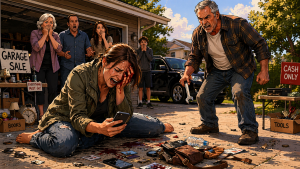
His hand shot forward. I jerked back. The edge of the box slipped against my palm. The latch popped. Bills spilled out in a loose green burst across the driveway, twenties and tens skittering in the breeze like leaves.
We both lunged.
I got one hand over a stack near the tire of my car. He snatched bills from under the folding chair. More money slid toward the open street. I heard my own breathing go ragged. It was absurd, two grown adults scrambling on hot concrete over cash made from old dishes and winter coats, but underneath the absurdity was something colder. I knew this wasn’t really about the money. It was about being allowed to say no.
“That belongs to the family,” he barked.
“It belongs to Mom.”
He straightened so suddenly I did too. His face had gone blotchy red. There was spit at the corner of his mouth. Then his eyes cut toward the open bed of his truck.
And I saw him reach in.
Part 2
I wish I could tell you there was one clean moment where I understood exactly what was about to happen.
There wasn’t.
There was only a blur of details my brain still plays back in the wrong order. The metallic shine near his hand. The hot driveway under my knees. The paper edge of a twenty-dollar bill sticking to my sweaty wrist. The smell of sun-baked rubber from his front tire. My own voice saying, “Dad, don’t—” and not even sounding like mine.
Then the wrench was in his hand.
It was one of those heavy crescent wrenches with a red handle worn black at the grip. I recognized it because it had lived in the garage my entire childhood, hanging on a pegboard above Mom’s flower pots. I had seen it a thousand times. In my memory it still belongs next to twine and paint stirrers. In real life it came down through the white glare of afternoon and turned my face into a sound.
The crack came first.
Not pain. Sound.
Like stepping through thin winter ice, except the ice was inside my head.
Light exploded across my vision. My left ear rang so hard it felt physical. The driveway swung sideways. Something hard hit the concrete near my hand with a tiny wet click. For one absurd second I thought a pebble had flown up.
It was my tooth.
Then the pain arrived all at once, huge and electric and wrong. My mouth filled with heat. Not warmth—heat. My jaw didn’t feel attached right anymore. It hung at an angle my body knew was impossible. I tasted copper and grit and something chalky that my brain eventually identified as enamel.
I hit the driveway on my shoulder and cheek. The concrete was rough under my skin. Blood spread under me so fast I felt it cooling in patches where the breeze touched it.
Dad stood over me, chest heaving, wrench still raised.
“Selfish,” he shouted. “Just like your mother.”
The words came to me through a roar, like hearing somebody from underwater. I tried to say his name. What came out was a gurgling animal noise. My tongue found empty places where teeth should’ve been. When I moved my jaw, the left side shifted loose and sick, like drawer hardware ripped off its track.
He looked down at me for maybe half a second, and there was something in his face I had never seen before—not rage exactly. Rage at least has motion in it. This was flat. Decided.
Then he crouched and started grabbing money.
Bills stuck to the blood on my forearm. He peeled them away. He reached across my body for a ten trapped near my hip. He stuffed twenties into his front pocket, then his back pocket. One bill had a streak of my blood across Andrew Jackson’s face. He pocketed that too.
I could hear myself breathing in wet little pulls. The world narrowed to bright pieces. A boot lace. A fly landing on the driveway. My phone face-down three feet away beside the leg of the folding chair.
That phone became the whole world.
I dragged myself toward it with my right hand.
My left arm didn’t seem interested in helping. Pain shot up my face every time my chest touched the driveway. I left a smear behind me. Dad was still scooping up money, muttering under his breath. I caught pieces of sentences. “Ungrateful…” “my house…” “think you know better…”
My fingers closed around the phone.
I don’t know why I did what I did next except that Mom had spent years saying, quietly and constantly, “Write things down. Keep records. People can lie about words.”
So I opened the camera.
The screen was slick with blood. My hand shook so hard the first shot blurred. I took another. The wrench on the concrete, half in shadow. My teeth—four of them that I could see—scattered near the oil stain by Dad’s truck. My reflection in the car door: face swelling already, jaw hanging visibly left, blood down my neck and shirt. Dad’s boots in the edge of the frame. His hand reaching for bills while I lay there.
I took photos of the empty lock box dented at one corner. Photos of blood on the wrench handle. Photos of his jeans pocket stuffed with cash.
He noticed me then.
For one second I thought he’d take the phone and finish what he started.
Instead he just stared, breathing through his mouth. Maybe he thought I was too far gone. Maybe he thought no one would believe me over him anyway. Maybe people like Dad spend so long getting away with things that evidence feels imaginary.
He turned away first.
I opened my cloud app with fingers that wouldn’t obey. Upload. Select all. My vision pulsed black at the edges, but the tiny blue progress bar started moving. I sent copies to my email too because I was suddenly terrified of one system failing. My thumb kept hitting the wrong letters. Blood dotted the screen like red rain.
Dad shoved the last of the money into his pocket and got in his truck.
The engine turned over hard. Gravel spit from the tires. He backed out too fast, clipped the edge of the curb, then straightened and drove off with the windows down.
He did not call 911.
He did not look back.
The neighborhood stayed weirdly normal around me. A lawn mower somewhere. Wind chimes. A kid laughing two houses over. The sky above the roofline was bright stupid blue, the kind of blue that belongs in detergent commercials.
Then I heard a screen door bang open.
“Oh my God. Oh my God.”
Mrs. Patterson.
She lived across the street and had bought Mom’s cookie jar for five dollars an hour earlier. I saw her sandals slap the driveway as she ran toward me. Her white hair was half out of its clip. She had her phone in one hand already.
“I’m calling 911,” she said, and then, because people say useless human things when horror lands in front of them, “Honey, don’t move. Please don’t move.”
I wasn’t going anywhere.
She crouched near my shoulder, then flinched when she saw my mouth. Her face went pale under the brown freckles. “Yes,” she said into the phone, voice shaking. “Assault. She’s been assaulted. Her father hit her with—yes, a wrench, I think. She’s bleeding. There are teeth—yes, teeth, plural. Her jaw looks—just hurry.”
I wanted to tell her about the photos. About the cloud upload. About the money. About the headstone. About Mom. Instead I made another awful wet noise and tasted more blood.
Mrs. Patterson took my hand without touching my wrist, like she was afraid I might come apart if she grabbed too hard. “You stay with me,” she said. “You hear me? You stay right here.”
Sirens started faint and grew.
I remember the ambulance doors opening with a hollow metallic bang. I remember a paramedic kneeling in the driveway, sunglasses reflecting my broken face back at me. I remember the smell of antiseptic hitting the copper smell of blood. Somebody cut my shirt. Somebody said, “Possible mandibular fracture, severe facial trauma.” Somebody else said, “BP is dropping.”
As they lifted me, the world swung and I caught one last sideways glimpse of the driveway.
Four of my teeth.
An empty lock box.
A smear of red where my face had been.
Then the light above me turned white and thin, and I had one clean thought before I went under:
If I passed out now, would the pictures be enough?
Part 3
When I woke up, everything hummed.
The lights hummed. The vents hummed. The machines beside my bed made soft electronic sounds like they were gossiping about me. The room smelled like antiseptic, plastic, and whatever hospitals use to make every breath feel a little too cold.
My face felt massive.
Not just painful. Foreign. Packed tight and swollen, as if somebody had filled my skin with wet sand and pulled it too hard to the left. I tried to swallow and pain flared all the way into my ear. I tried to move my mouth and learned immediately that was a mistake.
A nurse leaned over me. She had dark purple scrubs, a cartoon bandage on one finger, and tired eyes that looked kind in a practiced, durable way.
“Don’t try to talk,” she said. “Your jaw is stabilized for now, but it’s badly fractured. Blink if you understand.”
I blinked.
“Good. You’re in County General. You’ve been here about four hours.”
Four hours. I had lost four hours and apparently several parts of my face.
I lifted my hand, and she understood right away. “Your phone?”
I blinked again.
She found it in the tray table drawer, wiped clean but still wearing a dried rust-colored smear in the corner of the case. When she put it in my hand, relief hit so hard I nearly cried. The screen lit. Dozens of notifications. Cloud backup complete. Email sent.
I opened the notes app and typed with clumsy fingers.
Dad did this. I have photos. Wrench. Money. In cloud.
She read over my shoulder, and something in her expression sharpened from professional softness to anger. Not loud anger. The cold useful kind.
“I’m getting the officer,” she said. “He’s been waiting.”
A few minutes later a young cop came in carrying a small notebook he didn’t end up using much because I typed faster than he could ask. His name tag said Mendoza. He looked about thirty, clean haircut, coffee on his breath.
“I’m Officer Mendoza,” he said quietly. “Take your time. We don’t need this all at once.”
I spent the next twenty minutes writing the story in broken pieces while morphine made the edges of everything feel too smooth. Garage sale. Mom’s estate. $1,847. Headstone. Dad demanded cash. Wrench from truck. Teeth. Photos. Cloud.
He read each note carefully, not skimming, not interrupting. Then I showed him the pictures.
His jaw tightened as he scrolled.
“These are timestamped,” he said. “And you uploaded them immediately?”
I nodded once. Regretted it.
“This is excellent documentation,” he said, sounding grim instead of pleased, which weirdly comforted me. “Do you know where the wrench is now?”
Driveway, I typed. Maybe still there.
He took screenshots with his department phone. “Crime scene already secured. We’ll look for it. I’m going to be direct with you. Based on what I’m seeing and your injuries, this is aggravated battery with a weapon. Your father will be arrested.”
Good, I typed.
Something almost like a smile flickered and disappeared. “Yeah,” he said. “Good.”
When he asked if there was family he should call, I stared at the screen a long time.
Dana had already half disappeared before the garage sale. Eric lived forty minutes away and had his own talent for not showing up when things got ugly. Dad was the reason I was there. Mom was dead.
Finally, I typed, Just police for now………………….

