“YOU NEED TO LEARN RESPECT,” My Mother Hissed, Pinning Me Down As My Stepdad Heated The Metal Rod. I Was 15 When They Scarred My Back For Defending My Little Sister. When The Judge Saw The Evidence Today, Their Perfect Family Facade Crumbled. Now They’ll Learn What Real Pain Feels Like.+
Part 1
I stood in the courthouse bathroom with both hands on the sink, staring at a version of myself I still hadn’t fully gotten used to.
The fluorescent lights overhead were too white, too honest. They flattened everything. The tiny crease between my eyebrows. The half-moon scar near my hairline. The way my blazer sat a little crooked because the scar tissue across my upper back always pulled more on one side than the other. I tugged at the collar, then stopped, because every time I reached back, I could feel it there—raised, tight, permanent. Not just skin. A sentence.
My name is Julia Bennett, and for three years I had been waiting for this day.
A soft knock came at the door.
“Jules?” Sarah’s voice, low and careful. “Ms. Alvarez said they’re ready.”
I opened the door, and there she was in the blue dress we’d found at a thrift store two towns over, the one with the tiny pearl buttons and the hem I had stayed up late fixing by hand. She was fourteen now, tall for her age, all elbows and watchful eyes. Most people looking at her saw a shy girl trying to be brave. I saw the kid who used to sleep with her sneakers on because she was afraid we’d have to run in the middle of the night.
“You don’t have to go in right away,” I told her. “You can stay with Detective Rivera until—”
“No.” She lifted her chin. “I’m not leaving you alone with them.”
There are moments when younger siblings stop feeling younger. When they say one sentence and you realize life has already charged them for more than they should have ever owed. That was one of those moments.
I smoothed the front of her dress, mostly because my hands needed something to do.
“You okay?”
“No,” she said, which made me love her even more. “But I’m here.”
We walked down the hallway together. The courthouse had that old-building smell—dust, coffee, paper, lemon cleaner, a little mildew under it all. The kind of place where the walls had heard a thousand lies and learned not to react.
When we stepped into Courtroom 2B, I felt them before I saw them.
My mother sat at the defense table in a cream suit she used to save for Easter services and funerals. Her Bible was in her lap, hands folded neatly over it as if she were posing for a church bulletin. Beside her sat Marcus, my stepfather, broad-shouldered and freshly shaved, his gray tie perfectly centered, his mouth arranged in that familiar line of offended dignity. He always looked most dangerous when he looked calm.
Behind them, two rows of church people sat shoulder to shoulder. Mrs. Peterson in lavender. Deacon Ray in his dark blazer that smelled faintly of mothballs and peppermint. The Vances, who’d once brought over a casserole after Marcus split my lip and told the neighbors I’d fallen down the porch steps. Their faces were set in the same expression: sorrowful support. The look people wear when they want to believe they’re on the side of righteousness.
Our side was smaller.
Ms. Alvarez, my attorney, stood at our table flipping through a legal pad covered in tight black notes. Detective Rivera gave me a small nod from the second row. Dr. Chen sat near the aisle, his silver glasses catching the light. Sarah and I took our seats, and Ms. Alvarez leaned in.
“One more thing came through this morning,” she whispered.
“What kind of thing?”
Her eyes flicked toward my mother, then back to me. “A good kind.”
I should have asked more, but Judge Martinez walked in before I could.
Everyone stood. The room settled. The air felt packed tight, like a storm cloud had somehow been dragged indoors and pinned above our heads.
Judge Martinez did not look at the defense first. She looked at the gallery. At the church members. At us. Then she sat and opened the file in front of her.
“We are here for sentencing and final ruling in the case of the State versus Elizabeth Bennett and Marcus Bennett,” she said. Her voice was level, but not soft. “Before I proceed, there is an evidentiary matter entered this morning that I intend to address.”
The defense attorney stood up so fast his chair legs scraped the floor.
“Your Honor, with respect, we continue to object to—”
“You may continue objecting in silence, Mr. Kline.” She held up a leather-bound book. “Mrs. Bennett, do you recognize this?”
I did before my mother answered.
Dark brown cover. Corners rubbed pale from use. Tiny brass lock on the side, decorative more than functional. I had seen that journal on her nightstand for years. Sometimes she wrote in it after church. Sometimes after one of Marcus’s “correction nights.” She would sit with a mug of tea and that satisfied, faraway look on her face, writing as neatly as if she were copying recipes.
My mother’s mouth tightened.
“I keep many journals,” she said.
“I’m sure,” Judge Martinez replied. “This one was collected under lawful search of your residence.”
My mother’s fingers closed more tightly around her Bible. Marcus leaned toward Mr. Kline and muttered something sharp enough to make the lawyer’s ear go pink.
Judge Martinez opened the journal to a page marked with a yellow tab.
When she started reading, even the air conditioner sounded too loud.
“‘Julia’s defiance required stronger measures tonight. Marcus prayed first, then heated the iron until it glowed at the edges. I held her wrists because love is not always gentle. Her screaming was terrible, but so is sin when it leaves the body.’”
A sound escaped someone in the gallery. Not quite a gasp. More like a small animal getting stepped on.
My whole body went cold and hot at the same time. Sarah’s hand slid into mine under the table, and I held on hard enough to feel the bones of her knuckles.
Judge Martinez turned another page.
“‘The flesh rose and blistered immediately. The smell was awful, but afterward I felt peaceful. The Lord gave us authority over our home, and Julia will now carry our name where rebellion once lived.’”
This time the gasp was louder. Mrs. Peterson put a hand over her mouth. Deacon Ray looked at Marcus, then away.
Mr. Kline got to his feet again. “Your Honor, inflammatory language in a private religious journal should not—”
“Sit down.”
He sat.
For the first time that morning, I stopped being aware of the scar on my back. I became aware of my mother’s face instead.
Not sad. Not ashamed.
Angry.
Not because of what she had done. Because it was being read out loud.
Judge Martinez closed the journal with a quiet snap that somehow sounded louder than a slammed door. “We will proceed.”
And for the first time that morning, my mother looked scared.
Part 2
The night Marcus branded me, the house smelled like roast chicken, furniture polish, and the first hard rain of April blowing through a cracked kitchen window.
That’s what I remember before anything else. Not the pain. Not my own screaming. The smell.
My mother always cooked on Wednesdays because Bible study met at our house. By six-thirty the dishes had been washed, the counters wiped dry, and every throw pillow in the living room had been fluffed into obedience. If our life had been a photograph, that would have been the one people framed: white curtains, casserole dishes, polished wood cross over the doorway, my mother humming while she dried her hands.
The problem started over one word.
Sir.
Sarah forgot to say it.
She was eleven and tired and trying to finish math homework at the dining room table. Marcus asked her if she had fed the dog. She said, “I did,” without adding the title he demanded in that syrupy voice of his.
The room changed.
It wasn’t dramatic at first. Just a stillness. Marcus set down the church bulletin he had been reading and folded it in half with precise fingers.
“What did you say?”
Sarah froze with her pencil in her hand. I was in the den pretending to do English homework, but really listening the way I always listened when his tone went flat.
“I fed him,” she said again, softer this time.
He stood.
Even now, years later, the sound of a heavy man pushing back a dining chair can raise every hair on my arms. There are noises your body stores like emergency alarms.
“Try that again,” he said.
Sarah looked toward the kitchen where my mother was scraping plates into the trash. She didn’t turn around. She never turned around right away. She liked to make us sit in the silence first. Let dread do some of the work.
“Sir,” Sarah whispered.
Marcus walked toward her slowly, loosening his tie with one hand. “Too late.”
I was on my feet before I had fully decided to move. My notebook slid off my lap and hit the carpet. I stepped into the doorway between Marcus and Sarah.
“She said it,” I told him. My voice shook, and I hated that he could hear it. “She forgot one time. She’s a kid.”
He looked at me like I was something moldy he’d found in the refrigerator.
“Go back to your room, Julia.”
“No.”
My mother finally turned then. She dried her hands on a dish towel and leaned one hip against the counter.
A stranger might have thought she looked tired. I knew better. That expression meant she was watching to see how bad it would need to get.
“Julia,” she said, almost pleasantly, “don’t make this uglier than it needs to be.”
I remember every tiny thing from the next ten seconds. The yellow light over the stove. The dishwasher humming. Sarah’s pencil rolling off the table and onto the floor. My own heartbeat, so loud it felt like it was inside my teeth.
“Don’t touch her,” I said.
Marcus smiled.
I used to think smiles meant warmth. Marcus taught me otherwise. His were always his cruelest expression.
He stepped closer. “You think because you’re bigger than her now, you get to speak over me in my own house?”
“She forgot a word.”
“She forgot respect.”
“I said don’t touch her.”
My mother folded the dish towel neatly in half and set it on the counter. “Then maybe Julia needs another lesson in respect too.”
That was the moment the room tipped from possibility into certainty. Before that, a piece of me still believed maybe someone would back down. Maybe there was a line. Maybe even they had one.
They didn’t.
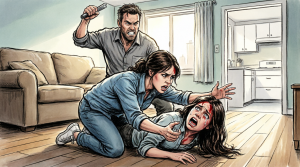
Marcus grabbed my arm first. Hard. His fingers dug in above the elbow. I tried to wrench free, but my mother was already there, catching my other wrist. The betrayal of that touch still lives in me sharper than the rest. Marcus hurting me had become familiar. My mother helping him never did.
“Mom,” I said, stupidly, because sometimes the body reaches for old instincts even after they should be dead. “Mom, stop.”
“Don’t call me that in this tone,” she said.
They dragged me into the living room. My sock caught on the hallway runner, and I slammed one knee into the floor hard enough to make my vision spark. Sarah was crying now, saying my name over and over. Marcus told her to sit in the corner and face the wall. She obeyed because we all knew disobedience spread punishment the way gasoline spreads fire.
Marcus opened the fireplace tool stand.
The poker, the brush, the shovel, the decorative iron with our last name worked into the end in looping metal script. BENNETT.
It had been a wedding gift from someone at church. I knew that because my mother used to tell the story every Christmas when she decorated the mantel. “A home should carry the family name proudly,” she’d say.
Marcus pulled the iron free and set it across the fireplace grate, where old embers still glowed under the ash from the previous night. He added kindling with calm, practiced movements. My mother kept hold of me while he worked. Her hand never shook.
“Please,” I said. “Please don’t.”
My mother’s breath touched my ear. She smelled like Ivory soap and the rose lotion she bought at the pharmacy.
“If you would only submit,” she murmured, “we wouldn’t have to keep doing this.”
Keep doing this. As if this belonged in a category with grounded weekends and extra chores.
Marcus knelt to stoke the flames. Orange light licked across his face. He looked almost happy.
“Tonight,” he said, “you’re going to remember who you belong to.”
I fought then. Really fought. Kicked, twisted, jerked my shoulders so violently something popped in my neck. My mother slapped me once across the mouth, not because it hurt much, but because it stunned me enough for her to get behind me. She forced my arms back. Marcus came over with a length of extension cord from the hall closet and tied my wrists together so tight my hands started tingling.
My mother pushed me down over the arm of the couch.
The upholstery smelled faintly like dust and lemon oil. I remember staring at one loose thread hanging near the seam and thinking with total insanity, I need to trim that.
Marcus went back to the fire. The iron’s tip glowed a dull, ugly orange.
Then my mother did something I would remember even more clearly than the brand itself.
She set her phone on the mantel, propped against a framed watercolor of a church field trip, and angled the camera toward us.
“What are you doing?” I whispered.
“Documenting this correction,” she said.
My stomach dropped. They weren’t losing control. They thought this was righteous. Something to preserve.
Sarah made a sound from the corner like she was choking on her own crying.
“Mom,” I said again, but this time it came out hoarse and thin, and I knew before Marcus even turned around with the iron in his hand that nobody was coming to save me.
The metal hissed when he lifted it from the fire.
Then he took one step toward me, and the whole room filled with the smell of burning iron.
Part 3
Pain changes the world into fragments.
For a while, all I had was fragments.
The couch fabric against my cheek. My mother’s hand pressing between my shoulder blades. Marcus breathing through his nose like he was lifting something heavy. Sarah screaming from the corner. My own voice ripping out of me raw enough that I didn’t recognize it. The sound when the metal touched skin—small, wet, impossible—and then the smell. Sweet, sick, unforgettable.
The first burn took me out of my body.
I know that sounds dramatic, but there isn’t a better way to say it. One second I was there, and the next I was somewhere above it, floating near the ceiling fan, watching a girl with my hair and my wrists tied behind her back kick against the couch while a man pressed a glowing piece of iron into her skin.
He lifted it. I think I blacked out for a second, because the next thing I remember is my mother saying, “Hold still,” in the same tone she used in grocery stores.
Marcus stepped back to look at the mark. I couldn’t see it. I only felt heat, then air, then a throbbing so deep it seemed to come from inside my bones.
“She’ll blur the edges if she keeps moving,” my mother said.
As if we were discussing frosting.
Marcus reheated the iron.
That detail mattered later in court because it showed intent. Repetition. Deliberation. But that night it just meant I had enough time to understand it was going to happen again.
“No,” I sobbed. “Please, I’ll do whatever you want.”
I meant it in that moment. I would have said sir, ma’am, Your Highness, Your Majesty, anything. Pain strips pride clean off you.
Marcus came back. “That’s what rebellion always says after the lesson starts.”
The second burn landed lower, half-overlapping the first. I screamed so hard something tore in my throat. Then I threw up on the rug.
That finally made my mother flinch—not out of pity, but annoyance.
“Marcus.”
He stepped away, breathing hard, the iron hanging loose in his hand. “She’ll remember now.”
I don’t know how long I lay there after that. Long enough for the fire to die down a little. Long enough for the room to cool while my back felt like it had been left inside the flames. My wrists were untied at some point. My mother made me get on my knees and pray. I don’t remember the prayer. I only remember blood and spit on my chin and the taste of metal in my mouth.
Sarah was ordered to bed without dinner.
I got marched to the downstairs bathroom. My mother cleaned the wound with hydrogen peroxide. It foamed white. I bit the edge of a washcloth to keep from making noise because I had already learned that my screaming pleased Marcus.
“You should be grateful,” she said while dabbing at raw skin. “We are trying to save you from becoming the kind of girl who ruins her own life.”
I looked at her in the mirror. My face was gray. My hair was stuck to my forehead. My lip had swollen from where she slapped me.
“You helped him.”
The words barely came out.
Her eyes met mine in the mirror. “I married him. That means I stand with him.”
That sentence lodged in me deeper than the brand did.
She taped gauze over my back, wrapped my torso in bandages so tight it hurt to breathe, and sent me to bed with Tylenol and a warning not to stain the sheets. The sheets were pale yellow and smelled like bleach. I lay on my stomach until dawn, shivering every time fabric brushed the wound.
Around two in the morning, my door creaked open.
Sarah slipped in wearing her sock feet, carrying a bowl of water and the stuffed rabbit she had slept with since kindergarten. Its left ear had been stitched back on twice. She set the bowl on my nightstand and climbed carefully onto the edge of the bed.
“I’m sorry,” she whispered.
“For what?”
“For forgetting.”
I turned my head enough to look at her. Moonlight from the window laid a silver stripe across her face. She looked younger in that light. Smaller. Like somebody had shrunk the whole world except her fear.
“This is not your fault,” I said.
She was crying silently, the way kids do when they’ve already been taught that loud crying brings adults running for the wrong reasons.
“I should’ve said sir.”
“No.” I swallowed and tasted blood from the raw place in my throat. “Listen to me. This is not because of a word. It was never because of a word.”
That mattered too. It took me years to understand how much it mattered. Abusers love rules because rules make violence look tidy. They act like the punishment grew naturally from the mistake, the way thunder follows lightning. But in our house, the punishment was the point. The rule was just decoration.
Sarah dabbed my forehead with a wet washcloth. The water smelled faintly of tap metal and dish soap from the bowl she’d stolen out of the kitchen.
“Does it look bad?” I asked.
She hesitated too long.
That told me enough.
The next two weeks blurred into fever and lies.
My mother kept me home from school and told people I had the flu. Marcus said I could consider the pain “a mercy from God.” The wound got sticky, then angry, then hot enough to make me dizzy. When I said I needed a doctor, my mother told me hospitals filled children’s heads with worldly nonsense. She changed the bandages herself, clicking her tongue when she peeled gauze from skin.
“It only looks worse because you fought,” she would say. “Submission would have made this cleaner.”
The infection came with a smell all its own—sweet rot under the medicated ointment. I knew enough by then to recognize danger even if nobody around me wanted to call it by name.
On day twelve, she decided I was well enough to go back to school.
“Gym class is canceled for testing week,” she said while buttoning my blouse herself. “And if anyone asks, you fell against the wood stove at your grandmother’s place.”
My grandmother had been dead six years.
I went anyway because staying home meant being alone with them. At school, I moved like an old woman. Every hallway jostle sent sparks of pain through my shoulders. In second period, sweat soaked through the bandages under my shirt.
Then fourth period came, and gym wasn’t canceled……………….

