My brother took my ATM card on a Thursday, but the truth was he had been reaching for my life long before he ever slid his hand into my coat pocket and closed his fingers around that thin rectangle of plastic. By the time I understood what he had done, he was not just stealing money. He was acting out the oldest family belief I had ever been taught without anyone saying it directly: what was mine was negotiable, what was his was sacred, and if I objected loudly enough to threaten the arrangement, I would be punished until I learned the shape of my place again.
That Thursday began like a hundred other days had begun in my parents’ house in Columbus, Ohio. My alarm went off at 5:03 a.m. in the small bedroom at the back of the hall, the one that used to be a guest room before I moved back in and became the unspoken, useful disappointment occupying borrowed space. I slapped the alarm silent, lay still for a second in the dark, and tried to decide whether the weight in my chest was exhaustion or dread. Most mornings it was both. I had worked a double shift on Tuesday, nearly a double on Wednesday, and the hospital had been full of the kind of human suffering that gets under your skin and stays there. I was a respiratory therapist. I spent my days and nights listening to lungs fail, fighting for breath on behalf of strangers, suctioning airways, checking vent settings, adjusting oxygen, teaching panicked families how to breathe around their own terror. When you do that work long enough, you start to measure life in air hunger. Who has it. Who hides it. Who survives it. Who doesn’t.
The house was quiet when I got up. My mother always said she loved early mornings, but what she loved was sleeping until other people had already started the day and making sure somebody else had made the coffee first. I moved through the kitchen by habit, filled a travel mug, ate half a banana because it was the only thing I could tolerate before dawn, and stood for a moment at the sink staring out at the bare March branches in the backyard. The grass was still wet and colorless from the night. The sky had not decided what it wanted to be yet. Everything looked suspended. In that weak gray light, even the old fence seemed tired.
I remember touching my coat hanging over the chair back because I had a stray thought about whether I had left my ATM card in the pocket from buying gas the night before. I almost checked. I didn’t. I was running late, and I told myself I would deal with it after my shift. That single choice haunted me for weeks afterward, though the truth is it would not have changed much. Jason already knew my habits. He knew where I put things. He knew I was too tired most days to notice small disturbances. Growing up with someone teaches them the choreography of your weaknesses.
The drive to the hospital blurred into the rest of the week. Gray roads. Red brake lights. A radio host laughing too loudly about something I barely heard. At work, the hours stacked themselves in the unforgiving way hospital hours do. A man in his sixties with COPD who refused BiPAP until he was blue enough to terrify his wife. A post-op patient who kept yanking off her oxygen mask because it made her feel trapped. A young asthmatic in the ED with shoulders heaving so hard I could see each rib between breaths. Too many families asking versions of the same question in different voices: Is she getting enough air? Is he okay? Why is the machine making that sound? My body moved on training. My mind moved on duty. By noon I had forgotten what day it was. By three I had forgotten I was hungry. By the time I clocked out after nine that night, my feet burned, my lower back ached, and all I wanted in the world was a hot shower, five silent minutes, and a bed.
On the drive home I stopped at a pharmacy for toothpaste and ibuprofen. I used a credit card because the line was long and I didn’t want to dig for cash. That detail mattered later too. There were so many details that mattered later. That is how betrayal works when it becomes evidence. Memory stops being a fog you wander through and turns into a warehouse of labeled boxes. What time did you leave? Which pocket was your wallet in? Did he know the PIN? Did she say the words before or after she smiled?
When I pulled into my parents’ driveway, the porch light was on even though it was past nine-thirty. That should have warned me. My mother believed electricity existed to be wasted by other people. If a light was left on late, it meant someone wanted a scene illuminated.
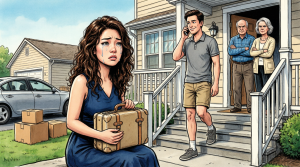
I let myself in through the front door and immediately saw my suitcase.
It was placed upright beside the door like it had been waiting for me. Not leaning carelessly, not half-hidden, not in the hall closet where it usually lived. It stood there deliberate and composed, handle extended. For one second my exhausted brain tried to turn it into something harmless. Maybe my mother had been cleaning. Maybe she had tripped over it and moved it out of the closet. Maybe this was one of those household inconveniences that turns into an argument because everyone is already irritated.
Then I saw the zipper tags. Closed. Aligned. My suitcase was packed.
I stared at it, then crouched and unzipped the top compartment. My toothbrush in a plastic bag. My shampoo bottle wrapped in one of my old T-shirts. My laptop charger stuffed sideways into the mesh pocket. My underwear folded. Socks rolled. A pair of scrubs laid flat on top like whoever packed it did not know me well enough to understand what mattered but knew enough to mimic care. It was not packing. It was removal. It was the kind of tidiness people perform when they are turning your life into an object and want to congratulate themselves for not making a mess.
Then I heard the laughter from the kitchen.
My brother’s laugh always had a mean edge to it, like he was daring the room to say he wasn’t funny. My father’s was lower, more satisfied. My mother’s slipped around the others and made them seem less ugly than they were if you did not listen carefully. I stood, zipped the suitcase closed with fingers that had begun to shake, and walked toward the kitchen with my pulse climbing into my throat.
Jason sat at the table in one of Dad’s chairs as though he had reclaimed a throne. He was two years older than me, taller by nearly six inches, thick through the shoulders in the way men often get credit for even when most of the bulk comes from beer and entitlement. He had one foot propped on the rung of the chair, a half-finished beer in his hand, and the easy expression of somebody who had been talking about me, not to me, for a while. Dad sat across from him with his own mug. My mother stood at the counter, wiping down a clean surface because she always needed her hands occupied when she was about to pretend innocence.
“Oh, you’re home,” she said, and smiled.
I remember that smile better than some funerals I have attended.
“Why is my suitcase by the door?”
Jason leaned back. “Your work is finished,” he said, like he was delivering a punch line that deserved applause. “We got what we wanted. Don’t look back at us now.”
I thought at first that I had misheard him. The words were too theatrical, too absurd. Exhaustion makes the mind stutter. “What are you talking about?”
Dad chuckled. “Don’t act confused.”
Then Jason reached into his jeans pocket, pulled out my ATM card, and flicked it onto the table between us.
For a moment, every sound in the room narrowed to one hard rush in my ears. I knew that card by the scratch near the chip, by the worn corner from years of being shoved too quickly into my wallet, by the small sticker on the back from the bank’s new security rollout. It landed face up. My name was on it. Seeing it in his hand felt almost obscene, like catching somebody reading your diary naked under a spotlight.
“You stole my card?”
He grinned. “Borrowed.”
I took one step toward the table. He flattened his palm over the card before I could reach it.
“And emptied the account,” he added.
The words did not enter me all at once. They arrived in pieces. Emptied. The account. No. My mouth opened before I had language. “What?”
Mom made a soft sound in the back of her throat, halfway between a sigh and a laugh. “Don’t be dramatic, Claire.”
“How much did you take?” I asked him.
Jason shrugged lazily. “Everything.”
The kitchen seemed to tilt. I grabbed my phone from my scrub pocket so hard I nearly dropped it and opened the banking app with clumsy fingers. There is a particular kind of terror in waiting for a screen to load when you already know what you are going to see but still need the machine to tell you. It felt like falling in slow motion. Then the numbers appeared.
Savings: $0.43.
Checking: $12.11.
Under that, transaction after transaction. Withdrawals. Another withdrawal. Another. Across town. Across more town. A wire transfer. Total loss: just under thirty-eight thousand dollars.
My lips moved before sound came out. “That was my money for graduate school.”
Jason stood then. He liked standing over people. He liked using his body as an argument. “Not anymore.”
“Give it back.”
“No.”
Dad rose too, slower, but with the satisfaction of a man who believed his presence itself settled the moral order of a room. “You’ve been staying here almost two years,” he said. “Bills, food, utilities. Your mother and I decided this evens things out.”
I looked at him, actually looked, trying to find some hint of embarrassment in the face that had taught me to ride a bike and once bandaged my knee after I split it on the driveway and used to tell his friends I was the smart one. There was nothing there I recognized. “You never asked me for rent.”
“We shouldn’t have had to,” Mom said.
That was the moment, more than the balance on the screen, when I understood I was not in an argument. I was in a verdict they had already delivered. The money was gone because they had told themselves a story in which I owed it. The suitcase was packed because they had decided my usefulness had ended. The cruelty was not incidental. It was administrative.
Jason lifted the suitcase with one hand, walked to the front door, and opened it. Cold March air flooded the hall. He set the suitcase on the porch with a little shove, like he was taking out trash.
“You can go now,” he said. “And don’t come crawling back.”
My parents laughed behind him.
There are moments the body never forgets. Not because they are the worst things that happen to you, but because they redraw your entire understanding of what reality has been. Standing there in my blue scrub top with the smell of reheated food and beer in the house, hearing the people who had known me my whole life laugh while throwing me out, I felt something separate cleanly inside me. Not hope. Not love. Something more primitive than that. Something like orientation. I no longer knew where home was, only where it was not.
I do not remember what I said before I left. I know I grabbed the card when Jason finally lifted his hand off it. I know I picked up my phone charger from the hall table and my coat from the peg by the door. I know my mother called after me in a falsely patient voice, telling me not to make a scene for the neighbors. I know Jason said something about me being ungrateful. I know Dad’s final contribution was, “You’ll cool off and understand we did what had to be done.”
What I remember most clearly is walking down the porch steps into the sharp wet cold, putting my suitcase in the trunk, sitting behind the wheel, and not turning the engine on for almost three minutes because my hands would not stop shaking.
I drove without direction at first. Past the strip mall where I used to buy school supplies. Past the gas station where Jason once left me at sixteen because I would not give him twenty dollars. Past the church my parents still attended when it suited them to be seen. The roads were mostly empty, and the city at that hour looked stripped down to its mechanical bones. Streetlights. Reflections on wet pavement. Closed storefronts. Dark windows holding other people’s ordinary lives.
I parked behind a twenty-four-hour grocery store because I did not know where else to go. The lot there always had enough cars to make me feel less visible and enough turnover to make me feel less trapped. I pulled into a spot under a flickering light, reclined the seat halfway, and stared through the windshield while the interior of the car slowly cooled.
My phone rang at 10:34 from an unknown number. I let it go to voicemail. It rang again at 10:52. Then 11:17. By then I had cried once in a quiet ugly burst that left my face hot and my chest raw, and I was too tired to protect myself from one more thing.
“Hello?”
“Ms. Claire Bennett?” a woman asked.
“Yes.”
“This is Natalie from Fifth River Bank’s fraud prevention department. We detected unusual withdrawals and attempted to reach you several times. Did you authorize cash withdrawals totaling twenty-nine thousand dollars and a wire transfer of eight thousand four hundred dollars today?”
Relief and panic collided so fast I almost laughed. “No. No, I didn’t. My brother stole my ATM card.”
Her tone changed at once, becoming more precise. “Do you have possession of the card now?”
“Yes.”
“Good. We’re freezing the account. Given the volume and pattern of withdrawals, this has been flagged for internal review. I also need to ask whether you know the source of the funds in the savings account.”
I closed my eyes. There it was. The part my family did not understand. The part that made this more than theft.
“Yes,” I said. “It’s part of a restricted disbursement connected to my aunt’s wrongful death settlement.”
Silence for half a breath.
“I see,” Natalie said carefully. “Then you need to come into the branch first thing tomorrow morning. Bring identification and any related documentation you have. If these funds were withdrawn by an unauthorized person, this may involve both law enforcement and probate compliance.”
I thanked her. I do not remember the rest of the call, only that when it ended the car seemed very small and my life seemed suddenly full of moving machinery I had no control over.
My aunt Rebecca had died three years earlier on a two-lane highway outside Dayton when a trucking company driver crossed over after being on the road too long and too tired and too protected by a system that counted profit more carefully than human bodies. She had survived breast cancer once and was halfway through believing she might get to keep her life when a stranger’s negligence took it from her in seconds. Rebecca had no husband, no children, and, by the time she died, very little illusion left about my family. She had loved them in the stubborn obligatory way some women love people who never deserve them, but she was not sentimental about who showed up. When she was sick, I had shown up. I drove her to appointments, sat with her through infusions, learned the names of medications I never wanted to know, sorted paperwork, argued with billing departments, and once slept upright in a vinyl hospital chair for fourteen hours because she woke confused after a complication and kept asking if somebody was there.
After she died, the settlement from the trucking company was divided in ways I only partly understood until Martin Kessler, her attorney, explained it to me. Some went to medical bills. Some to fees. Some to taxes. A small private trust remained. Not huge. Not life-changing in the way lottery money changes lives. But enough to build a bridge. Enough for graduate school if I used it wisely. Enough to let me step toward the life I wanted instead of constantly putting out fires in the one I had.
The trust had conditions. Rebecca had insisted on them. The money could be used for tuition, documented housing, books, transportation, and verified living costs while I pursued additional training. Larger withdrawals triggered review. The account was in my name, but it was watched. It was hers in purpose, not mine in appetite.
Jason and my parents knew only the rough shape of the story. They knew Rebecca had left me “something.” They knew the account existed. They knew I had refused several times over the previous year when Jason, with fake casualness, asked whether I could “spot” him for a truck payment, a security deposit, a business idea, a “short-term thing” that never had terms and would certainly never have been short. They did not know the structure. They did not care about structure. In their minds, money with my name on it was money I was selfishly withholding from the family ecosystem, the same ecosystem that somehow always fed Jason first.
I did not sleep that night. I dozed in jagged fifteen-minute pieces and woke each time convinced I had forgotten something crucial. My documents. My scrubs. My dignity. A future. Around 4:30 a.m. the lot behind the grocery store began filling with delivery trucks, and I sat up, started the engine for heat, and checked my voicemail. Two messages from Mom. One from Dad. Three texts from Jason.
Mom’s first voicemail was trembling and furious at once. “Claire, this has gone too far. We were trying to teach you responsibility, and now you’re making it ugly. Come home, stop this nonsense, and we’ll talk like adults.”
Dad’s message was colder. “You better not be telling outsiders family business. This is between us.”
Jason’s texts began cocky and turned defensive as the night went on.
You really called the bank?
Don’t be stupid.
You owe us anyway.
You know what? If you keep pushing this I’ll tell them you gave me the PIN.
Then, an hour later: Pick up your phone.
I did not answer any of them.
At seven-thirty I drove to the bank branch downtown. My hair was pulled back with yesterday’s elastic. I was still wearing yesterday’s clothes under my coat. I had brushed my teeth in the grocery store restroom and washed my face with paper towels and hand soap because I could not bear to arrive looking exactly like what had happened to me.
The branch manager, Denise Harper, was a woman in her late fifties with careful silver hair, rimless glasses, and the kind of posture that suggested competence had been her religion longer than church ever was. She met me in the lobby, shook my hand, and led me to a private office with frosted glass walls. She closed the door gently before sitting across from me.
“Ms. Bennett, Natalie briefed me,” she said. “Let’s go through everything from the beginning.”
I told her. The day at work. The suitcase. The confrontation. The card on the table. The withdrawals. The trust. As I talked, something shifted inside me. Shame, I think. Shame thrives in vagueness. The more precisely I described what had happened, the more I could see it as an act committed against me rather than an exposure of some secret weakness in me. Denise took notes without interrupting except to clarify times and names.
When I explained the trust arrangement, she nodded once. “That matters,” she said. “Because if the funds were restricted and someone knowingly withdrew them without authorization, this moves beyond a simple family dispute. We are already attempting to reverse the wire. Cash withdrawals are harder, but we’ve requested ATM footage and transaction logs.”
“Can I get it back?” I asked, hating how young I sounded.
“Some of it, likely. All of it, possibly, depending on timing, evidence, and law enforcement cooperation.”
I pressed my palms together in my lap to stop them trembling. “I should have protected it better.”
She looked at me for a moment. “Your brother stole your card and accessed funds without your authorization. The failure here is not yours.”
No one in my family had spoken to me that cleanly in years.
By eleven I had filed a police report. The officer taking my statement was younger than I expected and far more respectful than my father had trained me to anticipate from institutions. He asked where the card had been kept, whether my brother knew the PIN, whether there had been prior incidents of theft. I almost laughed at that last one because how much time did he have? But I answered honestly.
“Yes. Small things. Cash from my purse when we were teenagers. A check from graduation cards that he said he ‘borrowed.’ Tools from neighbors that somehow ended up in Dad’s garage. Nothing I ever pressed charges over.”
“Why not?”
Because in our house naming something wrong was treated as a greater offense than doing it. Because the family story required Jason to remain salvageable and me to remain accommodating. Because every time I objected I was told I was ruining dinner, Christmas, peace, Mother’s Day, Dad’s blood pressure, Jason’s chances. Because children in unequal homes learn very early that justice is expensive and love is conditional. Instead I said, “Because I knew no one would back me.”
He nodded as if that answered more than I meant it to.
At noon I called Martin Kessler, the attorney who had handled Rebecca’s estate. I expected an assistant, maybe a call back in a day or two. Instead Martin himself came on the line after the receptionist heard my name. His voice was warm at first, then sharpened into something almost metallic as I explained what had happened.
“Did you authorize any of these withdrawals?”
“No.”
“Did anyone else have lawful access to the account?”
“No.”
“Did your relatives know the funds were associated with Rebecca’s settlement?”
“They knew there was money from her estate, yes. I don’t think they understood the restrictions.”
“That may matter less than they imagine,” he said. “Claire, do not speak to them further about this. Save every message. Every voicemail. Every text. If the account was tied to court-monitored disbursement conditions, unauthorized access can trigger both civil and criminal issues. I want copies of everything by this afternoon.”
I forwarded him documents from the bank sitting in my car outside the police station with my phone battery sinking under the weight of my new life.
Somewhere in the middle of all that, I realized I had nowhere to shower and nowhere to sleep that night if things did not improve. The practical humiliations came in waves. You can be a competent professional handling ventilators and arterial blood gases and still sit in a parking lot wondering where you are going to wash your hair. I thought of hotels and rejected them immediately. Even a cheap room would cut into the checking balance Jason had left me. I thought of coworkers and felt my face heat with resistance. Independence had been one of the few things I still clung to. Asking for help felt like failing at the last corner of myself.
But around two that afternoon, while sitting on a bench outside the courthouse annex to eat a stale granola bar from my glove compartment, I got a text from Lena Morales, one of the senior RTs on my floor……………….
Click Here to continuous Read Full Ending Story👉PART 2-“My Brother Emptied My Account and Kicked Me Out—He Thought It Was Over”