After my mother passed away, my father moved her sister into our house—and Amanda wasted no time making it clear I wasn’t welcome. Even with a broken arm and leg, she still called me “useless” and expected me to organize her wedding without complaint. But everything changed when my grandmother arrived with a “present” that left them both shouting.
I was nineteen when Dad announced that Amanda would be moving in.
Mom had been gone less than a year. There was still a dent in the couch cushion where she used to sit, still a mug with a tiny chip on the rim at the back of the cupboard that I couldn’t bring myself to throw away. Her perfume lingered in the hallway if you opened the right closet. Grief had turned our house into a museum of almosts and used-to-bes.
So when Dad cleared his throat one Tuesday morning and said, “Amanda will be staying with us for a while,” my brain immediately filed it under temporary. Just a visit. Just until she “gets back on her feet.”
I was halfway through my cereal at the kitchen table. “Staying,” I repeated. “Like… for a weekend?”
Dad kept his eyes on his coffee. “No. Indefinitely.”
Something in my chest tightened. “Why? She has her own place.”
He exhaled slowly, like he’d been rehearsing this conversation and it still hurt. “She’s lonely. I’m lonely. It makes sense.”
I blinked at him. “She’s my aunt, Dad. Mom’s sister. And you’re saying you two are… together?”
Saying it out loud felt wrong, like tasting metal.
He finally looked at me then, his expression strangely calm. “Sometimes these things just happen,” he said. “You’re too young to understand now, but someday you will.”
I wanted to scream that this was insane, that if he wanted companionship there were literally millions of people in the world who weren’t my dead mother’s sister. I wanted to ask what Mom would say if she could walk into this kitchen right now and see them.
But grief had taught me something: once Dad decided something, my feelings were an afterthought.
So I swallowed it. I rinsed my cereal bowl. And I tried—really, genuinely tried—to adjust.
At first, Amanda made it easy.
She moved in with three suitcases, a box of shoes, and a smile so polished it could’ve been sold. She hugged me at the door, smelling faintly of fake vanilla and expensive lotion.
“Oh, Ruth,” she cooed. “You’ve grown so much. You look just like your mother did at your age.”
The mention of Mom was a punch to the gut, but I managed a smile. “Hi, Aunt Amanda.”
She insisted I call her Amanda. “We’re all adults now,” she said breezily. “No need for formalities.”
For the first few weeks, she was… nice. If I stayed home sick from my café job, she brought me soup on a tray and scolded me for trying to get up.
“You’ll spill it, sweetheart,” she’d say, chuckling. “Just rest. I’ll handle things.”
When Dad was home, she hovered in that perfect-wife-in-training way: asking about his workday, offering to iron his shirts, chatting about the news like she’d been part of this routine for years. She asked about my college classes, nodded along when I talked about my assignments, even told Dad he should be proud of me for working and studying at the same time.
For a moment, I let myself believe we might find a way to coexist. It felt strange, but not unbearable. Maybe this was what “moving on” looked like, and I was the one stuck in the past.
The illusion didn’t last.
The first time she lashed out, we were alone. I’d just finished two back-to-back closing shifts at the café. My feet ached, my eyes were gritty, and I’d collapsed on the couch for a ten-minute break before doing the laundry.
Amanda walked in, heels clicking against the hardwood, perfectly put together in a soft sweater and jeans that somehow looked designer.
Her eyes fell on the laundry basket, still overflowing with clean clothes I hadn’t folded yet. She stared at it for a full three seconds, then looked at me.
“Honestly,” she said, her tone flat, “you’re just as useless as your mother.”
The world shrank to the space between us. “What?” I whispered.
She tilted her head. “Don’t gape like that. Your mother was always scattered. Sweet, but hopeless with anything practical. It’s no wonder you picked up some of her habits.”
Heat rose in my face. “Don’t talk about Mom like that.”
She rolled her eyes. “You’re too sensitive, Ruth. I’m just helping you grow up. Nobody else is going to tell you the truth.”
Then she grabbed a blouse from the basket, shook it out with a snap, and walked away, humming under her breath as if she hadn’t just insulted the dead.
I sat there, heart pounding, fingers digging into the couch cushion. Part of me wanted to run after her and scream. Another part whispered that maybe she was right. Maybe I was failing at basic things, like folding laundry on time, like keeping up, like being “useful.”
That became the pattern.
Whenever Dad was home, she was gentle, patient, endlessly understanding. “Ruth’s under so much pressure with school and work,” she’d say, resting a hand on my shoulder. “We should be proud of her effort.” She’d smile at me like we shared a secret. I’d feel like a liar just standing there.
But the second he stepped out the door for a late shift or disappeared into the garage, a switch flipped.
Warmth vanished. Her voice sharpened.
If my room wasn’t spotless, she’d wrinkle her nose. “I don’t know how you live like this. Do you enjoy being disgusting, or is it just laziness?”
If I wore earbuds while cleaning, she’d snatch one out of my ear. “That’s rude. You’re in a shared space. Try not to broadcast how little you care about everyone else.”
If I forgot to wipe the counter after making a sandwich, she’d sigh dramatically. “You know, for someone who’s supposedly an adult, you’re remarkably helpless.”
And when she ran out of creative insults, she reached for her favorite like a well-worn tool.
“You’re so useless.”
That word started following me.
It echoed when my alarm went off before dawn for my café shift. It muttered in the back of my mind when I submitted an essay. It hissed at me in the quiet moments, making me second-guess every move.
Was I really that terrible? Maybe I was making more mistakes than I realized.
I tried telling Dad once.
We were in the living room; Amanda was out shopping. The absence of her perfume made the air feel breathable for the first time all day.
“Dad,” I said, heart hammering, “she’s different when you’re not here.”
He frowned. “Different how?”
“She’s… cruel,” I said. “She calls me names. She talks about Mom like—like she was worthless. And she acts like I’m some kind of burden.”
His jaw tightened. “Amanda? No, Ruth. She’s been nothing but kind to you.”
As if summoned by the sound of her name, she came through the front door, bags on her arm.
“What’s wrong, sweetheart?” she asked, her voice dripping concern.
She looked at me, then at Dad, and I realized exactly how this would play out. I was the dramatic teenager. She was the composed adult. He’d already chosen who to believe before I opened my mouth.
“Nothing,” I muttered.
Amanda’s smile sharpened just a little at the edges, so faint only I would notice. “Teenage moods,” she said lightly to Dad. “I remember those days.”
It wasn’t long after that they got engaged.
Dad told me with awkward excitement, as if he knew I wouldn’t be thrilled but hoped I might at least pretend. Amanda flashed the ring at me, a simple gold band with a modest diamond.
“We’re going to keep it small,” she said. “Intimate. But special.”
By “we,” she meant “me.” The planner. The organizer. The live-in assistant who didn’t need her own life.
I tried to keep my head down and my distance. Between shifts at the café and my classes, I was exhausted. But any time I tried to step back, Amanda reminded me who she thought I was.
“Don’t be useless, Ruth,” she’d say, dropping another list in front of me. “You live here rent free. The least you can do is help.”
Then I got hurt.
The day I fell, she handed me a carefully written list of pickups: favors from one shop, printed menus from another, flowers from a third.
“These all need to be picked up today,” she said. “You have time before work, don’t you?”
Outside, snow was falling in thick, lazy flakes, the kind that hide ice underneath. The weather report had been full of warnings all morning.
“It’s getting bad out there,” I said. “Can some of these wait until tomorrow?”
She arched a brow. “The world doesn’t stop for a little snow. If you leave now, you’ll be fine. But don’t take forever. I need to check everything before the rehearsal dinner.”
I wanted to refuse. But Dad walked in just then, stamping snow off his boots. Amanda turned to him with her perfect smile.
“Ruth’s going to pick up the favors and the menus,” she said. “Isn’t she helpful?”
Dad gave me a distracted smile. “Thanks, kiddo. That’s a big help.”
And that was that.
By the time I headed home, my arms were loaded with packages. The wind had picked up. The sidewalks were slick, the snow now a wet, icy slush that looked harmless until your foot slid out from under you.
I shifted the boxes to get a better grip, and for a second, they blocked my view of the ground. My boot hit a patch of ice I didn’t see.
I slipped.
The world flipped. Boxes flew. Pain exploded in my leg and arm as I hit the ground hard. The side of my head cracked against the concrete. For a moment, everything went white.
My last conscious thought was not about my arm or my leg. It was a sickening burst of panic:
Amanda is going to be furious if anything is damaged.
Then nothing.
I woke up under harsh fluorescent lights, the smell of antiseptic burning my nose. Machines beeped steadily around me. My arm and leg were trapped in heavy casts, dull pain throbbing under them like a heartbeat.
The first face I saw wasn’t Dad’s. It was Amanda’s.
She leaned over me, her expression flat. No fear. No worry. Just annoyance.
“Don’t think this little stunt gets you out of your duties,” she hissed, voice low so the nurse wouldn’t hear. “You’re still preparing everything for the rehearsal dinner and the wedding.”
“I… broke…” My tongue felt thick. “My leg…”
“You’re fine,” she snapped. “Stop being useless.”
Normally, she saved that word for home. Hearing it in a hospital room, with IV lines in my hand and a monitor tracking my heartbeat, made something inside me break that the doctors couldn’t see on an X-ray.
When we got home, she climbed the stairs ahead of me without once looking back. Each step felt like a mountain. My cast bumped the edge of a riser; pain shot up my body. I gripped the railing, teeth gritted, curious if she could hear me struggle and was choosing not to care.
Dad came home later. He took one look at my casts and shook his head.
“You should’ve been more careful,” he said. “Ice is dangerous.”
No “I’m glad you’re okay.” No “That must have been scary.” Just blame.
That night, I lay in bed staring at the ceiling, pain radiating through my body. My phone buzzed on the nightstand. The screen lit up with a name that made my throat ache.
Grandma.
“How are you, my sweet girl?” she asked as soon as I answered.
Her voice was warm and steady, like a hand on my back.
The dam broke.
I told her everything. How Amanda talked to me. How she talked about Mom. How Dad refused to see it. How I felt like a stranger in my own house. I told her about the fall, about the hospital, about being told I was still expected to handle everything for the wedding.
Grandma didn’t interrupt. She just listened. I could hear the small sounds of her house in the background—the tick of the big clock in her living room, the faint hum of the fridge. Familiar, safe sounds.
When I finally ran out of words, she was silent for a moment.
“Ruth,” she said slowly, “for now, be careful. Do what they say.”
I wiped my eyes with the back of my good hand. “Why?”
“Because when I arrive,” she said, her voice suddenly steel, “I’m going to give them a celebration they’ll never forget. And Amanda will regret exactly how she’s treated you.”
I wasn’t sure what that meant. Grandma was more likely to bring a casserole than a plan for vengeance. But there was something in her tone that made me sit up a little straighter.
“Okay,” I whispered. “I trust you.”
So for the next week, I pushed through the pain and did everything.
I reserved the restaurant for the rehearsal dinner, making a dozen calls to adjust for Amanda’s “last-minute inspiration.” I printed and mailed the invitations from my laptop, pecking at the keyboard with one working hand. I arranged the seating chart, listening to Amanda complain about people she barely knew as if they’d personally offended her.
“You can’t put Aunt Carol next to Uncle James,” she’d say. “They had an argument about politics five years ago. Honestly, do you think at all before you do these things?”
I even collected her wedding dress from the boutique, watching as the clerk loaded it into the car while I sat uselessly in the passenger seat, my casts awkward and heavy.
Every time I asked for help, Amanda had a reason to say no.
“I’m exhausted, Ruth. I’ve been dealing with vendors all morning.”
“Your father’s working late. We can’t bother him with this.”
“It’s not that hard. Use your other arm. Stop being so dramatic. Stop being so useless.”
That word again. As if I weren’t holding her entire event together with two broken limbs and a body full of bruises.
The day of the rehearsal dinner, an hour before we were supposed to leave, I was lying in bed, drained. My leg was elevated on pillows, my arm pulsing in rhythm with my heartbeat. Sweat beaded at my temples from the effort of merely existing upright.
The doorbell rang.
“I can’t come down,” I called weakly toward my closed door. Even swinging my legs off the bed felt like running a marathon.
Amanda didn’t knock. She swung my door open so hard it hit the wall.
“You’re so useless, Ruth,” she snapped. “Why do I even bother feeding you?”
The words stung more than usual. I swallowed hard. She didn’t wait for an answer. I heard her stomp down the stairs and yank open the front door.
Then a voice floated up that made my heart leap.
“Hello, dear! Time to celebrate!” Grandma.
A second later, there was a loud crash—like a heavy box being dropped or kicked over.
“MOM, WHAT ARE YOU DOING? WHY TODAY OF ALL DAYS?” my father shouted.
“What is wrong with you?” Amanda screeched. “Why would you bring all of this here?”
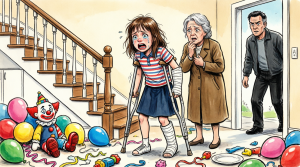
Despite the pain, curiosity—and something like hope—dragged me out of bed. I gripped the banister and slowly made my way downstairs, one step at a time, leg throbbing, arm cradled against my chest.
When I reached the bottom, I stopped.
The entryway looked like a children’s birthday party had exploded.
Colorful balloons bobbed against the ceiling. Streamers lay tangled on the floor. Party hats were scattered everywhere. A large cardboard box lay tipped on its side, spilling out oversized clown shoes, neon wigs, and plastic horns.
That must have been the crash.
And in the middle of the chaos stood three clowns.
Real clowns. Painted faces, big red noses, ruffled collars, comically large shoes. But their posture was all wrong for clowns—they stood with arms folded, expressions serious despite the painted smiles, like they were part of some bizarre intervention.
Grandma stood among them, still wearing her coat, her purse tucked neatly over her arm. Her gray hair was pinned back, her chin lifted just enough to telegraph that she was not to be trifled with.
Dad’s face was red. “What is this supposed to mean, Mom?” he demanded.
Grandma smiled sweetly. “Well,” she said, gesturing to the clowns and the mess, “since you’ve turned your life into a circus, I figured this would be an appropriate wedding gift.”
My mouth actually fell open. Despite everything, a laugh bubbled up in my chest.
“This is not funny,” Amanda snapped, hands on her hips.
“You’re humiliating us!” Dad added. “The neighbors will hear!”
“Before we worry about the neighbors,” Grandma said evenly, “I’d like to see my granddaughter.”
Her eyes slid past them and landed on me immediately.
“There you are,” she said, her voice softening. “Come here, sweetheart.”
I hobbled toward her, suddenly blinking back tears. She opened her arms carefully, mindful of my casts, and I leaned into her, inhaling the familiar smell of her—soap and cinnamon and something floral.
“I’m here, just like I promised,” she whispered. “And no matter what happens, you’ll be okay.”
Then she pulled back and nodded to the clowns.
“Gentlemen, thank you. You may wait outside.”
Without a word, they gathered the larger props, slipping surprisingly gracefully through the door and onto the porch. The balloons and streamers remained, a vivid backdrop for the confrontation about to unfold.
Now it was just the four of us: Dad, Amanda, Grandma, and me.
Grandma guided me to a chair by the wall and sat next to me, taking my good hand.
“You’ve done exactly what I asked, Ruth,” she said quietly. “You’ve been patient. Now I need you to speak. Just the truth. Nothing else.”
My heart pounded so hard I could hear it in my ears. But her hand was warm, steady. I took a breath.
And I told my father everything.
I told him how Amanda talked to me when he wasn’t around—the names, the insults, the constant “useless.” I told him what she’d said about Mom, how she’d dismissed her as scatterbrained and weak. I described how she’d reacted in the hospital, how she’d made me climb the stairs alone with broken bones, how she’d piled responsibility after responsibility on me for the wedding.
My voice shook, but I didn’t stop. Every time I faltered, Grandma squeezed my hand. She didn’t add anything. She didn’t correct me. She just let me talk.
When I finished, the room was very quiet.
Amanda laughed first. A sharp, disbelieving sound.
“Barbara,” she said, turning to Grandma, “I don’t know why you’re staging this ridiculous scene or dragging Ruth into it, but this has gone far enough.”
“This isn’t ridiculous!” I burst out. “Grandma didn’t tell me to say anything. Everything I said is true.”
Amanda’s eyes snapped to mine, cold and hard. “Where’s your proof?” she demanded. “Any evidence at all? Text messages? Recordings?”
She turned to my father, her tone softening instantly. “I’ve tried with Ruth,” she said, placing a hand on her chest. “I really have. But she’s never accepted me. She’s grieving. She’s twisting things in her head. Are you really going to cancel our wedding over accusations with no proof?”
Dad stared at the floor, his shoulders hunched. His hands were buried deep in his pockets, knuckles white.
Grandma stepped forward.
“She’s right about one thing,” she said calmly. “There’s no proof.”
Amanda straightened, smugness flickering in her eyes.
“But there is a choice,” Grandma continued.
The smugness vanished.
“You can believe that woman,” Grandma said, gesturing toward Amanda with a small, controlled motion, “or you can believe the child you raised—the one sitting here in casts because no one protected her.”
She moved closer to my father, standing almost toe to toe with him. She had to tilt her head back to look him in the eye, but somehow she seemed taller.
“And if you choose wrong,” she said, her voice low but unshakable, “you won’t just lose a wedding. You’ll lose your daughter—and me.”
The word “me” landed with unexpected weight. Dad glanced up, startled.
“You’d leave?” he asked quietly.
“I won’t stand by and watch my granddaughter be abused in her own home,” Grandma said. “I won’t visit. I won’t call. You’ll have made your decision clear.”
For a long moment, no one moved.
Dad’s gaze ping-ponged between Amanda and me. I could see the war on his face: the need not to be alone again, the comfort of the relationship he’d built around his grief, the nagging doubt he’d been pushing down every time I flinched when Amanda spoke.
He took a step toward Amanda.
My heart sank. My fingers tightened around Grandma’s.
We all held our breath.
Then he stopped. Closed his eyes. Exhaled.
“The wedding is off,” he said.
Amanda recoiled like he’d slapped her. “You can’t be serious.”
“I am,” he replied, turning fully to face her. “I’m sorry, Amanda. But I can’t ignore this. Not anymore.”
He turned to me, and for the first time in months, his expression was open, unguarded, almost boyish in its regret.
“I’m sorry, Ruth,” he said. “I didn’t want to see it. But I should have. I believe you.”
Something unclenched in my chest so suddenly it almost hurt.
Amanda stood frozen for half a second. Then she exploded.
“You’re throwing everything away for this?” she screamed, jabbing a finger in my direction. “For a sulky child with a victim complex? You’re pathetic.”
She grabbed her bag and stomped to the door, shouldering past a stray balloon that squeaked against her arm. The clown props still on the porch probably watched her go with their painted eyes.
The door slammed so hard a party hat fell off the console table.
Silence settled over the room.
Grandma let out a slow breath. “That,” she said softly, “is how we start fixing this.”
Dad crossed the room in three quick strides and knelt in front of my chair, careful not to bump my casts. Up close, I could see the lines around his eyes, the tired slump of his shoulders.
“I’m so sorry,” he repeated, voice rough. “I should have protected you. I should have listened.”
I hesitated, then rested my good hand on his shoulder. The hurt wouldn’t disappear overnight. But for the first time in a long time, I felt something in this house that had been missing since Mom died.
Safe.
It wasn’t instant peace.
In the weeks that followed, there were awkward phone calls, canceled deposits, and whispers from relatives who’d heard about the “scene” at the house. Dad spent a lot of time sitting at the kitchen table with his head in his hands. Sometimes he cried when he thought I couldn’t hear.
Grandma came by often. She brought real gifts this time—homemade soup, fresh bread, a stack of movies we used to watch when I was little. She made Dad help her cook, made him talk about Mom, made him remember that love didn’t have to look like clinging to the closest person who offered comfort.
Slowly, the house began to feel like ours again.
One afternoon, weeks later, I caught Dad staring at the clown shoes Grandma had “forgotten” in the hall closet. The bright red leather looked absurd next to Mom’s old umbrella.
He shook his head and laughed, just once, under his breath.
“I deserved that,” he said.
“Yeah,” I replied, smiling a little. “You kind of did.”
He nodded. “But I’m glad she did it.”
“So am I.”
I still had the casts then. I still had pain. I still had nights when the word “useless” crept back into my thoughts. But now, when it did, I could see Grandma standing in our entryway, clowns lined up behind her, telling my father he had a choice.
And I remembered that I did too.
I could choose to believe Amanda’s version of me.
Or I could believe the version Grandma saw: a girl who had survived grief, manipulation, and a fall on the ice, and still found the strength to stand at the bottom of the stairs and tell the truth.
Maybe not useless after all.
THE END.