“Vacation is off. Expect a visit from our lawyer.”
My father’s voice cracked across the dining room like a whip, and for a second the entire family reunion froze the way a room freezes when someone drops a glass—except nothing had fallen. It was worse. It was deliberate.
Forks hovered midair. The cousin who’d been mid-laugh stopped with her mouth open. The little kids at the card table in the corner went quiet, sensing the shift the way animals sense a storm. Even the ceiling fan seemed louder, its blades chopping the air above us with steady indifference.
Dad’s glare stayed locked on me, cold and unblinking, like he’d been waiting all afternoon to say it.
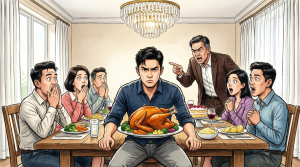
My mother did what she always did when the temperature rose: she lowered her eyes to her plate, as if mashed potatoes could hide her from conflict. My sister Jenna leaned back in her chair, one elbow propped, lips curling into that satisfied little smile she wore whenever she watched someone else take the hit.
All because I refused to cosign a $220,000 loan for Jenna’s latest “brilliant venture”—a boutique she insisted would finally make her independent.
Independent.
I’d heard that word from her before. I’d watched it turn into debt, into excuses, into emergencies that somehow found their way to my phone at 2:00 a.m. I’d watched it become a family group text titled “URGENT” and then my own bank account bleeding out to keep her fantasy alive for another month.
Dad didn’t ask me to cosign. He demanded it, the way he demanded everything from me when it came to Jenna.
“Just sign it, Michael,” he’d said earlier that week, phone pressed to his ear, voice already impatient. “Family supports each other.”
Not like this, I’d told him. Calmly. Carefully. Like I was defusing a bomb.
Because that’s what my life had become—talking my own family down from explosions they set on purpose.
“Not like this,” I’d said. “I’m not attaching my name to a loan bigger than most people’s mortgages for a business plan that’s basically an Instagram mood board.”
Silence on the line. The kind of silence that means you’ve committed a crime.
Then the storm.
Dad’s voice had turned sharp and ugly. “After all we’ve done for you.”
Done for me.
Even now, sitting there with the smell of barbecue and lemon cake in the air, I almost laughed at the absurdity of it. My mind flashed through receipts the way some people flash through childhood photos—except mine weren’t vacations or birthdays. Mine were payments.
The mortgage I covered when Dad “missed a few months” and swore it was temporary. The electric bill I paid when Mom cried and said the lights might get shut off. The transfer I sent when Jenna’s “account got hacked,” then another when her landlord was “being unreasonable,” then another when her credit card “accidentally” maxed out buying inventory for a business that never opened its doors.
And I didn’t even bring it up.
I didn’t list it. I didn’t throw it in their faces. I didn’t remind them that the only reason they were sitting in that dining room at that reunion table with food and alcohol and the illusion of stability was because I’d quietly kept the whole structure from collapsing.
I just sat there and listened to my father threaten me like I was an employee who’d failed to deliver.
Jenna’s eyes filled with tears instantly, like she could summon them on command. That was her gift—turning herself into a victim so fast you’d forget who was bleeding.
“You never cared about me,” she said, voice quivering, chin trembling in practiced agony. “You never supported me.”
Mom, without looking up, murmured, “Michael, please. She’s your sister.”
Of course she was.
The sister who partied through college while I worked two jobs and studied at night with a borrowed laptop. The sister who crashed her car and called me crying from the side of the road because Dad refused to “deal with it,” and I paid the repairs because I didn’t want her driving something unsafe. The sister who took and took and took, then called it love when I gave.
I looked around the table at my family—my blood, my history, my obligation—and for the first time it hit me with perfect clarity.
They didn’t see me as family.
They saw me as a resource.
A wallet with a heartbeat. A safety net with a social security number. A problem solver they could threaten into compliance.
So when Dad stood up at the reunion and announced, loud enough for relatives and neighbors and anyone in earshot, “Vacation is off. Expect a visit from our lawyer,” it didn’t shock me.
It was just the final act of a tired play I’d been starring in since I was old enough to understand what a bill was.
And the strangest part?
I didn’t argue.
I didn’t defend myself.
I didn’t plead or bargain or try to make them see me.
I just nodded.
Once.
Like I was accepting the weather.
Then I stood up, pushed my chair in slowly, and walked out of the house.
Behind me, the silence cracked into whispers. Someone said my name. Someone else said, “What happened?” Dad’s voice rose again, demanding attention, demanding control. Jenna let out a dramatic sob. Mom whispered something I couldn’t hear.
I didn’t turn back.
I got into my car, sat there for a moment with my hands on the steering wheel, and felt something unfamiliar spread through my chest.
Not guilt. Not fear.
Relief.
Because when you’ve spent your whole life bracing for impact, there’s a strange peace in finally deciding you won’t stand in the blast zone anymore.
That night, I drove home alone. My apartment was quiet in a way my parents’ house never was—no TV blaring, no tense undercurrents, no footsteps that meant someone needed something. Just the hum of my refrigerator and the faint city noise through the window.
I didn’t pour a drink. I didn’t call a friend. I didn’t even sit down right away.
I went to my desk and opened a folder I’d kept for years. A plain folder, nothing dramatic. Inside were printouts and screenshots and old bank statements I’d saved in moments when a small voice inside me said, You might need this someday.
I’d always ignored that voice, because admitting I might need evidence against my own family felt like betrayal.
But evidence doesn’t become necessary in healthy families. That’s the point.
I opened my laptop and logged into my banking app.
I looked at the accounts.
Not just mine—because mine were simple.
I looked at the accounts my name was tied to because every time there’d been an “emergency,” every time the bank had demanded a cosigner, every time my father’s pride had clashed with his desperation, he’d come to me with that same line: “Just put your name on it temporarily. We’ll handle it.”
Temporarily had lasted eight years.
There was one account in particular—a family “household” account Dad had insisted I help set up after he’d missed payments and nearly lost the house. He’d framed it like responsibility. Like teamwork. Like something noble.
“We’ll all contribute,” he’d said. “You’re just better with money, Mike. You can manage it.”
Manage it had become fund it.
My name wasn’t just on it. I was the primary account holder.
Because when the bank asked who had the stable income, the credit score, the clean record, Dad looked at me and said, “Well, obviously Michael.”
Like it was a compliment.
I clicked through the settings, fingers steady, heart quiet.
Freeze authorized transfers.
Remove linked debit cards.
Restrict withdrawals.
Flag suspicious activity.
Then I made one call—short, professional—to the bank’s fraud and account security line. I didn’t lie. I didn’t invent a story. I simply said I needed to temporarily lock down an account due to concerns about unauthorized transactions and potential coercion. I answered their verification questions. They confirmed my authority.
And then, with one final click, I pressed confirm.
The next morning, they woke up to frozen accounts.
I didn’t do it for revenge.
Not really.
I did it because I knew exactly what would happen if I didn’t.
Within hours of my refusal, Jenna would spin another crisis. Dad would push harder. Mom would cry. They’d find a way to get the money with or without my signature. They’d drain whatever they could reach. They’d call it family and leave me holding the consequences.
Freezing the accounts wasn’t cruelty.
It was a boundary, finally given teeth.
I slept that night more deeply than I had in years.
The first call came at 7:15 a.m.
Dad’s number.
I watched it ring until it stopped. Ten seconds later, another call. Then another. It was almost comical—like he was trying to break my phone through sheer repetition.
I didn’t answer.
I made coffee instead.
The smell filled my kitchen, warm and grounding. I took my time. I watched the steam curl up like a quiet promise.
At 8:00 a.m., my work email lit up.
An email from Mom.
Subject line: How could you?
I opened it out of morbid curiosity.
Michael, please. This is a misunderstanding. Your father is upset, but we can fix this. Just call us. Please fix this.
Fix this.
That was what I always did.
I’d been fixing things since I was thirteen, when Dad lost his temper at the landlord and we nearly got evicted, and I quietly took over the job of making sure rent was paid on time. Since I was seventeen, when Jenna “forgot” her tuition deadline and Mom sobbed at the kitchen table, and I emptied my savings from my summer job to cover it. Since I was twenty-five, when Dad’s back injury turned into “I can’t work right now,” which turned into “We’re behind,” which turned into my credit score becoming the family life raft.
I closed the email without replying.
By noon, they were desperate.
Another email, this time from Jenna.
You’ve ruined everything. My boutique is dead because of you. They won’t even let me touch the money.
I stared at her words and felt a strange, almost detached clarity.
No, Jenna.
Your boutique was dead because it was always a fantasy.
A fantasy built on my labor and my anxiety and my refusal to say no.
But it didn’t stop.
At 3:00 p.m., Dad texted:
I don’t know what you did, but undo it now or you’ll see consequences.
Consequences.
The word would’ve made me sweat a year ago. It would’ve triggered the old reflex—panic, guilt, rushing to smooth it over.
Now it just made me tired.
By evening, the family group chat looked like a war zone.
Mom: Michael please talk to us.
Jenna: He’s a traitor. He’s always hated me.
Dad: You’ve crossed a line, boy. This is family.
Family.
They used that word like a weapon. Like a spell. Like if they said it enough, it would transform their demands into moral duty.
At 7:00 p.m., someone banged on my front door.
Three solid knocks, heavy and impatient.
I didn’t need the peephole.
I opened the door and there they were.
Dad in front, face twisted with rage, shoulders squared like he’d come ready for battle. Mom just behind him, eyes already wet, hands wringing each other. Jenna to the side, mascara smudged, mouth tight, looking like she’d been dragged here kicking and screaming—until she spotted me and her eyes sharpened into accusation.
Dad shoved past me into my living room without invitation, like my space still belonged to him.
“You’ve gone too far,” he shouted, slamming his hand on my kitchen counter hard enough to make the salt shaker jump. “What the hell did you do?”
Mom stepped forward, voice trembling. “Michael, please. Just… just fix this.”
Fix what? I wanted to say. Fix the fact that you can’t control me?
I let the door close behind them, calm as I could manage. “You’re not here to talk,” I said. “You’re here to demand. So let’s not pretend.”
Jenna’s voice shot through the room like a bullet. “You ruined everything!”
“I stopped being used,” I replied.
“You froze our money!” Dad roared. “That’s not your money!”
I looked at him. Really looked.
The gray in his hair was thicker than it used to be. The lines around his eyes deeper. But the entitlement was exactly the same, as if age had only made his certainty more rigid.
“Those accounts are in my name,” I said evenly. “Because you insisted they had to be. Remember? When the bank wouldn’t approve anything without me.”
Dad’s jaw clenched. “Family doesn’t do this to each other.”
I laughed.
I didn’t plan to. It just came out—short, sharp, almost disbelieving.
“Family?” I repeated. “You’ve dragged me into your messes for years. You’ve threatened me tonight over a loan for Jenna. And now that I said no, suddenly I’m not family? Interesting.”
“Stop being dramatic,” Jenna snapped, voice rising as if volume could rewrite reality. “I’m your sister.”
“A sister who has taken thousands from me,” I said, and my voice stayed cold. “A father who turned me into his personal bank. A mother who only speaks up when she wants to guilt me.”
Mom flinched. “That’s not fair—”
“Isn’t it?” I cut in, still calm. “When was the last time you called to ask how I was doing? Not what I could do. Not what I could pay. Just… how I was.”
Mom’s mouth opened, then closed.
Dad stepped closer until he was too close. I could smell cheap whiskey on his breath. His eyes were wild with the kind of anger that always preceded a demand.
“You have one chance,” he said low, dangerous. “Unfreeze the accounts. Or I hope you realize the impact of your actions.”
“Or what?” I whispered, leaning in just slightly. “You’ll threaten me? You’ll cut me off? From what? Your love? Your approval? Dad, you’ve been charging me for that my whole life.”
His face twitched, like he wanted to hit me. For a second, I saw the old pattern—the intimidation, the fear, the way I’d learned to shrink so he could feel big.
But I didn’t shrink.
I pulled out my phone, opened my banking app, and turned the screen toward them.
Frozen accounts. Locked transfers. Disabled cards.
“If you believe I owe you,” I said, “we can resolve it legally. That’s what you threatened, isn’t it? A lawyer.”
Dad’s mouth opened, then closed. He looked, for the first time, uncertain.
Jenna’s voice cracked. “I told you he never cared.”
I didn’t even glance at her. I walked to my desk, opened a drawer, and pulled out the folder.
“You want to know how much I’ve done for this family?” I asked, flipping it open. “Let’s start with the mortgage.”
I slapped down a printout on the counter.
Dad’s eyes flicked to it and then away, like he couldn’t bear to look.
“The electric bills,” I continued, placing another sheet down. “Internet. Groceries. Car payments for you, Jenna. Medical bill when Dad ‘forgot’ to pay the deductible. All me.”
Dad’s face drained of color. “You’re lying,” he said, but his voice had lost power.
“Am I?” I asked, and slid down another stack—screenshots of transfers, texts from Jenna asking for “just a little extra,” emails from Mom saying “please, it’s urgent,” every single one of them ending the same way: with my money leaving my account.
Mom’s hands shook. “Michael…” she whispered, like she’d just realized the weight of the truth.
“I’m done,” I said. Not loud. Just final. “I’m done being your safety net. I’m done being the one you call when your lies fall apart.”
Dad’s anger returned in a desperate surge. “You ungrateful—”
“Get out,” I said, opening my front door.
The cold air rushed in, sharp and clean.
Dad stared at the open doorway, fists clenching and unclenching. A split-second decision flashed across his eyes—fight or retreat.
Maybe he remembered that without me, his house of cards crumbled.
Maybe he realized I wasn’t bluffing.
Mom tried one last time, tears spilling. “We can talk. Please.”
“Not tonight,” I said. “Not like this.”
Jenna muttered something under her breath, cruel and childish. Dad turned on his heel and stormed out. Mom followed, sobbing quietly. Jenna lingered just long enough to glare at me like I’d stolen something from her.
Then she left too, slamming the door hard enough to make the picture frame in my hallway shake.
I stood there in the sudden quiet, listening to their voices fading down the stairs—Jenna’s sobs, Dad’s angry muttering, Mom’s helpless whispers.
I didn’t feel triumphant.
I didn’t feel free.
Not yet.
But I did feel something I hadn’t felt in a long time.
Space.
The next day, Dad texted again, shorter this time.
We’re coming tonight. 6 p.m. We’re sorting this out like adults.
I almost laughed at the phrasing.
Like adults.
As if adult meant “you do what I say.”
Still, I knew if I ignored them entirely, they’d escalate. They’d show up at my workplace. They’d call my friends. They’d spin stories to relatives. They’d play the victim until someone pressured me to “just fix it.”
So I made a decision.
If they wanted an adult conversation, I’d give them one.
But not the conversation they expected.
I didn’t dress up. Jeans, black T-shirt. No performance. No attempt to look like the obedient son.
At 5:45 p.m., I opened my laptop and checked everything one last time.
The recordings were saved in two places.
The receipts were organized.
The legal documents were ready.
Because while my family had always relied on emotion and intimidation, I’d learned to rely on proof.
I wasn’t born that way. I became that way after too many nights of being told I was remembering things wrong, too many arguments where Dad said, “You’re exaggerating,” and Jenna cried and Mom said, “He didn’t mean it,” and suddenly I was the villain for naming what they did………………………

