The voicemail was only fourteen seconds long, but it split my life into a before and an after.
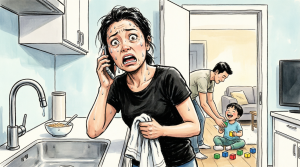
It came in on a Tuesday morning while I was rinsing cereal bowls in the sink. My phone buzzed across the counter, lighting up with my dad’s name. For a second I thought maybe he’d pocket–dialed me. We hadn’t spoken much in weeks, not since the last argument about money. I wiped my hands on a dish towel and picked up the phone just as the call went to missed.
Then the little red dot appeared.
New voicemail.
I tapped it and pressed the speaker to my ear, half–distracted, thinking it would be something mundane.
It wasn’t.
“You and that child of yours are no longer part of this family.”
That was it. No hi. No hesitation. His voice was flat, businesslike, as if he were canceling a subscription or closing a bank account.
I stood there with my fingers still wet, dish towel balled in one hand, and listened to it again, just to be sure I’d heard it right. The words hit somewhere below my ribs, cool and sharp, but it wasn’t the shock I expected. It was more like confirmation of something I’d been bracing for since the day my son was born and my father looked at the tiny bundle in my arms and said, “So this is the mistake we’re all supposed to pretend is a blessing.”
In the living room, my son laughed at something on the TV, his small voice cutting through the static hiss of the voicemail as it replayed. I watched him from the kitchen doorway, his socks mismatched, cereal smeared across his cheek. My husband was crouched beside him, tying his shoes, saying something about a spelling test.
My father’s voice droned again from my phone. “You and that child of yours are no longer part of this family.”
I didn’t cry. I thought I might. Instead, a strange quiet settled inside me, like someone had finally turned off a humming appliance I’d learned to tune out years ago.
I opened the text thread with my dad. There were months of messages in there: reminders from me about bills, his short responses, the occasional guilt–wrapped request for help. I stared at his last text—something about my sister’s rent being late—and then I typed one word.
Copy.
I stared at the word for a long moment, my thumb hovering above the screen as if there might still be time to say something different. To argue. To beg. To ask him why. To remind him of all the times I’d bailed them out, all the emergencies I’d padded for them with my own savings.
But there was nothing left to argue about.
I hit send.
The three dots never appeared. No reply. The message just sat there in the thread, a small, hard period at the end of a very long sentence.
My husband walked into the kitchen. “Hey, you okay? You look like you saw a ghost.”
I locked the phone and set it face–down on the counter. “I’m fine,” I lied automatically. “Just thinking about some bills.”
Which, technically, wasn’t a lie. I rinsed the last bowl, loaded the dishwasher, made sure my son’s backpack had the permission slip for his field trip. It was easier to move on autopilot. Easier to focus on the morning routine than the echo still ringing in my ears.
You and that child…
On the way out the door, my husband kissed my cheek. “Text me if you need anything.”
I nodded, my hand resting briefly on his wrist. “Drive safe. Love you.”
My son wrapped his arms around my waist. “Bye, Mom!”
“Love you. Have a good day,” I said, smoothing down his hair. “Don’t forget your lunch.”
The door closed behind them, and the apartment fell quiet. The kind of quiet that feels heavy.
I picked my phone back up, opened my banking app, and stared at the list of accounts.
I had kept my name on those accounts for far too long—joint accounts with my parents, “family cards” I’d opened when I landed my first good job, savings accounts that had slowly turned into community property because I was the “responsible one.” For years I’d told myself I was just helping them get on their feet. That family was messy and complicated and that I, as the “stable” adult, needed to be the one to hold it all together.
But I heard my father’s voice again, clear and clinical. “You and that child of yours are no longer part of this family.”
Fine, I thought. Then I won’t be your safety net, either.
I grabbed my keys, slipped my shoes on, and drove straight to the bank.
The branch was almost empty, a few people in line, a bored-looking teller clicking her pen. The air smelled faintly like coffee and printer ink. I sat down across from a banker in a navy blazer, a younger woman with a polite, professional smile and tired eyes. Her name tag said Lauren.
“How can I help you today?” she asked.
I slid my ID and debit card across the desk. “I need to remove my name from every joint account I have with my parents and my sister,” I said. My voice sounded calm, even to me. “And I’d like to close any account where I’m the primary and they’re authorized users.”
She blinked, fingers pausing on her keyboard. “All right,” she said slowly. “That’s… a lot of accounts. Are you sure? Sometimes it’s easier to—”
“I’m sure,” I said, maybe a little too quickly. “I should’ve done this a long time ago.”
She studied me for a second, something softening in her expression. “Okay. Let’s go through them one by one.”
We started with the “family travel fund” my dad was so proud of when we opened it. He’d made a whole speech about how we’d finally start taking vacations together, how this was us “acting like a real family.” In reality, I was the only one who’d ever deposited anything into it. The balance was embarrassingly low, because any time there was a minor emergency—a car repair, a late bill, a “temporary cash flow problem”—my dad would suggest, with faux reluctance, that we dip into the travel fund. It had never once been used for travel.
“Close it,” I told Lauren. “Transfer the balance to my personal savings.”
Next was the emergency fund I’d opened after my grandmother died. She’d left me a small inheritance—nothing life–changing, but enough to feel like a cushion. I’d used part of it to create a safety net for the family. “This is just in case,” I had said at the time, sitting at the kitchen table with my parents. “For medical stuff or real emergencies.”
Two months later, my dad drained half of it to pay off a gambling debt and called it a “miscommunication.” He did it again a year after that.
“Remove their access,” I said now. “And lock this with my name only.”
We pulled up the joint credit card—the one my sister had treated like a bottomless well. The transaction history read like a diary of her worst impulses: salon visits, rideshares, concert tickets, brunches, spur–of–the–moment clothing hauls at 2 a.m., entire months where the only charges were food delivery and beauty products.
“She’s an authorized user here,” Lauren said, tilting the screen. “Do you want to—”
“Cancel her card,” I cut in. “Immediately. And close the account once the balance is paid. I’ll make a payment today.”
I remembered Christmases where she’d bragged about how generous she was with gifts, knowing full well those purchases were hitting my credit score, not hers. I remembered our dad patting her shoulder and saying, “She just wants to feel included; don’t be so rigid.” I remembered my mom’s quiet, “It’s just money,” whenever I brought up the growing balance.
We kept going. Account after account. Frozen, closed, transferred.
By the time we were done, my signature had cramped into something barely legible.
“So,” Lauren said gently, printing one last form, “no one else will have access to any of these anymore. You understand they’ll notice soon. There might be… fallout.”
“Oh,” I said, a bitter little laugh escaping before I could stop it. “They already started that part.”
It took them three days to notice.
First, my sister called six times in a row. I watched the screen light up over and over, my thumb hovering above Decline until the calls finally stopped. Then came the text messages.
What did you do?
My rent payment bounced.
My card isn’t working.
This isn’t funny.
There were more—angrier, all-caps ones—but I stopped reading. I muted the thread and set the phone on the coffee table.
My son was sprawled on the floor, coloring. “Mom, how do you spell ‘dragon’ again?” he asked, tongue sticking out the corner of his mouth.
“D-R-A-G-O-N,” I said, forcing my voice to be light. “Why, are you drawing one?”
“Yeah. He’s protecting the treasure,” he said proudly.
I watched the crayon move across the paper, his small hand certain and unbothered. I thought about how many years I had spent as someone else’s treasure—maybe not loved, but definitely hoarded and exploited, the dependable resource everyone came back to when they’d burned through their own options.
My phone buzzed again, vibrating against the wood.
“Is that Grandma?” my son asked absently.
I swallowed. “No, baby. Just spam.”
That night, around ten, someone pounded on the front door hard enough to rattle the chain.
My husband and I exchanged a look. He turned down the TV, muting the late–night host mid–joke. Our son was already asleep in his room, soft snores coming through the cracked door.
The pounding came again, accompanied by a shrill voice. “Open the door! I know you’re in there!”
My sister.
I crept to the peephole, careful not to let the floorboards groan, and looked out. She stood on the porch in slippers and an oversized hoodie that definitely didn’t belong to her, hair twisted up into a messy bun like she’d thrown herself together in a hurry. She was pacing, gesturing wildly with her phone in one hand.
“I’ll call the cops!” she shouted toward the door. “You can’t just steal from people! I’ll sue you, do you hear me? You can’t do this to family!”
My husband came up behind me silently, resting his hand on my back. “Don’t,” he whispered. “Don’t open it.”
I wasn’t planning to. A few years ago, I would’ve. I would’ve let her in, made her tea, listened to her cry and curse and twist history until somehow the blame landed on my shoulders again. I would’ve apologized just to keep the peace.
I stood there with my eye pressed to the peephole, watching her rage in the hallway while my son slept peacefully a few steps away. I let her words wash over me like static. Eventually she punched the door one last time, screamed something about how ungrateful I was, and stormed off.
I stayed where I was long after her footsteps faded.
“You okay?” my husband murmured.
I nodded, even though he couldn’t see my face. “Yeah,” I said softly. “I’m just… done.”
He drew me away from the door, into the living room. We sat on the couch in the dim light, the muted TV flickering in front of us. After a while he said, “You know she’ll spin this however she wants.”
“I know,” I said. “They all will.”
The next day, my aunt called. I hadn’t spoken to her in a year, not since she’d taken my parents’ side in yet another fight about “respect” and “how I talked to my father.”
“Is it true?” she demanded as soon as I answered.
“Is what true?” I asked, though I already knew.
“That you stole thousands of dollars from your sister and then cut off the whole family? That you’re acting like some kind of… queen?”
I closed my eyes. “I didn’t steal anything.”
“She says you emptied the accounts,” my aunt continued. “Your mother says you’re abandoning them when they need you most. After everything they’ve done for you.”
I almost laughed. It came out as a sharp exhale. “Okay,” I said. “If that’s what they want to believe, I’m not arguing.”
“You’re really just going to throw your family away like that?” my aunt pressed. “Over money?”
Over money.
Sure. That was the story they would tell. Not over years of manipulation, not over being treated like a walking ATM, not over the way my father flinched when my son hugged him and called him Grandpa. No, if you asked them, it was about money.
“I have to go,” I said. “Please don’t call me about this again.”
She made a disbelieving sound. “You’ll regret this one day. Blood is blood.”
Then she hung up.
I stared at the blank call screen for a second, then tossed the phone onto the couch. It buzzed a few more times—texts, probably—but I ignored them.
I didn’t talk to my mother at all. She didn’t call. She never called when she knew she’d been caught in one of her quiet manipulations. Her damage was always subtle, filtered through other people. She’d plant ideas like seeds, then stand back and wring her hands when they grew into thorny, choking vines.
My dad, on the other hand, went nuclear.
I found out later that he had called my workplace. Not once, but twice.
“He said he was your father,” my boss told me, closing his office door behind me. “Said he was worried about your mental health, that there might be… issues with integrity.” He winced, clearly uncomfortable. “He insinuated you might be stealing. From us.”
For a moment, my lungs forgot how to work.
“What?” I croaked.
“I told him if he had concerns, he should speak to you, or HR,” my boss said firmly. “We’ve worked together for five years. I know your work. I know your character. I told him that as far as we’re concerned, you’re in good standing.”
I swallowed hard, my cheeks burning with a mix of humiliation and rage.
“I’m sorry,” my boss added gently. “I wouldn’t have even mentioned it if I didn’t think it might be part of something… bigger.”
I gave a short, humorless laugh. “Oh, it’s bigger,” I said. “You have no idea.”
He didn’t ask for details, and I didn’t offer any. I walked back to my desk, sat down, and stared at my computer screen until the lines of text blurred.
Despite everything—the accusations, the lies, the campaign to paint me as some kind of unhinged thief—I still didn’t pick up the phone. I didn’t defend myself. I didn’t send long texts explaining my side. I didn’t beg them to see reason.
They’d already decided who I was in their story.
Fighting over the script wouldn’t change the ending.
Instead, I waited.
Because people like them always overplay their hand. Always.
Two weeks passed.
The calls and texts slowed, then shifted from fury to weaponized silence. The family group chat went quiet in my direction but hummed with activity between them. Photos of my sister at brunch. Updates on my dad’s knee surgery recovery. Vague, cryptic posts on social media about “betrayal” and “some people only being around when it benefits them.”
I muted it all and focused on my own tiny universe: work, home, my husband’s tired but patient smile, my son’s school projects and bedtime stories.
One afternoon, my son came home waving a crumpled sheet of paper.
“Look what I drew!” he said, beaming.
I unfolded it, expecting a dragon or a spaceship.
It was a family portrait. Stick figures, bright colors, wide smiles. There was him in the center, his messy hair and big shoes. There was my husband next to him, tall with a rectangular jaw. There was me on the other side in a dress, long scribbled hair and a pink smile.
And off to the side were three more stick figures, each with a big, red X drawn over them.
My stomach tightened. “Hey, buddy,” I said gently. “Who are these ones?”
He didn’t even look up from kicking off his sneakers. “Those are the people who said they don’t love us anymore,” he said, as if it were the most obvious thing in the world.
I blinked hard. “Who told you that?”
He shrugged. “You said Grandpa doesn’t want to talk to us. And Auntie said on the phone that we’re not her family if you’re stealing. So I made them go away.”
I remembered that day—how I had scrambled in the kitchen, trying to distract him when my sister’s voice had come shrieking out of the speaker. I thought he was too busy building Lego towers to really absorb what was being said.
Children always absorb more than you think.
I forced a smile and pulled him into a hug. “I’m sorry they made you feel that way,” I said into his hair. “But you know what? We have our own family right here.”
He nodded against my shoulder, then wriggled free to ask about a snack.
Later that night, after he went to bed, I folded the drawing carefully and slipped it into the back of my dresser drawer. It felt like a document. Evidence. Proof of the damage they’d done even from a distance.
I sat on the edge of the bed with that folded paper in my hand and realized something: my father’s voicemail had hurt, but my son’s matter–of–fact explanation of those red X’s had gone deeper.
It was one thing for my parents to dissect me. I was used to that. It was another to have them carve up my child in the process.
The accident happened on another Tuesday.
By then I had stopped answering unknown numbers. Too many phone calls had come from blocked or unfamiliar lines, all of them carrying some variation of the same poison. Debt collectors pretending to be concerned relatives. Cousins I barely knew trying to guilt me into “making things right” with my parents.
When my phone buzzed with an unrecognizable number from two towns over, I almost let it go to voicemail. My thumb hovered over the screen, ready to ignore it.
Something in my chest whispered, pick up.
I did.
“Hello?”
“Is this…” The voice on the other end mispronounced my last name. “Is this the daughter of—” and then my father’s full name.
My pulse spiked. “Yes,” I said slowly.
“This is the emergency department at County General,” the caller said. Her voice was professional, steady. “Your father and your sister were in a car accident. You’re listed as the emergency contact.”
Of course I was. Even after being disowned, they still had my number down for emergencies. I almost laughed.
“What happened?” I asked, my throat suddenly dry.
“There was a collision at an intersection,” she said. “A driver ran a red light and struck their vehicle from the side. Your father has multiple broken ribs and some internal bruising. Your sister has a concussion and a broken wrist. They’ve both been admitted for observation and treatment. We need someone to authorize certain procedures and discuss payment arrangements.”
The words blurred. All I really heard was car accident and broken.
“I’ll be there as soon as I can,” I said.
“Take your time, but the sooner the better,” she replied. “Ask for me at the front desk. My name is Karen.”
I hung up and stared at the wall for a beat, my thoughts racing in disjointed flashes. My dad’s voicemail. My sister’s screaming in the hallway. My son’s drawing.
Then I got up and started moving.
My husband found me in the hall, pulling on my shoes with shaking hands.
“What’s wrong?” he asked, eyes wide.
I told him in clipped sentences. Car accident. Hospital. Broken ribs. Concussion.
His face softened with something like resignation and concern woven together. “Do you want me to come with you?” he asked.
“You have to stay with him,” I said, nodding toward our son’s room. “Someone has to get him to school in the morning.”
“We can find a sitter,” he offered immediately. “Or I can call in—”
“It’s fine,” I said, shaking my head. “I’ll… I’ll text you when I know more.”
He stepped closer and put his hands on my shoulders. “Are you sure you want to go?”
The question hung there, heavy. Was I obligated? After what my father had said? After what they’d done? After all the times they’d used me and discarded me?………………………….
Click Here to continuous Read Full Ending Story👉PART 2- “‘You’re No Longer Family’—So I Texted ‘Copy’ and Walked Away”

