My daughter told me the cottage had a mold problem. For four years, she said it wasn’t safe for me to visit, that the air would trigger my lungs, that I’d only suffer if I came. I believed her. I trusted her completely.
My name is Margaret Welllet. I’m sixty-four, a retired French immersion teacher from Thunder Bay. My life used to be simple in the way that feels safe—morning walks by the lake, quiet afternoons tending herbs, evenings filled with familiar routines. I thought that was what growing older meant. Stability. Peace.
Then everything changed.
My daughter, Renee, called less often. When she did, her voice was always warm, but careful. Measured. Every time I asked about visiting the cottage she owned along the Cabot Trail, she gave me the same gentle answer.
“Not yet, Mom. The mold isn’t gone. You’d be miserable.”
So I waited.
I sent food. Cards. Messages. I told myself she was busy. That good mothers don’t question too much. That love sometimes means giving space.
Then the phone rang.
A lawyer. An accident. A transport truck on an icy road. Both Renee and her husband, Thomas… gone.
Grief doesn’t arrive all at once. It comes in waves that don’t ask permission. I remember sitting on my kitchen floor after the call, staring at nothing, listening to the hum of the refrigerator as if the world hadn’t just ended.
Three days later, the lawyer handed me a key.
“She wanted you to have the cottage,” she said.
I remember the first thought that came to me.
She never let me see it.
The key sat on my counter for nearly two weeks. I walked past it every day, pretending I wasn’t afraid of what it meant. But eventually, grief becomes louder than fear.
So I went.
The drive along the Cabot Trail was quiet and cold, the ocean appearing and disappearing between the trees like something alive. I had imagined a neglected place, rotting from years of damage.
But the cottage was… perfect.
Repaired. Maintained. Alive.
There was no mold.
Not even a trace.
That’s when something inside me shifted.
Renee had lied.
Inside, the air felt wrong.
Not dirty.
Not damp.
Clean.
Too clean.
Sterile, like a place that wasn’t meant for living.
The rooms were bare. Functional. No photos. No signs of comfort. It didn’t feel like a home. It felt like a place with a purpose.
I followed a hallway to a door labeled “Storage” in Renee’s handwriting.
My hands trembled as I unlocked it.
The light flickered on.
And I stopped breathing.
It wasn’t a storage room.
It was a laboratory.
Shelves filled with samples. Equipment still running. Screens blinking quietly. The entire space humming with life that had nothing to do with warmth or family.
I stepped closer, drawn and terrified at the same time.
Every container was labeled.
Dates. Coordinates.
And one word, written again and again:
Airborne.
I opened a binder.
Charts. Chemical readings. Notes in Renee’s precise handwriting.
Then photographs.
The ocean near the cottage—discolored, unnatural.
Another page.
A sentence underlined twice:
“Contamination spreading inland faster than projected.”
My chest tightened.
This wasn’t mold.
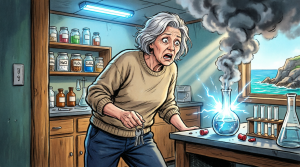
Then I saw the recorder.
I pressed play.
Static.
Then her voice.
“Mom… if you’re hearing this, I didn’t get the chance to explain.”
I sank into a chair, my heart already breaking all over again.
“I’m sorry I kept you away. I know it hurt you. But I needed you safe.”
Tears blurred everything.
“There’s something in the air here. Something no one wants to acknowledge. We reported it. No one listened. So we kept working. Quietly.”
Her voice trembled, just slightly.
“If something happens to us… I need you to continue this.”
Continue.
I shook my head, whispering, “Renee…”
“Don’t sell the cottage,” she said. “It’s not just a home. It’s evidence.”
Silence filled the room.
Then her voice softened in a way I hadn’t heard in years.
“I missed you. Every single day. But loving you meant keeping you away.”
The recording ended.
I sat there for a long time.
Long enough to understand what she had done.
She hadn’t shut me out.
She had protected me.
Outside, the wind from the ocean cut through my coat, sharp and real. I looked back at the cottage, at the place I had almost sold without ever knowing the truth.
This wasn’t something to walk away from.
This was something she had trusted me to finish.
I went back inside, picked up the folder marked in red, and found the name she had left for me.
My hands were steady now.
Not because I wasn’t afraid.
But because I finally understood.
I dialed the number.
Held the phone to my ear.
And as it rang, I looked out at the ocean that no longer felt peaceful.
“I’m Margaret Welllet,” I said when someone answered. “I think my daughter was trying to show the world something. And I’m ready to help finish what she started.”
Some inheritances aren’t meant to be kept.
They’re meant to be carried.
And this one… was never about a cottage at all.

