I still remember the Miami trip the way some people remember the exact second a car skids toward them on black ice. One moment, everything feels ordinary. The next, your whole body knows life is about to split into before and after.
At the time, I was thirty-nine, living in Chicago, and working long days for a construction firm that had convinced itself every deadline was a life-or-death emergency. I had learned to survive on coffee, airport food, and silence, which was fitting, because silence was also what had ended my marriage.
Rachel Adams had been my wife for eleven years. For almost three years after the divorce, she was also the person I trained myself not to think about when the apartment felt too quiet or when I saw a woman in a grocery store reach for the same brand of tea she used to buy.
Our marriage hadn’t ended in betrayal. There had been no slammed doors, no shattered dishes, no courtroom war over who ruined what. It ended the way a house settles into the ground—slowly, invisibly, until one day the cracks are too wide to ignore.
We were exhausted by then, both of us. Tired of trying to say the right thing, tired of disappointing each other, and most of all, tired of the grief that lived between us every time the subject of children came up and then quietly died again.
We signed the divorce papers with the numb politeness of two people handling a funeral bill. She moved to Florida and built a career in resort management. I stayed in Chicago and buried myself in work so thoroughly that my coworkers probably thought I had been born in a hard hat.
For nearly three years, we had no contact. No holiday messages, no accidental check-ins, not even one of those weak “hope you’re doing well” texts people send when they are lonely and pretending they aren’t.
Then Miami happened.
I had flown in for a four-day site inspection on a hotel renovation project near the coast. By the third night, I was tired, sticky from the humidity, and too wired to sleep, so I ducked into a quiet bar a few blocks from my hotel just to have one drink and sit somewhere that didn’t smell like paint, concrete, or jet fuel.
The place was dim without being gloomy, the kind of bar designed to make strangers feel reflective. There was low jazz in the background, amber lights over polished wood, and the soft clink of glasses from couples speaking in voices too private to interrupt.
I had just taken my first sip of bourbon when I saw her.
Rachel stood at the far end of the bar, half turned toward the bartender, one hand resting lightly against the counter. Her dark blonde hair fell over one shoulder in a way I recognized instantly, and even before she turned, my chest tightened with that awful certainty the body has before the mind catches up.
Then she looked up.
For one suspended second, neither of us moved. It felt as if the room had gone quiet around us, though I knew it hadn’t. I only knew that the woman who had once been my entire future was standing ten feet away in a pale blue dress, staring at me as if she had just seen a ghost she wasn’t sure she was allowed to speak to.
“Daniel?” she said softly.
My name in her voice hit me harder than the bourbon had. I stood too quickly, nearly knocking my knee against the stool, and managed an awkward smile that felt absurdly small for a moment that big.
“Rachel,” I said. “I didn’t know you were in Miami.”
A strange expression crossed her face, half amusement and half disbelief. “I live in Florida now, remember? Miami isn’t exactly impossible.”
That made me laugh, mostly because I needed something to steady myself. She smiled too, and just like that, the first layer of shock cracked open enough for us to act like two adults and not two people standing in the wreckage of something unfinished.
She moved to my side of the bar, and we took a table near the back where the light was softer. At first we spoke carefully, like people testing the temperature of water before stepping in. Work. Travel. Chicago winters. Florida storms. Neutral territory.
But memory is a dangerous thing when it starts to feel safe again.
Within half an hour, we were laughing about old apartments, terrible vacations, the time I tried to assemble a crib for my sister’s baby shower prize and somehow built the side panel backward twice. Rachel laughed with her whole face, the way she always had, and for a few reckless moments I forgot that there had ever been years between us.
She looked good. Not just beautiful, though she was that in a way that hurt to look at directly, but self-contained. Stronger, somehow. There was a steadiness in her that hadn’t been there at the end of our marriage, when we had both been worn thin by disappointment and the kind of quiet sorrow that doesn’t leave bruises but still destroys things.
“You seem different,” I said at one point, before I could stop myself.
She tilted her head slightly. “So do you.”
I let out a breath through my nose. “That sounds like it could mean anything.”
“It does,” she said, smiling faintly. “But I mean it kindly.”
I should have left after one drink. Maybe after two. There was a version of this story where I thanked her for the conversation, wished her well, and returned alone to my hotel room with nothing worse than a restless night and a renewed sense of old regret.
Instead, we stayed.
The bar grew quieter as the night deepened. The crowd thinned, the music softened, and something old and familiar rose between us—not the bright, reckless chemistry of strangers, but the deeper current of two people who already knew each other’s silences.
By midnight, the air inside felt too warm. Rachel glanced toward the windows, where the city lights shimmered against the dark, and then looked back at me with an unreadable expression.
“Where are you staying?” she asked.
I told her the name of the hotel. It was only a few blocks away, high-end enough that my company would complain about the rate later while still billing the client for it anyway.
She nodded once and traced the rim of her glass with one finger. “Do you want to walk by the beach?”
There are invitations that sound casual and mean everything. That was one of them.
We left the bar without touching, but the space between us felt charged. Outside, Miami was humid and alive, the night air thick with salt and traffic and music drifting from places neither of us entered.
The beach was quieter than the city. Waves rolled in with a rhythmic hush, the moonlight breaking on the water in strips of silver, and the sand cool enough under our shoes to make the whole scene feel unreal.
We walked for a while without speaking. Every now and then our arms brushed, and each accidental contact felt deliberate. Finally Rachel stopped and looked out at the ocean, her face turned slightly away from me.
“I didn’t expect this,” she said.
“Running into me?”
“Feeling this normal with you.”
I stared at the water because looking at her felt too dangerous. “It doesn’t feel normal to me.”
That made her turn. “No?”
“It feels like stepping into a room I thought was gone.”
Her expression changed then, the guarded humor fading into something more vulnerable. I had loved that face for more than a decade. I had also failed it more than once, and standing there beside her, I felt the weight of both truths.
“We were never good at timing,” she said quietly.
“No,” I replied. “We were good at missing each other.”
She looked down at the sand and gave a small, sad smile. “That sounds about right.”
The distance between us disappeared slowly, then all at once. A pause. A shared breath. The kind of silence that becomes its own language when two people already know how to hear each other inside it.
When I kissed her, she didn’t hesitate.
It wasn’t wild or drunken or careless. It was worse than that. It was familiar. Her mouth, the shape of her hand on my shoulder, the way she leaned into me as if some part of her had remembered this even when the rest of her had learned how to live without it.
She came back to my hotel with me, and neither of us insulted the moment by naming it something it wasn’t. We did not promise anything. We did not pretend the past had been repaired by one walk on the beach and one night in a hotel room.
We simply let the loneliness between us break.
The next morning I woke later than I meant to. Sunlight cut through the curtains in long white bands, bright enough to make me squint. For a second, I had that disoriented feeling of forgetting where I was, until I turned and saw Rachel standing by the window.
She was wearing my white shirt. Her bare legs caught the morning light, and her hair was loose over her shoulders, and the sight of her there—so intimate, so impossible—made my chest ache with a tenderness I had no right to feel so quickly.
She glanced back at me, and for one second, there was a softness in her expression that belonged to another life. “You’re awake,” she said.
“Apparently,” I muttered, pushing myself upright.
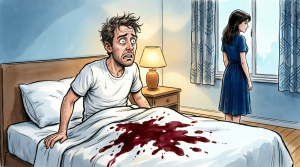
I swung my legs over the side of the bed and stood. Then I looked down.
The stain on the sheet was small, but unmistakable. A deep red smear against the white hotel linen, not dramatic enough to look violent, but more than enough to stop my breath cold.
For a second, my brain refused to process it. I simply stared.
Then I looked at Rachel.
She followed my gaze, and I saw the exact moment she understood what I had seen. Every trace of softness vanished from her face. Her shoulders tightened. The air in the room changed instantly, as if someone had opened a door and let winter in.
“It’s nothing,” she said too quickly.
I didn’t move. “Rachel.”
“It’s fine.”
“That doesn’t look fine.”
She folded her arms across her body, not defensively exactly, but as if she were physically holding herself together. “It’s an old medical issue. That’s all.”
A cold pressure settled behind my ribs. During our marriage, medical conversations had never been simple for us. They had always led somewhere painful—fertility tests, specialist appointments, percentages, false hope, and the devastating cheerfulness of doctors trying to sound encouraging while delivering disappointment.
“What kind of medical issue?” I asked.
Her eyes flicked up to mine and then away. “Irregular bleeding.”
I took a step toward her before realizing how tense she had become. I stopped immediately. “Rachel, tell me the truth.”
She closed her eyes for a moment, and when she opened them again, I saw something there I had not expected.
Fear.
“It is the truth,” she said, but her voice had that brittle, rehearsed quality people use when they’ve had too much practice saying things they hope won’t lead to more questions. “At least all of it for now.”
“For now?” I repeated.
She looked toward the chair where her dress was folded. “I have to go to work.”
“That’s not an answer.”
“No,” she said quietly, “it’s all I have.”
She dressed quickly, and the speed of it felt almost panicked. I stood there, half angry and half terrified, wanting to push harder and knowing instinctively that if I did, she would shut down completely.
At the door, she paused with her hand on the handle. The sunlight behind her sharpened the edges of her profile, but it did nothing to soften the guarded look in her eyes.
“I’m okay,” she said.
I heard the lie, or at least the unfinished truth, in every syllable. “Rachel—”
“Please,” she interrupted, and that one word stopped me cold. “Not right now.”
Then she left.
I stayed in the room for a long time after the door clicked shut. The hotel air conditioning hummed. Somewhere down the hall, a housekeeping cart rattled past. Everything sounded grotesquely normal, which only made the silence inside my head feel louder.
I kept staring at the sheet.
It wasn’t just the stain. It was the look on her face. The fear. The way her body had gone rigid the moment she realized I had seen it. I knew Rachel well enough to recognize the difference between embarrassment and genuine alarm.
That day, I was useless at work.
I walked the site with a clipboard in my hand and absorbed almost nothing. My project manager asked me three separate questions about a materials delay, and I answered two of them wrong. By late afternoon, I had reread the same email six times and still couldn’t remember what it said.
That night, I texted her.
Are you okay?
She didn’t answer for nearly an hour. When she finally did, the message was painfully brief.
I’m fine. Please don’t worry.
I stared at the screen until it dimmed in my hand. Then I typed, deleted, typed again, and finally sent:
You know I’m going to worry anyway.
Her reply came faster this time.
I know. But I’m okay.
It should have reassured me. It didn’t.
Over the next few days, I tried to keep the contact going without sounding desperate. I asked how work was. She answered politely. I asked if she’d seen a doctor. She ignored that question completely and sent a vague message about being busy.
The formal distance of it unsettled me more than silence would have. Something had happened in that hotel room, and whatever it was, Rachel had decided to carry it alone.
When my trip ended, I flew back to Chicago with the uneasy feeling that I had left something unfinished on a nightstand in Miami and couldn’t name it. The city met me with cold wind, gray streets, and the old routine waiting to swallow me whole.
For a while, I let it.
Work piled up. Meetings blurred. Days passed with the dull efficiency of someone choosing motion over thought. But at night, the image came back without mercy: white sheets, red stain, Rachel’s face going pale with panic before she locked it down.
A month later, I was in my apartment reviewing blueprints at the kitchen counter when my phone rang.
I glanced at the screen and went completely still.
Rachel.
For one irrational second, I only stared. Then I answered so fast I nearly dropped the phone. “Rachel?”
“Daniel,” she said.
Her voice was tight in a way I had never heard before, as if the words were being held together by pure effort. My entire body went alert.
“What happened?”
“I need to see you.”
No greeting. No explanation. Just that.
Every muscle in my back tightened. “Are you okay?”
A pause. I could hear her breathing on the line. “Can you meet me tonight?”
“Yes,” I said immediately. “Tell me where.”
She named a small café near my apartment, one we had never been to together, which somehow made the whole thing feel even more serious. By the time I got there, my pulse was pounding so hard I could feel it in my throat.
She was already seated in the back corner when I walked in.
One look at her nearly stopped me in my tracks. She looked thinner than she had in Miami, paler too. There were shadows under her eyes that makeup hadn’t fully hidden, and her hands were wrapped tightly around a cup of tea she didn’t seem to be drinking.
I sat down across from her, my mouth suddenly dry. “Rachel.”
She looked at me, and whatever I was expecting, it wasn’t the expression on her face. Fear was there, yes. But beneath it was something even more fragile.
Something like hope.
I leaned forward, every nerve in my body straining toward the words I knew were about to change everything.
“What is it?” I asked.
Rachel swallowed hard. Then she lifted her eyes to mine and said, very quietly, “I’m pregnant.”
The world seemed to collapse in on me at that moment, and for a fraction of a second, I wondered if I had somehow misheard her. Pregnant? The word felt so absurdly impossible that my brain rejected it entirely. My mouth went dry, and all the noise of the café—the clink of silverware, the soft hum of conversation—faded into an overwhelming silence.
I stared at her, trying to find the right words, but they didn’t come. Everything inside me screamed for clarity, for something that would make this make sense, but the truth of it hit me like a wave crashing against jagged rocks.
Pregnant.
“Rachel…” I managed to say, though my voice felt strange in my own ears. I reached for the edge of the table, gripping it like a lifeline. “How far along are you?”
She met my gaze, her eyes hollow and tired, and the vulnerability in them nearly took me apart. “Six weeks.”
Six weeks. That was the timeline—the same timeline as that night in Miami. My mind reeled back to that night—the soft, familiar kisses, the closeness that felt like it had never been lost. I couldn’t wrap my head around it. It was impossible and yet, sitting there across from me, Rachel looked both fragile and resolute, as if her soul was pulling her toward something she couldn’t control.
The quiet panic in her eyes told me that this wasn’t a celebration; this wasn’t something she had expected or wanted. The pregnancy, according to Rachel, was high-risk. It wasn’t the first time she had struggled with her health—she had been to specialists, had endured surgeries, and had faced endless warnings that having children might never be in the cards for her.
But now, here she was, in front of me, telling me that she was carrying a child, the child that had seemed so impossible. I wanted to ask a hundred questions, but none of them seemed right. What did this mean for her? For us? Was I even ready for this? Could we even try again? And most terrifying of all, was this baby even going to survive?
The silence between us stretched. I could feel the weight of it, pressing against my chest, suffocating me.
“I’ve been seeing a specialist,” she continued, her voice trembling just slightly. “They’ve told me it’s going to be complicated. I’ve been through tests, scans, and I’m under constant observation. The pregnancy is fragile.”
My head swam with the flood of information. She hadn’t been alone in this. She had known. She had been carrying this burden quietly, making decisions without me. And I hadn’t known any of it. I hadn’t been there.
“You didn’t tell me,” I said, the words coming out sharper than I intended. My own guilt tightened around my chest. “You didn’t tell me any of this.”
Rachel didn’t flinch at my words, though I could see the ache in her eyes. “I didn’t know how. I didn’t know if you’d even care, Daniel. After everything we’ve been through…”
I looked at her, helpless, feeling the space between us stretch in ways I had never wanted. It felt like the mistakes of the past were crashing into the present, and I couldn’t help but see it all, too clearly. The distance between us wasn’t just measured in miles—it was measured in years of silence and decisions made alone. And now, this. This child.
For a long moment, I couldn’t find the words. I thought of that night in Miami again—how we had been so close to something, so close to a reconciliation that never came. I thought of the way Rachel had looked when she left my hotel room, the way she had closed off, never letting me in again.
Now, I wasn’t sure where we stood. But I knew this: I couldn’t walk away. Not now.
“I want to be involved,” I said, and the words felt so simple and so important that they landed between us like a promise. “I want to be part of this. I don’t know how, but I will.”
Rachel’s eyes flickered, and for a split second, I saw a softness in her face that hadn’t been there since our marriage ended. She reached out slowly and placed her hand on top of mine.
“I’m scared, Daniel,” she whispered, her voice breaking. “This is all so much, and I don’t want to make any more mistakes.”
I swallowed hard, trying to steady myself. “We’re not going to make any more mistakes. Not this time.”
The café around us resumed its life, the chatter, the clinking of cups, the steady rhythm of the world moving on. But in that moment, it felt like nothing else existed except the two of us, sitting at a table, trying to rebuild something that had shattered long ago.
As I looked into her eyes, I knew one thing for certain: I couldn’t walk away. Not again. I would stay this time. I would figure this out.
We sat together for a while longer, not saying much, just sharing the weight of the moment. I wanted to hold her hand, but I wasn’t sure if she would let me. But I also knew that even though we had lost so much time, we still had something. There was still the potential for something real, for something new.
“Do you want me to come with you to the doctor?” I asked, the words slipping out before I could think about them.
She nodded, her eyes full of something like relief. “Yes. I don’t want to be alone anymore.”
It felt like we were finally starting to rebuild, piece by piece. Maybe not in the way I’d hoped, and maybe not without fear or doubt, but something was beginning. Something I wasn’t ready to stop.
The next few weeks were a blur. My work schedule didn’t allow much time for anything else, but every chance I got, I found myself flying to Florida, sitting in waiting rooms, attending doctor’s appointments, learning things about Rachel that I should have known during our marriage but never bothered to ask.
We spoke more openly than we had in years. And it wasn’t easy. Sometimes it felt like we were walking on a tightrope between the past and the present, between the ghosts of what we’d lost and the possibility of what we could build again. But with each step, something felt more certain.
Rachel’s pregnancy was fragile, but it was there. And for the first time in a long time, I found myself allowing hope to settle inside me, even though it felt like a delicate thing.
But then everything changed……………………………….

