Part 1
The first thing I noticed about Vanessa that afternoon was her shoes.
Black patent leather, red soles, sharp enough to leave marks in hardwood if the heel caught just right. She wore them to the house five days after we buried Daniel, clicking across the floorboards I had polished with Murphy Oil Soap for twenty-two years, as if my husband’s death were just another event she had dressed for. I knew exactly what those shoes cost because I had seen the credit-card statement in February when Daniel asked me to help him sort the mail. One pair, fourteen hundred dollars. More than I used to make in a month working night shifts at St. Vincent’s when Robert was a boy and Daniel was still driving that rusted company van with the broken heater.
Vanessa stood in my living room, looked around at my furniture, my curtains, my wedding china still stacked in the breakfront, and said, “Now that the funeral is over, let’s be practical. Cry it out if you need to, pack your things, and go live on the streets.”
Just like that.
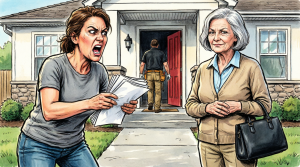
No lowering of her voice. No shame. No glance toward the framed photograph of Daniel on the mantel with the white funeral lilies already starting to turn brown at the edges.
My son Robert stood a few feet behind her with his hands in the pockets of his expensive coat and his eyes fixed on the rug. Forty-two years old, broad shoulders, thinning hair at the temples, and in that moment he looked exactly like he had at nine when he broke the lamp in the den and waited for me to decide whether he was in trouble.
Only this time, he was not a child.
This time, he let his wife throw me out of my own home and said nothing.
Linda, my sister, had stationed herself in Daniel’s armchair like she’d been invited to witness a legal proceeding. She had flown in from Ohio for the funeral wearing too much perfume and grief that came and went depending on who was in the room. She crossed one ankle over the other and watched me the way people watch a pot they expect to boil over.
Vanessa wanted a scene. I could see it in the way she held her phone low against her thigh, ready to record if I cried or shouted or called her what she deserved.
Instead I looked at her, then at Robert, then at the little brass key in my coat pocket pressing into my palm through the lining.
Daniel had given me that key three weeks before he died.
He’d been in a hospital bed by the window, skin gray, lips cracked, his voice weak but stubborn. He took my hand and pressed the key into it with surprising force. “Keep this safe, Maggie. Don’t tell anyone. Not Robert. Not anybody.”
I thought the medication was making him dramatic. Daniel had always handled illness badly, even a cold. I tucked the key into my purse and told him to rest. Two days later he was gone, and now here I was in the house we had paid off together, being told to disappear by a woman who had been in this family for eight years and still called meatloaf “that loaf thing.”
“Did you hear me?” Vanessa asked.
I nodded once. “I heard you.”
She blinked, probably disappointed by how calm I sounded.
Robert cleared his throat. “Mom, Vanessa and I have been talking, and with Dad gone, the house situation needs to be streamlined.”
Streamlined.
He used to come home from high school and ask me for grilled cheese with tomato soup on rainy days. He used to call me from college when he had the flu because he said no one else knew how to make him feel less awful. Now he was talking to me like an underperforming department head.
I should tell you that Daniel and I built that house one shift and one skipped purchase at a time. We bought it in 1989 when Robert was eight, when the shingles curled at the edges and the upstairs plumbing groaned like an old man every winter. I worked nights at St. Vincent’s, twelve-hour shifts in orthopedic recovery, and Daniel moved up from logistics coordinator to regional operations director by swallowing every miserable hour they offered him. We clipped coupons. We drove the same Honda for fifteen years. I sold my mother’s jewelry to pay the last of Robert’s tuition when the aid package came up short. I made curtains from fabric bolts on clearance. Daniel built the coffee table in the garage with his own hands and sanded it so smooth he kept running his fingertips over it like he didn’t trust wood could feel that soft.
Nobody mentioned any of that at the funeral.
Vanessa had insisted on a professional eulogist because, as she put it, “We need someone who speaks well.” The man talked about Daniel’s “executive instincts” and “market brilliance” and mispronounced our last name twice. He never once said that Daniel woke up at four-thirty for twenty years to make my coffee before my night shift ended because he said the world felt less mean if at least one person handed you a warm mug when you were tired.
By the time Vanessa and Robert left that afternoon, she had already put yellow sticky notes on half the furniture.
Sell.
Donate.
Trash.
My wedding china was boxed by the front door with a note that said Donate. Upstairs, Daniel’s suits were gone from the closet. So were three of my dresses, including the blue one I bought for our fortieth anniversary dinner that never happened.
On our bed was a stack of papers from Whitmore & Associates, a law firm whose stationery looked cheap and overdesigned.
Vanessa had left a pink note on top.
Sign here, here, and here. Voluntary transfer to Robert J. Hayes. Witnessed by Linda Schultz.
Voluntary.
I sat on the edge of the bed where Daniel used to untie his shoes every evening, and the mattress dipped under my weight in the place his body had shaped over decades. The room still smelled like his shaving cream and peppermint lozenges. I looked at those papers for a long time.
Then I picked up the pen and signed.
My signature did not shake.
What people miss about older women is how much practice we have at surviving while everyone assumes we are folding. By the time I was done, the light outside had gone watery and gray. I packed one small suitcase. Jeans, sweaters, underwear, my Bible, my blood-pressure pills, the quilt my mother stitched in 1972, my nursing shoes, a photograph from our wedding day, and the bar of Ivory soap I always kept in the linen closet because hotel soaps smell like strangers.
In the kitchen, the coffee maker had a sticky note on it too.
Trash.
I bought that coffee maker in 2001 with a holiday bonus from the hospital. I left it on the counter.
I left everything.
The East Side Motel on Route 119 charged sixty-seven dollars a night and didn’t ask questions if you paid cash up front. My room smelled like bleach, cigarettes, and old heat. The carpet was the color of weak tea. The bedspread was orange with little brown diamonds that had probably looked cheerful sometime during the Reagan administration. Trucks droned all night on the road outside. The bathroom mirror had a crack running diagonally through it so my face split into two crooked halves every time I looked up.
I sat on the bed with the brass key in my hand and listened to the mini-fridge hum.
I had three hundred and twelve dollars in my purse, a dead husband, a son who had not defended me, and a daughter-in-law who thought she had already won.
At five the next morning, after a night with no sleep and too much thinking, I took a wrinkled business card out of my wallet. Daniel had slipped it into my purse two months earlier and told me not to lose it. Donald P. Brennan, Esq. No explanation.
I dialed the number.
Three rings.
Then a man said, “Brennan.”
“This is Margaret Hayes,” I said. My voice sounded older than I felt. “Daniel Hayes’s widow. I think… I think we need to talk.”
There was a brief pause, paper rustling somewhere in the background, and then the man said, very quietly, “Mrs. Hayes. I’ve been waiting for your call.”
I looked down at the brass key in my lap and felt the room tip beneath me. If he had been waiting, then Daniel had known exactly what was coming. The question that made my skin go cold was why.
Part 2
Donald Brennan’s office was on West 47th Street, four floors up in a brick building squeezed between a deli and a jewelry repair shop with a flickering neon sign that said WE FIX WATCHES while only half the letters worked. There was no elevator. By the third flight my knees were complaining and I could smell hot dust coming off the radiators in the hall.
His secretary, a woman with silver hair and cat-eye glasses, led me into an office lined with filing cabinets and law books that looked heavy enough to settle arguments by falling on people. Brennan rose from behind his desk when I came in.
He was younger than I expected, maybe mid-fifties, broad-shouldered, graying at the temples, with the tidy kind of face lawyers have when they make a living noticing details other people miss. His suit was navy, his tie was plain, and the first thing I noticed about him was that he did not perform sympathy. I liked him immediately for that.
“I’m sorry for your loss, Mrs. Hayes,” he said, and sat down only after I did.
I put the brass key on his desk.
He turned it over in his palm, nodded once, and set it carefully on a legal pad.
“Daniel was my client for thirty-two years,” he said. “Estate planning, trust structure, some real-estate acquisitions, investment vehicles, and, toward the end, specific instructions related to asset protection.”
The phrase asset protection made me sit up straighter.
“I don’t understand.”
“I know.” He opened a manila folder. “That’s why you’re here.”
He slid a single sheet across the desk.
At the top, in clean black type, were the words: Estate of Daniel Jacob Hayes — Confidential Summary.
I read down the page once. Then again. My eyes snagged on words I recognized only in the abstract—irrevocable trust, beneficiary designation, holdings structure, offshore account—before stopping hard at the number at the bottom.
Estimated consolidated value: $28,000,000.
For a second, nothing in the room made sense. Not the buzzing fluorescent light overhead, not the smell of old paper and coffee, not the legal pad under Brennan’s hand. Twenty-eight million dollars belonged to other people. Men in glossy magazines. Women named Meredith who owned summer houses on islands. Not to Daniel and me, who bought our paper towels in bulk when they were on sale and saved takeout containers because they were still perfectly good.
“There’s a mistake,” I said.
Brennan did not blink. “No, ma’am.”
“My husband drove a twelve-year-old Honda.”
“Yes.”
“We lived in a Victorian in White Plains with one bathroom that rattled in the winter.”
“Yes.”
“We shopped at Stop & Shop.”
Brennan folded his hands. “Daniel’s father left him a minority stake in the manufacturing company in 2003. Daniel sold it quietly, invested through structures designed to keep his name out of public records where possible, and compounded that capital aggressively for nearly two decades. He was very good at it.”
I stared at him.
“Why didn’t he tell me?”
Brennan’s expression shifted then, just slightly, and I saw something almost like pity.
“He tried,” he said. “Repeatedly.”
I opened my mouth to argue and then closed it again, because memory is a cruel little clerk when it wants to be. Daniel, at the kitchen table with spreadsheets spread out between the salt shaker and the grocery list. Daniel, asking if I wanted to come with him to meet someone in the city “just so you’re looped in.” Daniel, starting a sentence with We should really talk about the future and me cutting in with Honey, I trust you. You’ve always handled that stuff.
I thought I was being loving.
I thought love meant not asking questions.
Brennan continued. “Daniel was also deeply concerned about your son’s marriage.”
That landed differently. Colder.
“He said, and I’m quoting him, ‘My son married a predator. If she smells money, she’ll strip him to the bone and smile while doing it.’”
I heard Vanessa’s voice in my living room telling me to go live on the streets.
I thought about the way she had first walked through our house eight years earlier when Robert brought her to Sunday dinner. She had complimented the roast chicken, asked whether the wallpaper was original, and then stood in the doorway to the den looking around with those bright, searching eyes of hers before saying, “So this place is paid off, right?”
Not “What a beautiful house.” Not “You must have wonderful memories here.”
Paid off.
Back then Daniel caught my eye over the mashed potatoes and lifted one eyebrow. After they left, he said, “That woman inventories things.”
I laughed and called him dramatic.
I sat in Brennan’s office now feeling that old laugh burn all the way down.
“There’s more,” he said gently.
Of course there was.
Daniel had bought a penthouse on Park Avenue eight years earlier, in cash. He had never taken me there. It had been meant, Brennan told me, as a surprise for our fortieth anniversary. “A second act,” Daniel had called it in his planning notes. He had wanted to hand me the keys over dinner, take me upstairs, and tell me we were done living for everyone else.
Instead, he died with that apartment empty.
Everything—investments, cash reserves, property—sat in an irrevocable trust established in 2019. Sole beneficiary: Margaret Louise Hayes. Me. Legally clean. Difficult to challenge. Nearly impossible to seize. Robert and Vanessa had no direct access. None.
“Not even discovery?” I asked, thinking of Vanessa’s sharp little eyes and Linda’s eager silence.
Brennan smiled without humor. “Not unless someone presents a court with a reason stronger than greed dressed up as suspicion.”
My hands were cold. I tucked them under my thighs to warm them.
“What about those transfer papers I signed yesterday?”
“Meaningless,” he said. “The Maple Avenue house was never the major asset, and Daniel moved title protections years ago. Vanessa used a cut-rate firm because cut-rate firms don’t ask why a grieving widow is being rushed into voluntary transfers. But they can’t reach what isn’t there.”
I should have felt relief. What I felt instead was a strange floating sensation, like stepping off a curb you thought was still under your foot.
Brennan picked up the brass key.
“This opens a private deposit box at Manhattan Trust. Daniel left documents there for you personally. Letters too.”
“Letters?”
He nodded. “Quite a few, actually.”
An hour later I was in a narrow vault room with brushed steel walls, a small table, and air so cold it smelled sterile. Box 447 was shallower than I expected. Inside were folders, statements, property deeds, a USB drive, and a bundle of envelopes tied with faded blue ribbon. On top lay one sealed in Daniel’s handwriting.
Maggie.
My throat closed just looking at it.
I opened it with the little silver letter opener the bank clerk had left on the table.
If you’re reading this, I’m gone. And first, I’m sorry. I’m sorry I ran out of time. I’m sorry I let you think our life was smaller than it was. I was trying to protect you, and maybe I was also trying to protect the version of us that didn’t have to talk in numbers.
Halfway through, I had to stop because I couldn’t see through the tears.
He wrote that he bought the Park Avenue apartment for us. That he wanted a home untouched by Robert’s growing pains, by family obligations, by the ghosts that settle into old houses like dust in curtain hems. He wrote that he knew Vanessa watched money the way foxes watched henhouses. He wrote that he feared Robert mistook softness for love and control for care.
Don’t let them bully you, he wrote. You gave me forty years. I’m giving you freedom. Use it.
Under that letter were twenty-three more.
The earliest one was dated May 1985.
You’re asleep with one hand on your belly while I write this, he had written. If something happens to me before I ever get my act together, I need you to know you are the only person on this earth I ever wanted to build with.
I sat in that cold little room and cried so hard my ribs hurt.
When I finally looked up, my reflection in the steel wall was blurred and old and furious.
There were twenty-three more envelopes beneath the first one, one for almost every year I had loved him. I had come to the bank thinking Daniel might have hidden money. What he had really hidden, all those years, was a map of the life I never knew he’d been building around me.
Part 3
I stayed in the motel.
That surprises people when they hear the story later. They imagine the estate summary, the trust documents, the deed to a Park Avenue penthouse, and they think I should have gone straight from Room 12 on Route 119 to marble floors and a doorman who knew my name. But grief makes ordinary things feel safer than luxury. Also, I am a nurse by training and temperament. When something catastrophic happens, my first instinct is never to faint onto a chaise lounge. It is to assess, organize, wait for the next bad thing, and keep my shoes where I can find them in the dark.
So I stayed in the motel and built a routine around the ugly little room.
Housekeeping came at nine with a cart that squeaked like a wounded animal. The woman who cleaned my room wore lavender body spray and hummed along to Spanish radio under her breath. The ice machine rattled all hours of the day and night. The faucet spat brown water for half a minute every morning before clearing. On Thursdays the couple in Room 14 screamed at each other through the wall over money, or fidelity, or maybe both. In the mornings I ate stale toast from the lobby and peanut-butter crackers from the vending machine when my blood sugar dipped. At night I sat cross-legged on the bed under the jaundiced yellow lamp and read Daniel’s letters one by one.
He had written them in hotel rooms, airport lounges, hospital waiting rooms, and once, according to the date and the smudged handwriting, during a thunderstorm when Robert was twelve and afraid to sleep alone. Some letters were two pages. Some were only a paragraph. None had ever been mailed.
In one from 1997 he apologized for missing my birthday because a shipment got held at port and he had to fly to Savannah. In another from 2008 he said he watched me fall asleep on the couch with a crossword on my chest and thought, for no reason he could explain, that there was no wealth in the world that felt bigger than being known by the same person for twenty-five years.
And in almost every one, there was money tucked between the lines. Not showy money. Not greed. More like careful scaffolding. An extra account opened. A property considered. A strategy adjusted. Daniel had never wanted to look rich. He had wanted to become impossible to corner……………….

