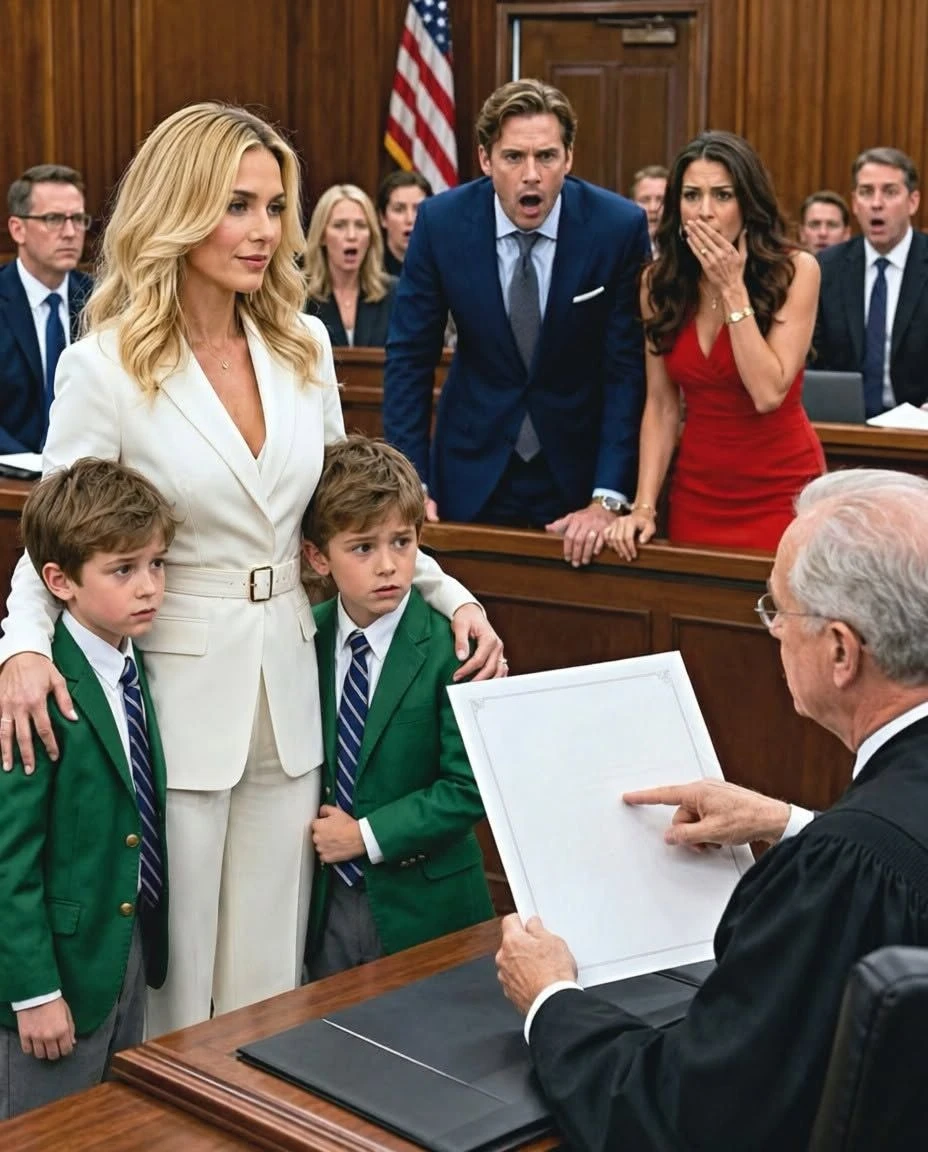
“I understand completely, Your Honor,” I said. My voice did not tremble. It did not carry the high, frantic pitch of a cornered woman trying to save her life. It was flat, measured, and quiet—the exact tone I used when reviewing multi-million-dollar ledger discrepancies in the dead of night while Barrett slept in luxury hotels three states away.
Douglas Croft let out a short, puffing breath through his nose, a half-smirk tugging at the corner of his thin lips. He adjusted his silk tie, turned his body slightly toward the gallery, and whispered something to Barrett. Barrett didn’t even bother to conceal his chuckle. Beside him, Paige Delancy rested her chin in her hand, her manicured nails tapping a rhythmic, mocking beat against her designer leather portfolio.
They thought I was a sacrificial lamb. They thought thirteen years of domestic isolation, of school pick-ups, doctor visits, and staying out of corporate photo-ops meant my brain had turned to mush. They believed their own PR machine.
“Very well, Mrs. O’Connell,” Judge Lawson said, her brown eyes tracking the subtle, arrogant shifts in Barrett’s legal team with an expression that was impossible to read. “If you choose to proceed pro se, that is your legal right. However, Mr. Croft has presented a substantial prenuptial agreement executed on May 14th, 2013, which purports to waive all claims to O’Connell Logistics, its subsidiaries, real estate holdings, and liquid assets acquired under the corporate banner. Do you contest the validity of this document?”
“No, Your Honor,” I replied, standing straight at my wooden table. “I do not contest the validity of the prenuptial agreement. It is an authentic document. Barrett’s father’s attorneys drafted it, and I signed it three days before our wedding.”
Barrett leaned toward Douglas, tapping his pen against the legal pad. “She’s giving up,” he muttered under his breath, loud enough for the court reporter’s microphone to catch a soft rustle. “See? I told you she has nothing.”
“Mrs. O’Connell,” Judge Lawson warned, her eyebrows rising slightly. “Are you aware of what you are conceding? Under the terms outlined in this agreement, if held valid, you waive all rights to equitable distribution of the business assets, the marital home in Upper Arlington, and any spousal support beyond a modest lump-sum severance.”
“I am fully aware, Your Honor,” I said. “I am not contesting the prenuptial agreement because the agreement governs the distribution of assets owned by *Barrett O’Connell*. It has no legal jurisdiction over assets that Barrett O’Connell does not own.”
A heavy, sudden silence dropped over Courtroom Three. The ambient murmur of the gallery died instantly.
Douglas Croft stood up slowly, smoothing the front of his jacket with a condescending smile. “Your Honor, this is absurd. Mrs. O’Connell is engaging in desperate semantic games. My client is the Founder, Chairman, and Chief Executive Officer of O’Connell Logistics. He holds ninety-eight percent of the voting shares. The corporate filings are a matter of public record in the State of Ohio.”
“The corporate filings registered with the Secretary of State *today* are indeed a matter of public record, Mr. Croft,” I said, turning my head just enough to look Douglas dead in the eye. “However, public records are built on foundational articles of incorporation. And those foundational records tell a remarkably different story.”
I reached down into my modest canvas tote bag—not a leather legal briefcase, but a plain bag I usually used to carry my boys’ water bottles and snacks. I pulled out a single, thick, red-bound binder. It wasn’t modern. The edges of the paper were slightly yellowed, and the spine bore the faded, gold-leaf seal of the Ohio Secretary of State’s Archives Division from 2008.
I walked forward and handed the binder to the bailiff, who carried it directly up to the bench.
“What is this, Mrs. O’Connell?” Judge Lawson asked, opening the heavy cover.
“That, Your Honor, is the certified, certified-true-copy of the original Corporate Charter and Founding Operating Agreement for *Vanguard Freight Systems LLC*—the corporate entity that was illegally rebranded as O’Connell Logistics in November of 2012 without a statutory vote of the founding board.”
Barrett’s smile didn’t disappear immediately, but it froze. His eyes flicked from the red binder on the judge’s desk to my face, his eyebrows pulling together in a sharp, sudden knot.
“Your Honor, this is a distraction!” Douglas shouted, his voice losing its polished tone for a split second. “Vanguard Freight was a failed early venture that my client closed out before establishing O’Connell Logistics! It has zero bearing on the marital estate!”
“If it was a failed early venture, Mr. Croft,” I said softly, “then perhaps you can explain why eighty-two percent of O’Connell Logistics’ current fleet leases, primary freight contracts, and terminal deeds in Columbus, Cincinnati, and Cleveland are still legally registered under Vanguard Freight Systems’ original EIN number?”
Judge Lawson held up a single hand, silencing Douglas before he could speak. She adjusted her reading glasses, flipped past the first three pages of certified corporate history, and arrived at the original Master Equity Registry on Page Four.
She stopped.
Her finger traced down the first column of text. Her eyes widened slightly behind her wire-rimmed lenses.
The silence in the courtroom stretched out like a thin wire pulled to its absolute breaking point.
Judge Lawson raised her head. She didn’t look at me. She didn’t look at Douglas Croft. She looked directly at Barrett O’Connell, her face completely drained of warmth.
“Mr. O’Connell,” Judge Lawson said, her voice dropping into a low, resonant register that vibrated through the wooden benches of the gallery. “Who is *Loretta Morgan-Vane*?”
The name hung in the air like poison gas.
Barrett didn’t move. He sat completely rigid in his leather chair, his jaw locked, his eyes staring blankly at the dark wood of the judicial bench. The flush of confidence that had colored his cheeks for the past hour drained away in a matter of seconds, leaving his skin an unnatural, chalky white.
Beside him, Paige Delancy leaned closer, her brow furrowed in confusion. “Barrett? Who is that? Who is Loretta Morgan-Vane?”
Barrett didn’t answer her. He couldn’t.
“Your Honor,” Douglas Croft interjected, his voice shaking slightly as he tried to regain control of the room. “I… I am not familiar with that name in the context of the current filings. If there is a third-party equity holder from an archaic entity, it should have been disclosed in discovery, but—”
“It *was* disclosed in discovery, Mr. Croft,” Judge Lawson interrupted, her tone sharp as a razor. “It was listed under Exhibit A of Mrs. O’Connell’s financial affidavit. You simply failed to read it because you assumed her pro se filing was a formality.”
The judge turned the red binder toward the defense table, pointing her finger at the crisp, bold black lettering at the top of the founding equity ledger.
“Listed as Founder, Primary General Partner, and 100% Capital Contributor of Vanguard Freight Systems LLC,” Judge Lawson read aloud, her voice echoing into every corner of the crowded courtroom: “*Loretta Morgan-Vane*.”
She looked up at me. “Mrs. O’Connell… Morgan-Vane was your maiden name prior to your marriage in 2013.”
“It was, Your Honor,” I replied calmly. “In 2008, five years before I married Barrett, I inherited my grandfather’s regional courier business, Vane Transport. I restructured the company, invested my entire inheritance—three hundred and fifty thousand dollars—and incorporated Vanguard Freight Systems as the sole legal owner.”
I turned slowly to face my husband. For thirteen years, I had watched him take the stage at corporate banquets. I had watched him accept awards for “Business Visionary of the Year.” I had watched him pour champagne for politicians and smile for the cameras while I sat at Table 12, dressed in modest clothes, holding his coat.
“In 2010,” I continued, my voice steady and unyielding, “Barrett O’Connell came to work for me as a junior logistics coordinator. He was charismatic. He was ambitious. And he was broke. When we began dating in 2011, he convinced me that putting his name on the operational filings would help us secure conservative institutional loans from old-fashioned Midwest bankers who were reluctant to extend multi-million-dollar lines of credit to a twenty-five-year-old woman.”
Barrett’s hands were shaking now. He gripped the edge of the mahogany table so hard his fingernails turned blue.
“I trusted him,” I said. “I granted him a temporary operational proxy. I allowed him to act as the public face of the company while I handled the back-end infrastructure, the fleet acquisitions, the route algorithms, and the corporate financing. When we decided to marry in 2013, his father presented me with a prenuptial agreement designed to protect *Barrett’s* assets.”
I picked up a second paper from my tote bag—a single sheet of heavy bond paper bearing the seal of the Franklin County Probate Court.
“What Barrett’s father and his legal team did not realize,” I said, “was that the prenuptial agreement specifically protected assets *owned by Barrett O’Connell prior to May 2013*. Because Barrett was merely an operational proxy and an employee of Vanguard Freight Systems, he owned zero equity in the company at the time the prenup was signed.”
Douglas Croft slumped back into his seat, his mouth open, his face flushed with embarrassment. He looked at Barrett as if he were seeing a stranger. “Barrett… is this true? Did you not own the founding entity?”
Barrett didn’t answer. He couldn’t speak.
“Furthermore, Your Honor,” I continued, turning back to Judge Lawson, “in November of 2012, six months before our wedding, Barrett executed an unauthorized name change, registering ‘O’Connell Logistics’ as a Doing-Business-As entity under the parent charter of Vanguard Freight Systems. He then issued himself ninety-eight percent of the operational stock in the DBA without my written consent—an act that constitutes felony corporate fraud, conversion of assets, and breach of fiduciary duty under Ohio Revised Code Section 1705.28.”
The gallery erupted.
Reporters from the *Columbus Dispatch* and regional business journals began scribbling furiously on their pads. Local business owners who had come to watch Barrett humiliate his wife were now staring at him with unadulterated shock.
Paige Delancy pulled her hand away from Barrett’s arm as if his jacket were coated in acid. She looked at him, her eyes wide with terror and disgust. “Barrett… what did she just say? You don’t own the company? You… you’re an employee?!”
“Silence in the court!” Judge Lawson slammed her gavel down once. The sharp *BANG* echoed off the high plaster ceiling, cutting through the rising tide of murmurs.
When the courtroom settled, Judge Lawson looked down at Barrett over the rim of her glasses.
“Mr. O’Connell,” Judge Lawson said, her tone dangerously quiet. “I am looking at a certified copy of the original capital contribution schedule from Huntington National Bank, dated March 12th, 2008. The three hundred and fifty thousand dollars used to purchase the first fifteen tractor-trailers for this enterprise came directly from a trust account bearing the name Loretta Morgan-Vane.”
She flipped to the next page.
“I am also looking at the Master Proxy Agreement signed by you on August 14th, 2011. In Section 8, Clause B, it explicitly states: *’The Operational Proxy granted to Barrett O’Connell is temporary, non-transferable, and conveys zero underlying equity ownership in Vanguard Freight Systems LLC or any of its operational subsidiaries, DBAs, or future corporate derivatives.’*”
Judge Lawson closed the red binder with a heavy, final *THUD*.
She looked at Douglas Croft. “Mr. Croft, do you have any documentation—any bill of sale, any equity transfer agreement, any board resolution signed by Loretta Morgan-Vane—that demonstrates your client ever legally acquired equity in this company?”
Douglas stood up, his knees visibly trembling. He looked at Barrett, then down at his thick black binder—the binder he had carried into court with such arrogance an hour ago.
“Your… Your Honor,” Douglas stammered, his face red, cold sweat glistening on his forehead. “We… we were provided with the current Secretary of State filings by our client. We… we were not made aware of the underlying organizational structure of Vanguard Freight Systems…”
“In other words, Mr. Croft,” Judge Lawson said coldly, “you did not perform basic due diligence before filing a claim to seize a multi-million-dollar corporation and demand primary custody of two minor children based on a fraudulent premise of sole ownership.”
“Your Honor, I object!” Barrett suddenly shouted, slamming both palms down on the table as he stood up. His eyes were bloodshot, his tailored suit jacket wrinkled, his hair disheveled. The smooth, media-trained CEO was completely gone. “This is a setup! She knew this the whole time! She sat at home for thirteen years while I worked eighty hours a week! I built the brand! I built the network! I am the face of O’Connell Logistics!”
“You were the face, Mr. O’Connell,” I said, turning to look at him with a cold, quiet pity. “I was the brain. While you were playing CEO at charity galas and posing for magazine covers with your public relations director…” I glanced briefly at Paige, who cowered back into her seat, “…I was running the late-night logistics algorithms from our home office. I was managing the fuel-hedging contracts. I was signing off on the fleet maintenance budgets. Every single strategic expansion this company made over the last decade was calculated by me on the desk in our study while you were out living your double life.”
Barrett stared at me, his mouth opening and closing like a fish pulled out of water.
“You thought I was sitting at home doing nothing, Barrett,” I said softly, stepping closer to his table. “You thought because I didn’t care about designer dresses, red carpets, or corporate titles, that I was stupid. But I didn’t stay out of the spotlight because I was weak. I stayed out of the spotlight because I was watching you.”
Judge Lawson tapped her gavel twice, bringing the room back to absolute order.
“Mr. O’Connell, sit down immediately or I will have the bailiff place you in holding for contempt,” Judge Lawson ordered.
Barrett slowly sank back into his chair, looking broken, defeated, and completely hollowed out.
Judge Lawson turned her attention to the legal filings before her, her red pen flying across the official court documents with furious speed.
“Let the record reflect,” Judge Lawson announced in a clear, ringing voice, “that this court finds the prenuptial agreement executed on May 14th, 2013, to be legally binding *only* as to the personal property owned independently by the parties prior to marriage. Because O’Connell Logistics is a DBA operating under the master corporate charter of Vanguard Freight Systems LLC, which is 100% owned by Loretta Morgan-Vane, O’Connell Logistics is hereby declared the exclusive pre-marital property of Mrs. Loretta O’Connell.”
Paige Delancy let out a small, terrified gasp. She grabbed her designer purse, stood up from the defense table, and practically ran down the center aisle of the courtroom, her high heels clicking frantically against the marble floor as she burst through the double doors, abandoning Barrett completely.
Barrett didn’t even turn around to watch her go. He stared straight ahead at the empty table in front of him.
“Furthermore,” Judge Lawson continued, “in light of the evidence presented regarding fraudulent conversion of corporate assets and breach of fiduciary duty, all corporate bank accounts, lines of credit, and operational authorities associated with O’Connell Logistics are hereby frozen under emergency judicial oversight, pending a full forensic audit to be conducted by a court-appointed receiver.”
She looked at Douglas Croft.
“Mr. Croft, your petition for primary physical custody based on your client’s superior financial stability is denied with prejudice. Mr. O’Connell currently possesses zero verified independent income, zero real estate holdings in his own name, and faces severe civil and potential criminal liabilities.”
Judge Lawson looked across the room at my twin boys, Wyatt and Emmett, who were sitting quietly on the bench near the bailiff. Emmett was no longer clutching his brother’s fingers; both boys were looking at me with wide, proud eyes.
“Temporary sole physical and legal custody of Wyatt and Emmett O’Connell is awarded immediately to Mrs. Loretta O’Connell,” Judge Lawson ruled. “Mr. O’Connell will be permitted supervised visitation at a court-designated facility, pending the outcome of a full psychological evaluation and the resolution of the corporate receivership.”
She struck the wooden block once. *BANG.*
“We are adjourned until Monday morning for formal receiver appointment.”
‘
By eleven o’clock, the storm inside Courtroom Three had cleared out into the cold, rainy corridors of the courthouse.
Reporters swarmed the hallway outside, but my father’s former legal counsel—a sharp, elderly attorney named Arthur Vance whom I had retained privately three days ago—stepped forward to handle the media circus, shielding me and the boys as we walked toward the private elevators.
Barrett sat alone at his legal table inside the empty courtroom. His three high-priced attorneys were frantically packing up their leather portfolios, speaking to each other in low, panicked whispers as they calculated the devastating blow this would deal to their firm’s reputation.
I stopped at the doorway, holding Wyatt and Emmett’s hands. I looked back one last time.
Barrett raised his head. The charcoal-gray suit that had looked so majestic two hours ago now looked ill-fitting, draped over a man who had lost his identity, his fortune, his mistress, and his children in a single morning.
“Loretta…” Barrett whispered, his voice trembling as he took a step toward me. “Please… you can’t take everything… I built that brand… my name is on the building…”
I looked at the man I had spent thirteen years loving, supporting, and protecting from his own inadequacies.
“Your name was on the building, Barrett,” I said quietly, my voice carrying cleanly across the empty courtroom. “But my name was on the foundation. And when you decide to betray the person who built your foundation… you shouldn’t be surprised when the roof comes crashing down on your head.”
I turned my back on him, walked through the heavy wooden doors, and led my sons out into the bright, clean afternoon light.
The rain had stopped. The sky over Columbus was clear, blue, and open.
Wyatt looked up at me, squeezing my hand gently. “Mom? Are we going home now?”
“Yes, sweetie,” I said, pulling both of my boys close as we walked toward our car. “We’re going home. And this time, it really is ours.”
The rain had stopped over Columbus, leaving the asphalt of High Street slick and black under a sudden, blinding midday sun.
Wyatt and Emmett walked quietly beside me, their sneakers making small, rhythmic *slap-slap* sounds against the wet concrete. They didn’t ask questions about their father. Children raised in the quiet, suffocating atmosphere of a home dominated by an narcissist possess an uncanny, instinctual radar for survival: they know when the air has finally cleared, and they know when it is safe to breathe.
Arthur Vance, my grandfather’s lifelong attorney, walked half a pace behind us, his heavy wool overcoat open, a leather briefcase swinging gently in his right hand.
“The receivership papers will be filed with the Secretary of State’s office by two o’clock, Loretta,” Arthur said, his voice a low, raspy rumble that sounded like gravel grinding under an iron wheel. “Barrett’s personal accounts are already frozen under the emergency injunction. By four o’clock, he won’t be able to buy a cup of coffee using the corporate credit card.”
“What about Croft?” I asked, keeping my eyes fixed on the parking garage across the street.
“Douglas Croft is currently sitting in his office on the twentieth floor of the LeVeque Tower trying to figure out how to explain to his managing partners why his firm spent six months preparing a domestic trial against a woman who owns the entire underlying infrastructure of their primary client,” Arthur chuckled dryly. “He’ll send Barrett a withdrawal notice before sunset. Croft is a mercenary, Loretta. Mercenaries don’t fight when the gold chest turns out to be filled with lead.”
We reached my modest Subaru station wagon parked on the second level of the garage. I unlocked the doors, helped Wyatt and Emmett into the back seat, and made sure their seatbelts were clicked securely into place.
“Mom?” Emmett whispered, looking up at me through the open window, his small fingers resting on the glass edge. “Are we going to have to move out of the house in Upper Arlington?”
I reached through the window and smoothed his soft brown hair. “Do you want to live in that house, Emmett?”
He looked down at his lap, hesitating for a second, then shook his head slowly. “It’s too big. And Dad was always yelling on the phone in the hallway.”
“Then we won’t live there,” I said softly, giving him a warm, reassuring smile. “We’re going to stay at Great-Grandpa’s old farmhouse in Knox County for a while. There’s a pond, three acres of trees, and zero corporate galas.”
Emmett’s face lit up with a genuine, unburdened smile—the first real smile I had seen on his face in six months. “Can we get a dog?”
“We’ll talk about the dog tomorrow,” I promised.
I closed the rear door, turned to Arthur, and handed him my tote bag containing the certified copies of the original 2008 corporate charter.
“Take these back to your vault, Arthur,” I said. “And make sure the forensic accounting team starts pulling the digital ledgers for the offshore logistics terminals in Nassau immediately. Barrett thought he was hiding secondary freight revenues in the Bahamas through Paige Delancy’s shell entity.”
Arthur stopped. His bushy grey eyebrows pulled together in a sharp, sudden line. He looked at me for three long seconds, the leather briefcase hovering in mid-air.
“Nassau?” Arthur asked slowly. “Loretta… how did you know about the Nassau entity? The forensic discovery order hasn’t even been served on the Bahamian registry yet.”
I opened the driver’s door and stepped into the car. I looked up at Arthur through the open window, my face completely impassive.
“I didn’t need a discovery order, Arthur,” I said quietly. “I set up the Nassau entity in 2014. Under Paige’s maiden name.”
Arthur froze. For the first time in the forty years he had represented my family, the venerable old attorney looked thoroughly, profoundly bewildered. “You… you set up the entity that Barrett used to hide money with his mistress?”
“Barrett didn’t pick Paige Delancy out of a corporate talent pool, Arthur,” I said, a faint, cold smile touching my lips. “I hand-picked her resume from a stack of sixty applicants four years ago and placed it on Barrett’s desk during the autumn recruitment drive. I knew his ego. I knew his weaknesses. And I knew exactly what kind of woman he would use when he decided he was tired of playing the loyal husband.”
I started the engine. The Subaru hummed quietly into life.
“I’ll see you at the receiver’s office at eight tomorrow morning, Arthur,” I said gently. “Get some rest. The real work hasn’t even started yet.”
The farmhouse in Knox County sat at the end of a long, gravel driveway bordered by towering black walnut trees. Built in 1922 by my great-grandfather, Henry Vane, it was a solid, three-story white structure with a wraparound porch and green wooden shutters that creaked softly in the evening breeze.
While the boys ran upstairs to explore their old bedrooms—filled with wooden toys, hand-stitched quilts, and dusty books—I sat at the heavy oak kitchen table on the ground floor.
I pulled out my private, encrypted laptop—a sleek, unmarked silver machine that had never been connected to the Upper Arlington home Wi-Fi, never touched Barrett’s corporate servers, and never appeared on a single tax filing associated with the name O’Connell.
I opened a secure terminal, entered a thirty-two-character cryptographic key, and watched as a massive, intricate network diagram bloomed across the dark screen.
It wasn’t a diagram of O’Connell Logistics.
It was a structural map of *Apex Global Freight Network*—a private, Swiss-domiciled logistics conglomerate valued at four hundred and eighty million dollars, operating across fourteen countries, with primary distribution hubs in Rotterdam, Singapore, Chicago, and Santos.
At the very top of the organizational pyramid sat a single parent holding entity registered in Zurich: *Vane Heritage Holdings AG*.
And listed as the sole, 100% beneficial owner of Vane Heritage Holdings AG was one name: **Loretta Morgan-Vane**.
I leaned back in the creaking wooden chair, picked up a mug of black tea, and watched the digital ledger update in real time.
The public in Columbus—the reporters, the judges, the high-society elites who had looked down on me at charity galas for thirteen years—believed they had just witnessed a dramatic, victorious domestic underdog story. They thought a humble, neglected housewife had pulled out an old 2008 corporate charter from her tote bag and saved herself from a ruthless corporate husband.
They had no idea.
Barrett O’Connell had never been a CEO. He had never been an entrepreneur. He had never even been a real fraudster.
He was a construct. A carefully cultivated, meticulously managed corporate shell designed, built, and operated by me for thirteen years to absorb every operational liability, every tax exposure, every labor dispute, and every environmental violation inherent to the Midwest trucking industry.
While Barrett was riding in limousines, giving speeches to the local Chamber of Commerce, and taking credit for “his” rapid expansion, O’Connell Logistics was serving as a high-volume, low-margin operational shield for Apex Global Freight.
Every unprofitable route, every high-risk freight contract, every toxic fuel-hedging liability was funneled into O’Connell Logistics under Barrett’s signature. Meanwhile, every lucrative, high-margin international supply chain contract was quietly routed through Vane Heritage Holdings in Zurich.
Barrett hadn’t been stealing from me for thirteen years.
I had been using Barrett as a human lightning rod to absorb ninety percent of my global enterprise’s domestic tax liabilities while he blissfully believed he was pulling the wool over his “unemployed, quiet wife’s” eyes.
And Paige Delancy?
Paige was the final, critical mechanism in the long-term liquidation strategy.
A company as massive as O’Connell Logistics couldn’t simply be dissolved overnight without triggering massive federal antitrust reviews and employee pension audits. I needed a clear, undeniable, high-profile legal cause of action to trigger an immediate, court-ordered emergency receivership—a crisis so sudden and publicly scandalous that the entire Midwest division could be legally restructured, stripped of its debt, and folded directly into Apex Global Freight without a single shareholder vote.
Barrett’s vanity had provided that cause of action on a silver platter.
When he walked into Courtroom Three with Paige Delancy on his arm, carrying his thick black binder and his ironclad prenup, he wasn’t marching toward his victory. He was walking directly into the final execution phase of a corporate liquidation plan I had authored in 2018.
At 11:30 PM, the sound of tires crunching over the wet gravel driveway broke the stillness of the Knox County night.
I didn’t jump. I didn’t reach for a weapon. I sat at the kitchen table, watching the headlight beams sweep across the yellowed wallpaper of the dining room before turning off.
A car door slammed. Then another. Heavy, frantic footsteps marched up the porch steps, followed by the violent, echoing *THUD-THUD-THUD* of a fist pounding against the old wooden door.
“Loretta!” Barrett’s voice screamed through the heavy oak door, ragged, hoarse, and laced with absolute, manic desperation. “Loretta, open the door! I know you’re in there! Open the damn door!”
I closed my silver laptop, placed it inside a wall safe concealed behind the pantry cupboard, and walked calmly to the front door. I unlocked the heavy brass bolt and swung the door open.
Barrett stood on the porch under the yellow bug light.
He was no longer wearing his tailored charcoal suit. He wore a rumpled, rain-stained white dress shirt with the top three buttons undone, his tie missing, his hair plastered to his forehead with sweat and cold rain. Behind him, idling in the driveway, was a cheap rental sedan—his luxury Mercedes had been repossessed by the court-appointed receiver at five o’clock.
Beside him stood Douglas Croft. The high-priced attorney looked like a broken man. His leather briefcase was gone, his coat was damp, and his eyes were wide with a strange, terrified hyper-alertness.
“Loretta…” Barrett gasped, stepping forward, his hands outstretched as if he were trying to grab the air between us. “You… you have to stop this. The police came to the house in Upper Arlington two hours ago! They served a federal freeze order on my personal safe deposit boxes! They took my passports!”
I leaned against the doorframe, crossing my arms over my chest, looking down at him with the cool detachment of a scientist observing an insect under glass.
“The federal freeze order wasn’t issued by the state court, Barrett,” I said softly. “It was issued by the United States District Court for the Southern District of Ohio, requested directly by the Department of Justice.”
Douglas Croft stepped forward, his voice dropping into a frantic, trembling whisper. “Mrs. O’Connell… please. I am speaking to you now not as Barrett’s attorney, but as an officer of the court. Something has gone terribly wrong with the federal registry filings. When the federal marshals executed the freeze order on O’Connell Logistics’ servers tonight, they didn’t just lock Barrett’s accounts.”
Croft swallowed hard, his throat making a loud, dry click.
“They uncovered a secondary, underlying master corporate charter registered in Zurich,” Croft whispered, his hands trembling as he pulled a crumpled fax sheet from his coat pocket. “An entity called *Vane Heritage Holdings AG*. The federal prosecutors are claiming that Barrett was operating an unregistered offshore tax shelter worth nearly half a billion dollars!”
Barrett grabbed Croft’s shoulder, shaking him violently. “I don’t know what Zurich is! I’ve never been to Switzerland in my life! Tell her, Douglas! Tell her I don’t have half a billion dollars!”
Barrett looked back at me, his eyes wide, bloodshot, and bulging with pure, unadulterated horror.
“Loretta!” Barrett sobbed, sinking to his knees on the wooden porch floor, gripping the hem of my jeans with his trembling fingers. “Tell them! Tell the FBI! You know me! You know I’m not a global tax fraudster! I’m just… I was just running the trucking company! I don’t know anything about Zurich! I don’t know anything about Vane Heritage!”
I looked down at my husband—the man who, twelve hours ago, had sat in Courtroom Three laughing behind his hand while his attorney described me as an unemployed visitor in my own life. The man who had told my twin sons that their mother was a penniless nobody who had abandoned them.
I reached down, took his wrists, and slowly, firmly detached his fingers from my jeans.
“You’re right, Barrett,” I said, my voice dropping into an icy, beautiful whisper that cut through the night air like a razor blade. “You don’t know anything about Zurich. You don’t know anything about Vane Heritage. Because for thirteen years, you were never the CEO.”
Barrett froze, staring up at me, his mouth hanging open in complete, paralyzing confusion. “What… what are you talking about?”
“You were the liability vessel, Barrett,” I whispered, leaning down until my eyes were six inches from his. “I created you. I gave you the suit. I gave you the watch. I gave you the shiny red truck leases and the magazine covers. I let you play the big, powerful Midwest businessman so that when the federal tax auditors and environmental inspectors finally looked at the massive, forty-year debt liabilities of the Vane transport legacy…”
I smiled—a slow, blindingly brilliant, terrifying smile.
“…they would see your name at the bottom of every single page.”
The porch went dead silent.
The wind rustled through the walnut trees in the yard. Douglas Croft backed away slowly, step by step, down the porch stairs, his eyes fixed on me as if he had just realized he was standing on the precipice of an active volcano.
“You…” Barrett rasped, his voice barely a breath. “You… set me up? From… from the very beginning?”
“Not from the beginning, Barrett,” I corrected gently. “In the beginning, in 2011, I actually loved you. I thought you were a good man with a simple, honest heart. I was willing to let you share the wealth. I was willing to let you sit beside me while we built an empire together.”
I knelt down on the porch floor, bringing myself level with his face.
“But then in 2014,” I continued softly, “I caught you taking five thousand dollars from the company account to buy an emerald necklace for that junior dispatcher in Cincinnati. Do you remember her, Barrett? Her name was Sarah. You thought I didn’t notice. You thought I was too busy making dinner and changing diapers to look at the secondary audit logs.”
Barrett’s face went completely grey. A memory long buried, long forgotten, surged back to the surface of his eyes with terrifying clarity.
“That was twelve years ago…” Barrett whimpered. “It was five thousand dollars…”
“It wasn’t about the five thousand dollars, Barrett,” I said, my voice cold as iron. “It was the realization that you were a small, greedy, disloyal man who would betray the person feeding him the moment he felt an ounce of unearned power. That was the day I realized I couldn’t leave my grandfather’s legacy in your hands. That was the day I restructured the corporate hierarchy in Zurich.”
I stood up, wiping a speck of dust from my knee.
“For twelve years, Barrett, every time you took a mistress to a luxury hotel, every time you took credit for my logistics algorithms on local television, every time you treated me like a servant in front of your friends… you were simply signing off on another layer of your own corporate liquidation plan.”
“No…” Barrett moaned, pressing his forehead against the cold wooden floorboards of the porch, weeping openly now—the ugly, loud, hopeless sobs of a man who realized he had been a pawn in a game played by a grandmaster he had slept beside for a decade. “No… please… Loretta… I’m the father of your boys…”
“And you will always be their father, Barrett,” I said calmly. “Which is why I have set up an irrevocable educational trust in Switzerland that will pay for Wyatt and Emmett’s college tuition, their housing, and their futures—completely insulated from the federal asset forfeiture proceedings that will consume your life for the next ten years.”
I looked out into the driveway, where Douglas Croft was already scrambling into the passenger seat of the rental sedan, terrified that remaining on the property for another minute would make him an accessory to a global federal indictment.
“Douglas!” Barrett screamed, turning around on the porch, scrambling on his hands and knees. “Douglas, don’t leave me! Help me!”
Croft didn’t even look back. The rental car reversed frantically down the gravel driveway, its red taillights disappearing into the dark Knox County night.
I stepped back inside the warm, brightly lit foyer of the farmhouse.
“I left a box of your personal clothes in the garage at Upper Arlington, Barrett,” I said softly, holding the heavy oak door. “You should probably go pick them up before the federal marshals place the yellow tape across the front door at seven tomorrow morning.”
“Loretta!” Barrett cried out, reaching a hand toward the closing door. “Loretta, please! What am I supposed to do?! I have nothing! I have nowhere to go!”
I paused, looking at him through the three-inch gap between the door and the frame.
“You still have your freedom for another forty-eight hours, Barrett,” I whispered. “I suggest you use it to learn how to cook your own breakfast.”
I shut the heavy oak door. The heavy brass deadbolt clicked into place with a deep, final *CLACK*.
At 6:00 AM the next morning, the mist was rising off the surface of the pond behind the Knox County farmhouse.
The air was crisp, cool, and smelled of damp earth, pine needles, and fresh morning dew.
I sat on the wooden dock, dressed in an old wool sweater, my jeans tucked into leather boots, holding a hot mug of coffee with both hands.
Beside me on the wooden planks sat my silver laptop. On the screen was the morning edition of the *Wall Street Journal*.
The front-page headline in the business section read:
**MIDWEST FREIGHT GIANT COLLAPSES IN MASSIVE FEDERAL FRAUD PROBE: CEO BARRETT O’CONNELL ARRESTED ON CORPORATE CONVERSION AND TAX EVASION CHARGES.**
Below the headline was a photograph of Barrett being led out of a downtown Columbus hotel in handcuffs by two federal agents, his head bowed, his face hidden behind his jacket. Standing right behind him in the crowd of onlookers was Paige Delancy, weeping hysterically into her hands as two IRS criminal investigators served her with a subpoena.
And in the very last paragraph of the article, tucked away where only corporate lawyers and forensic auditors would know to look, was a small, three-line update:
*’In a related development, Zurich-based Apex Global Freight Network announced this morning that it has acquired the remaining operational fleet assets and route contracts of the bankrupt O’Connell Logistics under an expedited bankruptcy court sale for eighty-two million dollars. The transaction was overseen by primary equity holder Loretta Morgan-Vane, who will assume the role of Executive Chairwoman of Apex Global’s North American operations effective immediately.’*
I closed the laptop screen.
From the back porch of the farmhouse, I heard the sound of the wooden screen door squeaking open, followed by the light, energetic patter of small feet running across the grass.
“Mom!” Emmett shouted, running down the grassy hill toward the dock, his face bright and flushed with morning excitement. “Mom! Look what Wyatt found in the old barn!”
Wyatt walked down the hill behind his brother, carrying a small, trembling golden-retriever puppy in his arms—a stray that had taken shelter in the dry hay loft during last night’s rain storm.
“Can we keep him, Mom?” Wyatt asked, his dark eyes wide, hopeful, and entirely free of the anxiety that had shadowed them for six months. “Please? We promised we’d take care of him.”
I set my coffee mug down on the wooden dock, stood up, and pulled both of my sons into a tight, warm hug. The little puppy licked Emmett’s cheek, making both boys burst into loud, ringing fits of laughter that echoed across the quiet pond.
I looked out over the still, clear water, watching the golden rays of the morning sun break through the trees, bathing the old Vane land in brilliant, warm, unyielding light.
The noise of the courtrooms, the fake smiles of corporate galas, the arrogance of weak men who thought they could build an empire on someone else’s foundation—all of it had burned away into dust.
“Yes, boys,” I whispered, holding them close against my heart as the morning breeze carried the clean smell of the woods across the water. “We can keep him. We have all the time in the world.”