At eight months pregnant, I had learned to read the weather of a room before I walked into it. I knew the particular set of Eric’s jaw that meant silence was safer than speaking. I knew the way his fingers tapped against a steering wheel when the morning had already gone wrong in his mind, before anything had actually happened. I knew how to make myself smaller inside a car, inside a house, inside a marriage, without ever quite admitting to myself what I was doing or why I kept doing it.
That morning he was in one of his moods. The kind that had no clear origin and no clean ending, the kind that settled over him like weather and made everything around him feel pressurized and fragile. He was driving me to my prenatal appointment, which he had agreed to the night before with the martyred patience of someone granting a significant favor. One hand rested on the steering wheel. The other drummed against the door column in a rhythmless, restless beat. He had already mentioned twice that he was going to be late for work. I had already apologized once, though the appointment had been scheduled for six weeks.
I tried not to respond to his mood. Over the previous year and a half, I had learned that silence was often the safest reply, not because silence worked exactly, but because it bought time before things escalated. I sat with my hands folded across my belly and watched the streets scroll past the window and thought about nothing in particular, which was itself a kind of practice I had developed without naming it.
About fifteen minutes into the drive, a sharp pain twisted low in my stomach. It was not the usual pressure I had grown accustomed to, not the stretching or the dull persistent weight that had become background noise over the past several weeks. This was sudden, deep, and wrong in a way my body communicated very clearly. I pressed my palm flat against my belly and shifted in the seat.
“Eric,” I said carefully, “I need you to pull over.”
He didn’t look at me. “You’re fine.”
A second cramp came before I could answer, stronger than the first, spreading upward in a way that made my breath catch. “No. Something doesn’t feel right. Please, just stop for a minute.”
He exhaled through his nose in that sharp, dismissive way that I had stopped noticing years ago and had only recently begun to hear again. “I’m already running late, Claire.”
“I understand that. I’m asking you to stop the car.”
He swerved abruptly onto a side street without slowing down first, braked hard enough that I had to brace against the dashboard, and then turned toward me with a face so cold it barely seemed like the face of someone I had chosen and lived with and shared a bed with for three years. There was no concern in it. There was annoyance, and something harder underneath.
“You do this every time,” he said. “Every single time something matters to me, you need attention.”
Before I could speak or even fully register what he had said, he got out, walked around the front of the car, and yanked my door open. When he grabbed my arm I was too stunned to move quickly enough. He pulled me partway out of the car while I scrambled to get my footing, one hand locked around my forearm, the other briefly gripping my shoulder. I managed to grab the doorframe with my free hand and get both feet onto the ground, but the movement was rough and sudden and nothing about it was careful.
“Eric, stop it!” I said. “I’m in pain, I’m telling you something is wrong!”
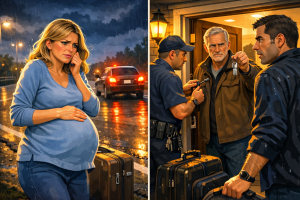
He was loud enough that two people walking a dog on the sidewalk across the street stopped and stared. “You are not in pain. Stop acting. You want attention? Walk home. Get out of the car.”
He released me, got back behind the wheel, and drove away.
I stood on the sidewalk for a moment that I cannot accurately describe in terms of duration. It felt very long and also like no time at all. One hand was on my stomach and the other was reaching back toward where the car door had been. My heart was hammering. The pain was still there, cresting and then backing off slightly, and I could not tell yet whether it was contractions or something else, could not tell whether I was about to go into labor on a residential street in the middle of a Tuesday morning, could not fully believe that this was what was happening.
I started to walk in the direction of a larger intersection I could see at the end of the block, because walking felt like doing something and I needed to be doing something. After three or four steps another wave of pain hit and I bent forward with my hand pressed hard against my lower abdomen.
A woman across the street had been unloading grocery bags from the back of an SUV. She saw me. She left the bags sitting in her trunk and came across at a near-jog. She introduced herself as Dana and the ordinariness of the name made it easier to focus on her face, which was open and alarmed and entirely on my side.
“Ma’am, are you okay? Do you need help?”
“I’m pregnant,” I said, as if that were not immediately obvious. “I think something’s wrong.”
She got me sitting in the passenger seat of her SUV with the air conditioning on and her teenage son standing nearby with a phone in his hand while she crouched beside the open door and kept talking to me in a low, steady voice, asking my name and how far along I was and whether I could tell her what happened. I answered her questions. I did not tell her everything, but I told her enough. Her son called 911. The pain kept coming, closer together now, and my dress was damp across my back and my hands would not stop trembling no matter how deliberately I held them still.
Dana asked whether my husband was coming back. I heard myself make a sound that was not quite a laugh. “No,” I said. “He left.”
She did not say anything to that. But she put her hand over mine and kept it there until the ambulance arrived.
The paramedics took me to St. Andrew’s Medical Center. A nurse helped me call my sister Megan because my phone was still in Eric’s car and I had no bag, no wallet, no water bottle, nothing except the clothes I was wearing and the appointment card I had tucked into my pocket that morning. Megan arrived within forty minutes, which meant she had driven faster than she should have. She came through the door and saw me in the hospital bed with monitors attached and started crying before she even reached me, which made me cry too, not from pain this time but from the particular relief of being seen by someone who already understood.
The doctors were efficient and calm in that way that is more frightening than panic because it tells you they are taking things seriously. One of them explained that I was showing early labor signs along with indicators of placental stress. They needed to observe me closely and were not prepared to call the situation stable yet. I lay in the bed and stared at the ceiling and listened to the sound of my baby’s heartbeat on the monitor and tried very hard not to think about what might have happened if Dana had not looked up from her grocery bags at the right moment.
Megan held my hand and did not push me to talk. She had been concerned about my marriage for a long time. She had mentioned it once, carefully, about six months earlier, and I had defended Eric with the specific exhausting energy that people use when they are trying to believe something they already doubt. She had not brought it up again after that. She was patient, my sister, in ways I had not always deserved.
Hours passed. The medication worked. The contractions slowed. The room got quieter. At some point in the early evening, when the monitors had settled into a steadier rhythm and the worst of the fear had ebbed enough for thoughts to come back in order, Megan asked me the question I had been keeping at arm’s length for longer than I could honestly account for.
“Claire,” she said. “If he can do this while you’re carrying his child, what do you think happens when the baby is actually here?”
I did not have an answer. But I did not argue with the question the way I would have six months earlier. I lay there and I let the question sit between us and I understood, in the clear and honest way that fear sometimes produces, that she was right. That I had known she would be right. That some part of me had known for a long time.
Eric did not call the hospital to ask about me until that evening. He had come home to an empty house, found my overnight bag missing from the closet, and then received a voicemail from Megan telling him that I was under medical care. That was what prompted the calls. Not concern that had simply expressed itself slowly. Concern about an empty house. I know the difference because I had spent years learning the difference, the way you learn to distinguish one bird call from another, not by any single feature but by accumulated familiarity.
When he arrived at the hospital, he came in the way he always did when he believed smoothing things over was still an option: clean shirt, controlled expression, the particular measured confidence of someone who had rarely faced consequences he could not talk his way around. He walked down the hallway toward my room and stopped when he saw who was waiting.
My sister. My mother. And a police officer with a small notebook standing at the end of the hall beside them.
His expression changed in stages that I could track even from my bed through the half-open door. First irritation, then confusion, then a rapid and visible calculation as he processed the uniform and adjusted his approach accordingly.
“What is this?” he asked.
Megan stepped forward. “This is what happens when you leave your eight-months-pregnant wife on the side of the road.”
He scoffed in the precise way that had always made me feel like I was overreacting. “That is not what happened.”
Officer Ramirez lifted the notebook. “Then this would be a good time to explain what did happen.”
The nurse beside me offered to close the door. I told her no. I wanted to hear this. For years I had lived inside a house where events were constantly being renamed, where cruelty became stress and neglect became a communication style and control was reframed as love until I genuinely could not always tell what had actually occurred. I wanted, for once, to hear things spoken plainly in a room where plain speech had consequences.
Eric lowered his voice into the calm, reasonable register he used when he needed to seem like the adult in the situation. “My wife has been emotional throughout the pregnancy. She asked to stop. I pulled over. She got out, and I believed she wanted a moment to herself.”
“You pulled her out,” Megan said.
“She is exaggerating the situation.”
My mother, who had kept her reservations about Eric to herself for three years because she believed that was what supporting my marriage required, moved closer. She was not someone who raised her voice to make a point. She did not raise it then. “A woman named Dana witnessed what happened. She stopped her car, she stayed with Claire until the ambulance arrived, and she gave a statement.”
Eric went still for a moment. “A statement.”
Officer Ramirez confirmed it. He explained that the paramedics had documented my account, that Dana’s witness statement was already part of the incident file, and that given my condition and the circumstances, the matter was being formally recorded. Whether it moved forward as a charge depended on the district review process and my own decisions going forward.
Eric’s face reddened. “I didn’t touch her in any harmful way. I didn’t hit her.”
The officer’s expression did not change. “Neglect and reckless endangerment of a vulnerable person are both taken seriously regardless of physical contact.”
That was the moment something rearranged inside me. Not because a police officer had used formal, official language. Not because my family was standing in the hallway. But because Eric still could not locate his remorse. He was right there, standing outside the room where I had spent the day with monitors on my belly and fear in my chest, and his entire defense was a technicality. He had not hit me. Therefore, in his accounting of the world, nothing had been done that required genuine reckoning.
He asked to see me. I said no.
He texted Megan. Then he called my mother. Then, somehow, he got the number for the hospital room phone, and I lay in the bed and watched it ring until the nurse unplugged it from the wall without my having to ask. He left two hours later, and the quality of the silence that settled into the room afterward was different from any silence I had experienced in years. It had no edge to it. It did not feel like the pause before something worse.
The next morning my doctor sat at the edge of my bed and told me that the baby had stabilized and the risk of premature delivery had decreased significantly, but that I needed strict rest and careful monitoring for the remainder of the pregnancy. Stress, dehydration, and physical strain had pushed my body much closer to early labor than it should have gotten at this stage. She spoke directly and without drama and I appreciated the steadiness of it.
Megan helped me shower and sat beside me while I ate breakfast and stared out the window at the street below and tried to get my bearings on what my life now looked like. The shape of it had changed in less than twenty-four hours, or perhaps it had been changing for much longer and yesterday was simply the first day the change was visible to everyone, including me.
“You can come stay with me when they discharge you,” Megan said. “You don’t have to go back there.”
“I know,” I said.
“I mean it, Claire. You don’t have to.”
“I know,” I said again, and this time I meant it too.
What I could not fully explain to her then was how strange it felt to recognize the obvious. Eric had not always been like the man in that car. At the beginning he was attentive and perceptive in ways that felt like being genuinely known. He remembered things. He made plans. He was ambitious and funny and he paid attention to small details that most people overlook. The version of him I had believed in at the start of our marriage was not entirely invented. But people show you one face early, and then, when they believe they have you, another. The cruelty came gradually, in increments small enough that each one could be explained individually. He criticized my friends once, and then more often, until I saw them less frequently and eventually not at all. He found fault with how I dressed, how I kept the house, how I handled money. He kept score in ways I never knew he was keeping until I found myself on the wrong side of a tally I had not agreed to. If I cried, he told me I was manipulative. If I defended myself, I was disrespectful. If I went quiet, I was cold and withholding. Pregnancy had not softened any of this. It had simply given him new material. Every need I expressed became an imposition. Every fear I voiced became evidence of instability.
By the third morning in the hospital I had made three decisions with a clarity that surprised me given how tired I was. I would not return to the house alone. I would speak with a lawyer before the end of the week. And Eric would not be in the delivery room unless I decided otherwise at some later point, which I could not imagine doing at that moment.
Megan drove me to her apartment when I was discharged. That afternoon, with my mother at the kitchen table and a yellow legal pad between us, I called a family attorney whose name came through a colleague of my mother’s. Her name was Ms. Bennett. She listened to everything I told her without interrupting, and when I finished she said several things I had not realized I needed to hear.
“What happened to you is serious,” she said. “And documenting it carefully right now matters more than you might think.”
We built a list together. Hospital records and the incident file number. Dana’s witness information. Screenshots of every text Eric had sent since I left. Bank account details and copies of the lease agreement. A request for formal documentation of my sole medical decision-making authority for the remainder of the pregnancy. Ms. Bennett also told me to save every message Eric sent without responding to any of them, particularly anything that contradicted his account or showed his real motivations.
That advice proved useful almost immediately.
His first messages were angry. You embarrassed me in front of a police officer. Your family is filling your head with poison. Call me right now. When I did not respond those softened slightly. I was under enormous stress. I didn’t fully understand what was happening with you physically. You know I would never truly hurt you. By the next day he had moved to bargaining. Come home and we can talk about this like two rational adults. Don’t blow up our family over one bad moment.
One bad moment.
I saved everything. Every single message, screenshot by screenshot, time-stamped.
Then the one arrived that removed any remaining ambiguity: If you keep escalating this situation, don’t expect me to keep covering your medical expenses and baby purchases like nothing is happening.
I read it three times. There it was, undressed completely. Not fear for the baby. Not genuine regret. A financial threat intended to remind me of my dependence and make me afraid of losing his support. That was what he reached for when everything else failed. Not love. Not concern. Leverage.
Ms. Bennett read the message the same afternoon I forwarded it. “Good,” she said. “He is writing his own character reference.”
A week later Eric was formally served with notice of my request for temporary separation, exclusive authority over my medical care going forward, and a framework for boundaries before the birth. He called twenty-three times in a single day, a number I know because my phone logged every attempt. He emailed my mother claiming I had become unstable and was making irrational decisions under the influence of people who wanted to destroy our marriage. He told two of our mutual acquaintances that I had panicked and was weaponizing a stressful moment against him. But the particular power these maneuvers had always held over me, the power of making me feel that I was the unreasonable one, had lost most of its weight. Because now there was a police report with a file number. Medical records that documented what my body had gone through on that sidewalk. A statement from a woman named Dana who had no reason to lie and every reason to have simply driven past without stopping……………………….
Click the button below to read the next part of the story.⏬⏬
PART 2-At Eight Months Pregnant He Left Me on the Road—That Night My Father Changed the Locks (End)

