PART 5 — THE CHRISTMAS THAT CHANGED EVERYTHING (FINAL PART)
I looked at my son standing on the porch, holding the letter his father had written him four years earlier.
Behind him stood Lily and Noah.
For the first time since that terrible telephone call, I felt something resembling hope.
But hope, I had learned, was not the same thing as trust.
“Everyone, come inside,” I said.
We gathered around the kitchen table where, only days earlier, Alicia had tried to convince me to sign away my independence.
The investigator introduced herself as Catherine Miller.
She explained that several concerns had been brought to her attention regarding the unauthorized financial documents and the allegations about my ability to care for myself.
“Mrs. Dorothy, I want you to understand that we’re here to establish the facts.”
“Good,” I replied. “I’ve had enough of people making decisions based on lies.”
She opened her folder.
“Have you experienced problems remembering important appointments?”
“No.”
“Have you had difficulty managing your household expenses?”
“No.”
“Have you expressed a desire to move into assisted living?”
“Absolutely not.”
Lily leaned forward.
“Grandma remembers our birthdays better than our parents do.”
Noah nodded.
“She even remembers what we ordered at restaurants three years ago.”
Despite everything, I laughed.
Catherine smiled.
Then she continued asking questions.
I answered every one.
I showed her my calendar, my household records, and the documents Harold had helped organize.
She listened carefully without interrupting.
Finally, she turned toward Mark.
“Do you have anything you’d like to add?”
My son looked at me.
Then he looked down at his father’s letter.
“Yes.”
He took a deep breath.
“My mother has never needed someone to make decisions for her.”
His voice trembled.
“The claims about her memory weren’t true.”
Catherine made a note.
“Were you aware they weren’t true when they were made?”
Mark closed his eyes.
“Yes.”
The single word seemed to cost him everything.
But for once, he didn’t hide behind Alicia.
He didn’t blame his financial problems.
He didn’t offer an excuse.
He simply told the truth.
When Catherine finished, she explained that further inquiries would be necessary.
Then she gathered her paperwork and left.
Lily and Noah went into the living room.
Mark remained at the kitchen table.
Between us lay the letter from Raymond.
“Read it, Mom.”
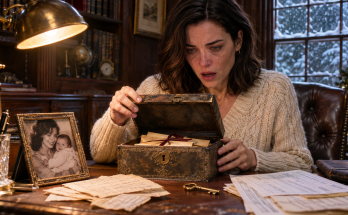
I unfolded the pages.
My husband’s handwriting carried me back to a time when our family had still seemed whole.
Dear Mark,
I have spent my entire life trying to teach you what it means to be a good man.
Not a wealthy man.
Not an important man.
A good man.
I paused.
Mark’s eyes were already filled with tears.
I continued.
I know you have made mistakes. I know you are frightened. And I know you believe that protecting your marriage means hiding the truth from everyone else.
But a marriage built on dishonesty cannot be protected by more dishonesty.
One day, your mother will be alone.
When that day comes, I expect you to protect her dignity, not control her decisions.
Her home belongs to her.
Her money belongs to her.
Her remaining years belong to her.
My hands began trembling.
If you ever find yourself choosing between your mother’s security and your own financial comfort, remember everything she sacrificed to give you a life better than ours.
And if you fail her, my son, do not ask her to pretend that you haven’t.
Make it right.
Your father, Raymond.
I lowered the letter.
Mark was crying silently.
“Dad gave me that nine days before he died.”
I nodded.
“I know.”
“He knew I was lying about some of the money.”
“Why didn’t you listen to him?”
Mark stared at his hands.
“Because I thought I could fix everything before anyone found out.”
“And instead?”
“I made everything worse.”
I looked toward the living room.
Lily and Noah were quietly examining the Christmas ornaments on my tree.
“Your father left me a letter too.”
Mark looked up.
“What did he say?”
I retrieved the six pages I had found inside the recipe box.
“He asked me to remember that you were more than your worst mistakes.”
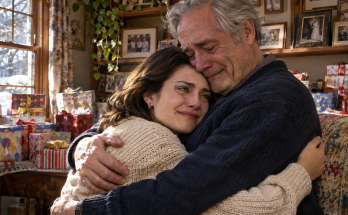
Mark covered his mouth.
“He also asked me never to sacrifice my independence to save you from those mistakes.”
My son began sobbing.
“Mom, I don’t deserve another chance.”
“Perhaps not.”
He looked at me.
“But your father believed people could change.”
I folded Raymond’s letter carefully.
“And I am willing to believe that too.”
Mark reached for my hand.
I allowed him to hold it.
“But listen carefully, Mark.”
He nodded.
“I will not pay your debts.”
“I understand.”
“I will not surrender my home.”
“I know.”
“I will not protect you from the consequences of your actions.”
He wiped his eyes.
“I don’t expect you to.”
“And Alicia will never again have access to my finances or authority over my decisions.”
He nodded slowly.
“Then what are you giving me?”
I looked at him for a long moment.
“An opportunity to become the man your father believed you could be.”
He lowered his head and cried.
For the first time, I believed his tears might be about something more than losing money.
The following morning, Harold called with important news.
The financial organization connected to the unauthorized thirty-two-thousand-dollar obligation had opened a formal fraud review.
Additional records had been requested.
Bruce’s involvement was also receiving attention.
And Silver Meadows had been informed that I had never consented to the proposed arrangements.
The entire plan Alicia had worked so hard to build was collapsing.
Not because I had taken revenge.
Because I had finally refused to cooperate with my own exploitation.
That afternoon, another car pulled into my driveway.
Alicia stepped out.
She looked exhausted.
There was no carefully applied lipstick.
No expensive handbag.
No cheerful expression.
She rang the doorbell.
When I opened the door, she looked at me with red eyes.
“Can I come inside?”
“No.”
She seemed genuinely surprised.
“Dorothy, please.”
“We can speak here.”
She glanced down at the porch.
“Mark has left.”
I said nothing.
“He’s staying with his brother-in-law.”
“I see.”
“He’s talking to investigators.”
I nodded.
“He says he’s going to tell them everything.”
“That would be wise.”
Her face twisted with anger.
“You’ve destroyed my marriage.”
I took a slow breath.
“No, Alicia. I discovered what was already happening inside it.”
She began crying.
“I was desperate.”
“So was Raymond when he was fighting cancer.”
She froze.
“He didn’t steal from anyone.”
My voice remained calm.
“He didn’t forge anyone’s signature. He didn’t try to take someone’s home.”
Alicia wiped her face.
“I made mistakes.”
“A mistake is forgetting to pay a bill.”
I looked directly into her eyes.
“What you did required planning.”
She began explaining the investment.
The mounting debts.
The growing pressure.
The fear of losing the lifestyle she had worked so hard to create.
For years, she had believed that another financial arrangement would solve the problems caused by the previous one.
Eventually, she had stopped seeing people as people.
They had become opportunities.
Resources.
Solutions.
And I had become the largest solution available.
“Did you ever love me?” I asked.
The question seemed to catch her completely off guard.
“Dorothy—”
“Just answer.”
She looked away.
“I cared about you.”
“Then why did you think I deserved to lose everything?”
She couldn’t answer.
I realized that I might never receive an explanation that satisfied me.
Some people could spend an entire lifetime trying to understand why someone hurt them.
I didn’t want to spend my remaining years doing that.
Alicia looked at the Christmas wreath hanging on my door.
“Are you going to forgive me?”
I considered her question.
“Perhaps someday.”
She looked hopeful.
“But forgiveness does not mean that everything returns to the way it was.”
Her expression changed.
“You’re really going to let them investigate me?”
“Yes.”
“You would do that to the mother of your grandchildren?”
I shook my head.
“You should have thought about your children before you used their grandmother’s name.”
Alicia began crying again.
Then, in a voice so quiet I almost missed it, she said, “I’m sorry.”
For the first time, there was no threat attached to her apology.
No demand.
No bargain.
Just two words.
I nodded.
“I hope you mean that.”
She waited.
Perhaps she expected an invitation inside.
Perhaps she expected me to comfort her.
But I remained in the doorway.
Eventually, she turned and walked toward her car.
I watched her leave.
There was no satisfaction in seeing her broken.
Only the understanding that sometimes compassion means allowing someone to face the truth.
Christmas Eve arrived three days later.
For forty-eight years, Raymond and I had hosted Christmas dinner.
This year, I had considered canceling everything.
The thought of sitting at an empty table had nearly convinced me to pack away the decorations.
Then Eleanor arrived at my back door carrying two bags of groceries.
“Absolutely not,” she announced.
“Absolutely not what?”
“You’re not spending Christmas feeling sorry for yourself.”
I laughed.
“Good morning, Eleanor.”
She put the groceries on the counter.
“Turkey. Potatoes. Cranberry sauce. Everything.”
“Who are we feeding?”
“Whoever deserves feeding.”
By noon, Lily and Noah arrived with gifts.
Noah carried a badly wrapped package approximately the size of a shoebox.
Lily was holding flowers.
“Grandma!”
She hugged me so tightly that my glasses shifted.
Noah wrapped both arms around us.
For several moments, we simply stood there.
Then Lily whispered, “We’re staying, right?”
“As long as you like.”
Her face lit up.
For the first time in days, my house sounded alive again.
Music played in the kitchen.
Noah complained about peeling potatoes.
Lily decorated cookies.
Eleanor criticized my gravy.
And I laughed.
Really laughed.
The kind of laughter that had been missing for far too long.
At four thirty, someone knocked on the front door.
It was Harold.
He brought a bottle of sparkling cider and a small wrapped present.
“Your husband would be pleased to see this house full again.”
I smiled.
“He always liked Christmas.”
Harold looked toward Raymond’s photograph.
“He liked seeing you happy.”
Those words nearly brought me to tears.
At five fifteen, the doorbell rang again.
Noah ran to answer it.
Mark stood outside.
He was carrying a pie.
He wore an old winter coat I recognized immediately.
Raymond’s coat.
The one he had refused to replace for twenty years.
My son looked nervous.
“Mom?”
I waited.
“I wasn’t sure if I was welcome.”
I looked at the pie.
“Did you make that?”
He nodded.
“It’s probably terrible.”
I smiled.
“Your father’s first apple pie nearly broke a kitchen knife.”
He laughed through his tears.
Then I stepped aside.
“Come in.”
Mark stood motionless.
“Really?”
“Yes.”
His eyes filled.
“Thank you.”
He entered the house slowly.
There was no folder in his hands.
No paperwork.
No hidden request.
For the first time in years, he had come to my home without wanting anything.
At dinner, I left Raymond’s usual chair empty.
Not because I couldn’t accept that he was gone.
Because I wanted to honor everything he had taught us.
Before we began eating, Mark stood.
“I’d like to say something.”
Everyone turned toward him.
He looked at Lily and Noah.
“Your grandmother has always taken care of this family.”
His voice trembled.
“And I forgot that taking care of someone doesn’t mean taking advantage of them.”
Lily reached for her brother’s hand.
Mark continued.
“I lied. I hid things. I made decisions I’m ashamed of.”
He looked at me.
“And Grandma didn’t deserve any of it.”
Nobody spoke.
“I can’t change what I’ve done. But I can change what I do from now on.”
He sat down.
I took his hand.
“Then let’s begin with dinner.”
For the first time in many years, Christmas felt honest.
There was no pretending.
No discussion about expensive vacations.
No competition over gifts.
No carefully constructed image of a perfect family.
There were simply people sitting together.
Some wounded.
Some disappointed.
All trying to find a way forward.
After dinner, Lily handed me her present.
It was a framed photograph of Raymond and me standing beneath the oak tree.
Across the bottom, she had written:
The roots of this family are stronger than its mistakes.
I cried.
Then Noah handed me his badly wrapped package.
Inside was a small wooden sign.
He had made it in his school workshop.
It read:
GRANDMA’S HOUSE — ALWAYS GRANDMA’S RULES.
I laughed so hard that Eleanor nearly spilled her tea.
“I’m hanging that on the front door.”
“You should,” Noah replied proudly.
Later that evening, after the children had finished opening their gifts, I retrieved three sealed envelopes from my bedroom.
I gave one to Lily.
One to Noah.
And one to Mark.
Lily looked at hers.
“Grandma, what’s this?”
“Something for your future.”
I explained that I had made arrangements, with Harold’s assistance, to help the twins pursue their education when the time came.
The arrangements were designed around their needs rather than their parents’ financial circumstances.
Lily burst into tears.
“Grandma, you didn’t have to.”
“I know.”
Noah hugged me.
“Thank you.”
Then Mark opened his envelope.
Inside was a single sheet of paper.
There was no check.
No property agreement.
No financial promise.
He read the words silently.
His face crumpled.
I had written:
Dear Mark,
I cannot give you the childhood we once shared.
I cannot give your father back to you.
I cannot erase the choices you have made.
But I can give you a mother who still loves you.
What happens next is your responsibility.
Build a life you can be proud of.
Tell the truth even when it costs you.
Earn back what you have lost through your actions, not your promises.
And remember that you will always be my son, even when I have to tell you no.
Love, Mom.
Mark pressed the letter against his chest.
Then he looked at me.
“I think this is the most important thing you’ve ever given me.”
I nodded.
“I hope you remember it.”
He stood and wrapped his arms around me.
This time, I hugged him back.
Not because everything was forgiven.
Not because trust had been restored.
But because I understood that love and accountability could exist together.
The months that followed were difficult.
There was no magical solution to the debts.
Mark eventually closed the struggling business.
He sold possessions he could no longer afford.
He moved into a modest apartment and found work managing operations for another company.
For the first time in years, he began living within his means.
Alicia faced serious consequences as the investigation progressed.
Bruce’s professional conduct was reviewed, and the evidence Thomas had provided became part of the broader inquiry.
The unauthorized financial obligation in my name was ultimately resolved in my favor.
I was not responsible for money I had never authorized anyone to borrow.
It took time.
There were meetings, paperwork, difficult conversations, and days when I wished the entire situation had never happened.
But I kept going.
Because every honest step forward was a victory.
Mark and Alicia separated for a period while they confronted the damage their decisions had caused.
I never interfered in their marriage.
That was no longer my responsibility.
The twins continued visiting me.
We cooked together.
We watched old movies.
We celebrated their birthdays.
They never once asked about my money.
And every Sunday afternoon, Mark started coming to help with the garden.
The first few visits were awkward.
He would trim the hedges while I sat on the porch.
Sometimes we barely spoke.
But he kept coming.
Not for eleven minutes.
Not because he needed something.
Sometimes he stayed for hours.
One afternoon, almost six months after Christmas, he approached me while I was watering my roses.
“Mom, I brought you something.”
He handed me an envelope.
Inside was a check for one hundred dollars.
I looked at him.
“What’s this?”
“The first repayment.”
“Repayment for what?”
“What Dad paid to help us.”
My eyes filled with tears.
“Mark, you understand that could take a very long time?”
“I know.”
“Why?”
He looked toward Raymond’s old workshop.
“Because I promised him I would make things right.”
I studied my son’s face.
For the first time, I saw something I hadn’t seen in years.
Not the little boy he had once been.
The responsible man he was finally becoming.
I accepted the check.
Not because I needed the hundred dollars.
Because he needed to understand what keeping a promise felt like.
A year after that unforgettable telephone call, I stood in Harold’s office again.
This time, I wasn’t frightened.
I had established a small charitable fund in Raymond’s memory to support older people experiencing financial hardship and exploitation.
It helped connect them with trustworthy resources and practical assistance.
I called it the Raymond and Dorothy Home & Dignity Fund.
When Harold read the name, he smiled.
“Raymond would have loved this.”
I smiled too.
“I think so.”
The money Raymond had earned through decades of hard work would help people maintain something more valuable than any bank balance.
Their independence.
Their dignity.
Their right to make decisions about their own lives.
I also made some changes to my house.
I installed better lighting along the stairs.
I replaced the old bathroom flooring.
I added handrails where they were useful.
Not because Alicia had told me I was too old to live alone.
Because I had made my own decision about how to live comfortably and safely.
There is an enormous difference between accepting help and surrendering control.
One is independence supported by love.
The other is independence taken through pressure.
I learned that distinction the hard way.
On the second Christmas after the pocket-dial, my house was filled with music again.
Lily was preparing for college.
Noah had developed an interest in woodworking, just like his grandfather.
Eleanor still criticized my cooking despite eating everything I served.
Harold stopped by with his traditional sparkling cider.
And Mark arrived carrying another homemade pie.
This one didn’t look terrible.
“Getting better,” I told him.
“I’m learning.”
“I can see that.”
Later that evening, we sat together beneath the Christmas tree.
Mark looked at Raymond’s photograph.
“I wish Dad could see us.”
I reached for his hand.
“Me too.”
“Do you think he’d be proud of me?”
I considered the question.
“I think he’d be proud that you’re still trying.”
Mark nodded.
For a while, we listened to the Christmas music.
Then he asked something I had been waiting nearly two years to hear.
“Mom, are you happy?”
I looked around my home.
The furniture Raymond and I had purchased together.
The photographs on the walls.
The crooked Christmas angel.
My grandchildren laughing in the kitchen.
My dearest friend arguing with Noah over the last cookie.
And my son sitting beside me without asking for anything.
“Yes,” I answered.
“I am.”
That night, after everyone left, I carried a cup of tea to my kitchen table.
The same table where I had once listened to nineteen minutes of betrayal.
My old grocery notepad was still tucked inside a drawer.
I opened it.
The timestamps were still there.
7:19.
7:21.
7:26.
7:31.
For a moment, I remembered the woman who had sat in that chair with her heart breaking.
A seventy-three-year-old widow who had discovered that the people she trusted most were planning to remove her from her own home.
I wished I could go back and tell that frightened woman something.
That losing her illusions about her family would not mean losing her family forever.
That saying no would not make her cruel.
That demanding honesty would not make her selfish.
That growing older would never make her less deserving of respect.
I turned to a clean page.
At the top, I wrote:
Things I learned at seventy-three.
Then I began writing.
Love is not permission to take.
Family is not ownership.
Forgiveness is not forgetting.
Trust must be earned through actions.
And growing old does not mean giving up your right to choose how you live.
I closed the notepad.
On the mantelpiece, Raymond smiled at me from our wedding photograph.
“Thank you, sweetheart,” I whispered.
For the house.
For the memories.
For the letters.
And for leaving me a future that was mine to live.
I turned off the kitchen light and walked upstairs.
My house was peaceful.
My heart was peaceful.
For the first time in years, I wasn’t worried about what someone might want from me.
I was simply looking forward to tomorrow.
Alicia had once believed that by Christmas she would have my house, my money, and control of my future.
She had underestimated me.
She had mistaken kindness for weakness.
She had mistaken age for helplessness.
And above all, she had mistaken my love for permission.
That accidental telephone call was supposed to be nothing more than a mistake.
Instead, it became the moment I took my life back.
Because at seventy-three, I discovered something I wish every person understood before it was too late.
You are never too old to stand up for yourself.
You are never selfish for protecting your peace.
And you never have to surrender your dignity to prove that you love your family.
My name is Dorothy.
This is my house.
This is my life.
And for however many Christmases I have left, I intend to live every single one of them on my own terms.
THE END.