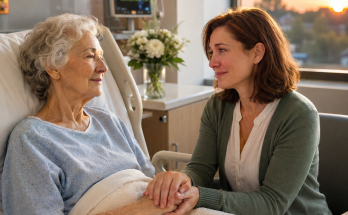
PART 7: THE MAN WHO COULD NOT CARRY THE GROCERIES
The morning I fell, Rachel asked me to buy milk on the way home.
I remember that more clearly than anything that happened afterward.
Not the sound of the ladder shifting.
Not the sharp white flash of pain.
Milk.
She stood beside the refrigerator holding the nearly empty carton.
“Unless you want Lucas putting orange juice on his cereal.”
From the hallway, our son said, “That was one time.”
“One memorable time,” she replied.
I kissed her.
Promised I would remember.
Then I went to work.
By ten forty, I was sitting on cold concrete with my leg at an angle that told me not to look at it again.
One of my crew was kneeling beside me.
Another was calling for help.
And my first clear thought was not about the pain.
It was that somebody had to call Rachel.
My second was that I did not want them to.
THE VOICE ON THE PHONE
I was conscious.
Talking.
Angry.
That last part reassured the men more than anything else.
I kept trying to tell them what needed doing.
Where the next delivery should go.
Which area had to be closed.
Who should call the site manager.
“Brian,” Luis said.
He was still kneeling beside me.
“We have it.”
“You need to—”
“We have it.”
I looked at him.
He held my gaze.
For years, I had been the person who gave the next instruction.
Now the most useful thing I could do was remain still while someone else made decisions.
I disliked it immediately.
By the time Rachel answered the phone, I had already tried to convince Luis that I could speak to her myself.
He gave me a look.
Then turned slightly away.
“Rachel, it’s Luis.”
I watched his face.
“Brian’s had a fall.”
There was a pause.
“He’s awake.”
Another pause.
“He’s talking to us.”
I closed my eyes.
I knew those questions.
I had asked them.
Alive?
Conscious?
Breathing?
The small gates a frightened person had to pass through before the rest of the world became visible.
Luis listened.
Then held out the phone.
“She wants you.”
I took it.
“Rach.”
Her breath caught.
Then she said, “Where are you?”
I told her.
“Are you alone?”
“No.”
“Good.”
I swallowed.
“I’m sorry.”
“For what?”
“I don’t know.”
Her voice softened.
“All right.”
A siren sounded in the distance.
Rachel heard it.
“Stay with them.”
“I am.”
“Brian.”
“Yes?”
“You don’t have to manage me right now.”
I pressed the phone harder against my ear.
She knew.
Of course she knew.
THE CHAIR ON THE OTHER SIDE
At the hospital, Rachel arrived carrying my wallet, a charger, and a clean shirt.
She had remembered things I had not known I needed.
I lay on a narrow bed, furious with the ceiling.
There were fractures.
Tests.
A plan that involved surgery and a recovery longer than I wanted to hear.
The medical team explained.
I asked practical questions.
When could I walk?
Drive?
Return to work?
The answers contained too many qualifications.
Rachel sat beside me.
Listened.
Wrote things down after asking whether I wanted her to.
I said yes.
When we were alone, she put the notebook on her lap.
“Do you want the milk now or later?”
I looked at her.
For a moment, neither of us smiled.
Then I began laughing.
It hurt.
I did it anyway.
“I forgot.”
“I suspected.”
She took my hand.
Her own was cold.
Only then did I look properly at her face.
The color had not quite returned.
“Rachel.”
“I’m here.”
“I scared you.”
“Yes.”
“I’m—”
“Don’t apologize for being hurt.”
I looked at our hands.
There were things I had learned while she recovered.
Apparently, I had learned them in only one direction.
LUCAS IN THE DOORWAY
Lucas arrived after school with Kyle.
He stopped outside my room.
I saw him through the glass.
His face changed when he saw the bed.
Rachel went to him.
Crouched.
They spoke for a moment.
Then he came in.
Slowly.
I lifted one hand.
“Hey, buddy.”
He looked at the bandage.
The equipment.
My bare foot at the end of the blanket.
“Does it hurt?”
“Yes.”
He frowned.
“They’re helping with that.”
“Did you fall far?”
“Far enough.”
He did not smile.
I regretted the joke.
Kyle put a chair beside the bed.
Lucas sat.
For several seconds, he studied me.
Then he asked, “Are you coming home?”
“Yes.”
“When?”
“We’re finding that out.”
His eyes moved toward Rachel.
She nodded.
“Daddy’s leg needs treatment.”
“The doctors will tell us when it’s safe for him to leave.”
Lucas looked back at me.
“Can I see the picture?”
“What picture?”
“The bone one.”
I glanced at Rachel.
She smiled faintly.
“If Daddy wants to show you.”
Later, someone helped us look at the image.
Lucas leaned closer.
Studied the break.
Asked sensible questions.
For the first time since arriving, his shoulders lowered.
He could see the problem.
It had edges.
A place.
Not every frightening thing looked the same once someone explained it.
Before he left, he put his hand on the blanket.
“You can borrow my room.”
I stared.
“What?”
“It’s closer to the bathroom.”
My throat tightened.
“We’ll work it out.”
He nodded.
Then added, “But don’t move my bridge stuff.”
THE THINGS PEOPLE BRING
Luis came the next day.
He brought my work bag and a folder I did not want to open.
“The site is fine.”
“I didn’t ask.”
“You were going to.”
I looked away.
He sat.
Explained what had been secured.
Who had taken over the schedule.
What had been documented.
There would be a review of the accident.
I wanted it.
Not a story arranged to make me feel less responsible.
The truth.
I also wanted, in the same unreasonable breath, to be back at work before anyone discovered they could manage without me.
Luis looked around the room.
Then at me.
“You know we’ve had meetings when you weren’t there before.”
“That’s different.”
“How?”
I had no answer I liked.
He smiled.
Then placed the folder on the table.
“Read it when you can.”
After he left, Kyle arrived with socks.
Joanne brought food the nurses helped us store properly.
A neighbor offered to mow the lawn.
Someone from work sent a message about taking Lucas to his Saturday activity.
People kept appearing with useful things.
I thanked them.
Then privately counted how much trouble I had become.
THE FIRST MORNING HOME
We arranged the downstairs room before I returned.
Not elegantly.
Well enough.
A clear path.
Things within reach.
The practical changes recommended to us.
Lucas’s bridge materials remained untouched.
He checked.
I pretended not to notice.
On my first morning home, Rachel brought breakfast.
Toast.
Eggs.
Coffee in a mug with a lid.
I looked at the lid.
“Really?”
“Yes.”
“I’m thirty-something years old.”
“And remarkably attached to spilling things when you’re annoyed.”
She put the tray down.
I wanted to argue.
Instead, I said, “Thank you.”
It came out stiffly.
She heard.
Did not comment.
For the first hour, I behaved well.
By the second, I had rearranged the pillows six times.
By the third, I was trying to work from my phone.
By noon, Rachel stood in the doorway with her hands on her hips.
“Have you eaten?”
“Yes.”
“All of it?”
I looked toward the tray.
She followed my eyes.
A long silence.
Then, very quietly, she said, “Oh.”
I looked up.
“What?”
Her expression changed.
Recognition.
Not satisfaction.
She pulled out the chair.
“We’re doing it again.”
THE QUESTION BENEATH THE QUESTION
Rachel sat beside me.
I locked my phone.
“What?”
“The watching.”
“The counting.”
She glanced at the tray.
“I hated it.”
“I know.”
“And now I’m doing it to you.”
I looked at the half-eaten eggs.
“I’m not hungry.”
“All right.”
She took a breath.
“Do you need help with something?”
I almost said no.
The word was ready.
Familiar.
Automatic.
Then I looked toward the bathroom.
My face grew hot.
Rachel waited.
I had helped her with things neither of us would have chosen to need help with.
I had believed that because I loved her, embarrassment should not exist between us.
Now I understood how little love could do to prevent the feeling.
“I need a minute.”
“All right.”
She stood.
Not offended.
Not insisting.
“I’ll be in the kitchen.”
She left.
I stared at the closed phone in my hand.
Five minutes later, I called her.
She came back without making me repeat myself from the doorway.
THE BAG OF GROCERIES
By the second week, I could move around the house more easily.
More easily did not mean easily.
Everything took longer.
Everything required thought.
The cup.
The plate.
The telephone I had left in another room.
I began each task by forgetting that one hand was occupied.
Then remembered in a way that made me swear.
One afternoon, Rachel came home carrying groceries.
Two bags.
A shoulder bag.
A stack of papers from work.
I stood immediately.
“What are you doing?”
“Helping.”
She looked at me.
I looked at the bags.
There was no sensible way to carry them.
Not safely.
Not yet.
“Sit down, Brian.”
“I can take something.”
“You can.”
She placed a bunch of bananas on the table beside me.
Then went back outside.
I stared at them.
A ridiculous thing to be angry at.
Bananas.
By the time she returned, I had moved them to the fruit bowl.
The effort had not improved my mood.
She put away the groceries.
Asked about my afternoon.
I answered too sharply.
She paused.
“Do you want to try that again?”
I looked at her.
She waited.
“I’m sorry.”
“What’s happening?”
I gestured toward the bags.
“I can’t even do that.”
“Carry groceries?”
“Yes.”
“Not today.”
I laughed bitterly.
She closed the refrigerator.
Then sat opposite me.
“Do you think I loved you because you carried the groceries?”
I looked down.
“No.”
“Then tell me what you mean.”
It took longer.
Much longer.
Finally, I said, “I don’t know who I am when I’m not useful.”
THE THING SHE DID NOT SAY
Rachel did not tell me I was always useful.
She did not list tasks I could perform from a chair.
I was grateful later.
At the time, I wanted exactly that.
A new list.
A way to earn my place before supper.
Instead, she sat quietly.
Then she asked, “Who was I when I came home?”
I closed my eyes.
“Rachel.”
“Just Rachel?”
I nodded.
“Even when I couldn’t do much?”
“Yes.”
“Even when I got angry?”
“Yes.”
“Even when I needed you?”
I covered my face.
She let me.
For a while, the only sound was the refrigerator.
Then her hand touched my wrist.
“I’m not asking you to enjoy this.”
I lowered my hands.
“I don’t.”
“I know.”
“I’m scared.”
Her expression softened.
“About healing?”
“That.”
“What else?”
“The money.”
“The work.”
“Whether they’ll still need me.”
She nodded.
“And whether you’ll get tired of needing to do everything.”
Rachel looked toward the bags.
Then back at me.
“I will get tired.”
The honesty hurt.
It also steadied me.
“But we can ask for help before I’m exhausted.”
“We can change the plan.”
“We can tell each other when we’re angry.”
She squeezed my hand.
“I don’t need you to pretend this is easy so I’ll keep loving you.”
THE CHART ON THE FRIDGE
We made another plan.
Not because plans could make recovery pleasant.
Because confusion was making us both meaner than we wanted to be.
Kyle took Lucas to an activity on Tuesdays.
Joanne helped with one school pickup.
A neighbor handled the lawn.
Meals arrived twice a week from people who wanted to bring them.
We learned to ask what day suited them instead of saying we were fine until we were not.
Rachel kept her work hours.
I attended my appointments.
We put the schedule on the fridge.
At the bottom, Lucas added a task.
DOG: ME.
Then, after some thought:
MOSTLY.
Rachel laughed.
I looked at the chart.
A few months earlier, I would have seen evidence that I had failed to manage my family.
Now I could see the names.
People.
A structure we had not built alone.
It still took practice not to apologize every time someone arrived.
THE MORNING I WAS NOT THERE
Lucas’s class had a small exhibition.
Models.
Drawings.
Projects from the term.
He had built a bridge.
A better one.
Lighter.
Stronger.
With supports he could explain in exhausting detail.
I had planned to attend.
Then an appointment was changed.
There was no good alternative.
For a while, I considered postponing it.
Rachel looked at me.
“Ask him.”
“What?”
“Don’t decide what he needs without asking.”
So I did.
We sat at the kitchen table.
I explained.
Lucas frowned.
“How long is the appointment?”
“I don’t know.”
“Can Mommy come?”
“Yes.”
“Grandma?”
“She wants to.”
He considered.
Then nodded.
“Okay.”
I stared at him.
“Okay?”
“You can see it afterward.”
“I want to be there.”
“I know.”
He turned the model carefully.
“This bit is the best one.”
He began explaining.
I listened.
Later, I realized I had been expecting disappointment to become damage.
Sometimes a child could be disappointed and still know he mattered.
Sometimes knowing why was enough.
Sometimes we could miss a moment without making him responsible for reassuring us.
I went to the appointment.
Rachel went to the exhibition.
That afternoon, Lucas brought the bridge home.
Set it beside my chair.
“Ready?”
“Yes.”
He gave the whole presentation.
I did not pretend I had heard it before.
THE REVIEW
The site review was uncomfortable.
Good reviews often are.
We looked at the work area.
The equipment.
The conditions.
The decisions made before the fall.
Including mine.
There were things we needed to change.
Things I should have questioned.
Things someone else had assumed were already checked.
I read the report slowly.
For years, I had demanded answers from the people involved in Rachel’s case.
Now I had to sit with a smaller, very different set of failures and resist every urge to explain them away.
No one had died.
That mattered.
It did not make the findings optional.
I joined a meeting remotely.
Listened.
Acknowledged where I had been wrong.
Luis spoke plainly.
So did I.
When the meeting ended, I sat looking at the dark screen.
Rachel stood in the doorway.
“How was it?”
“Necessary.”
She nodded.
“Painful?”
“Yes.”
She came in.
Sat.
After a while, I said, “I wanted to tell them I’d been doing this for twenty years.”
“What would that have changed?”
“Nothing.”
She nodded.
I rubbed my face.
“That’s why I didn’t say it.”
THE FIRST BAG I CARRIED
Recovery did not arrive as one triumphant morning.
It came in dull increments.
A little farther.
A little steadier.
A task I could do without thinking through every movement.
Then a day when everything hurt again and I wondered whether any progress had happened at all.
It had.
Just not on the schedule I preferred.
Months after the fall, Rachel brought groceries home.
I met her at the door.
She stopped.
We looked at each other.
“I can take one.”
She glanced at the bag.
Then handed it to me.
“Not the heavy one.”
“I know.”
I carried it to the kitchen.
Milk.
Bread.
Apples.
An absurdly ordinary load.
I put it down.
Stood there a moment.
Rachel came in with the other bags.
She did not applaud.
Did not call me brave.
She opened the cupboard.
“Put the cereal up, will you?”
I smiled.
“Which shelf?”
“The one it’s been on for eleven years.”
“That shelf?”
“Yes, Brian.”
I put it away.
THE THING LUCAS REMEMBERED
That evening, Lucas asked whether my leg was better.
“Getting there.”
“Can you run?”
“Not yet.”
“Climb?”
“Not the way I used to.”
He considered.
“Can you sit on the floor?”
“Yes.”
“Then come help.”
I lowered myself carefully beside him.
The dog watched with professional interest.
There were pieces of a model spread across the rug.
Not a bridge this time.
A house.
Lucas held up two small walls.
“Which one goes here?”
I studied the instructions.
He watched me.
Then said, “When you fell, I thought you might not come home.”
I put down the paper.
“I know.”
“I didn’t want to say.”
“Why?”
He shrugged.
“I thought it would make Mommy sad.”
I looked toward the kitchen.
Rachel was on the telephone.
Laughing with someone from work.
“Your mom can be sad and still help you.”
He nodded.
I let a moment pass.
“So can I.”
He looked at me.
Then at the little walls in his hands.
“Okay.”
I waited.
He leaned against my shoulder briefly.
Not a long embrace.
A boy checking something.
Then he sat up.
“Can we do the roof?”
“Yes.”
We found the pieces.
He held one side.
I held the other.
It took several attempts.
The roof kept slipping.
At one point, he became frustrated and accused the instructions of being wrong.
I told him that was entirely possible but we should check our work first.
We had reversed two parts.
He groaned.
I laughed.
Then we took them apart.
Started again.
From the kitchen, Rachel called to ask whether either of us wanted tea.
Lucas asked for hot chocolate.
I said yes to tea.
She brought both.
Set them on the low table.
Then sat with us.
For a while, the three of us worked on the little house.
None of us carried it alone.
And when it finally stood, we left it on the rug until morning.
PART 8: THE SIGN IN THE FRONT YARD
The first person who mentioned selling the house was Lucas.
Not Rachel.
Not me.
Our son.
He was standing in the upstairs hallway holding a cardboard box against his chest.
“What if my room was somewhere else?”
I looked up from the stair rail I was tightening.
“What do you mean?”
He shrugged.
“A different house.”
I smiled automatically.
“Does the different house have a swimming pool?”
“No.”
“A room full of video games?”
“No.”
“Then I’m not hearing a convincing argument.”
He did not smile.
That was when I put down the screwdriver.
“Lucas?”
He lowered the box.
It held old books.
A broken flashlight.
Two small toys he had decided he was too old to keep and too attached to throw away.
“Never mind.”
He went downstairs.
I remained beside the rail with the screwdriver in my hand.
There had been a time when I would have let the conversation end there.
Children said odd things.
Changed their minds.
Wanted different houses because somebody at school had a basement with a pool table.
But our son had learned to retreat politely when a question mattered.
We were still learning not to let him.
THE HOUSE WE HAD STOPPED SEEING
I found him in the garage.
He was examining the flashlight.
Twisting the end.
Taking it off.
Putting it back.
I leaned against the workbench.
“You can tell me.”
He did not look up.
“Tell you what?”
“About wanting a different house.”
“I didn’t say I wanted one.”
“You asked.”
He shrugged.
I waited.
Finally, he said, “Mason’s moving.”
I nodded.
“Far?”
“Not really.”
“Is that why you’re thinking about it?”
“Maybe.”
He turned the flashlight again.
“His new room has a window seat.”
“That sounds nice.”
“Yeah.”
I looked around our garage.
Tools.
Paint tins.
A bicycle Lucas had nearly outgrown.
So many things we had kept because they belonged to the place where we had learned to survive.
“Is there something you don’t like about your room?”
He stopped turning the flashlight.
Then he said, “Sometimes.”
“What?”
His eyes moved toward the ceiling.
His bedroom was above us.
Down the hall from ours.
“I remember standing there.”
I knew which there.
The bedroom doorway.
The morning Rachel became ill.
The house did not change.
The old workbench remained beneath my hand.
A bird called somewhere outside.
But I saw our son at seven.
Bare feet.
Stuffed fox.
Watching strangers enter the room where his mother should have been waking up.
I looked at Lucas.
He was older now.
Taller.
Still holding the flashlight.
“How often?” I asked.
“Not always.”
I nodded.
“Sometimes when I wake up.”
He looked embarrassed.
“I know it’s over.”
I moved closer.
“You can know something and still remember it.”
He rubbed one sleeve across his nose.
“I don’t want Mommy to think I hate the house.”
“She won’t.”
“How do you know?”
I took a breath.
“I don’t know exactly what she’ll feel.”
“But we can tell her.”
He looked down.
“Together?”
“Yes.”
He nodded once.
Then handed me the flashlight.
“Can you fix this?”
“I can look.”
It needed batteries.
Some problems were merciful.
THE WINDOW OVER THE SINK
Rachel listened.
Lucas sat at the kitchen table.
I stood beside the counter until she reached for my hand and pulled out another chair.
Then all three of us sat.
He told her about waking.
The hallway.
The doorway.
The way he sometimes listened before coming downstairs.
Rachel’s face changed.
Not dramatically.
The smallest tightening near her mouth.
I knew what it cost her to remain quiet.
When he finished, she asked, “Would you like us to think about moving?”
He looked startled.
“I don’t know.”
“All right.”
“I wasn’t trying to make you.”
“I know.”
“You like it here.”
Rachel looked toward the window over the sink.
The garden beyond it.
Her rosemary.
The crooked line of stones Lucas had arranged years earlier and insisted was a path.
“Yes,” she said.
“I do.”
His shoulders lowered.
Not with relief.
With surrender.
I saw it happen.
Rachel did, too.
She leaned forward.
“That isn’t the end of the conversation.”
He looked at her.
“I can like something and still consider changing it.”
He thought about that.
Then asked, “Would you be sad?”
“Probably.”
“Then—”
“Sad isn’t always a reason not to do something.”
She looked at me.
I nodded.
We had both learned that slowly.
Lucas traced a mark in the table with one finger.
“Could we just look?”
Rachel smiled faintly.
“Yes.”
“We can look.”
THE DRAWER OF MEASUREMENTS
That night, after Lucas went to bed, I opened the drawer where I kept old house papers.
Receipts.
Paint colors.
Measurements written on envelopes because apparently I had never owned a proper notebook until recently.
Rachel stood beside me.
I pulled out a sketch of the kitchen.
My handwriting.
Her corrections.
The year we bought the house.
We had argued about the cabinets.
Not seriously.
Enough to make a memory.
“I said we would be here forever,” I told her.
She looked at the paper.
“You also said the cabinets would take one weekend.”
“They were complicated.”
“They were six doors, Brian.”
“Six very complicated doors.”
She smiled.
Then it faded.
“Do you want to move?”
I looked toward the hallway.
“I don’t know.”
“Neither do I.”
I put the sketch down.
“We don’t have to decide tonight.”
“No.”
She rested one hand on the counter.
After a while, she said, “Sometimes I wish I could walk into our bedroom without knowing what you see first.”
I looked at her.
She kept her eyes on the drawer.
“I don’t always.”
“I know.”
“But sometimes.”
“Yes.”
I closed the drawer.
Not quickly.
Gently.
Then I asked, “What do you see?”
She took a long time answering.
Finally, she said, “The space where everybody became afraid of me sleeping.”
THE ROOMS WE WALKED THROUGH
We looked at five houses.
The first smelled of fresh paint and somebody else’s dinner.
The second had a basement Lucas loved until he discovered how low the ceiling was.
The third was too expensive.
The fourth had a garden Rachel stood in for so long the agent stopped talking.
The fifth was smaller than ours.
One floor.
A little farther from town.
An awkward front room.
A kitchen with old cupboards.
No pool.
No window seat.
A back porch just wide enough for three chairs if nobody minded their knees touching.
Lucas walked through it quietly.
Then returned to the smallest bedroom.
I followed.
He stood near the window.
Looked outside.
There was a tree beyond the fence.
Nothing remarkable.
Bare branches.
A bird feeder hanging crookedly.
“What do you think?”
He looked around.
“Where would my desk go?”
I leaned against the doorway.
“That depends.”
“On what?”
“Whether your mother lets me build shelves.”
From the hall, Rachel said, “Only if you admit how long they’ll take.”
Lucas smiled.
The agent continued explaining the property to someone else.
For a moment, the three of us stood in a room where nothing had happened to us.
It felt strange.
Almost disloyal.
Then Lucas went to the window again.
And I wondered when we had begun believing that peace had to be earned by staying where we had been hurt.
THE PERSON WHO DID NOT WANT US TO LEAVE
Joanne did not take the news well.
We had not bought anything.
We had not listed our house.
We were only considering.
Still, her face changed when Rachel told her.
“But you’ve done so much to that place.”
“I know.”
“The garden.”
“Yes.”
“Lucas grew up there.”
“He’s still growing up.”
Joanne looked down.
I sat quietly.
This was Rachel’s conversation with her mother.
I could support it without taking it over.
“Is it because of what happened?” Joanne asked.
Rachel considered.
“Partly.”
“Then won’t moving make it feel as though…”
She stopped.
“As though what?”
“As though it ruined the house.”
Rachel looked toward me.
Then back at her mother.
“I don’t think we have to decide whether the house is ruined.”
“We can decide whether we want to live there.”
Joanne’s eyes filled.
“I remember bringing you home.”
Rachel’s expression softened.
“So do I.”
“I stood in your kitchen.”
“I know.”
“I thought…”
Her voice broke.
We all knew what she had thought.
That the worst was over.
That bringing her daughter through the front door would return the world to its proper shape.
Rachel reached across the table.
“Mom.”
Joanne looked up.
“You brought me home.”
“You didn’t bring me back to a building.”
For a while, her mother could not speak.
Then she nodded.
It was not the same as being ready.
It was a beginning.
THE MARKS BESIDE THE PANTRY
The hardest part was the wall.
Not the bedroom.
Not the kitchen cupboards.
The narrow strip of wood beside the pantry where we had marked Lucas’s height.
Rachel had started it.
Five years old.
Then six.
Then seven.
A gap during the year when measuring things had stopped seeming important.
Then eight.
Nine.
The latest mark sat higher than I was prepared to accept.
When the agent suggested painting the pantry trim before photographs, Rachel said, “No.”
The word came out so quickly that the agent stepped back.
“Of course.”
After she left, we stood beside it.
I traced one mark with my finger.
Lucas at five.
He had refused to stand straight because he thought stretching counted.
“We can take a photograph,” I said.
Rachel nodded.
Neither of us moved.
Then I looked more closely at the trim.
The nails.
The joins.
“I can remove it.”
She turned.
“What?”
“The whole piece.”
“Replace it with another.”
She stared.
Then laughed through tears.
“You’re serious.”
“I build things.”
“I’ve noticed.”
Lucas came in while I was examining the top corner.
“What are you doing?”
“Stealing part of the house.”
He looked at Rachel.
She nodded gravely.
“Your father has finally become useful.”
He grinned.
Then stood beside the marks.
“Do this year first.”
So we did.
THE QUESTION SARAH ASKED
Sarah came over to help Rachel sort books.
She had become one of the people who could arrive without either of us feeling the need to prepare the house.
They worked at the dining table.
Three piles.
Keep.
Donate.
Decide later.
The third pile grew fastest.
I carried boxes.
Listened when invited.
Otherwise stayed out of the way.
At one point, Sarah held up an old cookbook.
“My mother had this.”
Rachel smiled.
“Did hers have flour glued to the pages?”
“Yes.”
“Then it’s the same edition.”
Sarah laughed.
Later, she came into the kitchen while I was making coffee.
“Does it feel strange?”
“Moving?”
She nodded.
“Yes.”
She leaned against the counter.
“I’m thinking about moving, too.”
I looked up.
“Far?”
“Closer to my daughter.”
“That sounds good.”
“Maybe.”
She took the mug I handed her.
“The apartment was the first place I lived where Mom didn’t know every corner.”
I nodded slowly.
“Now it feels like leaving it would make another place she’s never been.”
I understood.
Not logically.
More deeply than that.
All the ways we asked rooms to keep people.
“What would she say?” I asked.
Sarah smiled sadly.
“That the drive is too long and I should have done it last year.”
I laughed.
She did, too.
Then she looked toward the table.
Rachel was reading the back of a book.
Her hair falling across her face.
Sarah held the mug in both hands.
“Maybe I can take the important things.”
I thought of the pantry trim.
“Yes,” I said.
“Maybe we can.”
THE SIGN
The sign went into the front yard on a Thursday.
Lucas watched from the window.
The man hammered the post into the ground.
Straightened it.
Stepped back.
Our house became something strangers might choose.
I had not expected that to hurt.
I had agreed to it.
Signed papers.
Discussed dates.
Still, seeing the sign felt different.
Rachel stood beside me.
“You all right?”
“Yes.”
Then I thought about it.
“No.”
She nodded.
“Me neither.”
Lucas looked between us.
“Are we making a mistake?”
I crouched carefully.
My leg still objected on cold mornings.
“Being sad doesn’t mean we are.”
He looked toward the sign again.
“What if nobody wants it?”
I glanced at Rachel.
She smiled.
“Then your father gets longer to finish the little jobs he said were already done.”
I stood.
“That feels personal.”
“It is.”
Lucas laughed.
Then ran upstairs to make a list of what would go in his new room.
We remained by the window.
The sign moved slightly in the wind.
Rachel slipped her hand into mine.
We let ourselves be sad without calling it doubt.
THE PEOPLE WHO WALKED THROUGH
Strangers came.
Took off their shoes.
Opened cupboards.
Measured walls.
I disliked all of them on principle.
One man knocked on the kitchen counter and asked whether it was solid wood.
I wanted to tell him Rachel had rolled Christmas pastry there.
That Lucas had learned fractions beside the sink.
That I had stood in that room holding a phone while someone told me my wife was alive.
Instead, I said, “Yes.”
Because he had asked about a counter.
Not a life.
A young couple came twice.
They had a little girl who sat on the stairs while they spoke with the agent.
She wore bright yellow boots.
The second time, she asked whether the tree outside her possible bedroom was good for birds.
Lucas answered before any adult could.
“Mostly in the morning.”
“What kind?”
He shrugged.
“Loud ones.”
She considered that.
Then nodded.
Apparently, loud birds were acceptable.
When they made an offer, I thought of her sitting on the stairs.
Not frightened.
Not waiting for someone to tell her what had happened.
Just imagining a room.
For the first time, I could imagine giving the house to a future that had nothing to do with ours.
THE NIGHT WE PACKED THE RECORDING
Rachel found the old phone in a drawer.
The cracked screen.
The one that had played her voice during the farewell.
She carried it into the kitchen.
Lucas was upstairs.
I knew it immediately.
“So that’s where it went.”
She placed it between us.
“I thought it was in the folder.”
“So did I.”
Neither of us touched it.
We had saved the recordings elsewhere.
More than once.
The device itself no longer worked properly.
Still, it sat on the table with an importance no broken phone should have.
“What do we do with it?” I asked.
Rachel looked toward the ceiling.
“Ask him.”
Lucas came down a few minutes later.
We explained.
He looked at the phone.
Then at us.
“Can I hear the radio show?”
We played it from the saved copy.
His old laugh filled the kitchen.
Rachel answering ridiculous questions.
A pan clattering.
Me in the background asking where the good knife had gone.
Lucas listened with his mouth open.
“I sounded little.”
“You were little,” Rachel said.
He grinned at something he had forgotten.
Then the familiar part came.
Rachel calling his name.
I felt the old stillness.
But Lucas laughed.
“I did take that pen.”
Rachel turned toward him.
“You said you didn’t.”
“I was seven.”
“Apparently old enough to begin a criminal career.”
He laughed harder.
The recording continued.
Beyond the sentence that had changed everything.
Into a question about whether the moon followed our car.
Into Rachel’s patient explanation.
Into the ordinary noise of a life we had once feared was over.
When it ended, Lucas looked at the broken phone.
“We can put that in the recycling thing.”
I stared.
“You’re sure?”
He nodded.
“We have the voices.”
Rachel reached for his hand.
“Yes,” she said.
“We do.”
THE LAST SUPPER IN THE OLD KITCHEN
On our final evening, most of the furniture was gone.
The rooms echoed.
We ate pizza on paper plates.
Lucas sat on a box marked BATHROOM, which almost certainly did not contain bathroom things.
Kyle had labeled it while distracted.
We had learned not to rely entirely on his system.
Joanne came.
So did Sarah.
She brought lemon bread in a tin she wanted returned.
“Eventually,” she said.
Rachel promised.
After supper, people drifted through the rooms.
Remembering.
Laughing.
Opening doors as though they might find one last thing forgotten.
Joanne stood in the kitchen for a long time.
I joined her.
She looked at the empty space beneath the window.
“You’re taking the rosemary?”
“Yes.”
“Good.”
I nodded.
After a while, she said, “I was afraid if you left, it would feel like losing that day.”
“The day she came home?”
She nodded.
I looked around.
The walls were bare.
The counters nearly empty.
Still, I could see it.
Rachel at the sink.
Her hand around the blue cup.
I could always see it.
“I don’t think we can lose it by moving.”
Joanne looked at me.
Then nodded.
“Perhaps not.”
THE DOORWAY
When everyone had gone, Lucas walked upstairs one last time.
Rachel and I waited.
He returned carrying a small piece of paper.
“What’s that?” I asked.
“A note.”
“For whom?”
“The girl.”
He held it out.
I did not take it.
“Do you want us to read it?”
He considered.
Then nodded.
It said:
The birds are loud in the morning, but you get used to them.
The window sticks when it’s cold.
You have to lift it a little before you pull.
At the bottom, he had added:
It’s a good room.
Rachel put one hand over her mouth.
Lucas watched her.
“Is that okay?”
She nodded.
“Yes.”
“Where should I leave it?”
“On the windowsill,” I said.
He went back upstairs.
When he returned, he stood beside us at the front door.
We looked through the empty hallway.
I expected a speech to arrive.
Something about everything that had happened.
How we had survived.
What the house had held.
Nothing came.
Rachel checked the kitchen one last time.
I turned off the light.
Lucas stepped onto the porch.
Then Rachel.
I stood in the doorway for a moment.
There had been a morning when strangers carried my wife through it.
Another when she came home.
Years of leaving.
Returning.
Calling from one room to another.
I touched the doorframe.
Then stepped outside.
THE FIRST NIGHT
The new house smelled of cardboard and unfamiliar cupboards.
We could not find the kettle.
Or the towels.
Kyle’s bathroom box contained three lampshades and a winter coat.
Rachel looked at it.
Then at me.
“I’m going to discuss this with your brother.”
“Your brother.”
“He became yours when he packed.”
Lucas found the kettle inside a box of kitchen books.
We accepted the victory.
That night, he slept in his new room with the door half open.
We did not ask him whether he felt better.
Did not turn the first night into a test.
He would have good nights.
Other nights.
We would find out as we went.
Rachel and I sat on the narrow back porch.
Two chairs.
A crate between us holding mugs.
The garden was dark.
The tree near Lucas’s window moved in the wind.
“How does it feel?” I asked.
She listened for a moment.
“Unfamiliar.”
“Good unfamiliar?”
“I don’t know yet.”
I nodded.
She leaned against my shoulder.
Then she said, “I think I’m allowed not to know.”
“Yes.”
Inside, a door opened.
Footsteps.
Lucas appeared holding his pillow.
We both turned.
He looked embarrassed.
“Can I sit for a minute?”
“Of course.”
I moved the crate.
Rachel pulled the third chair closer.
He settled between us.
For a while, none of us spoke.
Then he looked toward the garden.
“There are birds here, too.”
“Apparently,” I said.
“Different ones.”
“Perhaps.”
He leaned his head back.
Closed his eyes.
After a few minutes, he stood.
“I’m going to bed.”
“All right.”
He paused at the door.
“Good night.”
“Good night,” we said.
Then he went inside.
Rachel took my hand.
We stayed on the porch until our tea went cold.
The old house was behind us.
Our son was asleep in a room that would collect its own marks, mistakes, and memories.
And when Rachel finally stood and asked whether I was coming in, I did not look back toward the road.
I picked up the mugs.
“Yes,” I said.
“I’m coming.”….
TO BE CONTINUED IN PART 9…
Click Here to continuous Read Full Ending Story: PART 9: THE FOLDER ON THE TOP SHELF