My name is Sophia Burke. I am thirty years old, and for most of my life I believed there were only two kinds of daughters in a family like mine.
There was the daughter people displayed.
And there was the daughter people used.
I had known which one I was long before the night at the Monarch, though I had never said it out loud, not even to myself. Some truths live in your body before they ever make it into language. They live in the way your shoulders tense when your phone lights up with your mother’s name. In the way you apologize before anyone has even accused you of anything. In the way you reach for your wallet without being asked because some ancient, invisible part of you has already learned that peace can be purchased, and in your family, somehow, the cashier is always you.
The Monarch was the kind of restaurant people didn’t just go to for dinner. They went there to be seen having dinner. It sat on a bright corner downtown with floor-to-ceiling windows, velvet chairs the color of old wine, gold fixtures that made every skin tone look warmer, richer, prettier than it really was, and staff who moved like they were participating in an elaborate ballet nobody else could hear. Even the water glasses seemed expensive. Even the bread basket seemed smug.
I remember sitting there with my hands folded too tightly on the white tablecloth, trying to look relaxed and failing. There was a private room tucked behind smoked glass panels, and that was where my family had chosen to celebrate my younger sister Lauren’s birthday and the launch of her newest “brand,” though if you had pressed any of us to explain what Lauren’s brand actually sold, you would have gotten three different answers and no actual product.
Lauren called herself a lifestyle consultant. Sometimes she said she was a creative entrepreneur. Sometimes she said she was building a digital luxury identity platform, which sounded important until you realized it meant she posted filtered pictures of herself holding iced lattes and standing in hotel bathrooms. She had a following, yes. My mother said that word the way some people said scholarship or legacy or inheritance. A following. As if Lauren were Joan of Arc instead of a thirty-two-year-old woman who had never paid her own phone bill.
The private room had been decorated with pale roses, floating candles, and a custom printed sign that said LAUREN BURKE: THE NEXT ERA in looping gold script. The sign leaned against the wall behind her chair like she was at a campaign fundraiser or the launch party for a perfume line. My mother had spent the first twenty minutes instructing the waitstaff on where to place things so Lauren would “look best in photographs.” My father had complained about the champagne being served two degrees too warm. Lauren had taken fifteen pictures before sitting down. I had smiled for them all.
I can smile through almost anything. That had become one of my special skills.
My boyfriend Jacob sat beside me, quiet and observant the way he always was around my family. He had a talent for seeing things exactly as they were, which I admired in private and resented in moments like that one. He was a graphic designer with patient hands and tired eyes and a face that only looked soft until you realized how much it noticed. He didn’t like my family. He was polite to them, but he didn’t like them. Not because he was rude, not because he was one of those men who automatically hated their girlfriend’s relatives, but because he watched the way they spoke to me, and unlike me, he had not been raised to call it normal.
Across the table, Lauren glowed. She had that kind of beauty that seemed designed to provoke other people into financing it. Her hair had been professionally blown out into perfect honey-blonde waves. Her makeup looked effortless in the way only expensive makeup ever can. She wore a white silk dress with a low square neckline and delicate gold heels that made her legs look endless. Everything about her said celebration. Everything about me said practical. I was wearing a navy dress I had bought on sale for a school banquet and a pair of heels that pinched one toe. I had come straight from grading essays in my classroom and gone home only long enough to change.
I was tired before the appetizers arrived.
Not physically tired. That kind of tired I knew how to handle. I could teach five sections of high school history, break up an argument between two sophomore boys, calm a girl who had just found out her parents were divorcing, meet with an administrator about curriculum pacing, answer twelve parent emails, come home, cook dinner, wash dishes, and still stand in front of the mirror brushing my teeth at eleven-thirty feeling more or less intact.
This was a different kind of tired.
This was soul tired.
The kind that comes from being in a room where everyone thinks your role has already been decided.
There had been signs all evening.
My mother had ordered the seafood tower without asking anyone if they wanted it. “We have to do this properly,” she said, waving away the menu like a queen bored by the concept of money.
My father had chosen a bottle of wine by pointing to the most expensive one on the page and telling the sommelier, “We’ll celebrate in a way that’s worthy of my daughter.” He meant Lauren, of course. When he said daughter in public, there was often a tiny pause afterward, almost as if he forgot for a second there were two of us and had to decide which one counted.
Lauren had ordered two desserts during the entrée course because she wanted “options for the table content.” Content. The word landed in me like a pebble thrown against glass. She said it so casually, as though content were what everyone else called life. “We need movement, texture, indulgence,” she explained to the waiter. “One warm, one cold. Something with gold leaf if you have it.”
The waiter nodded respectfully, because the world rewards confidence even when confidence is ridiculous.
My mother laughed too loudly at everything Lauren said. My father kept bringing the conversation back to how “special” and “visionary” she was. A few family friends had joined us, people from my parents’ country club circle, and they asked Lauren the kind of questions adults ask children when they want to flatter them into performing. “What’s next for you?” “Where do you get your creativity?” “How do you stay so motivated?”
No one asked me anything except whether school was “still going well.”
School was always going well. Teaching was apparently a weather condition, not a career.
At some point between the oysters and the main course, I realized I had barely spoken ten words. It didn’t matter. Nobody had noticed. I could have slipped out of the room and stood in the alley for twenty minutes and they would only have cared when the check arrived.
That thought should have warned me. Instead, I pushed it down, the way I always did.
Then my mother stood up with her champagne flute.
The room quieted. Forks paused in midair. Candles trembled in the reflection of crystal glasses. Lauren straightened in her chair, already smiling before a word had been spoken, because she knew instinctively that praise was coming toward her and had been all her life. She was one of those people who moved through affection the way fish move through water. She didn’t admire it because she never had to question whether it would still be there tomorrow.
My mother looked beautiful in a deliberate way. She had spent three hours getting ready, and you could tell. Her chestnut hair was pinned into a soft twist that made her look younger than sixty. She wore diamond earrings she liked to describe as timeless, by which she meant expensive. Her lips were glossed a perfect rose. When she lifted her glass, the light caught the stones at her ears and flashed.
“To Lauren,” she said, her voice bright and carrying, designed to be overheard. “The creative genius of this family.”
Applause erupted around the table. Lauren lowered her head modestly, then lifted it again just enough to glow.
My mother went on. “She is fearless. She is original. She has vision. She has what so many people don’t have, which is that spark. That instinct. That magic. She is the daughter I am truly proud of.”
There are moments in life when time does not slow down.
It sharpens.
Every sound in the room became specific. The ringing tap of silverware against a plate somewhere outside the private room. The fizz of champagne bubbles in my glass. The hum of the recessed lighting. The soft brush of Jacob shifting beside me. My own pulse, suddenly huge in my throat.
I clapped.
Of course I clapped.
I had been clapping for Lauren my whole life.
I had clapped when she got a lead in the school play after forgetting half her lines at auditions. I had clapped when she switched college majors for the third time and my parents called it bold. I had clapped when she quit her first job after two months because her supervisor “didn’t understand her energy.” I had clapped when she announced she was launching a curated capsule brand experience, which turned out to be an Instagram page and a logo someone on Fiverr made for forty dollars.
I had clapped because clapping was easier than asking why no one ever stood up with a glass for me.
Not when I graduated college with honors while working two jobs.
Not when I got my teaching credential.
Not when I paid my own way through a master’s program one class at a time.
Not when I spent weekends tutoring struggling students for free because some of them had nobody else.
Stability does not make a good toast. It makes a convenient daughter.
I don’t know what expression was on my face after my mother said those words. Maybe nothing. Maybe I had learned long ago how to let pain flatten me into composure before anyone could identify it as pain. Whatever it was, nobody at the table seemed disturbed by it. No one shifted awkwardly. No one said, “Helen, what a strange thing to say with Sophia sitting right here.” No one looked at me with sympathy.
Jacob did.
That made it worse somehow, because sympathy from an outsider confirmed what the insiders needed me never to name.
My mother sat down. Lauren reached over and squeezed her hand. “Mom,” she said softly, performing humility for the room. “You’re going to make me cry.”
“Oh, sweetheart,” my mother breathed.
My father lifted his own glass. “To Lauren,” he said. “May your success be only the beginning.”
Glasses clinked.
And then the waiter came.
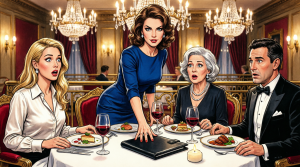
He passed my father. He passed Lauren. He passed my mother, who was still smiling at the center of her own performance. He walked directly to me with the solemn discretion of a man handling something important and set a black leather folder neatly beside my plate.
Not in the middle of the table. Not toward the end where my father sat. Not near the guest of honor. In front of me.
There are humiliations so precise they feel rehearsed.
I looked down at the folder as if it had appeared by magic. For one brief, stupid second, I honestly thought it might be a menu for dessert. Then I saw the edge of the receipt inside.
My fingers were suddenly numb.
I opened it.
The total was $3,450.
Not $340. Not even $1,200, which would still have been an obscene amount of money for dinner. Three thousand four hundred and fifty dollars, typed in clean black ink above a blank line for gratuity.
My mother leaned toward me so closely I could smell her perfume, the same expensive floral scent she had worn for as long as I could remember.
“You know,” she whispered, her mouth barely moving, “teacher salaries are stable, Sophia. Support your sister.”
That was the moment something inside me stopped trying.
Not shattered. Not exploded.
Stopped.
Like a machine that had been overworked for years finally hitting its limit and going still.
I looked at the number again. Then I looked at my mother.
If this had happened ten minutes earlier, if she had not made her toast, if she had not stood in front of an entire room and publicly named Lauren as the daughter she was proud of while privately handing me the bill for Lauren’s celebration, I probably would have paid. My hands would have shaken, my stomach would have dropped, and afterward I would have lain awake at three in the morning doing panicked calculations about rent and groceries and the credit card balance, but I would have paid.
Because that was the arrangement, though no one had ever said it plainly enough for me to refuse it.
Lauren got applause.
I got invoices.
But something about the cruelty of the sequence broke the trance.
Praise her.
Charge me.
Call it family.
I slid the folder closed.
Then I pushed it back across the table with one finger.
The soft scrape of leather against linen seemed louder than my mother’s toast had been.
“I’m not paying for this,” I said.
My voice was quiet. Very quiet. So quiet that the people closest to us leaned in automatically, and in leaning in, they made it heard.
The table went still.
My mother blinked as though she had not understood English for a second.
Lauren’s face changed first. Not with embarrassment, not even with anger. With confusion. Real confusion. The confusion of someone encountering a boundary where none had existed before. It offended her on a structural level. It did not fit her understanding of how the world worked.
My father set down his glass with a small, sharp click. “Sophia,” he said in the tone he used when I was twelve and had tracked mud onto the kitchen floor. “Don’t be dramatic.”
I met his eyes. “I’m not.”
I stood up.
My chair slid backward across the carpet.
Jacob was already rising beside me, not because I asked him to, but because some part of him had known this moment was coming even if I had not.
I picked up my purse.
“I’m just leaving,” I said.
The fact that I did not raise my voice made them angrier. You can argue with a tantrum. A tantrum confirms the family narrative that you are unstable, childish, overreacting, emotional. Calm refusal is much more dangerous. Calm refusal suggests reason. It suggests memory. It suggests the possibility that the person you thought was under your control has been paying attention all along.
“Sophia,” my mother hissed. “Sit down.”
I didn’t.
I turned and walked out of the private room.
I can still remember every detail of that walk as if it happened in bright weather rather than low light.
The main dining room of the Monarch glowed under gold pendant lamps. Waiters in black jackets moved between tables carrying plates that looked like art installations. Somewhere, someone laughed too loudly. Somewhere else, a woman in emerald silk reached elegantly for a glass of red wine. The room smelled like steak and truffle butter and expensive perfume and polished wood. It smelled like indulgence. It smelled like people who had never had to check the balance in their checking account before ordering dessert.
My heels clicked across the floor. I became aware of the cold air on my skin, of my heartbeat, of the fact that my hands were shaking so badly I had to clench them into fists just to keep walking straight. I did not look back. If I had looked back, I might have seen my mother’s outrage or my father’s disbelief or Lauren’s wounded princess stare, and maybe one of those familiar expressions would have reached into me and tugged the old strings.
Instead I kept moving.
Past the host stand.
Past the velvet rope.
Out the heavy front door and onto the sidewalk.
The night air hit me like a glass of water thrown in my face.
For a second I just stood there breathing.
The city was alive around me in the detached, indifferent way cities always are. Cars passed. A bus sighed at the curb across the street. Two women in bright dresses stood under the awning laughing into their phones. A cyclist zipped past wearing a reflective jacket. Nobody knew my life had just tilted. Nobody cared. There was something almost kind about that.
The restaurant door opened behind me a minute later.
Jacob came out and didn’t say a word. He just walked to the valet stand, handed over the ticket, then came back to stand beside me. After a moment, he took my hand.
His hand was warm. Solid. Real.
I think if he had asked, “Are you okay?” right then, I might have collapsed into tears. But he didn’t ask. He knew better than to offer me an easy lie.
We waited in silence until our car pulled up. It was a sensible sedan, four years old, with a faint scratch near the back bumper from where a shopping cart had once rolled into it in a grocery store parking lot. My parents hated that car. They thought it made us look unsuccessful. They drove a luxury SUV that cost more per month than my rent.
I got in behind the wheel because I needed something mechanical to do. Jacob settled in beside me. I pulled away from the curb and merged into traffic.
For several blocks, neither of us spoke.
The city lights smeared into red and white streaks across the windshield. My grip on the steering wheel tightened until my knuckles ached. I could still see the black folder in front of me. Still hear my mother’s whisper. Teacher salaries are stable.
It was such a revealing sentence.
Not teachers are underpaid.
Not you work hard.
Not I know this is a lot to ask.
Stable.
As if my discipline, my budgeting, my caution, my planning, my refusal to live beyond my means were not qualities but assets they had a claim on. As if the salary I earned spending my days managing thirty teenagers at a time, breaking down the causes of revolutions and the failures of empires and the human cost of greed, existed primarily to underwrite my sister’s fantasy life.
“You okay?” Jacob asked finally.
“No,” I said.
“Good,” he said.
I shot him a look. “Good?”
He leaned back against the seat and stared out the windshield. “You shouldn’t be okay.”
There are people who comfort by softening reality and people who comfort by clarifying it. Jacob always did the second thing. At first, when we started dating, it unnerved me. I was used to people around my family speaking in layers, implication, guilt, suggestion, emotional theater. Jacob was not a layered person. He was kind, but he was plainspoken. When something was wrong, he said it was wrong. When someone was manipulative, he said manipulative. He did not wrap rot in ribbon and call it tradition.
I swallowed. “I don’t know. Maybe I overreacted.”
He turned to me so fast I felt it before I saw it. “No.”
“It’s her birthday.”
“It’s her thirty-second birthday, Sophia,” he said evenly. “And that wasn’t a birthday dinner. That was a performance. A brand launch dinner for a brand that doesn’t make money. They ordered the most expensive things on the menu because they knew they weren’t paying.”
I stared at the road.
“You know why the waiter walked straight to you?” he continued. “Because somebody told him to.”
I hadn’t let myself think that yet.
My stomach tightened.
He went on, not cruelly, just clearly. “That doesn’t happen by accident. He didn’t guess. Your mother or your father told the staff ahead of time that the bill was yours. They planned it. That’s why nobody even looked surprised when he handed it to you. They were only surprised you said no.”
Tears pressed suddenly behind my eyes. I blinked hard and kept driving.
“It’s not just tonight,” he said more gently.
And because he said it, because he named the thing I had spent years blurring, memories began surfacing one after another, clean and ugly as bones washed up after a storm.
Three months earlier, my father had called on a Thursday afternoon while I was on my planning period. I remember because I was eating yogurt at my desk and entering quiz grades.
“Sophia, sweetheart,” he had said in a strained voice I had been trained to hear as urgent. “I need a little help. There’s been some issue with the bank. Temporary problem. Mortgage payment’s tied up. I’m short two thousand. Can you transfer it? Just until Monday.”
I did it within ten minutes.
Monday came and went.
Then a week.
Then three.
He never mentioned it again.
When I once timidly said, “Hey, Dad, about that transfer,” he frowned like I had brought up a vulgar topic at church and said, “I thought you understood that family doesn’t nickel-and-dime each other.”
At Christmas, Lauren had wanted a trip to Tulum because she needed “sunset architecture and neutral resort content” for her audience. My parents said they couldn’t afford it, then looked at me with that terrible softness I had come to dread. Not the softness of love. The softness of expectation wrapped in morality.
“You don’t have kids,” my mother had said. “You have savings. Help your sister build something for herself.”
I paid for the flight. I paid for the hotel. I paid extra because Lauren needed the room with the balcony and the plunge pool because “without an aspirational visual, what’s the point?” She posted bikini shots and rooftop dinners for a week under captions like self-made and grateful for the grind. She never tagged me. She never thanked me. My mother told everyone Lauren had funded the whole trip herself through partnerships.
Two years before that, Lauren had called me sobbing from a police station after a DUI. I was asleep when the call came. It was 1:17 a.m. Jacob and I had not been living together yet. I remember sitting bolt upright in the darkness, heart racing, as Lauren gasped, “Sophia, please, please don’t tell Mom and Dad, I can’t, they’ll die, please come get me.”
I got dressed in the dark and drove across town.
She needed bail money. She needed a lawyer. She needed someone to absorb the consequences so the consequences could keep being optional for her.
I drained my emergency fund. Five thousand dollars gone in less than forty-eight hours.
When I brought her back to my parents’ house that morning, my mother rushed to Lauren first. Wrapped her in a blanket. Made tea. Smoothed her hair. Whispered that everything would be all right.
Then she turned to me in the kitchen and said, “Thank God you handled that. We can’t have a scandal. It would destroy your father’s reputation at the club.”
Not How much did it cost?
Not Are you okay?
Not Thank you.
Handled that.
Like I was maintenance staff fixing a plumbing issue.
I gripped the steering wheel harder.
“I’ve been an idiot,” I whispered.
Jacob was quiet for a moment. Then, softly, “No. You’ve been a daughter who wants to be loved. That’s not the same thing.”
That nearly undid me.
Because the most humiliating part was not the money. Not really. Money was trackable. Money could be counted, listed, totaled. The deeper humiliation was the reason I kept giving it. I gave because every transfer, every rescue, every paid bill carried a little delusional hope inside it. Maybe this one will make them see me. Maybe this one will count. Maybe this one will earn me the kind of pride they hand Lauren for free.
“It’s the toast,” I said after a long silence. “That’s what I can’t get past.”
“I know.”
“She stood there and said Lauren is the daughter she’s proud of while I was sitting there about to pay for the whole thing.”
“That,” Jacob said, his voice flattening with disgust, “is what makes me sick. They insult you while their hands are in your pockets.”
We pulled into our apartment garage a few minutes later.
Our building was modest and clean, the kind of place with beige walls, potted plants by the entry, and a management company that sent too many emails about recycling rules. It wasn’t glamorous, which was exactly why I liked it. I liked predictability. I liked rent that did not require prayer. I liked hallways that smelled faintly of laundry detergent instead of status. Jacob and I lived carefully. We budgeted. We cooked. We argued about practical things like whether we could justify replacing the mattress this year or should wait until next spring. We did not order seafood towers. We did not hire photographers. We did not say the word brand over dinner.
I turned off the engine and sat in the darkness for a second.
“It stops today,” I said.
Jacob unbuckled slowly and looked at me. “I hope so.”
Then he added, “But you know what’s coming next.”
“What?”
“The guilt.”
He said it matter-of-factly, like naming weather rolling in over the horizon.
“They’re going to call. They’re going to text. They’re going to tell you you embarrassed them, hurt Lauren, ruined the night, disrespected the family. They’re going to make your refusal the real crime. Are you ready for that?”
I thought about my mother’s face when I pushed the bill back.
About the amount.
About the whisper.
About the way the waiter had walked straight to me like an arrow released from a bow.
“I’m ready,” I said.
It was a lie.
I was not ready.
But I was out of alternatives.
The second we walked into the apartment, my phone started buzzing inside my purse.
Not ringing. Buzzing. Over and over and over. A trapped insect sound. Urgent. Furious.
I set my purse on the kitchen island and stared at it for a second as the vibrations continued against the wood. Then I pulled out my phone.
The screen was lit with notifications.
Mom: Where did you go?
Mom: Sophia, come back immediately.
Lauren: Are you serious right now???
Dad: Pick up the phone.
Mom: The waiter is standing here.
Lauren: You literally ruined my night.
Dad: Unacceptable behavior.
Mom: Everyone is staring at us.
The familiar panic response kicked in so fast it was almost chemical. Heat in my chest. Weakness in my knees. The old training. Fix it. Fix it now. Make the sound stop. Make them stop being angry. If you act quickly enough, maybe nobody has to feel anything for very long.
My thumb hovered over the screen.
Jacob came into the kitchen, saw my face, and covered my hand with his.
“Don’t,” he said.
“They’re still there,” I whispered.
“They have credit cards.”
“What if they can’t pay?”
He stared at me. “Sophia. Your father wears a watch that costs more than our couch. Lauren has a Gucci bag. Your mother gets her hair done every two weeks. They can pay. They just don’t want to.”
The phone buzzed again.
Mom: I cannot believe you would do this to your sister on her big night. You know how hard she has worked for this brand. You are being incredibly selfish. We are family. We support each other.
Lauren: I literally hate you right now.
Dad: Answer your mother.
Mom: The manager is threatening to call the police if we don’t settle the bill. Do you want your father arrested? Is that what you want?
That one hooked exactly where she intended it to. My father arrested. Not because of his own choices, not because he had walked into a restaurant and ordered extravagantly without arranging payment, but because I, by refusing to absorb the cost, had supposedly endangered him. The emotional logic was obscene. It was also familiar.
Jacob gave a short, humorless laugh. “Nobody’s getting arrested. They’ll put it on a card and complain about it all week. Stop reading.”
But I kept reading because that is what daughters like me do. We read our own indictments looking for a sentence that sounds enough like love to keep us in the courtroom.
Lauren: You’ve always been jealous.
Lauren: You hate when I have attention.
Lauren: Sorry your life is boring but that’s not my fault.
Dad: We raised you better than this. Walking out on a bill is classless.
Classless.
That word made something cracked and bitter rise in me, almost a laugh. My father, who expected his daughter to quietly finance his lifestyle, calling me classless because I declined.
I sat down hard on one of the bar stools.
Jacob leaned against the counter across from me. He waited.
“Do you notice what they aren’t asking?” I said finally.
He tilted his head. “What?”……………………………………..

