For 25 Christmases, a Stranger Watched Me… Then I Learned He Was My Father

For 25 Christmases, A Stranger Stood Outside Our House In The Same Spot At The Same Time. He Never Knocked. My Parents Were Terrified And Called The Police Every Year. When I Was 15, I Finally Asked Him, “Who Are You?” He Looked At Me, And His Eyes Were The Same Color As Mine. HE STARTED CRYING…
HE STOOD UNDER THE SNOWY STREETLIGHT EVERY CHRISTMAS EVE, AND NO ONE IN MY HOUSE EVER SAID HIS NAME THE SAME WAY TWICE.
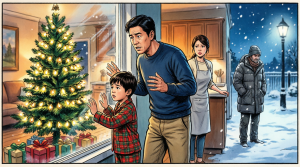
Some families measure Christmas in ornaments, casserole dishes, wrapping paper, and the same old vinyl record playing near the fireplace. Mine had all of that too. The same cedar garland on the stairs. The same church service in the early evening. The same quiet Connecticut street lined with porch lights and frozen lawns. But for as long as I can remember, Christmas Eve in our house also came with one more thing: a man across the street, standing still in the snow, looking toward our windows like he was waiting for a life that never opened for him.
I was five the first time I noticed him.
I was fifteen when I finally walked out to him.
And by then, I had already spent a decade watching my parents turn tense the moment they saw his silhouette under the oak tree. My father would go quiet first. My mother would busy her hands with plates, napkins, anything. Then one of them would make the call, and a few minutes later a police cruiser would glide onto our street and take the man away like part of a ritual everyone knew by heart except me.
“He’s not someone you need to think about,” my father told me once.
That only made me think about him more.
Because people don’t usually come back to the same place, on the same night, for twenty-five years unless something very deep is keeping them there.
By high school, I had memorized the pattern. He arrived near eight. He stood far enough away to keep the peace, close enough to see the front windows. He never pounded on the door. Never made a scene. Never asked for anything while I was watching. He just looked.
And every year, my mother seemed a little more fragile after he left.
One Christmas, I found her at the front window after the living room had emptied and the cocoa had gone cold in the mugs.
“Mom?”
She blinked and turned around too fast.
“You startled me.”
“Why were you standing here?”
“I wasn’t.” She smoothed the front of her sweater. “Go upstairs, sweetheart.”
But her eyes looked glassy in the tree lights, and that image stayed with me longer than any gift I opened that year.
Then came the Christmas Eve when I finally stepped outside.
The air was sharp enough to sting my throat. Snow rested on the mailbox, the hedges, the rooflines, turning our whole street into one of those postcard scenes people send from New England every December. I crossed the road in boots and a borrowed coat, every step feeling like I was walking into a story my parents had spent my whole life editing.
He saw me coming.
Up close, he wasn’t what I had been told to expect.
He looked older, yes. Tired, definitely. But there was no wildness in him. No chaos. Just a strange, heartbreaking gentleness. His face was lined from weather and time, and when I stopped a few feet away, he looked at me as if he had already lived this moment a thousand times in his head.
“Who are you?” I asked.
His lips parted. He swallowed.
“I’m sorry,” he said.
“For what?”
His eyes moved over my face the way someone looks at a photograph they’ve carried too long.
Then the front door behind me banged open.
“Ryan!”
My father’s footsteps hit the porch hard.
The man lifted his head and looked at him, not at me now, and the whole night seemed to tighten between them.
“Tell him the truth,” the man said.
Not loud. Not dramatic. Just steady enough to land where it was meant to.
My father grabbed my arm.
“Inside. Now.”
I stumbled backward once, still looking at the man in the snow. His face had changed. Whatever composure he had been holding all these years slipped for one instant, and I saw the kind of sorrow that doesn’t belong to one night. It belongs to years. To birthdays missed. To words never said. To something that has had to live outside in the cold because no one would let it come home.
Inside, my father shut the door and said exactly what he always said.
“Stay away from him.”
But after that, I couldn’t unhear those words.
Tell him the truth.
I carried them into college, into adulthood, into my career in Philadelphia, into every holiday visit where my parents still acted like our family photo albums had no missing pages. I stopped asking out loud, but I never stopped wondering. About the way that man looked at our house. About why my father sounded more unsettled than angry. About why my mother never met my eyes when I brought it up.
Then, three days after Christmas, my phone rang.
A Hartford lawyer.
A name I didn’t recognize.
A voice so calm it made the next sentence hit even harder.
“Mr. Anderson, I’m calling regarding the estate of David Mitchell.”
“I think you have the wrong number.”
“I do not.”
I stood there in my kitchen with the radiator humming softly behind me, one hand on the counter, not yet understanding why the room suddenly felt too small.
“David Mitchell,” the attorney said, “passed away on Christmas morning.”
I almost said I was sorry for the family before realizing I didn’t know this man at all. Or at least I thought I didn’t.
Then the attorney went on.
“He named you as his sole beneficiary.”
I didn’t say anything.
I couldn’t.
And then came the line that made every Christmas Eve of my life rearrange itself in my mind.
“Mr. Anderson… David Mitchell was not a stranger to you.”
I was five years old the first time I saw him. It was Christmas Eve, 1994. Snow was falling outside, big fat flakes that caught the light from our porch and sparkled like diamonds. I was supposed to be in bed, supposed to be asleep so Santa could come, but I had snuck downstairs to peek at the presents under the tree. I was crouched behind the couch, counting the boxes with my name on them, when I saw movement through the window. A man was standing across the street. He was tall, wearing a dark coat, his breath forming clouds in the frozen air. He was not moving, not walking anywhere, not waiting for someone. He was just standing there, perfectly still, staring at our house, staring at me. I did not scream. I did not run. I just stared back, this five-year-old boy in his pajamas locked in a silent exchange with a stranger in the snow. There was something in his eyes, even from that distance, that I could not understand. Something sad. Something desperate. Something that looked almost like love. Then my father’s hand clamped down on my shoulder.
“What are you doing out of bed?”
“Daddy, there’s a man outside.”
My father looked through the window, and his face changed. I had never seen that expression before, but I would see it many times over the years. Fear. Pure, naked fear.
“Go to your room. Now.”
“But Daddy—”
“I said now.”
I ran upstairs. From my bedroom window, I watched my father burst out the front door and march across the lawn. I could not hear what he was saying, but I could see him pointing, gesturing, his body rigid with anger. The man in the coat did not move, did not respond. He just stood there, absorbing my father’s rage as if it were nothing. Then the police car arrived. Two officers got out. They talked to my father, then walked over to the man. I watched them escort him to the patrol car, watched them put him in the back seat, watched the car drive away into the snowy night. The man looked up at my window as they drove past. Even through the glass, even through the falling snow, I swear he was looking directly at me. I did not sleep that night. I lay in bed staring at the ceiling, thinking about the man in the coat, thinking about the way my father’s face had changed when he saw him, thinking about that look in the stranger’s eyes. I did not know it then, but that Christmas Eve was the first of twenty-five. Every year, without fail, the man would return. Same spot, same time, same silent vigil in the snow. And every year, my parents would call the police.
I should tell you who I am. My name is Ryan Anderson, and I am thirty-five years old. I work as an architect in Philadelphia, designing buildings that I hope will still be standing long after I am gone. I have a good life by most measures, a career I love, an apartment in a nice neighborhood, friends who care about me, all the trappings of success you are supposed to accumulate by your mid-thirties. But I have always felt like there was something wrong with my life. Something off, like a painting that looks fine from a distance but reveals strange distortions when you look too closely. My parents were good people, or at least they seemed like good people. My father, Richard Anderson, was an accountant, steady and reliable, the kind of man who wore the same style of khaki pants every day of his life. My mother, Patricia, was a homemaker who later became a real estate agent. They lived in the same house in suburban Connecticut for forty years, attended the same church every Sunday, had the same friends over for dinner every month. They were normal. Aggressively, almost performatively normal, the kind of family that appears in stock photos for picture frames. But there was always something underneath, something I could never quite put my finger on. A tension in the air when certain topics came up. A guardedness in my mother’s eyes when I asked about my birth or my early childhood. A way my father would change the subject whenever I mentioned the man who came every Christmas.
“He is a stalker,” my father told me when I was eight, old enough to start asking real questions. “A dangerous man. He is obsessed with our family for some reason. The police know about him. They keep an eye on him.”
“But why does he come every Christmas?”

Part 2

“But why does he come every Christmas?”

My father didn’t answer right away.

He adjusted his glasses, looked past me instead of at me, and said the same thing he always said when he didn’t want to explain something.

“Some people are just… not right. Stay away from him.”

That answer never satisfied me.

Because the man outside never acted like someone dangerous.

He never shouted.
Never moved closer.
Never tried to come in.

He just… stayed.

Like someone holding onto a moment that the rest of us had already decided to forget.


Years passed.

I grew up. I left. I built a life.

But every Christmas Eve, no matter where I was, I found myself thinking about him. About the way he looked at our house. About the way my parents avoided his name like it carried something contagious.

And about the one thing I could never ignore.

His eyes.

The same color as mine.


Back in my apartment, holding the phone to my ear, I finally found my voice.

“I don’t understand,” I told the lawyer. “Why would he leave anything to me? I don’t even know him.”

There was a pause.

Then the lawyer said it gently.

“Yes… you do. You just weren’t told the truth.”

My grip tightened on the phone.

“What truth?”

Another pause.

The kind that prepares you for something that will change everything.

“David Mitchell… was your biological father.”


The world didn’t crash.

It didn’t explode.

It just… shifted.

Like everything I had ever believed quietly stepped out of place.

“No,” I said automatically. “That’s not possible.”

“I understand this is difficult,” the lawyer continued, calm and steady. “But the documentation is clear. He relinquished custody when you were very young. Your mother remarried shortly after. Your legal father adopted you.”

I couldn’t breathe properly.

Every Christmas Eve.

Every single year.

That man hadn’t been a stranger.

He had been my father… standing across the street, watching his son grow up from a distance he was never allowed to cross.


“Why didn’t he ever come to the door?” I whispered.

The lawyer’s voice softened.

“He tried. Once. Many years ago. Your father made it very clear he was not welcome. After that… he kept his distance. But he never stopped coming.”

“Why Christmas?”

“Because,” the lawyer said quietly, “that’s the only day your mother ever agreed he could see you… from afar.”


I sank into the chair behind me, my legs suddenly too weak to hold me.

All those nights.

All those silent stares.

All that waiting.

It wasn’t obsession.

It was love… with rules.


“There’s more,” the lawyer said.

Of course there was.

“There’s a letter. He asked that you read it.”


It arrived two days later.

A simple envelope.

My name written in careful, slightly shaky handwriting.

I sat at my kitchen table for a long time before opening it.

Then, finally, I did.


Ryan,

If you’re reading this, it means I no longer get to stand across the street and see the lights in your house on Christmas Eve.

I’m sorry for that. It was the only tradition I allowed myself.

I know you don’t know me. That was never your fault.

When you were very young, I made mistakes. Real ones. The kind that cost you everything. Your mother did what she thought was best. Your father—Richard—gave you a life I couldn’t at the time. And for that, I hated him… until I realized he was giving you what I couldn’t.

So I stayed away.

But I needed to see you. Just once a year. Just to know you were okay. That you were growing. That you were happy.

You used to look out the window when you were little. Do you remember? Probably not. But I do. Every time.

You have my eyes. That was enough for me.

I wanted to come closer. Every year, I thought maybe this time I would knock. But I made a promise… and I kept it.

I’m sorry I wasn’t there for your first steps. Your birthdays. Your life.

But I was there. Just… not where you could reach me.

If there’s one thing I hope, it’s that you never feel unwanted. Because you weren’t. Not for a single day.

I loved you from a distance the only way I was allowed to.

— Dad


I didn’t realize I was crying until the paper blurred in my hands.

Not loud. Not dramatic.

Just quiet, steady tears… like something inside me finally understood what it had been missing all along.


That year, on Christmas Eve, I drove back to Connecticut.

I stood across the street.

In the exact same spot under the oak tree.

Snow fell softly around me.

The house looked smaller than I remembered.

The lights were still on.

Everything the same.

Except now…

I understood.


Inside, my parents moved around like they always had.

But this time, I didn’t feel like I was on the outside of the truth anymore.

I had it.

Even if it came too late.


I stayed there for a long time.

Then I whispered, into the quiet night:

“I see you now.”


And for the first time in twenty-five years…

No one called the police.

Some people don’t leave your life… they’re just forced to love you from a distance.

The End

Leave a Reply

Your email address will not be published. Required fields are marked *