Part 1
The first thing I noticed in Mr. Patterson’s office was the silence. Not the calm kind, either—the kind that presses on your eardrums after someone says the name of a person who will never answer again.
Dad had been gone for three weeks, but the paperwork made it feel like he was still in the next room waiting for someone to call him back. There were framed degrees behind Patterson’s desk, a leather blotter, and a brass lamp that threw soft light across a table polished enough to show my tired face in the reflection.
Victoria sat across from me like she’d stepped out of a bridal magazine. Perfect hair, perfect nails, perfect posture. Her engagement ring was enormous, and she kept turning her hand as if the room needed reminding.
Patterson adjusted his glasses, the way he always did right before he said something that would make people upset.
“As executor of your father’s estate,” he began, “my job is to make sure the distribution is clear and consistent with the will.”
Victoria smiled without warmth. “It will be.”
He tapped a folder. “Total value is four hundred eighty thousand dollars.”
I swallowed. It wasn’t a fortune, but it was the kind of money that could change the texture of your life—pay off a mortgage, wipe away debt, buy time. Dad had worked hard, quietly. A man who fixed his own gutters and drove cars until the wheels begged for mercy.
“Per your father’s instructions,” Patterson continued, “the estate is divided equally between his two daughters.”
Victoria’s smile froze. “Equally?”
“Two hundred forty thousand each,” Patterson said.
It took my sister half a second to transform. Her cheeks flushed a bright, offended pink, and the ring stopped sparkling because her hand clenched into a fist.
“That can’t be right,” she said, voice sharpening. “Dad wouldn’t—”
Patterson held up a hand, polite but firm. “Miss Brennan, he was very explicit.”
Victoria leaned forward. “He knew I’m getting married. He knew what kind of wedding I’m planning.”
I had heard about the wedding for the last eight months the way you hear about weather—something constant and inevitable, discussed with dramatic urgency. The Belmont estate. The historic ballroom. The imported flowers. The photographer who only did celebrity weddings. Victoria talked about it like a birthright.
Patterson glanced down at his notes. “Your father did make a separate note. He expressed concerns about the cost of the wedding you discussed with him before his passing.”
Victoria’s eyes flashed. “Dad understood. He wanted me to have a beautiful wedding.”
“Dad wanted a lot of things,” I said quietly, and immediately regretted speaking.
Victoria’s head snapped toward me. “Don’t.”
Patterson continued, because he’d spent decades watching families fall apart over money and had learned not to pause for sentiment. “The will provides for both daughters. It does not authorize a different allocation based on one daughter’s anticipated expenses.”
Victoria sat back, lips parting slightly in disbelief. It was the same look she used to wear when a teacher told her she wasn’t allowed to change the rules because she didn’t like them.
“This is a mistake,” she said, already reaching for her purse.
“It isn’t,” Patterson replied. “If you’d like, I can show you the exact language again.”
Victoria stood so fast her chair legs scraped. “No. I know what it says. I also know what Dad told me. This isn’t over.”
She swept toward the door, heels clicking like punctuation. A gust of cold air followed her when she yanked it open, then the sound of it slamming shut echoed down the hallway.
Patterson exhaled slowly and looked at me with the careful neutrality of someone who has learned not to take sides out loud.
“I’m sorry,” he said. “I know this is difficult.”
I stared at the folder. Dad’s signature at the bottom of the will looked steady, like he’d written it the way he lived—no extra flourish, no apology.
“It’s not the money,” I said, though that wasn’t entirely true. “It’s the way she makes everything feel like a hostage situation.”
Patterson slid a stack of documents toward me. “I’ll need your signature on these. And… for what it’s worth, your sister seemed determined long before she walked in here today.”
“She always is,” I said, and signed where he indicated.
As I gathered my papers, I felt a familiar ache behind my ribs—something old, something built over years of being the quieter daughter, the one who got praised for being “easy,” which is another way of saying convenient.
In the parking lot, I saw Victoria’s Mercedes still idling under a tree. She sat behind the wheel with her phone pressed to her ear, her hand slicing the air as she talked. I didn’t have to hear the words to know who she was calling.
Mom.
By the time I got home, my phone was already buzzing like a trapped insect.
I waited, took a breath, and answered.
Mom’s voice came through tight and controlled. “Victoria is devastated.”
“It’s Dad’s will,” I said.
“She’s under so much pressure,” Mom continued as if I hadn’t spoken. “You know how important this wedding is to her.”
I set my keys down on the kitchen counter, the sound too loud in my quiet house. “Mom, she’s talking about spending more than the entire estate on one day.”
“She wants it to be special.”
“So did Dad,” I said, and my throat tightened unexpectedly. “For both of us.”
There was a pause—one of those pauses that tells you the person on the other end is choosing their next words carefully because they already know you won’t like them.
“You could be generous,” Mom said finally. “You have your job. You’re… you’re stable.”
I almost laughed, but it came out as a breath. My parents thought my stability was a small miracle. They assumed I did something harmless at the hospital—paperwork, scheduling, meetings where people nod and drink coffee. I had never corrected the misconception, mostly because it made family gatherings easier. It was hard to be jealous of a daughter who was “just doing admin.”
“The will divides it equally,” I said. “That’s what Dad wanted.”
Mom’s control snapped, just enough for her real frustration to show. “You’re being selfish.”
Then she hung up.
I stood in my kitchen for a long moment, phone in hand, staring at the window above the sink where the late afternoon sun made the glass look like liquid.
Three days later, Victoria came to my house.
Part 2
I lived in a modest two-story place in a quiet neighborhood where people waved when they walked their dogs. My lawn was tidy in the way of someone who respected the neighbors but didn’t feel the need to impress them. The house wasn’t flashy, and that was intentional. In my line of work, attention was currency, and I’d learned to spend it carefully.
Victoria’s car rolled into my driveway like a threat.
She didn’t knock so much as announce herself with the doorbell, the kind of press that says, I’m here and you will deal with me.
When I opened the door, she pushed past me as if the house belonged to her, too.
Behind her came Derek—tall, handsome in a bland way, wearing the slightly panicked expression of a man who’d been dragged into a fight he didn’t understand. He held a paper coffee cup like it was a shield.
“We need to talk,” Victoria said, already moving toward my living room.
“Vic,” Derek murmured, “maybe we should—”
“Not now,” she snapped, then turned to me. “I’ve done the numbers.”
I shut the front door slowly, as if moving too fast might ignite something. “Numbers.”
“The Belmont estate,” she said, counting off on her fingers. “The venue, the catering, the band, the flowers. The photographer is non-refundable. The dress I want has to be ordered from Milan.”
“Victoria,” I said, keeping my voice even, “you don’t have to do any of that.”
She swung toward me, eyes bright with fury. “You don’t get to tell me what I have to do. This wedding is my life.”
“It’s one day,” I said, then immediately regretted it. Saying “one day” to Victoria was like telling a hurricane it was “just wind.”
Derek shifted uncomfortably. “My parents… they said they’d be happy with something smaller. We could do—”
“Derek,” Victoria said, slicing his name into pieces. “Please.”
He fell silent.
Victoria stepped closer, lowering her voice like she was offering me a secret. “The full wedding is about three hundred forty thousand.”
I blinked. “You’re saying that out loud like it’s normal.”
“It’s the standard for our circle,” she replied, and I couldn’t tell if she believed it or if she’d repeated it so many times it had become true in her mind.
“Your circle,” I echoed, thinking about our childhood—two girls in a middle-class house, Dad teaching us how to balance a checkbook and Mom insisting we write thank-you notes.
Victoria’s gaze locked onto mine. “I need your portion.”
A cold, slow anger crept up my spine. “No.”
Her face twisted as if I’d slapped her. “It’s Dad’s money.”
“It’s Dad’s estate,” I corrected. “And he split it equally.”
“Because he didn’t understand,” she insisted. “He didn’t understand what’s expected. Derek’s parents are expecting something spectacular.”
Derek’s mouth opened, then closed. He looked at his shoes.
I crossed my arms. “If they’re expecting it, they can pay for it.”
Victoria’s laugh was sharp. “You’ve always been jealous of me.”
The words hit me like a familiar script. Jealous. Bitter. Small. It was the same story she’d told since we were kids—if I didn’t give her what she wanted, it was because I couldn’t stand seeing her shine.
“I’m not jealous,” I said. “I’m tired.”
Her eyes narrowed. “You work at a hospital doing whatever boring administrative thing you do. You’ll be fine. I need this.”
I felt Derek’s eyes flick toward me, curious, as if he was suddenly realizing he didn’t actually know what I did.
“I think you should leave,” I said.
Victoria’s lips pressed into a thin line. For a moment, I thought she might cry. She’d always been good at weaponizing tears. But the softness never came. Instead, something harder slid into place.
“Fine,” she said. “But this isn’t finished.”
She grabbed Derek’s arm and dragged him toward the door. He glanced back at me once, a look that was almost apology, almost fear.
As soon as they left, my phone started ringing.
Mom. Aunt Linda. Cousins who hadn’t spoken to me since high school, suddenly full of advice and outrage. The messages piled up—be reasonable, don’t ruin her dream, family is everything.
I didn’t answer.
I went to work the next morning the way I always did—early, before the building filled with noise. Regional Medical Center sat on a wide stretch of land like a small city, all glass and steel and humming machines. In the executive elevator, my reflection looked composed, the way I’d trained it to look. There were meetings, budget approvals, staffing concerns, a debate about upgrading security in certain employee parking areas.
I had built a life that ran on systems and protocols, where emotions were acknowledged but never allowed to drive the decisions.
At lunchtime, Jennifer Kim—my chief medical officer and one of the only people who could read me with unsettling accuracy—leaned against my office doorframe.
“Bad week?” she asked.
“You could say that,” I replied, scanning a report without absorbing the words.
“Family?”
I hesitated, then nodded.
Jennifer walked in, closed the door, and sat without being invited. “Do you want advice, or do you want someone to tell you you’re not crazy?”
I let out a breath. “Both.”
She listened while I gave her the short version: Dad’s will, Victoria’s demand, the pressure campaign.
When I finished, Jennifer’s expression had gone from sympathetic to angry. “She’s asking you to bankroll a fantasy.”
“She thinks she’s entitled,” I said.
Jennifer leaned forward. “Entitled people do dangerous things when they don’t get what they want.”
I frowned. “She’s dramatic, not violent.”
Jennifer didn’t smile. “Dramatic people can become violent when the drama stops working.”
That night, after another barrage of texts from relatives, I checked my home security system. It was a habit, a comforting ritual—cameras on the porch, the driveway, the backyard, and inside the foyer and basement stairs. The system uploaded to a cloud server automatically, partly for convenience and partly because I’d learned the hard way that evidence mattered.
Everything looked normal.
Two weeks passed, and the pressure didn’t ease.
Then Victoria came back again—this time alone.
She stood on my porch with her makeup smudged and her hair half falling out of its carefully styled waves, looking like someone who had run out of options.
“The venue is going to give my date away,” she said the second I opened the door. Her voice cracked. “I need the deposit by Friday.”
I didn’t move aside.
“Please,” she whispered, and for a moment she looked less like my sister and more like a desperate stranger. “Just this once. Just help me.”
I wanted to believe her. I wanted to believe this was the bottom of her tantrum, that if I stood firm she would eventually climb out and become reasonable.
But then her eyes lifted to mine, and I saw something that made my skin prickle.
Not sadness.
Hunger.
“Victoria,” I said, “I can’t.”
“You can,” she insisted, stepping forward. “You’re sitting on two hundred forty thousand you don’t even need.”
“It’s not about need.”
“Dad’s dead,” she snapped, and the softness vanished as quickly as it had appeared. “He’s not here. But I am. I’m your only sister.”
The air between us felt sharp. I held my ground anyway.
“I’m sorry,” I said. “No.”
The sobbing stopped. Her face went blank, then cold.
“You’re going to regret this,” she said, and there was no drama in it anymore—no performance.
It sounded like a promise.
She walked away before I could respond, slamming my door hard enough that the frame rattled.
I stood there, heart beating too fast, listening to her footsteps fade down the walkway.
That night, I slept lightly, the way you sleep when your mind keeps circling a single thought you don’t want to name.
The next afternoon, I carried a laundry basket up from the basement, thinking about nothing more dangerous than detergent and whether I needed to replace the dryer vent.
Halfway up the stairs, I heard my sister’s voice behind me.
And then everything changed.
Part 3
The basement stairs in my house were original to the build—concrete, narrow, and steep. Fifteen steps from the bottom to the kitchen landing. On one side, a painted cinderblock wall. On the other, open space where I’d always meant to install a railing, the kind of home improvement project that never made it to the top of the list because I was always busy taking care of everyone else’s emergencies.
I had just reached the second-to-last step. The laundry basket was balanced against my hip, warm towels and sheets pressing into my arm.
Behind me, a breath.
Then Victoria’s voice, sharp and too close. “It’s my inheritance.”
My body went rigid. I started to turn, instinctively shifting the basket as a shield, trying to make sense of how she’d gotten into my house without setting off the alarm. I would later learn she’d watched me code the keypad once years ago and remembered it. Victoria remembered everything that served her.
Hands hit my back—hard, flat palms between my shoulder blades.
The world tipped.
The laundry basket lifted like it was weightless and spun away from me. My foot missed the step. My stomach dropped. For a fraction of a second, my mind tried to insist this couldn’t be happening, like denial could act as a brake.
Then gravity took over.
My hip slammed into the edge of a step with sickening force. Pain lit up my side, a white flare. My shoulder hit next, and I felt something in it shift, wrong and sharp. I tried to curl, to protect my head, but there was nowhere to go, only the hard geometry of stairs.
My head struck concrete and sparks exploded behind my eyes. The sound wasn’t dramatic; it was dull, brutal. I tasted metal immediately.
I tumbled, body no longer a thing I controlled. Each impact came faster than I could process, like my bones were being tested one by one.
By the time I hit the bottom, my vision had narrowed to a tunnel. The basement light above me blurred into a smear. My cheek pressed against cold concrete. Something warm ran into my hair and down my temple, sticky and hot.
I tried to move.
Nothing happened.
Panic surged, but it had nowhere to go. My arms twitched. My legs… my legs might as well have belonged to someone else.
Above me, Victoria’s silhouette leaned over the stair opening.
“Get up,” she said.
I opened my mouth to speak, but blood filled it. I coughed and pain flared in my ribs so sharply I couldn’t pull in air.
“Stop faking,” Victoria added, her voice tight with contempt. “You always do this. You always act like the victim.”
A second shadow appeared behind her—Derek.
“Oh my god,” he said. His voice cracked. “Vic, I think she’s really hurt.”
“She’s fine,” Victoria snapped. “She’s trying to guilt me.”
Derek moved down a few steps, slowly, like he was approaching a wounded animal that might bite. His face came into view, pale and terrified.
“She’s bleeding,” he said, his voice rising. “There’s so much blood. We need to call someone.”
Victoria laughed, but it sounded wrong, thin and brittle. “Call who? Mommy? The lawyer? She’ll sit up the second you make me feel bad.”
I tried to blink my vision clear, but even that felt like lifting weight. My mouth formed a single syllable—“Vic”—and it came out as a wet rasp.
Derek flinched. “She’s not okay.”
“Derek,” Victoria hissed, and in that single word I heard the part of her that controlled him, the part that had built their relationship on him being agreeable. “We’re leaving.”
He looked from her to me. His whole body shook with indecision. Then he did something that surprised me.
He stepped down two more stairs, pulled his phone out, and hit emergency call.
Victoria’s head snapped toward him. “What are you doing?”
“What I should’ve done earlier,” he said, and his voice—still scared—had something firmer in it. “I’m calling 911.”
Victoria lunged toward him as if to stop him, but he backed away, keeping the phone up. “Don’t touch me.”
For a moment they stood in a frozen tableau, my sister’s face twisted with rage, her fiancé holding his ground like a man waking up.
Then Victoria spun and stormed out of the basement. I heard her footsteps pound up the stairs. A door slammed—front door, I thought, not the basement.
Derek stayed on the steps, phone pressed to his ear. “Yes,” he said into it, voice shaking. “My fiancée pushed her sister down the basement stairs. She’s bleeding and she’s not moving.”
There was a pause while the operator spoke. Derek swallowed hard. “Yes. Yes, I’m here. I’m with her. She’s breathing but I don’t think she can feel her legs.”
I wanted to tell him not to say those words out loud, as if speaking them would make them permanent.
But the truth didn’t wait for permission.
Derek crouched, careful not to touch my head. “Hey,” he whispered, and there were tears in his eyes now. “Don’t move, okay? Help is coming.”
I couldn’t answer. My chest hurt too much to breathe fully. Every inhale was jagged, as if my ribs had been cracked and turned into knives.
The basement ceiling wavered. My vision darkened at the edges.
“Stay with me,” Derek said, his voice distant, like it was coming from a radio in another room.
The sound of sirens appeared as a faint wail, then grew until it filled the world. Footsteps thundered through my house. Voices—multiple, trained, urgent.
“She’s here,” Derek said. “At the bottom.”
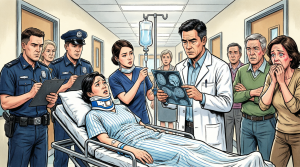
A paramedic knelt beside me. “Ma’am, can you hear me?” Her voice was steady in a way I envied. “Don’t try to move. We’re going to stabilize your neck.”
Hands slid a collar around my throat. Another set of hands pressed gauze against my head. Someone shined a light in my eyes.
“Pupils reactive,” a voice reported. “Possible spinal injury. Limited lower extremity response.”
They rolled me with practiced precision onto a board. Pain shot through my back like electricity. I couldn’t stop the sound that came out of me, half scream, half gasp.
“I’m sorry,” the paramedic murmured. “We’ve got you.”
As they carried me out, my house blurred around me—my framed photos on the wall, my clean hallway, my front door standing open to the late afternoon light.
On the lawn, neighbors had gathered at a distance, faces pinched with concern and curiosity.
I caught a glimpse of Victoria’s Mercedes tearing away down the street.
The last thing I saw before the ambulance doors closed was Derek standing on my porch, hands covered in blood, staring after the car like he couldn’t believe the person inside it.
Then the doors shut, sealing me into bright lights and the smell of antiseptic and urgency.
“Where are we taking her?” someone asked.
“Regional Medical Center,” the paramedic answered.
My hospital.
Even through the fog of pain, a strange, dark thought rose up.
Victoria had no idea what she’d just done.
Part 4
The ambulance ride came in fragments.
The ceiling lights above me vibrated with the movement of the vehicle. The paramedic’s gloved hand stayed on my shoulder, a constant anchor. A blood pressure cuff tightened around my arm and released in a steady rhythm, like the machine was trying to reassure itself that I was still here.
“Name?” someone asked.
My mouth was dry. My tongue felt too heavy. “Morrison,” I whispered.
“First name?”
I forced it out. “Elaine.”
In the front, the radio crackled. “Trauma activation. Female, late thirties. Fall down concrete stairs with suspected assault. Head laceration, possible skull fracture, possible thoracic spinal injury. ETA four minutes.”
The paramedic leaned close. “Elaine, listen to me. Don’t move your head. You’re doing great.”
Great. As if this were something to succeed at.
Pain pulsed behind my eyes, and the world drifted. In the haze, I thought of Dad, of the way he’d squeezed my hand in the hospital before he passed, his voice weak but clear.
Take care of yourself, Laney.
I had promised him I would.
The ambulance doors flew open, and cold air hit my face. The gurney rolled fast. Hospital lights streaked overhead like a tunnel. Voices multiplied—nurses, techs, security.
“Trauma Bay Two,” someone called. “Move.”
They pushed me through doors that hissed open. The trauma bay smelled like latex and disinfectant. Bright lights burned down from the ceiling. People surrounded me, hands working, voices clipped and efficient.
“Cut the shirt.”
“Pupils equal.”
“GCS twelve.”
“Obvious scalp hematoma.”
I tried to focus on the ceiling tiles, but my eyes kept slipping.
Then a voice cut through the noise, and something inside me steadied.
“Wait.”
That voice belonged to Dr. Aaron Patel, head of ortho-spine, a man I’d recruited myself three years ago. He had a calm that could make a room stop spinning.
He stepped closer, and his eyes widened for half a heartbeat—recognition.
The room went quiet in a way that wasn’t procedural.
Someone whispered, “That’s… that’s her.”
A nurse’s hands paused. A resident’s eyes darted between my face and the monitors as if the reality of who I was had rearranged the stakes.
Dr. Patel’s voice turned sharp with command. “Get neurosurgery down here now. Page Morrison’s—” He stopped, correcting himself. “Page Dr. Paige Morrison. Stat. And call the CMO.”
A nurse blinked. “Yes, doctor.”
I wanted to tell them not to panic, not to treat me differently, but the words didn’t come. My jaw trembled, and another wave of nausea rolled through me.
Jennifer Kim appeared at my bedside like she’d materialized from sheer will. Her hair was pulled back, her face serious.
“What happened?” she demanded, and when she asked it, it wasn’t small talk. It was an investigation.
I swallowed, tasting iron. “My sister,” I rasped. “She pushed me.”
Jennifer’s expression hardened so fast it was like watching steel cool. She turned her head slightly. “Security,” she said to someone behind her. “Pull her home footage. Now. And call the police.”
They wheeled me to CT. The scanner was cold and unforgiving. The machine hummed around my head, and I stared at a sticker on the inside of the tunnel—some cartoon astronaut someone had placed there to comfort children.
Back in the trauma bay, Dr. Patel stood by a monitor, scrolling through images. His jaw tightened.
“Compression fracture at T7,” he said, voice controlled. “Hairline fracture at L3. There’s narrowing at the canal around T7.”
Jennifer’s eyes flicked to me, then back to the screen. “And her head?”
Dr. Patel zoomed in on a slice of skull. “Left parietal fracture. Subdural hematoma, small but present.”
A uniformed police officer stood near the door, notebook open. “You said assault?”
Jennifer answered before Dr. Patel could. “Yes. And we have video.”
The officer’s eyebrows rose. “Video?”
Jennifer pulled out a tablet. “Her home system uploads automatically.”
She tapped the screen. A grainy image of my basement stairwell appeared. The camera angle caught the landing, the stairs, my back as I climbed with the laundry basket.
Then Victoria entered the frame.
I heard my own breath hitch. Even now, even after the pain and the blood, seeing it made the reality sharpen into something unbearable.
Victoria moved fast, hands out. The shove was violent, decisive. My body tipped, then disappeared downward in a blur of limbs and fabric. The audio picked up Victoria’s voice—hard, unmistakable.
“Get up.”
The officer’s mouth tightened. Derek’s voice, faint, panicked, overlapped.
Jennifer paused the video and looked at the officer. “A copy has already been uploaded to our secure drive. We’ll transfer it to your department.”
The officer swallowed, then nodded. “I’ll get a warrant.”
Dr. Patel stepped closer to my bed. “Elaine, we need to take you to surgery within the hour. We have to stabilize T7 before swelling worsens.”
I managed the smallest nod, careful not to move my head.
Jennifer leaned over me, her voice quieter but no less intense. “Board protocol has been triggered.”
I blinked, confused.
She squeezed my hand gently. “Executive injury. The MRI, CT, incident report—automated alert goes out to the board within thirty minutes.”
In my fog, I pictured twelve people—surgeons, lawyers, investors, community leaders—opening an email notification about their CEO. Seeing images of my spine and skull. Reading the word assault.
A strange, grim satisfaction cut through the pain.
Victoria had always treated power like it was a spotlight you stood under. But real power was quieter, built into systems, into protocols, into the fact that the right people would now know exactly what she’d done.
My phone, sealed in a belongings bag somewhere, began buzzing. I didn’t hear it, but I saw a nurse glance at it, her eyes widening.
Jennifer’s own phone rang. She stepped aside to answer, voice professional.
“Chairman Chen,” she said, and I heard the board chair’s name like a bell.
“Yes,” Jennifer continued, listening. “You’re looking at the imaging. It’s real. Her sister pushed her down a concrete staircase.”
She paused, then her voice turned clipped. “We need an emergency board convening tonight. All members.”
Dr. Patel turned back to the surgical team. “Prep OR three.”
As they wheeled me toward surgery, the ceiling lights streaked again, and I tried to hold onto one clear thought.
Survive.
Because if I survived, Victoria would learn what she’d underestimated.
Part 5
I woke up in ICU to the steady beep of monitors and the ache of my body reminding me, in a thousand small ways, that I was still alive.
My throat felt scraped raw from the breathing tube that had been removed. My head throbbed in time with my heartbeat. My back burned under a bandage I couldn’t see. And when I tried to move my legs, they answered—slowly, weakly, but they answered.
Relief hit me so hard I almost cried.
Jennifer sat in a chair beside my bed, her blazer tossed over the back like she’d been there for hours. She looked up when my eyes opened, and her face softened just a fraction.
“Surgery went well,” she said. “Patel stabilized T7. The hematoma is resolving. You’re going to be in recovery for a while, but… you’re here.”
I swallowed, wincing. “Victoria?”
Jennifer’s eyes turned cold again. “Arrested.”
A surge of emotion—anger, grief, something like shame—rose up. “What charges?”
“Aggravated assault causing bodily harm,” Jennifer said. “The DA is considering an attempted murder enhancement because of the force, the injuries, and the fact she left you.”
My mouth went dry. It was one thing to know Victoria had pushed me. It was another to hear the legal language that translated it into what it was: a choice that could have killed me.
Jennifer leaned forward. “Derek gave a full statement.”
I closed my eyes briefly. “He called 911.”
“He did,” Jennifer confirmed. “And he told detectives everything.”
I stared at the ceiling. Derek had always seemed like a man who let Victoria write the script. Apparently, even he had limits.
“What about the board?” I asked.
Jennifer’s lips pressed into a grim line. “They convened last night at eight. All twelve. Chairman Chen led. They voted unanimously for full institutional support. Legal team is coordinating with the district attorney. Security improvements you proposed last quarter are being fast-tracked.”
I let the words settle. Twelve people, all with influence, all now personally invested in the fact that their CEO had been assaulted in her own home.
“Any media?” I asked, because that was the kind of question my job trained me to ask even while lying in a hospital bed.
Jennifer nodded slightly. “We’re keeping it controlled. Statement will be minimal: you sustained serious injuries, you’re stable, the incident is under investigation. No family names released publicly yet.”
A nurse came in, checked my vitals, adjusted medication. The fog of painkillers floated around me, but underneath it was a sharp awareness: this wasn’t just a family feud anymore. Victoria had turned it into something public, something that would ripple.
Later that day, Thomas Chen came to see me.
He didn’t come in with a crowd or a dramatic expression. He came in quietly, wearing a suit that looked slept in, his silver hair slightly unkempt. He carried a folder, but he didn’t open it right away.
“How are you feeling?” he asked.
“Like I got hit by a truck,” I rasped.
His mouth tightened sympathetically. “I’m sorry.”
I looked at him. “You saw the imaging.”
“I did,” he said. “All of us did. And we saw the footage.”
The word footage made my stomach twist.
Chen pulled a chair closer, sitting as if he intended to stay long enough to make sure I understood the next part.
“The board voted unanimously,” he said. “We will support you fully. Legal counsel, personal security consultation, whatever you need. You built this institution into what it is. We are not letting this stand.”
A lump rose in my throat, unexpected. “Thank you.”
Chen nodded. “There’s another matter. The estate.”
I blinked. “The inheritance?”
“The estate attorney filed an emergency motion,” Chen said carefully. “Your sister’s actions may constitute grounds for forfeiture under state law. The assets are currently frozen pending investigation.”
I stared at him, processing. Victoria had wanted the entire estate for her wedding. Now she might lose her share entirely—not because I demanded it, but because her own actions had triggered the legal consequences Dad probably never imagined.
That evening, Jennifer brought my phone in, disinfected and placed on the bedside table.
Forty-seven missed calls.
Voicemails from board members, department heads, old colleagues, and—most painfully—my mother.
Mom’s first message was frantic. “Elaine, call me. Victoria said there was an accident, I don’t understand—”
The next message, recorded later, had a different tone. “Elaine… they arrested her. They’re saying she pushed you. Is that true?”
By the third message, her voice had broken into sobs. “What have we done? What did I do wrong?”
I didn’t have the strength to call her back yet. My body was stitched together with hardware and careful surgical work. My mind felt stitched too, but less neatly.
The next morning, Victoria’s bail hearing happened without me. Jennifer watched it on a secure stream with our legal counsel and summarized it for me later.
“The prosecutor presented the footage, your medical records, Derek’s statement,” she said. “The judge set bail at one hundred fifty thousand.”
“Can she pay it?” I asked, though I already suspected the answer.
Jennifer shook her head. “No. She spent her portion on deposits.”
Even in pain, the irony struck. Victoria had tried to steal money she didn’t have yet, spent money she didn’t understand, and now couldn’t afford freedom.
Derek broke off the engagement that afternoon, according to Jennifer. Not with a phone call or a face-to-face conversation, but with a text message. Jennifer didn’t say the words out loud, but I could imagine the message: I can’t do this. I can’t marry this.
Three days into my ICU stay, a detective came to take my formal statement.
He introduced himself as Detective Morris. He was polite, methodical, and clearly already convinced by the evidence.
“I’m sorry to ask you this while you’re recovering,” he said, notebook in hand. “But we need your account on record.”
I told him the truth: the inheritance dispute, Victoria’s threats, the shove, the words she said, the way she left.
Detective Morris’s pen moved steadily. When I finished, he looked up.
“You understand this will likely go to trial,” he said.
I met his eyes. “I understand.”
After he left, Jennifer stood by my bed, arms crossed.
“She’s already blaming you,” she said quietly.
I gave a weak, humorless laugh. “Of course she is.”
In jail, Victoria called Mom and demanded bail money. Mom didn’t have it. Victoria demanded Mom convince me to drop the charges. Mom couldn’t, because this wasn’t a petty accusation anymore—it was bone-deep, visible on imaging, recorded on video.
Victoria’s dream wedding had become a courtroom exhibit.
And my recovery became, in a strange way, the first quiet space I’d had in years to decide what kind of sister I was willing to be.
Part 6
Recovery is not a heroic montage. It’s not inspiring music and immediate progress. It’s repetition and frustration and learning your own body again as if it belongs to someone you’re responsible for but don’t fully understand.
After a week, I moved from ICU to a private room. After two, I began the first stages of physical therapy. The therapist—Marisol, a woman with strong hands and zero patience for self-pity—helped me sit up without turning my spine into fire.
“You’re going to hate me,” she warned.
“I already do,” I croaked, and she laughed like that was a good sign.
The first time I stood, supported by a walker and two nurses, my vision went fuzzy. My heart raced. Every nerve screamed that this was a terrible idea.
“Look at me,” Marisol said firmly. “You’re not falling.”
The word falling hit me like a slap.
I gripped the walker until my knuckles turned white. I stood for ten seconds. Then twenty. Then thirty.
When they helped me back into bed, sweat soaked through my gown and my hair stuck to my forehead. I felt both triumphant and furious—triumphant that I could do it, furious that I had to.
Jennifer checked in constantly, not just as my friend but as the person temporarily holding my job together.
“Executive team is stable,” she said one afternoon, sitting with a tablet. “We’ve delegated your immediate responsibilities. The board is adamant you focus on healing.”
“I hate that,” I admitted.
“I know,” she said. “That’s why I’m telling you. So you don’t try to sneak out and run a hospital with a concussion.”
I stared at the ceiling. “Is the staff… okay?”
Jennifer softened. “They’re angry. Protective. You should’ve seen the trauma nurses when they heard. They wanted to march to the jail themselves.”
I let out a breath. “I never wanted to be that kind of headline.”
Jennifer tilted her head. “You didn’t choose it.”
There were legal meetings I attended from my bed, wearing a hospital gown under a blazer someone had brought me. Our legal counsel walked me through the likely timeline: arraignment, discovery, plea offers, trial if Victoria refused to accept responsibility.
“Video changes everything,” our attorney said. “It’s rare to have that kind of clear evidence.”
I nodded slowly. The camera I installed for safety, the one I’d almost considered excessive, had become the line between truth and Victoria’s version of it.
Meanwhile, the estate attorney handled the inheritance matter. The law wasn’t simple, and it varied by state, but the argument was straightforward: Victoria’s violent act against me in pursuit of financial gain triggered forfeiture provisions meant to prevent someone from profiting from wrongdoing.
Dad hadn’t written those laws, but he’d known Victoria well enough to worry. The note he’d left about wedding expenses felt, in retrospect, like a warning.
Mom called every day. At first, I let it go to voicemail. Each message sounded smaller than the last.
“Elaine, I’m so sorry,” she said. “I should’ve… I should’ve listened.”
Then one afternoon, after Marisol had left me exhausted and shaky, I answered.
Mom’s breath caught. “Elaine?”
“Yes,” I said, and my voice sounded like someone else’s.
She started crying immediately. “I didn’t know. She said you slipped. She said it was an accident.”
I closed my eyes. “Mom. You’ve seen the footage.”
A sob. “Yes. Yes. I saw it. I don’t understand how… how my daughter could—”
“Your daughter,” I said gently, “has been practicing entitlement her whole life.”
Mom went quiet, and I hated myself for the harshness even though it was true.
“She’s in jail,” Mom whispered. “She keeps calling. She keeps saying it’s your fault.”
I opened my eyes, staring at the IV line taped to my hand. “Do you believe her?”
A long pause.
“No,” Mom said finally, voice breaking. “But she’s still my child.”
I swallowed hard. “So am I.”
Mom’s breath hitched like she’d been punched by the simplicity of that statement.
“I know,” she whispered. “I know. I’m sorry.”
We sat in silence on the phone, the kind of silence that held decades.
When I was discharged, eight weeks were prescribed like a sentence: physical therapy, limited walking, no lifting, frequent neurological checks. I went home with a cane and a new relationship with fear.
My house looked the same, but it didn’t feel the same. The basement door made my pulse jump. The stairs were still there, concrete and indifferent. The laundry basket had been collected and placed neatly on a shelf, as if order could erase the violence.
Jennifer insisted on security upgrades immediately. New locks, a new alarm code, a reinforced door to the basement, additional cameras. A private security consultant walked through my home like a somber real estate agent.
“You need a railing here,” he said, pointing at the open side of the basement stairs.
“I know,” I murmured.
“We’ll install it,” he said. “And we’ll install it in a way that you can’t rip it out during a stubborn mood.”
I almost smiled.
At night, I dreamed of falling. In the dream, my body never hit the bottom. It just kept tumbling, step after step, and I woke up with my heart racing and my back aching.
Marisol taught me a breathing technique for panic: in for four, hold for four, out for six.
“It won’t fix the past,” she said. “But it will stop your nervous system from acting like it’s still happening.”
In the middle of all that, the hospital kept running. Patients came in with broken bones and ruptured organs and heart attacks. The trauma center I oversaw—ironically—treated strangers who had been pushed, hit, crashed, shot.
One afternoon, I visited the hospital for a follow-up scan. Walking through the lobby with my cane, I felt eyes on me. Staff members paused, their expressions a mix of respect and anger and something like tenderness.
A nurse I recognized from trauma stopped me gently. “Dr. Morrison,” she said, voice thick. “We’re so glad you’re okay.”
I nodded, unable to speak for a moment.
She squeezed my arm. “We’ve got you.”
That night, I read an update from our legal counsel.
Victoria had been offered a plea deal.
She rejected it.
“She insists,” the attorney wrote, “that you fell accidentally and that the footage is misleading.”
I stared at the screen. There are lies people tell because they’re afraid. And there are lies people tell because admitting the truth would destroy the version of themselves they can live with.
Victoria would rather gamble on a jury than accept she was capable of what she’d done.
Fine, I thought, fingers tightening around my phone.
Let her gamble..,………………………………………….

