I had been gone for five years, but the house outside Denver had not bothered to change. The hedges were trimmed, the porch light was bright, and the small flag by the door still hung like decoration. What had changed was the way my family looked at me. Distance had given them permission to turn me into whatever version was easiest to dislike. By the time I came home, they had already written my role. Tiffany was the visible one. She had the engagement, the livestreams, the almost-husband with perfect teeth, and the parents who repeated her successes as if they were proof of their own good parenting.
I was the absence. The daughter who served quietly, called rarely, posted nothing, and came home with no medals on display. In my family, anything that could not be shown off might as well not exist.
The truth was more complicated, but I had learned not to hand complicated truths to people who wanted simple weapons. My work had taught me patience. My family had taught me why patience was necessary.
Five years earlier, my grandmother had stood beside me in that same driveway and adjusted the collar of my jacket. She had smelled like lavender soap and coffee, and her hands shook from age, not fear.
She told me, “Do not let them make you smaller because you move quietly.” At twenty-something, I thought she meant the Army. Later, I understood she had been warning me about the house behind her.
Tiffany and I had not always been enemies. She borrowed my clothes before dates, cried in my room after one breakup, and once slept beside me on the floor when Grandma was in the hospital.
That history mattered because betrayal needs access. Strangers can hurt you, but family knows which door is unlocked, which photograph matters, and which silence you will keep too long out of habit.
When Grandma died, I gave Tiffany one emergency number and a secure mailing address. I told her to use it only if something involved the house or our parents’ health. That was my trust signal.
Years later, she would pretend she barely knew where I was. She would say it in front of cameras, with my mother nodding beside her, as if my absence had been abandonment instead of service.
That night, Tiffany was hosting what she called a celebration dinner. Brad, her almost-husband, was being introduced to family friends as if he were a campaign announcement instead of a person.
I parked at 8:17 p.m., watched my breath fade from the windshield, and sat still long enough to let the house settle into me. Music thudded through the windows. Someone laughed too loudly inside.
I wore a plain jacket over my uniform shirt. No ribbons. No medals. No visual explanation. I had spent years learning that authority does not need to announce itself to people who recognize it.
Tiffany opened the door with a camera-ready smile. “Oh my god. You actually came back.” Behind her, the room glowed warm and polished, full of glassware, perfume, and people waiting to be entertained.
My mother joined her. “Five years,” she told the room. “No posts. No updates. We barely knew where she was.” It sounded mournful if you did not know how carefully she sharpened every word.
Tiffany looked at my shoulder patch and tilted her head. “So… that’s your rank?” A few people laughed because laughter follows the confident person, even when the confident person is cruel.
Brad stepped forward with his easy grin. “You’re military? You don’t look like the type.” He said it as if he had studied leadership from airport books and thought volume was the same as command.
Tiffany leaned into him. “Brad’s the real deal. Leadership. Visibility. My sister… she does something small on base.” The phone in her hand caught my face, my jacket, my silence.
My father looked over and muttered, “Try not to embarrass us tonight.” He did not say it privately. That was the point. Public correction had always been his favorite way to call himself fair.
I felt anger come up fast, then go cold. For one second, I imagined telling them what my clearance had cost me, what rooms I had stood in, what orders had crossed my desk.
Instead, I said nothing. Because when people think you’re powerless, they get sloppy. I had not driven back to Denver to win an argument on a livestream. I had come because of paperwork.
At 8:43 p.m., while Tiffany performed happiness near the kitchen island, I heard my father down the hall. His office door was cracked. His voice was low, urgent, and flatter than it should have been.
A stranger answered him. “Sign here and we can finalize the transfer.” His tone had the blank calm of someone who had said the same sentence in too many rooms.
I stepped into the office and saw the desk covered with papers. A deed transfer packet. A notary acknowledgment. A county recorder cover sheet. A typed asset schedule with my grandmother’s name still attached.
One page carried the Jefferson County Recorder watermark. Another had a blank signature line where mine did not belong. Across the thickest packet, the word TRANSFER sat in black ink.
My mother appeared behind me as if she had been waiting for this exact moment. “It’s for Tiffany,” she said. “You were gone. We had to be practical.”
Practical. The word landed harder than an insult because it was meant to sound reasonable. Practical meant they had already rehearsed the story where I was selfish for objecting.
Then I noticed the wall behind my father’s desk. Grandma’s framed photograph was gone. It had always been there, silver frame, sunlit driveway, her hand on my shoulder the day I shipped out.
The wall was bare except for a pale rectangle where the frame had protected the paint. They had erased her face before they were finished selling what she left behind.
I did not yell. I did not touch the papers. I took out my phone and photographed the transfer packet, the notary seal, the county cover sheet, the signature blocks, and the stranger’s business card.
That was something service had given me. Document first. Feel later. Rage is powerful, but paper survives the room after everyone starts lying about what happened there.
When I returned to the party, Tiffany was laughing again. Brad had one hand at her waist. My father had followed me out, trying to look offended instead of nervous.
Then three hard knocks hit the front door. The sound cut through the music. A wineglass froze halfway to someone’s mouth. My mother’s bracelet stopped chiming. Even Tiffany lowered her phone by an inch.
Two police officers stepped inside. One held a folded complaint summary. The other watched my hands with the practiced caution of someone who had been told what kind of person he was approaching.
Tiffany brightened too quickly. “Yes,” she said, pointing straight at me. “That’s her.” My parents did not ask what she meant. They looked relieved, which answered questions I had not spoken yet.
The officer read from the paper. “Ma’am, we need you to come with us.” I looked at the complaint in his hand and understood Tiffany had not merely mocked me. She had prepared me.
The allegation was simple enough to be useful. I had threatened my father. I had stolen family estate documents. I was unstable after years away. It was ugly because it was convenient.
I did not flinch. I did not plead. I did not explain. I only looked toward the window as headlights washed across the curtains in a slow white sweep.
A black SUV rolled up outside. Then another. Then another. The party shifted toward the sound, bodies leaning without permission, the whole room suddenly remembering what authority actually feels like.
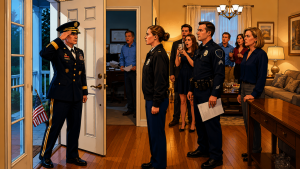
The front door opened again. A four-star general stepped inside in full dress uniform, the porch light catching the stars on his shoulders. His gaze moved from the officers to the phones.
Then he looked at me. He stopped in front of me, raised his hand toward his cap, and turned slightly toward the officer holding the complaint.
“Stand down,” he said.
The officer lowered the paper. That tiny movement broke the room. Tiffany’s smile faltered. Brad stepped out of her livestream frame. My father looked toward the hallway where the transfer packet still waited.
The general did not raise his voice. He did not need to. He removed a sealed folder from the officer behind him, its label stamped OFFICE OF THE INSPECTOR GENERAL — ACTIVE COMMAND REVIEW.
The folder changed the air. Tiffany had planned for embarrassment, maybe even cuffs. She had not planned for the federal chain of command to walk through my parents’ front door.
The general handed the first page to the local officer. “Read the complainant line.” The officer looked down, swallowed once, and looked toward Tiffany with the expression of a man realizing he had entered the wrong story.
The complainant was not my father. It was Tiffany. The supplemental note named Brad as a witness. My mother’s signature appeared beneath a statement claiming I had no lawful interest in my grandmother’s estate.
My father whispered, “Tiffany.” It was not a rebuke. It was fear finally finding a name. Tiffany’s phone was still live, angled toward the floor, broadcasting the silence she had created.
The general looked at me and asked, “Do you wish to make a statement here?” It was the first time anyone in that house had asked what I wanted.
I said, “No, sir. I documented the transfer packet at 8:43 p.m. The paperwork is in the office. The missing framed photograph was removed from the wall before the signing.”
The officers went down the hall with my phone images and the general’s folder. The stranger from the office tried to leave through the side door and found another uniform waiting by the kitchen.
No one tackled him. No one needed theater. They took his identification, his notary registration number, and the packet he had been trying to slide into my father’s file box.
The house became quieter after that, but not peaceful. Tiffany kept saying she thought it was “just family paperwork.” Brad repeated that he had not read everything. My mother stared at me like I had betrayed her by being prepared.
My father finally said, “You could have told us who you really were.” It was almost funny. Not because the words were harmless, but because they revealed the disease.
They did not regret what they had done to their daughter. They regretted misjudging what kind of daughter they had done it to.
The county investigation moved faster than I expected. The transfer was suspended within days. The notary acknowledgment was flagged. The complaint against me was withdrawn after the officers reviewed the office photographs and livestream footage.
Grandma’s estate documents showed what I already knew. She had left her interest protected from any transfer without my written consent, because she understood her family more clearly than any of us wanted to admit.
The final hearing was not dramatic. No one screamed. No one made a grand confession. The judge reviewed signatures, timestamps, recorder forms, phone metadata, and the report generated from that night.
The attempted transfer was voided. The complaint against me was marked unfounded. The stranger lost his commission pending further review. Tiffany’s livestream, the thing she had used to humiliate me, became evidence.
My parents did not apologize in any way that mattered. My mother sent one message about stress. My father said the family had been “under pressure.” Tiffany blocked me, then unblocked me long enough to say I had ruined her life…………………….

