For most of my adult life, I learned how to disappear in plain sight. Rank followed me through secure rooms, military bases, and briefings where people stood straighter before I even spoke. At family gatherings, I let that part of me stay folded away. My husband’s relatives knew I had served, but not what I had become. To Sarah, that was enough to invent the rest. She called me a failure soldier the first time at Thanksgiving. The phrase landed beside mashed potatoes and green beans, and everyone laughed too quickly, the way families laugh when cruelty has seniority.
Her father, Chief Miller, was the police chief in the county. That meant Sarah grew up believing authority was not something earned. It was something stored in the garage, beside fishing gear and folding chairs.
I had a Silver Star medal in a shadow box, tucked inside the hallway cabinet. Beneath it sat the citation card, a sealed copy of my service record, and the Department of Defense credentials I rarely showed.
That cabinet was not a secret. During the months our housing delay kept us close to my husband’s family, I trusted them with rooms, keys, and silence. Trust became the door Sarah later opened.
Independence Day arrived hot enough to make the patio shimmer. The grill smoked over the lawn, sweet tea sweated on plastic tables, and red-white-blue bunting clicked softly against the fence whenever the breeze moved.
My eight-year-old son had been excited all morning. He liked sparklers, ribs, and the small paper flags stuck in cupcakes. He also liked the medal because I once told him brave people sometimes get scared too.
I did not tell him what battle earned it. Children do not need every detail of war. He only knew it belonged to his mother and that it mattered.
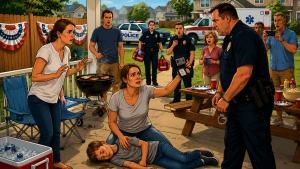
Sarah had been circling me all afternoon. She made comments about my clothes, about living on charity, about how some people knew how to “serve” but not how to succeed.
Her father laughed from a lawn chair, one hand around a beer can. Every time Sarah looked his way, his approval made her sharper. It was permission disguised as humor.
At 6:17 p.m., I heard the hallway screen door slam. A minute later, Sarah came back out with something behind her back. My son saw her first.
The shadow box was open in her hand. The ribbon caught the sunlight once, bright and impossible, before she tossed the Silver Star straight into the burning coals.
Metal made a small clink against charcoal. Then the heat took the ribbon edge. Smoke curled black. For a moment, all I could smell was lighter fluid and scorched fabric
My son screamed, “Aunt Sarah stole it from the cabinet!” His voice cracked over the patio with such pure outrage that every adult turned, not toward the grill, but toward him.
Sarah crossed the concrete before I could reach him. Her palm struck his face with a sound I still hear when a door slams too hard.
“Shut up, you nosy little brat,” she snapped. His head hit the patio edge. His body folded in a way no child’s body should.
The BBQ froze around us. A serving fork stayed lifted over ribs. A plastic cup hovered near someone’s mouth. Sauce dripped from tongs onto concrete, dark dot after dark dot.
Nobody moved.
I dropped beside my son and checked his pulse. His skin was fever-warm from the July heat, but his hand felt terrifyingly limp in mine. His eyes did not open.
Sarah did not step back in horror. She stood there breathing hard, then pointed toward the grill. “I’m sick of that fake glory. A medal for failure.”
I had survived rooms full of men trying to intimidate me. I had given orders under pressure. But nothing in uniform prepares you for the sight of your child unconscious while relatives study their shoes.
The anger did not explode. It narrowed. I imagined one clean answer, one motion that would end Sarah’s confidence forever. Instead, I held my son still and called emergency services.
At 6:19 p.m., I reported a pediatric head injury and an assault. At 6:21 p.m., the sirens arrived, tearing through the thick summer air and rattling every silent adult on the lawn.
Two cruisers stopped on the grass, dust rolling beneath their tires. An ambulance pulled up behind them. Sarah ran to the first cruiser before the door had fully opened.
“Daddy!” she cried, and the sound told me everything. She was not frightened of consequences. She thought consequences had just arrived to protect her.
Chief Miller stepped out in full uniform, broad and red-faced, with his hand resting near his holstered weapon. He looked past the smoke, past the medal, past the child on the patio.
He saw me kneeling in dirt and ash. He saw cheap clothes and a panicked family. He saw the story his daughter had written for him months earlier.
“She attacked me, Dad!” Sarah sobbed into his chest. “That leeching woman even threatened to kill me!” Her tears came fast, practiced, and perfectly aimed.
Chief Miller pointed at me. “You! Get away from the boy. Stand up and put your hands behind your back. You’re under arrest for disturbing the peace and assault.”
“My son has a head injury,” I said. “He needs immediate medical attention.” I kept my voice level because panic wastes oxygen and my son needed every second.
“I gave you a direct order!” Miller pulled out handcuffs. The metal clicked open in the sunlight. “Stand up before I drag you up.”
The paramedics reached the gate with a trauma bag and pediatric collar. Miller lifted one hand toward them without even looking. “Stay back. The scene is not secure.”
That was the moment the yard changed. Not because Sarah had lied. Not because Chief Miller believed her. Because an unconscious eight-year-old boy became less important than a police chief’s pride.
Some people mistake restraint for weakness because they have only ever met power when it shouted. Real power does not need volume. It needs timing.
I rose slowly, keeping my body angled between my son and the cuffs. The patio heat pressed through my shoes. Ash stuck to my palms. The neighbors’ phones were raised along the fence.
“Chief Miller,” I said, loud enough for the paramedics, officers, and family to hear, “this is your last warning. Let the medics through.”
He laughed and stepped closer. I smelled coffee, sweat, and gun oil. “Or what, sweetheart? You gonna cry?”
I did not hit him. I did not reach for his badge. I reached into my back pocket and removed the slim black leather wallet I carried out of habit.
When I flipped it open, the first thing he saw was the seal of the United States Department of Defense. Then his eyes dropped to the rank line.
Four-star general.
Chief Miller’s expression broke in layers. First irritation. Then confusion. Then recognition moving through him like cold water. His hand with the cuffs lowered until the chain hung uselessly by his thigh.
“Let the medics through,” I said again.
This time, the younger officer behind him moved. He opened the gate, and the paramedics rushed past Chief Miller as if his authority had evaporated in the sunlight.
The trauma bag hit the patio. One paramedic stabilized my son’s neck while the other checked his pupils and called out vitals. The sound of professionals working was the first mercy that afternoon.
Sarah grabbed her father’s sleeve. “Dad, she’s lying. Tell them she’s lying.” But her voice had lost its sharpness. It had become small, almost childish.
The younger officer stared at the open wallet, then at the grill. He saw the scorched ribbon. He saw the shadow box on the table. He saw the phones recording from every angle.
A radio crackled from the second cruiser. Dispatch confirmed a military liaison was on the line requesting scene status, officer names, and whether medical care had been delayed.
The paramedic looked up from my son. “Chief, if this child’s care was delayed, I need that on the report.”
Those words did more than accuse him. They documented him. Suddenly, Chief Miller was not standing in his daughter’s backyard story. He was standing inside a record.
Sarah started crying for real then. Not for my son. Not for the medal. For herself. Her father turned toward her, and for the first time, she was not protected by his badge.
The medics loaded my son carefully. He stirred once on the stretcher, faint and confused, and whispered for me. I walked beside him until the ambulance doors opened.
Before I climbed in, Chief Miller stepped toward me. The red had drained from his face. He looked smaller without certainty. His voice came out rough. “General… I didn’t know.”
That was the worst excuse and the only one he had.
He looked at the ambulance, the grill, his daughter, then the officers whose body cameras had been recording since arrival. His knees bent before his pride could stop them.
Chief Miller knelt on the patio in front of me. “Please,” he said. “Forgive me. I’m sorry. I’m so sorry.”……………………..
Click Here to continuous Read Full Ending Story👉:PART 2-My Sister-in-Law Called Me a “Failure Soldier” Until She Threw My Silver Star Into the Fire and Slapped My 8-Year-Old Son Unconscious—Then Her Police Chief Father Arrived, Took One Look at Me, and Begged for Forgiveness

